Start with the exam
What you need to be able to do
Function questions are about valid inputs and outputs as much as formulas. A composition feeds one output into the next function, while an inverse reverses a one-to-one mapping. The bank combines these operations with square roots, logarithms and restricted intervals. Write the domain while constructing the expression; repairing it at the end is harder. A correct inverse formula without its permitted branch and domain may describe the wrong function.
Spend 3 minutes reading the overview and diagram, 7 minutes learning the question patterns, 5 minutes writing out the worked example, and 5 minutes on a bank question or recall check. Take longer when you need to; the full bank is here for later practice.
Recognise → set up → write
How the questions are set
Form a composition
Recognise it: Find g∘f, evaluate repeated functions or determine unknown coefficients.
- Apply the inner function first. Replace every occurrence of the outer input with the full inner expression, using brackets.
- Require x to belong to the inner domain and f(x) to belong to the outer domain.
- Expand only as far as needed. For an identity valid for every x, compare corresponding coefficients.
Write g(f(x)) explicitly before evaluating a point or equating coefficients.
g(f(x)) and f(g(x)) generally differ. The simplified expression may look defined at inputs excluded by the original composition.
Find the inverse and select a branch
Recognise it: A function is restricted or the largest interval admitting an inverse is requested.
- Check the horizontal-line test or monotonicity on the stated interval.
- Set y=f(x) and solve for x. If a square root creates ± choices, use the original x restriction to choose the branch.
- Exchange the input/output names. State inverse domain=original range and inverse range=original domain.
Show the branch decision explicitly, for example x≤0 implies the negative square root.
f^(−1) means inverse function, not 1/f. A many-to-one function has no inverse until appropriately restricted.
Domain and range through operations
Recognise it: The formula contains a root, denominator, logarithm or inverse trigonometric function.
- Write all restrictions simultaneously: radicand≥0, denominator≠0, log argument>0, and arcsin/arccos input in [−1,1].
- Intersect these restrictions rather than solving them independently and taking their union.
- Find the range using endpoints, turning points and limiting values; distinguish reached endpoints from asymptotic values.
Use interval notation with open or closed endpoints justified by the original expression.
A square root in the denominator requires a strictly positive radicand, because zero would make the denominator vanish.
Write it before you reveal it
A worked exam-style example
Original teaching example, created for this lesson.
Original practice: f(x)=(x−2)²+1 for x≥2. Find f^(−1).
Reveal the worked solution
- The restricted parabola is increasing and has range y≥1.
- From y−1=(x−2)² and x−2≥0, obtain x=2+√(y−1).
- Swap the variable names and carry over the range as the inverse domain.
Answer: f^(−1)(x)=2+√(x−1), x≥1.
Check: f^(−1)(f(5))=2+√9=5. The negative branch would return −1, outside the original domain.
From your own collection
Apply it to past-paper questions
These questions anchor the patterns above. Attempt one without the answer, then compare your setup and conclusion with the reasoning. The linked reader contains the source answer and the question-specific syllabus review.
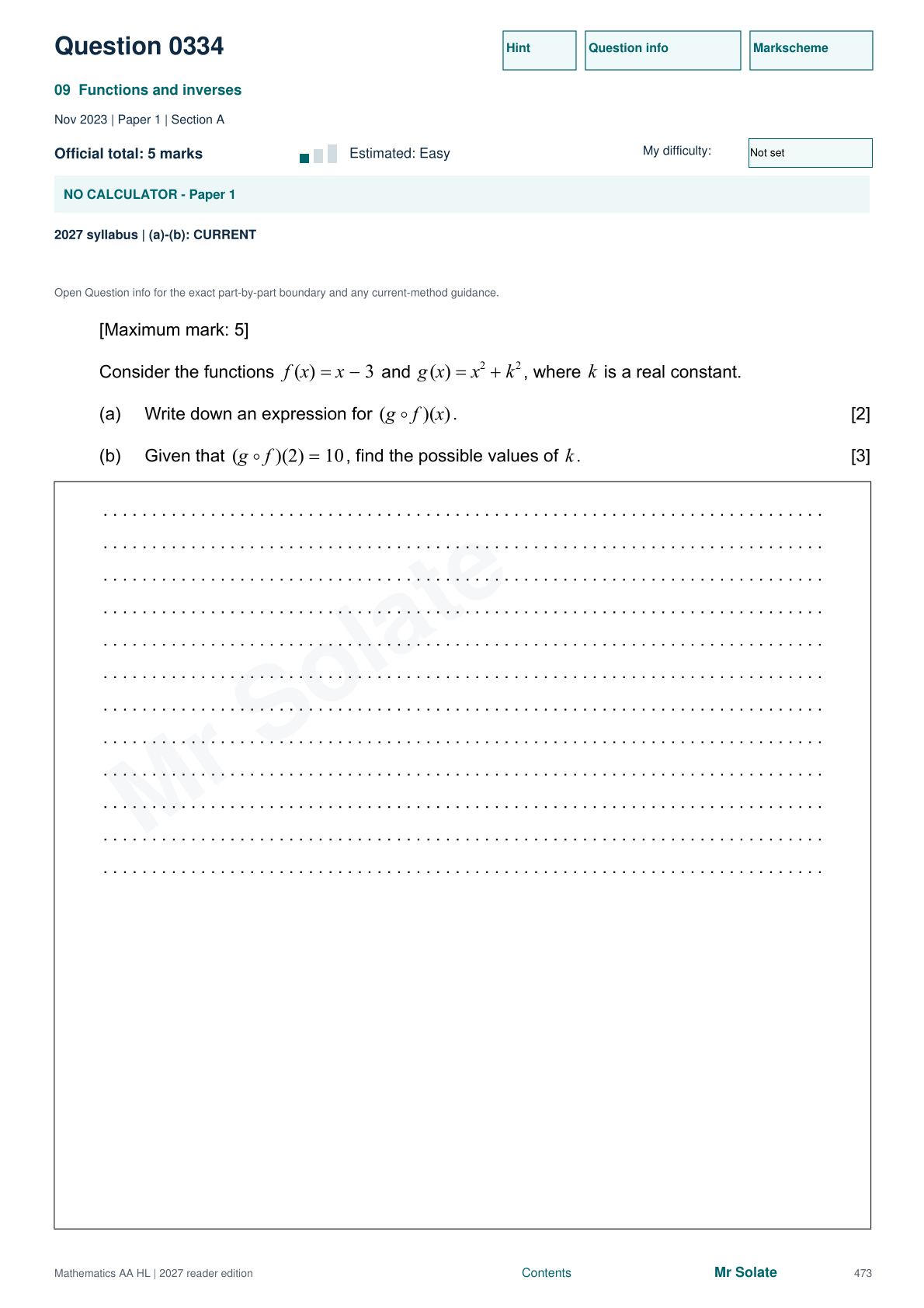
Question 334
Apply the method to the original question.
Compatibility: All parts test current AA HL content and can be solved using current syllabus methods.
View the original question
Original page images preserve the equations and diagrams. Write your response before revealing the reasoning.
Reveal the revision reasoning
The inner function gives x-3, so g(f(x))=(x-3)²+k².
At x=2 this becomes 1+k². The condition therefore gives 1+k²=10.
Thus k²=9 and k=3 or k=-3; both satisfy the original condition.
Editorial revision reasoning. Check the original answer for its marking detail.
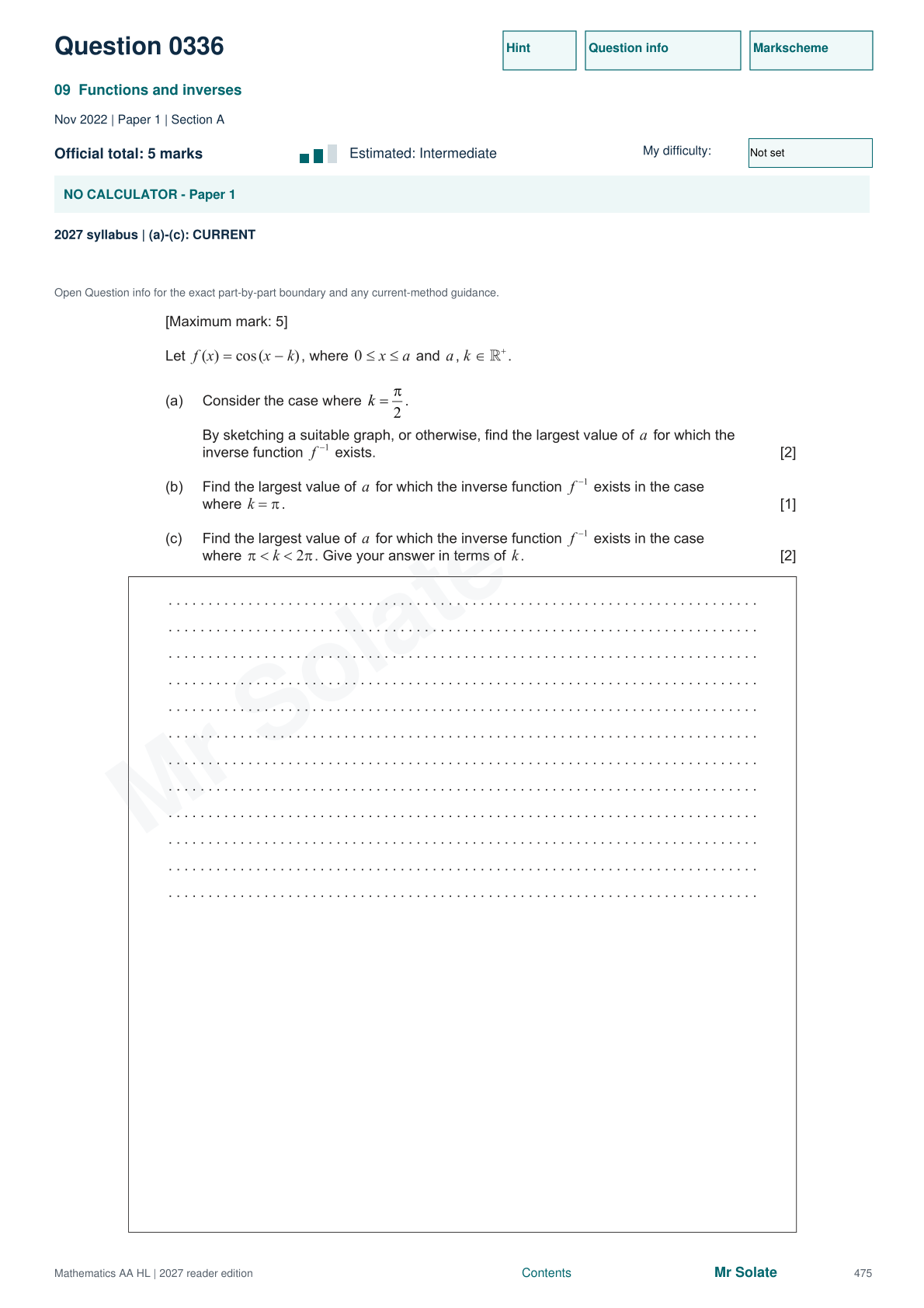
Question 336
Apply the method to the original question.
Compatibility: All parts test current AA HL content and can be solved using current syllabus methods.
View the original question
Original page images preserve the equations and diagrams. Write your response before revealing the reasoning.
Reveal the revision reasoning
An inverse exists only when the restricted cosine curve is one-to-one; a monotonic interval passes the horizontal-line test.
For k=π/2, f(x)=sin x. Starting at zero, its first turning point is x=π/2, so the largest a is π/2.
For k=π, f(x)=-cos x, which increases throughout [0,π]; the largest a is π.
When π<k<2π, the first turning point after x=0 occurs at x-k=-π, giving a=k-π. Extending beyond this point repeats outputs.
Editorial revision reasoning. Check the original answer for its marking detail.
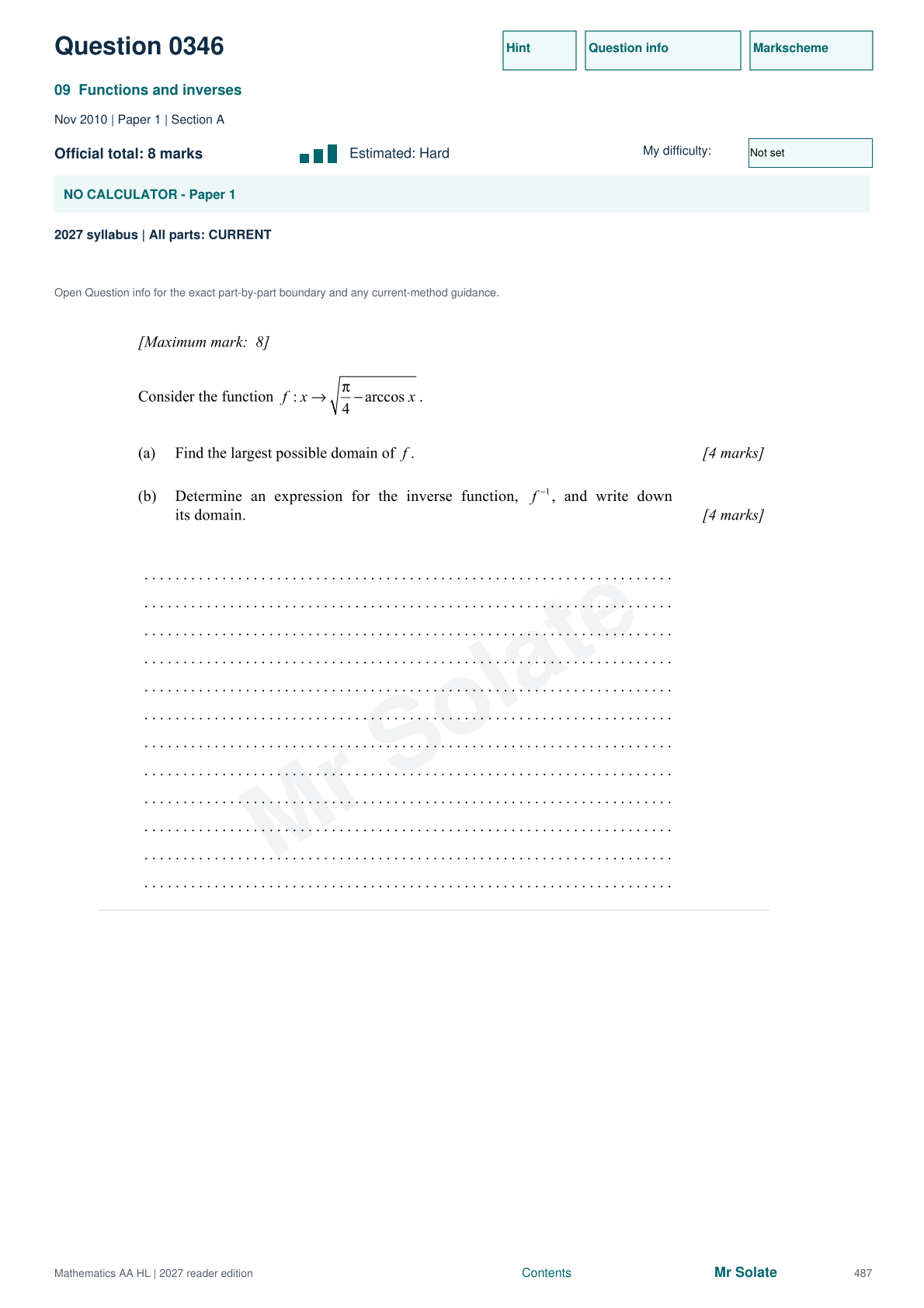
Question 346
Several linked steps in Square-root/arccos domain; Inverse; Branch range. Key distinction: The inverse-domain upper endpoint is √(π/4), not π/4.
Compatibility: All parts: The tested content remains current AA HL: Square-root/arccos domain; Inverse; Branch range.
View the original question
Original page images preserve the equations and diagrams. Write your response before revealing the reasoning.
Reveal the revision reasoning
- For √(π/4−arccos x), require −1≤x≤1 and arccos x≤π/4.
- Since arccos is decreasing, the combined domain is [√2/2,1].
- Set y²=π/4−arccos x, then x=cos(π/4−y²).
- Thus f^−1(x)=cos(π/4−x²), on 0≤x≤√π/2.
Editorial revision reasoning. Check the original answer for its marking detail.
All 56 questions in this topic
Close your notes first
Can you retrieve the method?
1. What becomes the inverse domain?
Check answer 1
The original function’s range.
2. Can √(x²) always be replaced by x?
Check answer 2
No; it equals |x|.
3. What must hold for g(f(x))?
Check answer 3
x must be valid for f, and f(x) must be valid for g.
Before you move on
- For an inverse answer, give formula, domain and chosen branch together. A short substitution check can reveal a branch error.
- When a composite is simplified, retain any holes or exclusions inherited from the original functions.
Your revision note
Record one missed cue, one corrected step and one question to retry. Saved only in this browser.