Start with the exam
What you need to be able to do
A periodic model can be built from four pieces: midline, amplitude, period and a known phase position. The bank uses wheels, tides and shifted graphs. Start from the largest and smallest values, then choose sine or cosine to match the starting position and direction. A formula that has the right range and period can still be shifted incorrectly, so check at least one labelled time before using it to solve a threshold question.
Spend 3 minutes reading the overview and diagram, 7 minutes learning the question patterns, 5 minutes writing out the worked example, and 5 minutes on a bank question or recall check. Take longer when you need to; the full bank is here for later practice.
Recognise → set up → write
How the questions are set
Recover a sinusoidal model
Recognise it: A graph gives maxima, minima, period or a known peak time.
- Set D=(maximum+minimum)/2 and |A|=(maximum−minimum)/2.
- For sine/cosine use B=2π/T. Choose a convenient reference: a cosine maximum at t=h uses A cos[B(t−h)]+D with A>0.
- Check the direction through a midline crossing or the value at time zero to select the sign and phase.
Write the values of A,D,T and B separately before the final model.
Adjacent maximum and minimum are half a period apart, not a full period.
Starting at the bottom or crossing a level
Recognise it: A wheel starts at its lowest point, or a height condition is imposed.
- For a minimum at t=0, use h(t)=D−A cos(Bt) with A positive.
- Set the model equal to the requested height, solve all angle branches in the full time interval, then convert back to time.
- For duration above a level, identify the intervals between crossings rather than reporting only the crossing times.
Show the normalized equation, such as cos(Bt)=(D−height)/A.
The height and the rate of height change are different quantities; use a derivative only for the latter.
Period, tangent and transformed graphs
Recognise it: Read a period or transform a trigonometric graph.
- Sine and cosine periods are 2π/|B|; tangent period is π/|B|.
- For tangent, identify asymptotes from the argument equal to π/2+kπ; shift them with the input.
- For a modulus graph, reflect negative output portions upward and inspect the new repeat length rather than assuming it is unchanged.
Label one full cycle and its key points, not just the period number.
Calculator degree mode produces the wrong graph when the model’s coefficient assumes radians.
Write it before you reveal it
A worked exam-style example
Original teaching example, created for this lesson.
Original practice: a wheel’s lowest and highest heights are 2 m and 10 m. It starts at the bottom and takes 12 s per revolution. Build a model and find its first time at 8 m.
Reveal the worked solution
- The midline is 6, amplitude 4 and B=2π/12=π/6.
- Use h(t)=6−4cos(πt/6). Setting h=8 gives cos(πt/6)=−1/2.
- The first nonnegative angle is 2π/3, giving t=4 s.
Answer: h(t)=6−4cos(πt/6); first reaches 8 m after 4 s.
Check: At t=0, h=2; at t=6, h=10; at t=12, h=2. The first 8 m crossing must occur before the maximum.
From your own collection
Apply it to past-paper questions
These questions anchor the patterns above. Attempt one without the answer, then compare your setup and conclusion with the reasoning. The linked reader contains the source answer and the question-specific syllabus review.
Question 576
Requires linking Amplitude and midline, Period, Positive phase parameter.
Compatibility: All parts: The tested methods are current AA HL: Amplitude and midline, Period, Positive phase parameter.
View the original question
Original page images preserve the equations and diagrams. Write your response before revealing the reasoning.
Reveal the revision reasoning
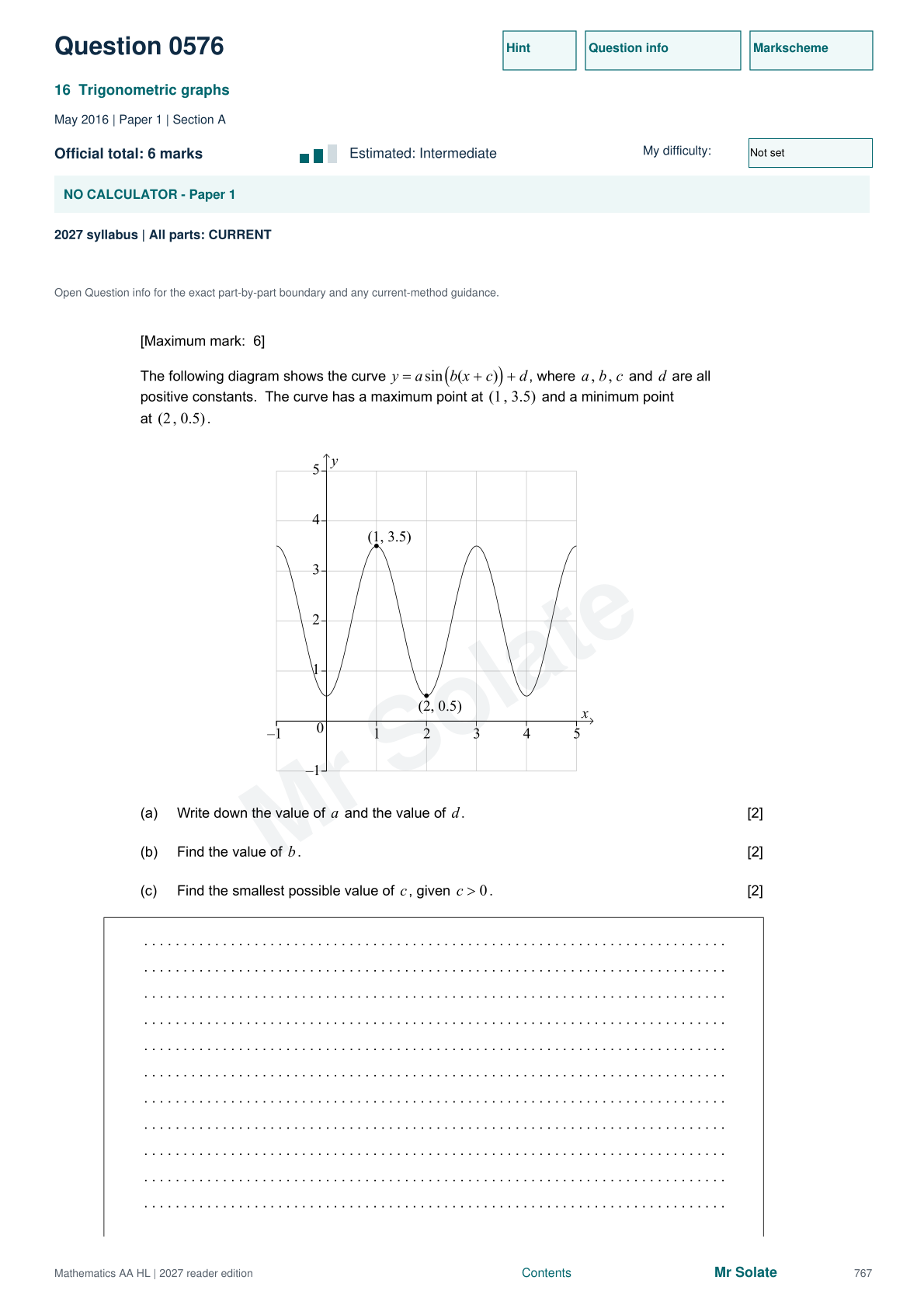
- The extremal heights 3.5 and 0.5 give amplitude 1.5 and midline 2.
- Their x-coordinates differ by 1, so the period is 2 and b=2π/2.
- At the maximum x=1, require b(1+c)=π/2+2kπ.
- Choose the smallest positive c among these equivalent shifts.
Editorial revision reasoning. Check the original answer for its marking detail.
Question 581
Direct application of Cosine amplitude and vertical translation, Period and angular frequency, Initial minimum.
Compatibility: The tested concepts and methods match the current AA HL syllabus; the original paper format and wording are retained.
View the original question
Original page images preserve the equations and diagrams. Write your response before revealing the reasoning.
Reveal the revision reasoning
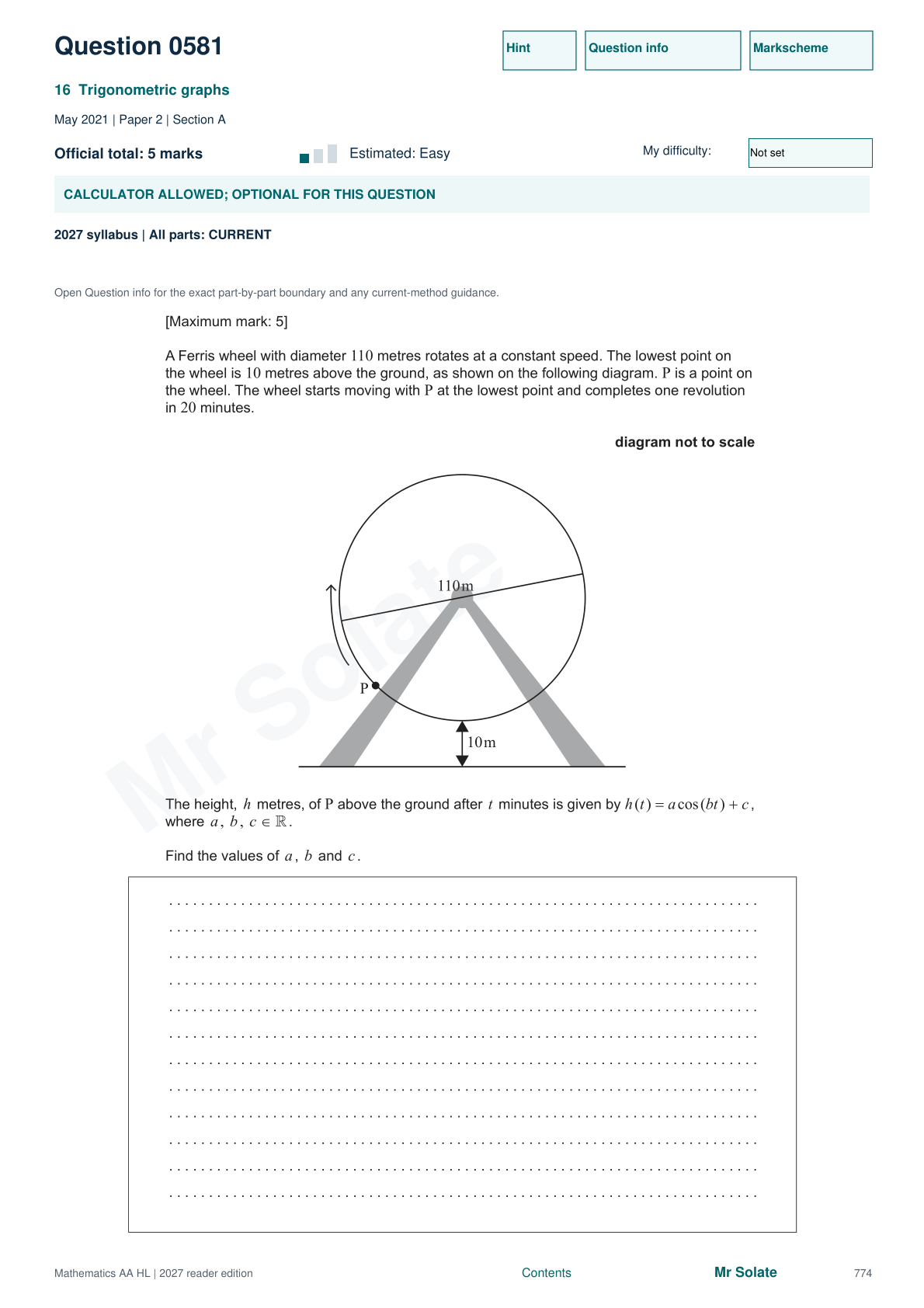
The radius is55m, so the oscillation amplitude is55. The centre is55+10=65m above the ground, giving c=65.
Since cos0=1 and h(0)=10, a+65=10, so a=−55.
One turn takes20 minutes, so b=2π/20=π/10 radians per minute. Thus h(t)=−55cos(πt/10)+65.
Editorial revision reasoning. Check the original answer for its marking detail.
Question 575
Apply the method to the original question.
Compatibility: All parts test current AA HL content and can be solved using current syllabus methods.
View the original question
Original page images preserve the equations and diagrams. Write your response before revealing the reasoning.
Reveal the revision reasoning
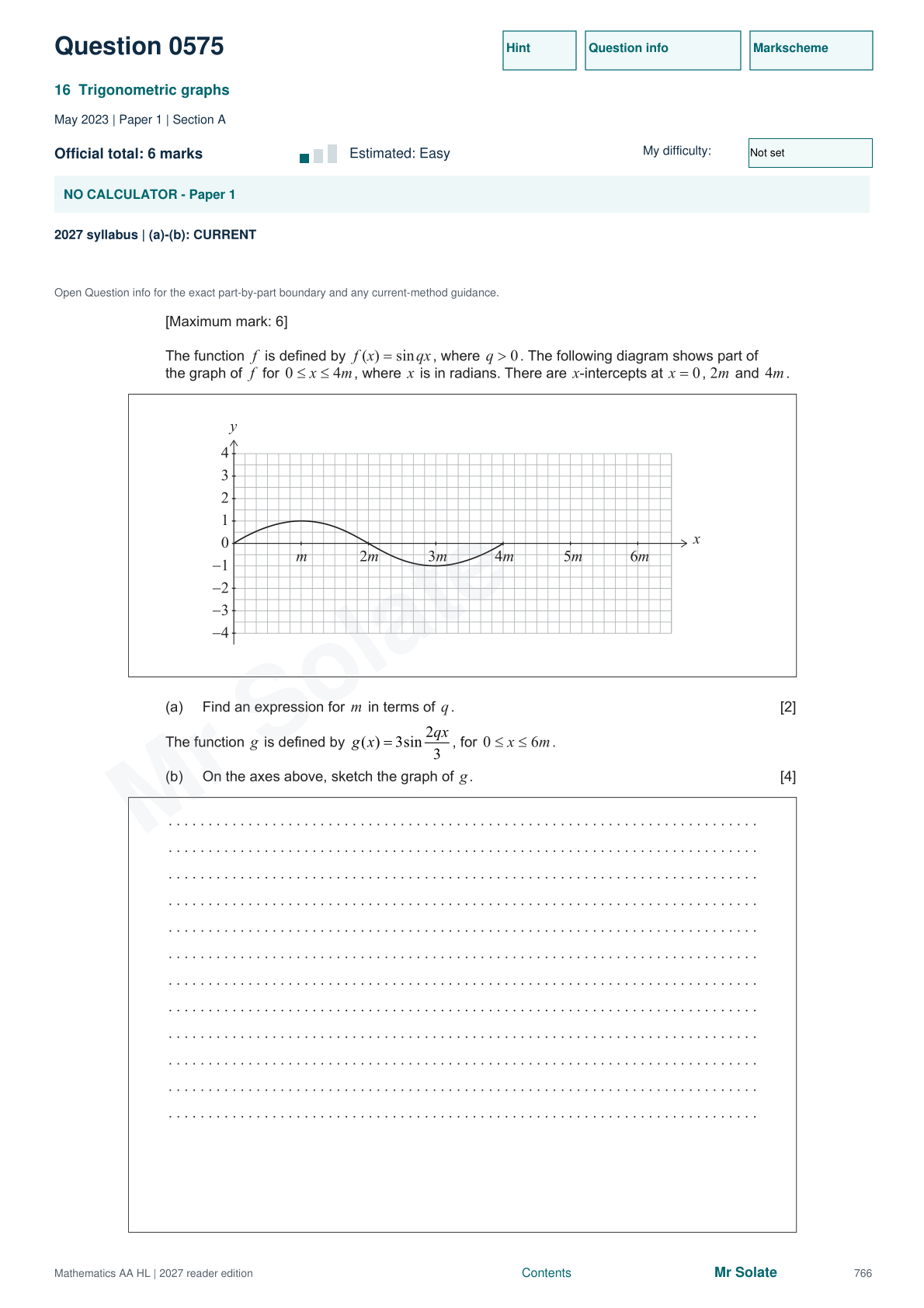
The diagram shows one complete sine cycle over 4m, so 4m=2π/q and m=π/(2q).
For g(x)=3sin(2qx/3), the amplitude is 3 and the period is 3π/q=6m.
Sketch one cycle on [0,6m], through (0,0), (3m,0) and (6m,0).
Its maximum is (3m/2,3) and minimum is (9m/2,-3); use a smooth sinusoidal curve.
Editorial revision reasoning. Check the original answer for its marking detail.
All 16 questions in this topic
Close your notes first
Can you retrieve the method?
1. What is amplitude if the range is [3,11]?
Check answer 1
4.
2. What is the period of tan(3x)?
Check answer 2
π/3.
3. Why is a negative cosine convenient at a minimum?
Check answer 3
cos0=1, so D−A starts at D−A, the lowest height.
Before you move on
- Evaluate your proposed model at the starting time and a quarter or half period before solving later parts.
- For a contextual answer, state time units and restrict solutions to the specified operating interval.
Your revision note
Record one missed cue, one corrected step and one question to retry. Saved only in this browser.