Start with the exam
What you need to be able to do
A tangent question needs a point and a slope. When the contact point is unknown, name it (a,f(a)), write the line in terms of a, then impose the additional condition. The bank uses parallel and perpendicular tangents, external points, common tangents and repeated intersections. Keep the external point distinct from the point at which you differentiate.
Spend 3 minutes reading the overview and diagram, 7 minutes learning the question patterns, 5 minutes writing out the worked example, and 5 minutes on a bank question or recall check. Take longer when you need to; the full bank is here for later practice.
Recognise → set up → write
How the questions are set
Known point or prescribed slope
Recognise it: The tangent is at a stated input or parallel to a line.
- Find the contact point from the original function and its slope from f′ at the same input.
- Use y−f(a)=f′(a)(x−a). For a finite nonzero slope m, the normal slope is −1/m. A horizontal tangent has vertical normal x=a.
- For a prescribed tangent slope, solve f′(a)=m before finding contact coordinates. Retain every root in the domain; several parallel tangents may exist.
Show the point, derivative value and point-slope equation separately.
An x-intercept solves f=0, not f′=0. The normal must use the same contact point.
A line through an external point
Recognise it: The tangent or normal passes through the origin or another fixed point.
- Let the contact input be a. For a tangent through (p,q), impose q−f(a)=f′(a)(p−a).
- Solve the resulting equation for every admissible a. Substitute each back into the tangent equation and test the external point.
- For a normal, use −1/f′(a) where defined. Check exceptional horizontal or vertical normals separately so division does not discard a solution.
Write the symbolic line first; this explains the condition used to determine contact.
The external point need not lie on the curve and cannot automatically be used as the differentiation input.
Common tangents and angles
Recognise it: Two curves touch the same line or a parameter creates tangency.
- At a shared contact point, require equal function values and equal derivatives. At different contacts a and b, require equal slopes and equal intercepts.
- For a line meeting a quadratic curve, tangency can give a repeated intersection root and hence zero discriminant. Explain the geometric reason for the repeated root.
- For finite slopes, tan θ=|(m₂−m₁)/(1+m₁m₂)| gives the acute angle where applicable. A slope product of −1 gives perpendicular lines.
State both tangency conditions; for an angle, identify the requested acute or obtuse angle.
Equal slopes alone prove parallelism, not a common tangent. The same line must also have the same intercept.
Write it before you reveal it
A worked exam-style example
Original teaching example, created for this lesson.
Original example: find all tangents to y=x² passing through (0,−1).
Reveal the worked solution
- At contact (a,a²), the derivative is 2a.
- The tangent is y−a²=2a(x−a), or y=2ax−a².
- Substitute (0,−1): a²=1, so a=1 or −1.
- The corresponding tangents are y=2x−1 and y=−2x−1.
Answer: Two tangents: y=2x−1 and y=−2x−1.
Check: Substituting each line into y=x² gives (x−1)²=0 or (x+1)²=0, verifying tangency.
From your own collection
Apply it to past-paper questions
These questions anchor the patterns above. Attempt one without the answer, then compare your setup and conclusion with the reasoning. The linked reader contains the source answer and the question-specific syllabus review.
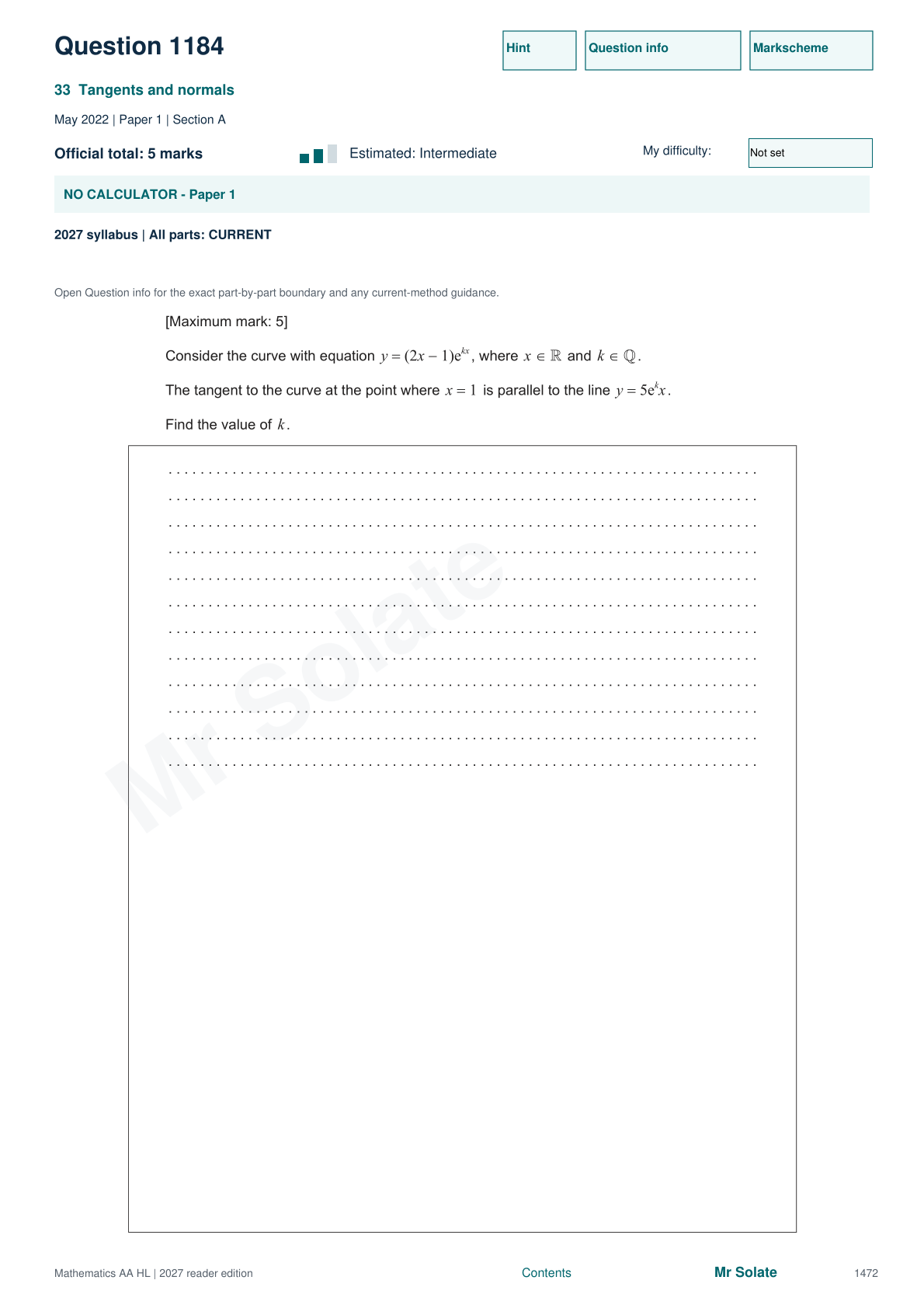
Question 1184
Apply the method to the original question.
Compatibility: This current-course AA HL question tests the listed current syllabus methods.
View the original question
Original page images preserve the equations and diagrams. Write your response before revealing the reasoning.
Reveal the revision reasoning
The product rule gives y′=2e^(kx)+k(2x-1)e^(kx).
At x=1 the tangent slope is (2+k)e^k.
The given straight line has slope 5e^k. Equating parallel slopes and dividing by e^k>0 gives 2+k=5, so k=3.
Editorial revision reasoning. Check the original answer for its marking detail.
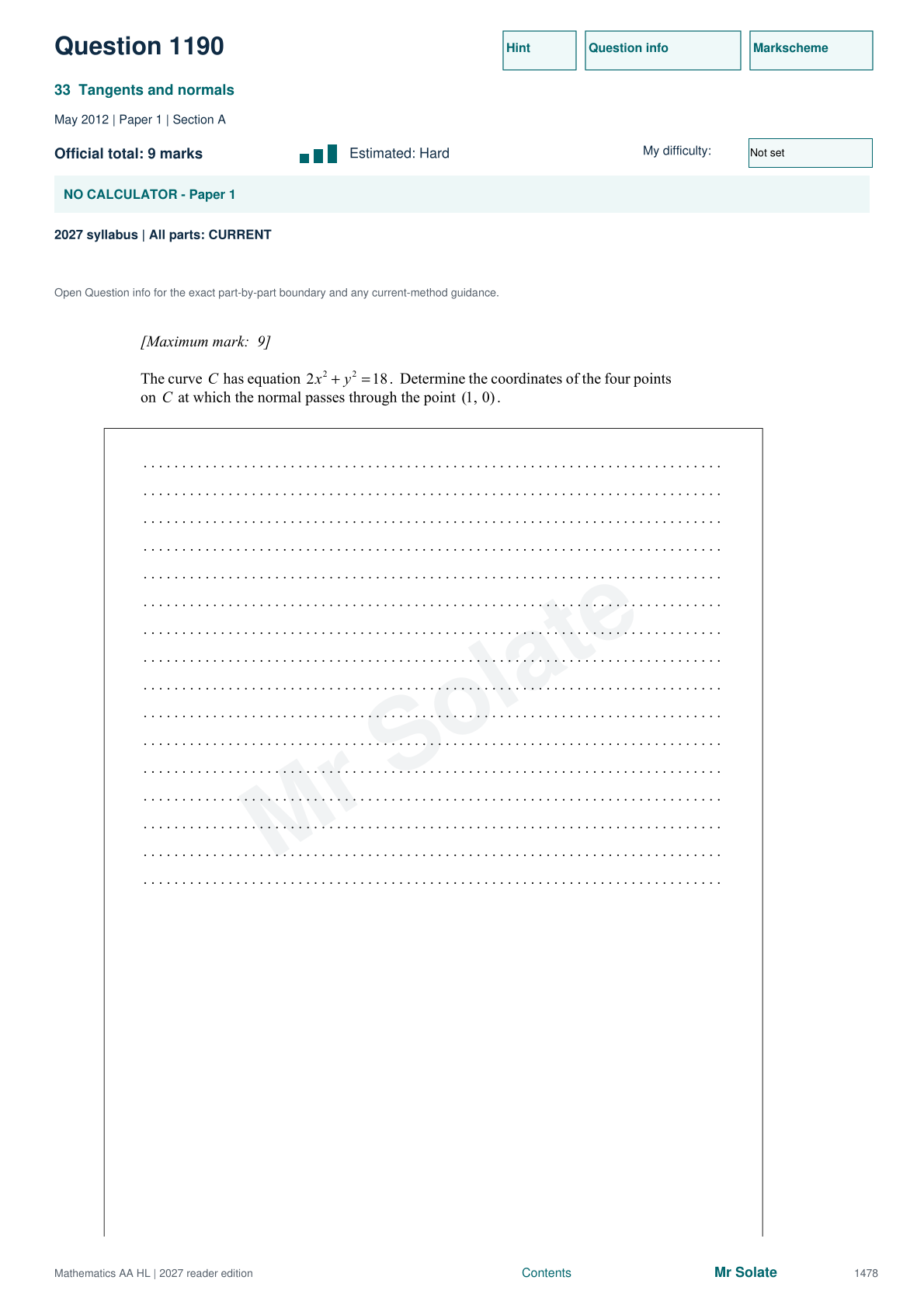
Question 1190
Extended reasoning linking Implicit derivative, Normal through fixed point, Exceptional horizontal normals.
Compatibility: Current: All parts
View the original question
Original page images preserve the equations and diagrams. Write your response before revealing the reasoning.
Reveal the revision reasoning
- For 2x²+y²=18, the tangent slope is -2a/b and normal slope b/(2a).
- Impose passage through (1,0) in the normal equation, giving b=0 or a=-1.
- Combine each case with the ellipse: (±3,0) and (-1,±4).
Editorial revision reasoning. Check the original answer for its marking detail.
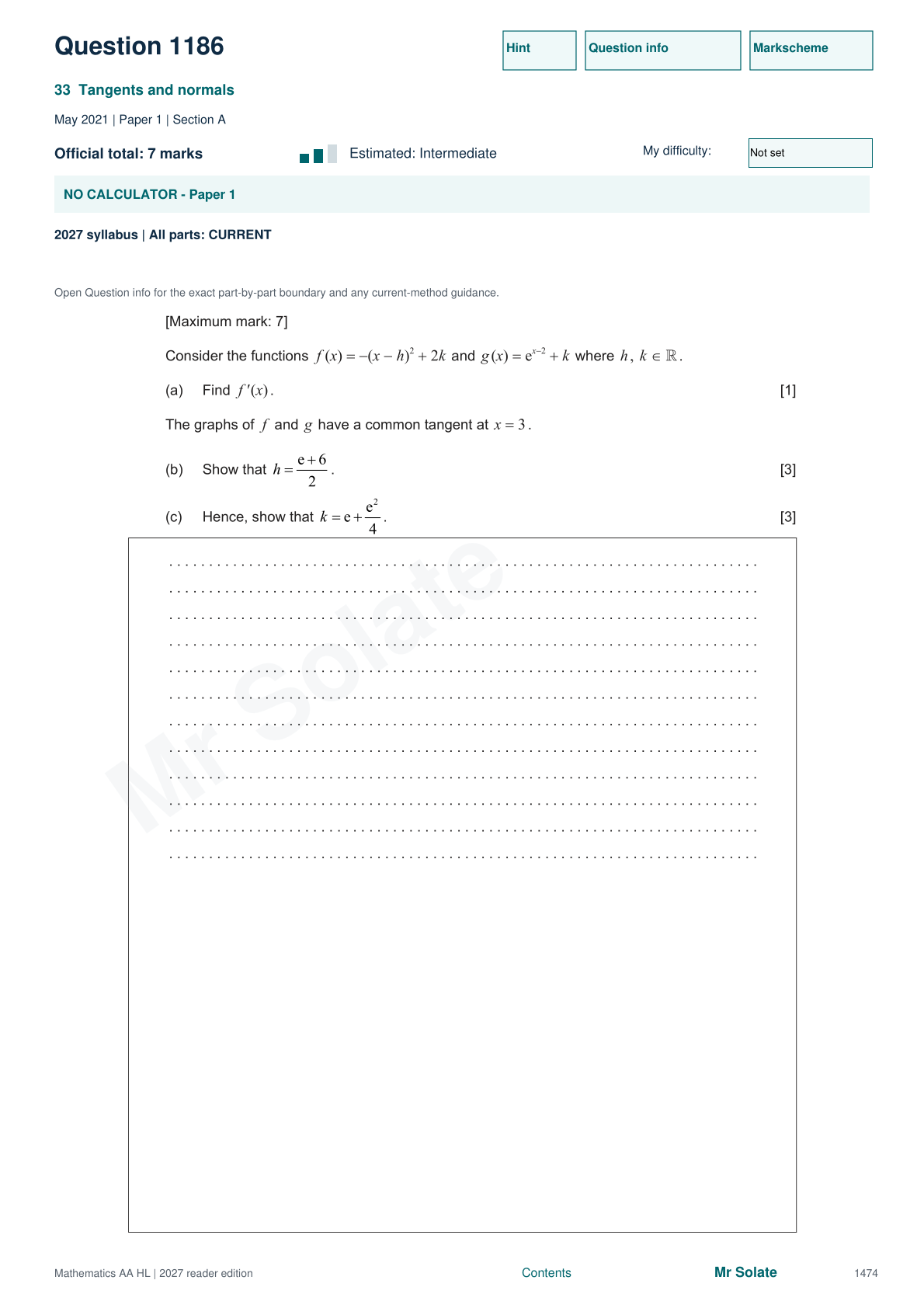
Question 1186
Apply the method to the original question.
Compatibility: This is a current-course AA HL question; the listed concepts and methods remain in the 2027 exam syllabus.
View the original question
Original page images preserve the equations and diagrams. Write your response before revealing the reasoning.
Reveal the revision reasoning
Differentiating gives f′(x)=-2(x-h), while g′(x)=e^(x-2).
At x=3, equal slopes give -2(3-h)=e, hence h=(e+6)/2.
Equal function values give -(3-h)²+2k=e+k.
Since 3-h=-e/2, this becomes -e²/4+2k=e+k, so k=e²/4+e.
Editorial revision reasoning. Check the original answer for its marking detail.
All 27 questions in this topic
Close your notes first
Can you retrieve the method?
1. What determines a tangent?
Check answer 1
A point and the derivative there.
2. Do equal slopes prove a common tangent?
Check answer 2
No; intercepts must match.
3. Normal slope for nonzero finite m?
Check answer 3
−1/m.
Before you move on
- Use a symbolic contact input when it is unknown.
- Keep the external point and contact point separate.
- Substitute all required points into each final line.
Your revision note
Record one missed cue, one corrected step and one question to retry. Saved only in this browser.