Start with the exam
What you need to be able to do
Inequalities need intervals, not just roots. Equality points locate possible boundaries; poles and domain endpoints can also divide the number line. The bank combines rational expressions, absolute values and substitutions such as ln x or e^x. Preserve equivalence at each step: multiplication by a negative quantity reverses the sign, and squaring is safe only when the signs allow it. Finish by checking which endpoints actually belong.
Spend 3 minutes reading the overview and diagram, 7 minutes learning the question patterns, 5 minutes writing out the worked example, and 5 minutes on a bank question or recall check. Take longer when you need to; the full bank is here for later practice.
Recognise → set up → write
How the questions are set
Polynomial and rational sign charts
Recognise it: Compare two functions or solve a fraction inequality.
- Move all terms to one side and factor. List numerator zeros, denominator zeros and any inherited exclusions.
- Divide the real line at every critical value and test one point in each interval, or use factor signs.
- Choose intervals with the requested sign. Include valid equality points only for ≤ or ≥.
Write a compact sign chart and the final union of intervals. A bare list of roots does not answer the question.
Never multiply by an unknown-sign denominator without splitting cases.
Modulus inequalities
Recognise it: The unknown appears inside | |, perhaps on both sides.
- For |u|<a with a>0, use −a<u<a. For |u|>a, use u<−a or u>a.
- If both sides are nonnegative, squaring preserves the inequality; otherwise establish sign conditions first.
- For several moduli, split at their zero points and solve each linear or polynomial branch within its own interval.
State the sign condition on the right side before squaring an inequality involving a modulus.
The two inequalities in −a<u<a are simultaneous and require intersection; the outside alternatives use union.
Substitution and domain intersection
Recognise it: The expression is quadratic in ln x, e^x or |x|.
- Define a temporary variable and record its range: t=ln x is real with x>0; t=e^x is positive; t=|x| is nonnegative.
- Solve the simpler inequality, intersect with the allowed t values, and map the intervals back.
- Combine with all original domain restrictions, especially logarithm positivity or roots in denominators.
Show both the t-interval and the resulting x-interval so the direction of the inverse transformation is visible.
A solution interval in t can include negative numbers that are impossible for e^x.
Write it before you reveal it
A worked exam-style example
Original teaching example, created for this lesson.
Original practice: solve (x−2)/(x+1)≥0.
Reveal the worked solution
- Critical values are x=−1, an excluded denominator zero, and x=2, a numerator zero.
- For x<−1 both factors are negative, so the ratio is positive. For −1<x<2 the ratio is negative. For x>2 it is positive.
- Include x=2 because equality is allowed; exclude x=−1.
Answer: x∈(−∞,−1)∪[2,∞).
Check: Test x=−2, 0 and 3 to obtain positive, negative and positive values respectively.
From your own collection
Apply it to past-paper questions
These questions anchor the patterns above. Attempt one without the answer, then compare your setup and conclusion with the reasoning. The linked reader contains the source answer and the question-specific syllabus review.
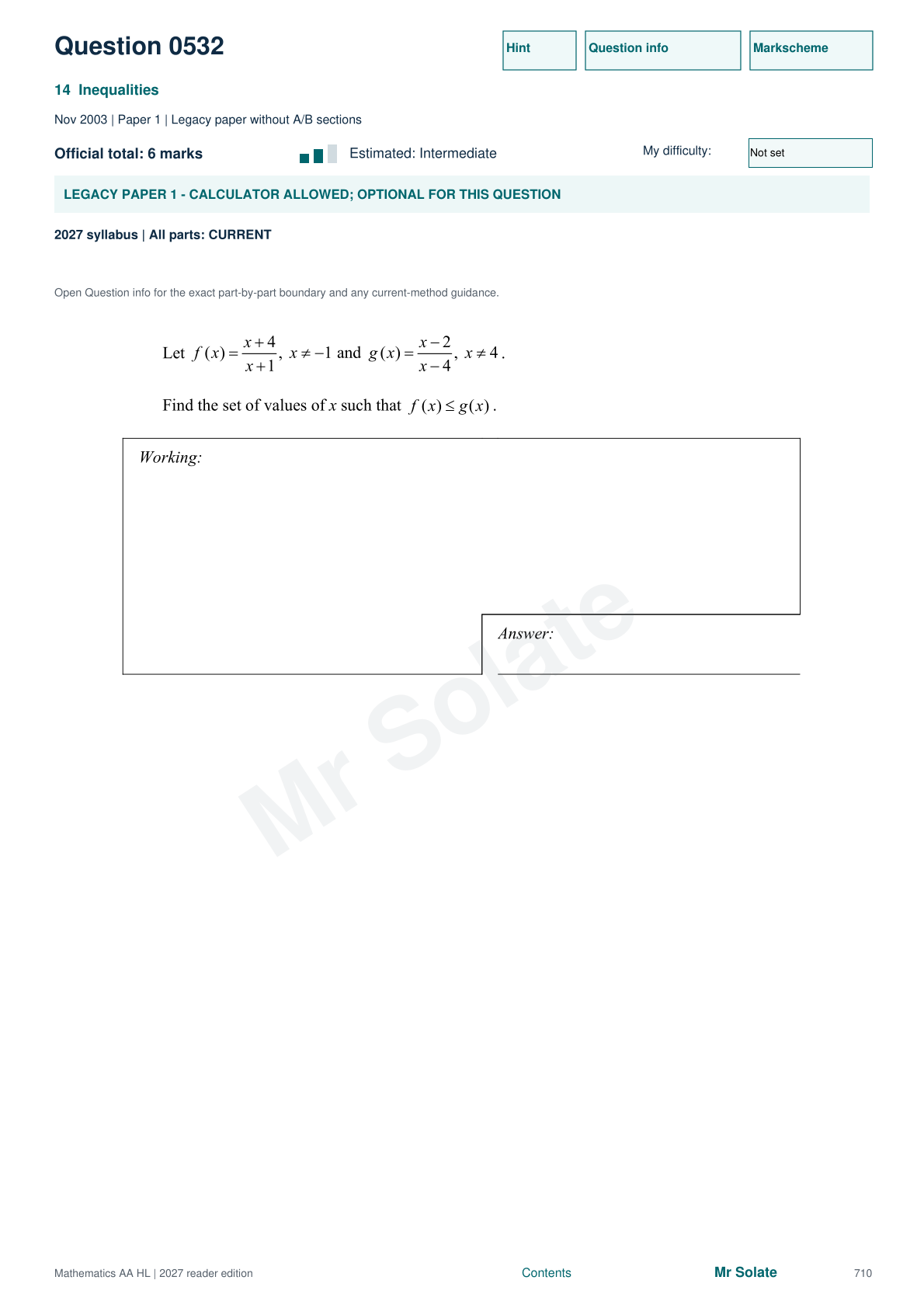
Question 532
Requires coordinating Comparison of rational functions; Common denominator; Sign chart. Cross-multiplying without denominator signs would incorrectly keep only x≤14.
Compatibility: All parts: The tested content remains current AA HL: Comparison of rational functions; Common denominator; Sign chart.
View the original question
Original page images preserve the equations and diagrams. Write your response before revealing the reasoning.
Reveal the revision reasoning
- Using f=(x+4)/(x+1) and g=(x−2)/(x−4), obtain f−g=(x−14)/[(x+1)(x−4)].
- The critical inputs are −1,4,14.
- The numerator zero at 14 may be included, while the two poles cannot.
- A sign chart gives x<−1 or 4<x≤14.
Editorial revision reasoning. Check the original answer for its marking detail.
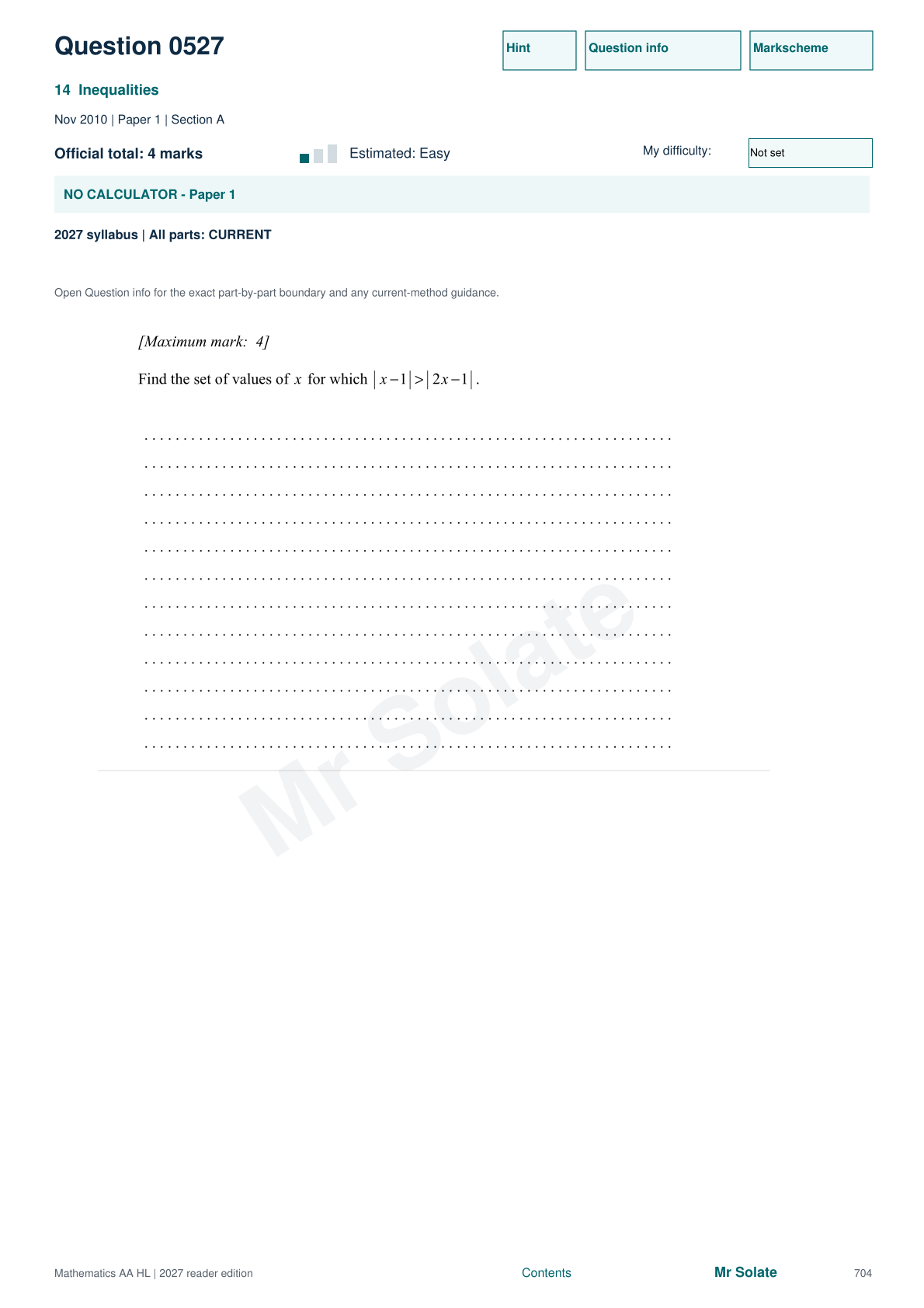
Question 527
Direct use of Absolute-value inequality; Quadratic sign. Square abs(x−1)>abs(2x−1) to get (x−1)²>(2x−1)².
Compatibility: All parts: The tested content remains current AA HL: Absolute-value inequality; Quadratic sign.
View the original question
Original page images preserve the equations and diagrams. Write your response before revealing the reasoning.
Reveal the revision reasoning
- Square abs(x−1)>abs(2x−1) to get (x−1)²>(2x−1)².
- Expansion gives 3x²−2x<0.
- Factor x(3x−2)<0.
- Thus 0<x<2/3, excluding equality at both boundaries.
Editorial revision reasoning. Check the original answer for its marking detail.
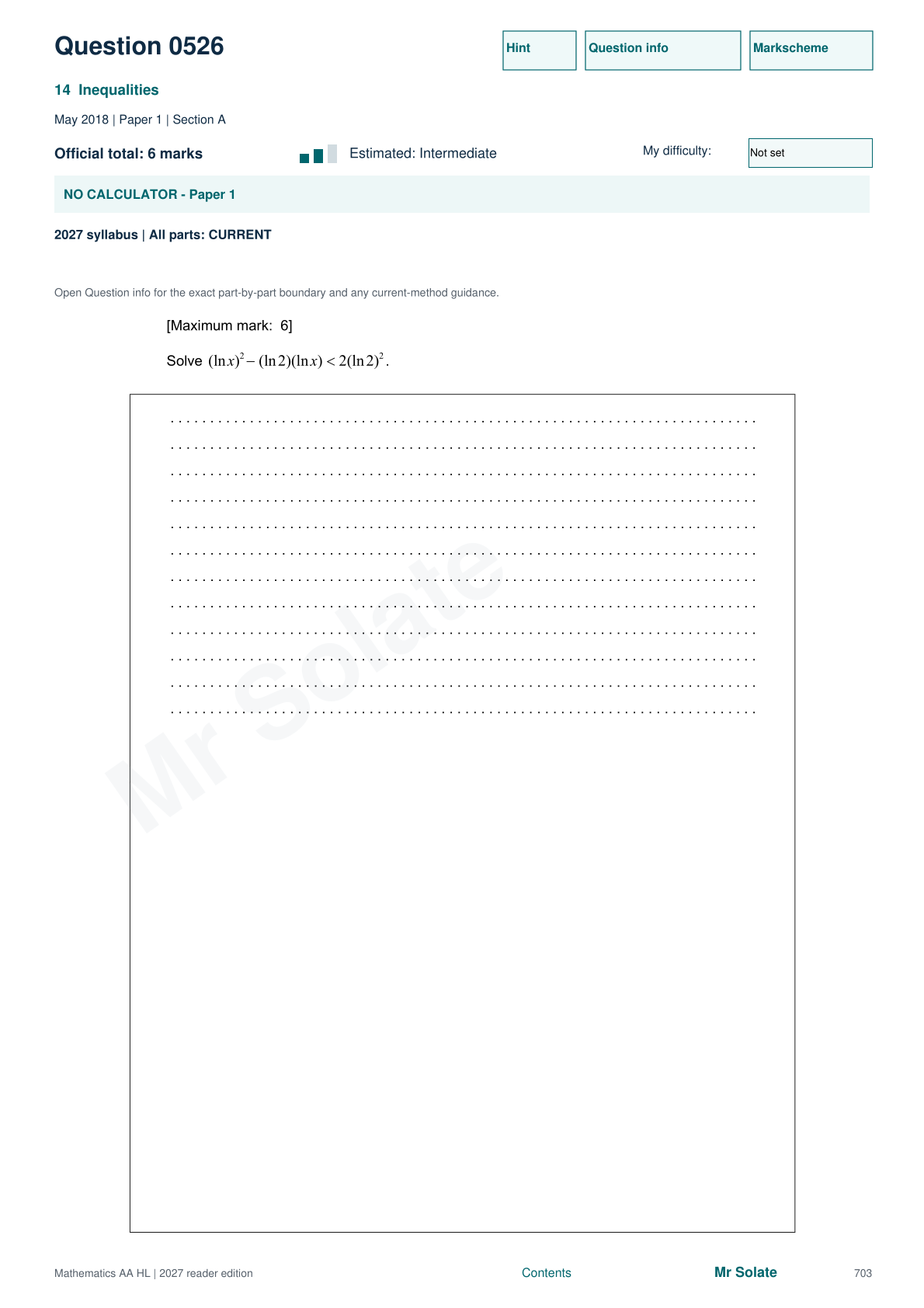
Question 526
Apply the method to the original question.
Compatibility: All tested methods remain in current AA HL; the original question is from the 2018 Mathematics HL syllabus.
View the original question
Original page images preserve the equations and diagrams. Write your response before revealing the reasoning.
Reveal the revision reasoning
The real logarithm requires x>0. Let u=ln x and L=ln 2.
Rearrangement gives u²-Lu-2L²<0, or (u-2L)(u+L)<0.
Because the quadratic opens upwards, -L<u<2L.
Exponentiation preserves the inequalities, giving 1/2<x<4.
Editorial revision reasoning. Check the original answer for its marking detail.
All 17 questions in this topic
Close your notes first
Can you retrieve the method?
1. Does solving the equality finish an inequality?
Check answer 1
No; test the intervals between all critical values.
2. When can both sides be squared without changing an inequality?
Check answer 2
When both sides are nonnegative.
3. Is a pole included in a ≥ answer?
Check answer 3
Never; the original expression is undefined there.
Before you move on
- Check a sample input in every accepted interval and inspect each finite endpoint separately.
- Use clear interval brackets or a correctly shaded number line; “between the roots” is not sufficient when poles or several intervals occur.
Your revision note
Record one missed cue, one corrected step and one question to retry. Saved only in this browser.