Start with the exam
What you need to be able to do
This is a legacy extension, not compulsory current AA HL material for the reader’s 2027 target. Use it for deliberate extension practice or when a model is supplied. Rate scaling, conditional probability and nested binomial counts are transferable. Prioritise the current probability chapters before spending revision time memorising the legacy Poisson formula.
Spend 3 minutes reading the overview and diagram, 7 minutes learning the question patterns, 5 minutes writing out the worked example, and 5 minutes on a bank question or recall check. Take longer when you need to; the full bank is here for later practice.
This collection contains content outside the current course, or a mixture of current and legacy skills. Use the compatibility note for each original question to decide which parts to practise for your exam.
Recognise → set up → write
How the questions are set
Scale the parameter
Recognise it: A Poisson model changes duration or area.
- For X~Po(λ), use P(X=r)=e^(−λ)λ^r/r!. Its mean and variance both equal λ.
- At constant rate c per unit, exposure t has mean ct. Convert time or area units before multiplying.
- Translate integer tails carefully: P(X≥r)=1−P(X≤r−1). For independent disjoint intervals, multiply probabilities of the stated interval events.
State λ with its exposure, then the exact probability expression or cumulative event.
The standard deviation is √λ, not λ. A daily mean is not a weekly mean.
Recover the rate
Recognise it: A zero mass or relationship between count probabilities is given.
- P(X=0)=e^(−λ), so λ=−ln P(X=0). A legitimate mean must be nonnegative.
- For adjacent masses use P(X=r+1)/P(X=r)=λ/(r+1), obtained by cancelling the complete formulas.
- A nonlinear equation may have several positive roots. Check the original probability equation and all extra conditions before selecting one.
Show the logarithmic equation or the cancellation of factorials and powers.
For integer λ>0 there are two modes, λ−1 and λ; blindly rounding the mean is insufficient.
Condition and count qualifying intervals
Recognise it: A later part concerns qualifying days or capacity-limited revenue.
- Define events A and B and write P(A∩B)/P(B). Nested events are not independent just because counts on different days are independent.
- If one interval qualifies with probability q, the count among n independent identical intervals is binomial B(n,q), with mean nq.
- For capped income, sum low-count payoffs individually and combine the tail probability with the constant capped payoff.
Show the conditioning denominator and define any outer count variable.
Expected arrivals and expected occupied capacity differ when arrivals can exceed capacity.
Write it before you reveal it
A worked exam-style example
Original teaching example, created for this lesson.
Original extension example: a supplied model gives two arrivals per hour. Find the chance of at least one in 30 minutes and the expected number of qualifying intervals among ten independent half-hours.
Reveal the worked solution
- The half-hour parameter is λ=2×1/2=1.
- q=P(X≥1)=1−e^(−1).
- For Y~B(10,q), E(Y)=10q=10(1−e^(−1)).
Answer: Probability ≈0.632; expected qualifying count ≈6.32.
Check: An expectation may be noninteger although every observed interval count is integer.
From your own collection
Apply it to past-paper questions
These questions anchor the patterns above. Attempt one without the answer, then compare your setup and conclusion with the reasoning. The linked reader contains the source answer and the question-specific syllabus review.
Question 992
Several linked steps in Poisson mean scaled by area, Conditional probability with an integer threshold.
Compatibility: Poisson distributions are a legacy Mathematics HL requirement, outside current AA HL. Conditional probability itself is current; supply Poisson probabilities or the mass-function/CDF rule for extension practice.
View the original question
Original page images preserve the equations and diagrams. Write your response before revealing the reasoning.
Reveal the revision reasoning
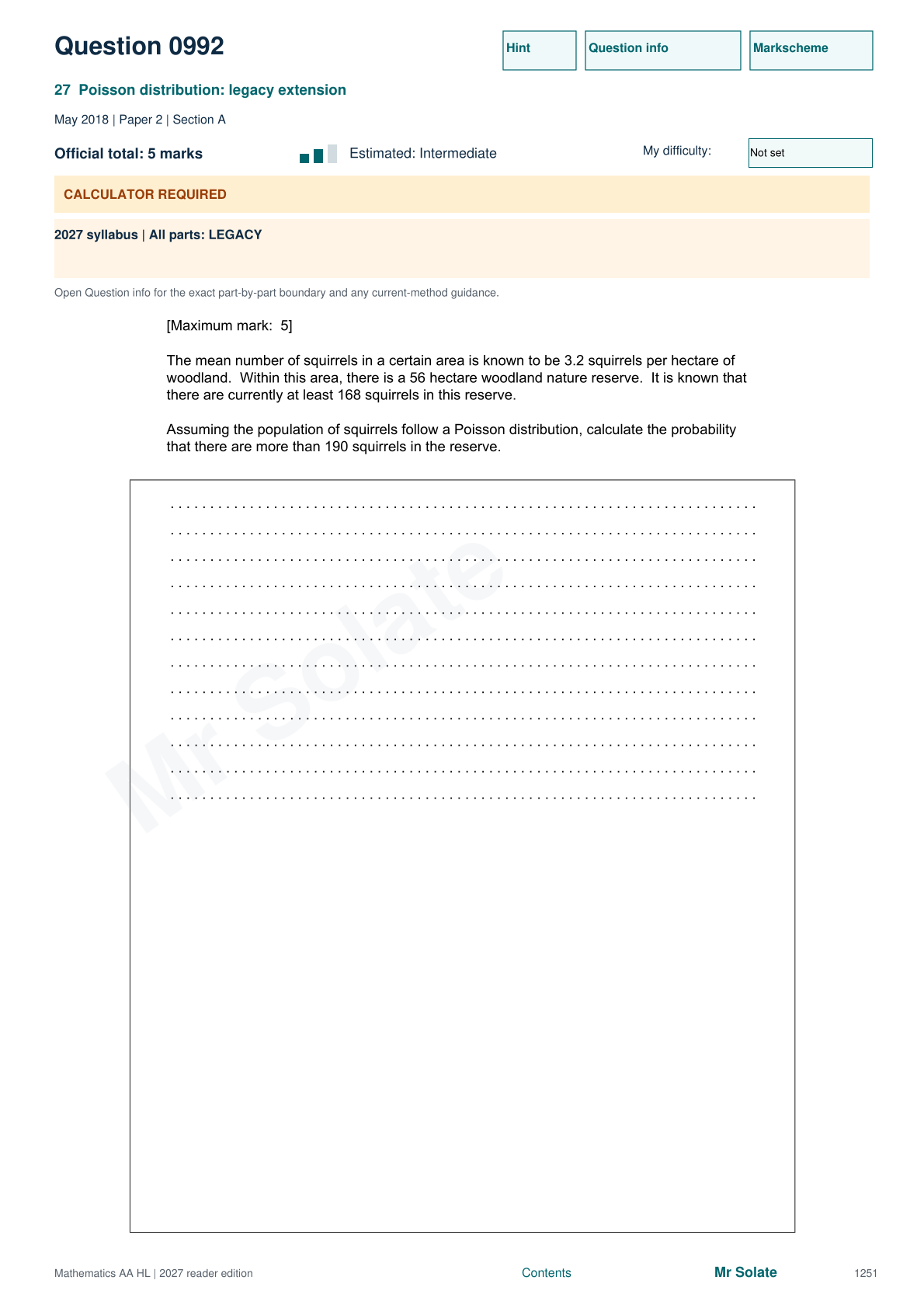
The reserve mean is λ=3.2×56=179.2, so the supplied model is X∼Poisson(179.2).
Because X>190 implies X≥168, the conditional probability is P(X≥191)/P(X≥168).
Use upper tails 1−P(X≤190) and 1−P(X≤167), respectively. Their ratio is approximately 0.245331.
Editorial revision reasoning. Check the original answer for its marking detail.
Question 989
Requires linking Legacy Poisson zero mass, Logarithms and exact probability.
Compatibility: (a)-(b): The probability formula and Poisson parameter scaling are legacy. The subsequent logarithm and complement algebra are current.
View the original question
Original page images preserve the equations and diagrams. Write your response before revealing the reasoning.

Reveal the revision reasoning
- Since P(X>0)=3/4, P(X=0)=1/4=exp(−m).
- Take logarithms to obtain m=ln 4.
- Y has mean 2m=ln 16, so its zero mass is 1/16 and its one mass isln 16/16.
- Subtract these from one to obtain(15−ln 16)/16.
Editorial revision reasoning. Check the original answer for its marking detail.
Question 991
Direct application of Legacy Poisson tail, Current conditional probability.
Compatibility: (a): Poisson modelling is outside current AA HL examination content. (b): Conditional probability of nested events is current, but its input probabilities come from the legacy Poisson model.
View the original question
Original page images preserve the equations and diagrams. Write your response before revealing the reasoning.

Reveal the revision reasoning
- For Poisson mean 1.5, use P(X=k)=exp(−1.5)1.5^k/k!.
- More than two is 1−[P(0)+P(1)+P(2)], approximately 0.191.
- At least one has probability 1−exp(−1.5).
- Every outcome with more than two also has at least one, so divide the first probability by the second, giving approximately 0.246.
Editorial revision reasoning. Check the original answer for its marking detail.
All 32 questions in this topic
Close your notes first
Can you retrieve the method?
1. Is Poisson compulsory here?
Check answer 1
No, it is labelled legacy extension.
2. Mean over three hours at hourly rate c?
Check answer 2
3c.
3. Probability of at least one?
Check answer 3
1−e^(−λ).
Before you move on
- Identify legacy facts separately from current probability operations.
- Record the exposure attached to each λ.
- Check the integer boundary before using a cumulative probability.
Your revision note
Record one missed cue, one corrected step and one question to retry. Saved only in this browser.