Start with the exam
What you need to be able to do
Maclaurin series is current AA HL content in this reader. These questions ask for coefficients, products and compositions, approximate integrals and limits after cancellation. The efficient approach is to decide the required degree first and keep only terms capable of contributing. A truncated polynomial is an approximation near zero; it is not automatically an exact identity or a globally valid formula.
Spend 3 minutes reading the overview and diagram, 7 minutes learning the question patterns, 5 minutes writing out the worked example, and 5 minutes on a bank question or recall check. Take longer when you need to; the full bank is here for later practice.
Recognise → set up → write
How the questions are set
Coefficients from derivatives
Recognise it: The question supplies a derivative relation or asks for several terms.
- Use f(x)=f(0)+f′(0)x+f″(0)x²/2!+f‴(0)x³/3!+… to the requested degree.
- When derivatives are expressed through y, differentiate the supplied identity successively and evaluate at zero. Record derivative values before dividing by factorials.
- If the question asks for the coefficient of xⁿ, distinguish f⁽ⁿ⁾(0) from that coefficient: divide by n!. Check whether symmetry forces odd or even coefficients to vanish.
Show a derivative-value table or a clear chain of evaluations, then the resulting polynomial.
The nth derivative at zero is n! times the coefficient, not the coefficient itself.
Products and compositions
Recognise it: Two known series are multiplied or the argument is replaced by another expression.
- Write each series only as far as required, but account for terms whose powers combine to the target degree.
- For a composition such as e^(x²), substitute x² into the standard expansion. For e^(x+x²), expand powers of the full inner expression and collect like powers.
- For a coefficient in a product, pair powers whose exponents add to the target. Keep exact fractions until collection is finished and use a clearly stated truncation order.
Show the contributing products, making it clear why omitted higher powers cannot affect the requested coefficient.
Truncating the inner series too early can lose a term needed after multiplication or cancellation.
Approximate integrals and leading-term limits
Recognise it: A series is used to estimate an integral or evaluate a quotient near zero.
- Integrate the retained polynomial term by term and apply the stated limits. Explain that the result is an approximation unless the series argument justifies an exact equality.
- For a limit, cancel lower-order terms first and identify the first surviving numerator power. Compare it with the denominator power.
- Use a supplied error condition if a guaranteed accuracy is requested. More terms often improve a local approximation, but the truncated expression alone does not establish a rigorous numerical bound.
State the retained order and distinguish ≈ from = when replacing a function by a finite polynomial.
A low-order polynomial may be poor far from zero, and a limit after cancellation may need more terms than initially expected.
Write it before you reveal it
A worked exam-style example
Original teaching example, created for this lesson.
Original example: find the Maclaurin polynomial of eˣcos x through x³ and use it to find lim x→0 of (eˣcos x−1−x)/x³.
Reveal the worked solution
- Use eˣ=1+x+x²/2+x³/6+… and cos x=1−x²/2+….
- Multiply: the x² coefficient is 1/2−1/2=0.
- The x³ coefficient is 1/6−1/2=−1/3. Thus eˣcos x=1+x−x³/3+terms of degree four and higher.
- After subtracting 1+x and dividing by x³, the limit is −1/3.
Answer: Polynomial 1+x−x³/3; limit −1/3.
Check: Direct derivatives give f(0)=1, f′(0)=1, f″(0)=0 and f‴(0)=−2, giving coefficient −2/6=−1/3.
From your own collection
Apply it to past-paper questions
These questions anchor the patterns above. Attempt one without the answer, then compare your setup and conclusion with the reasoning. The linked reader contains the source answer and the question-specific syllabus review.
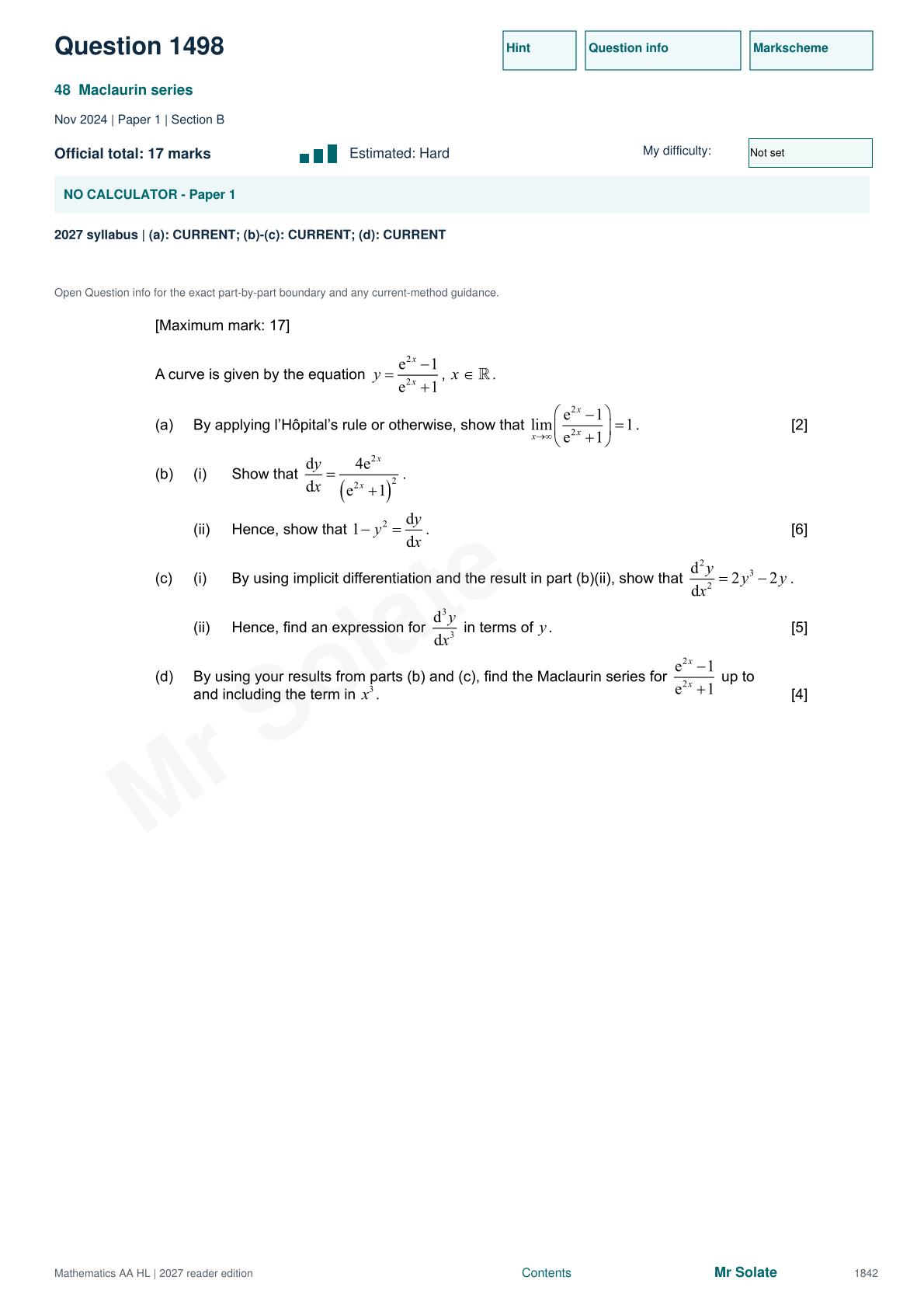
Question 1498
Apply the method to the original question.
Compatibility: All parts test current AA HL content and can be solved using current syllabus methods.
View the original question
Original page images preserve the equations and diagrams. Write your response before revealing the reasoning.
Reveal the revision reasoning
As x→∞, divide numerator and denominator of (e^(2x)-1)/(e^(2x)+1) by e^(2x); the ratio tends to (1-0)/(1+0)=1.
The quotient rule gives y′=4e^(2x)/(e^(2x)+1)². Combining 1-y² over the same denominator produces exactly that expression.
Differentiate y′=1-y² implicitly: y″=-2yy′=-2y(1-y²)=2y³-2y.
Differentiate again: y‴=(6y²-2)y′=(6y²-2)(1-y²)=-6y⁴+8y²-2.
At x=0, y=0, y′=1, y″=0 and y‴=-2. The Maclaurin series through x³ is 0+x+0x²/2!-(2/3!)x³=x-x³/3.
Editorial revision reasoning. Check the original answer for its marking detail.
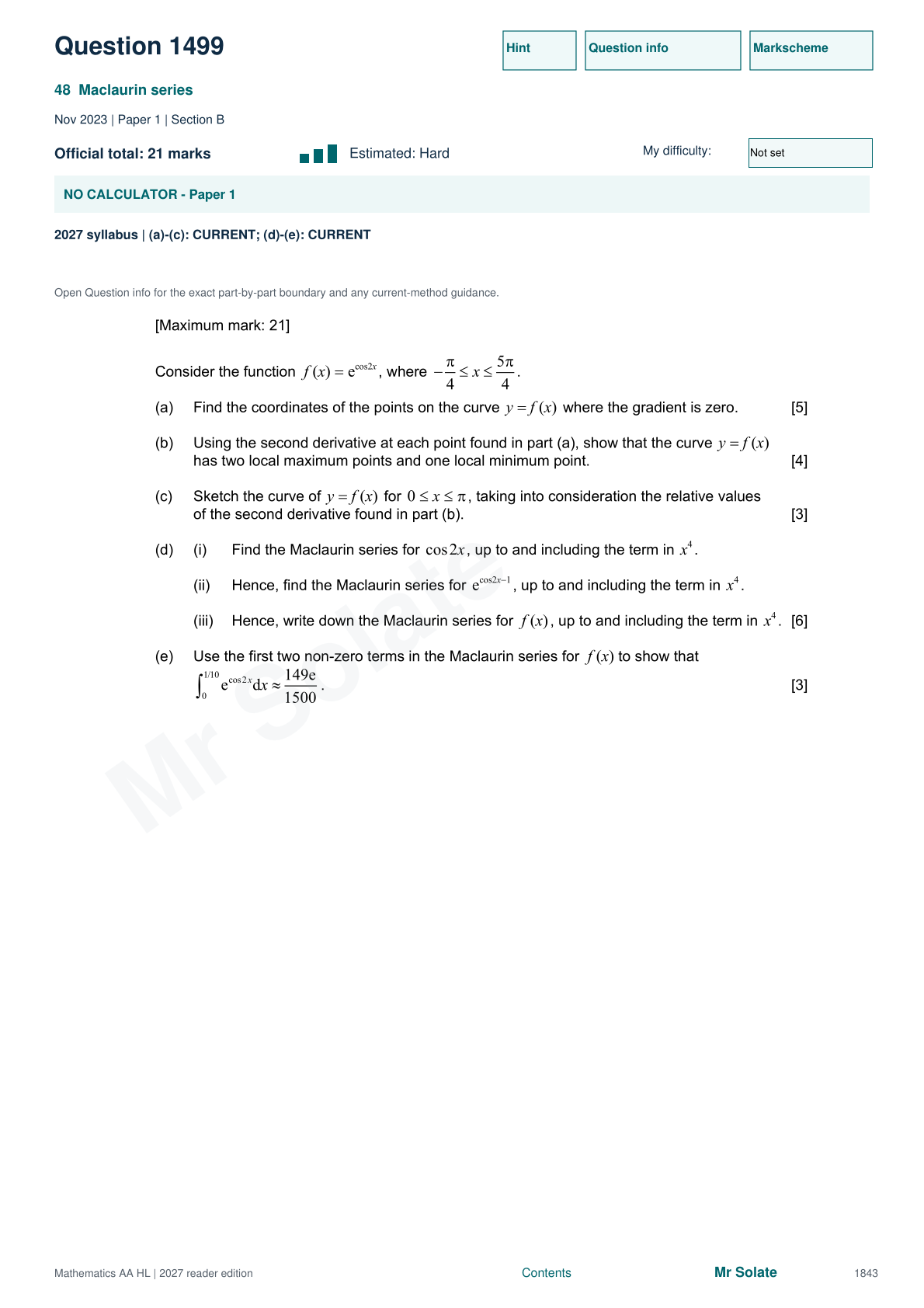
Question 1499
Apply the method to the original question.
Compatibility: All parts test current AA HL content and can be solved using current syllabus methods.
View the original question
Original page images preserve the equations and diagrams. Write your response before revealing the reasoning.
Reveal the revision reasoning
Differentiate f=e^(cos2x): f′=-2sin2x e^(cos2x). On [-π/4,5π/4], derivative zeros give (0,e),(π/2,1/e),(π,e).
The second derivative is 4e^(cos2x)(sin²2x-cos2x). Its values are -4e at the two maxima and 4/e at the minimum.
For the sketch on [0,π], show both maxima and the flatter central minimum: the magnitude of curvature is larger at the maxima.
Expand cos2x=1-2x²+(2/3)x⁴+… . Let u=cos2x-1, which tends to zero, and use e^u=1+u+u²/2+… .
Collecting through x⁴ gives e^(cos2x-1)=1-2x²+(8/3)x⁴+… . Multiply by e to obtain f(x)=e-2ex²+(8e/3)x⁴+… .
Using only the first two nonzero terms, integrate e(1-2x²) from 0 to 1/10: e[x-(2/3)x³]=149e/1500, an approximation.
Editorial revision reasoning. Check the original answer for its marking detail.
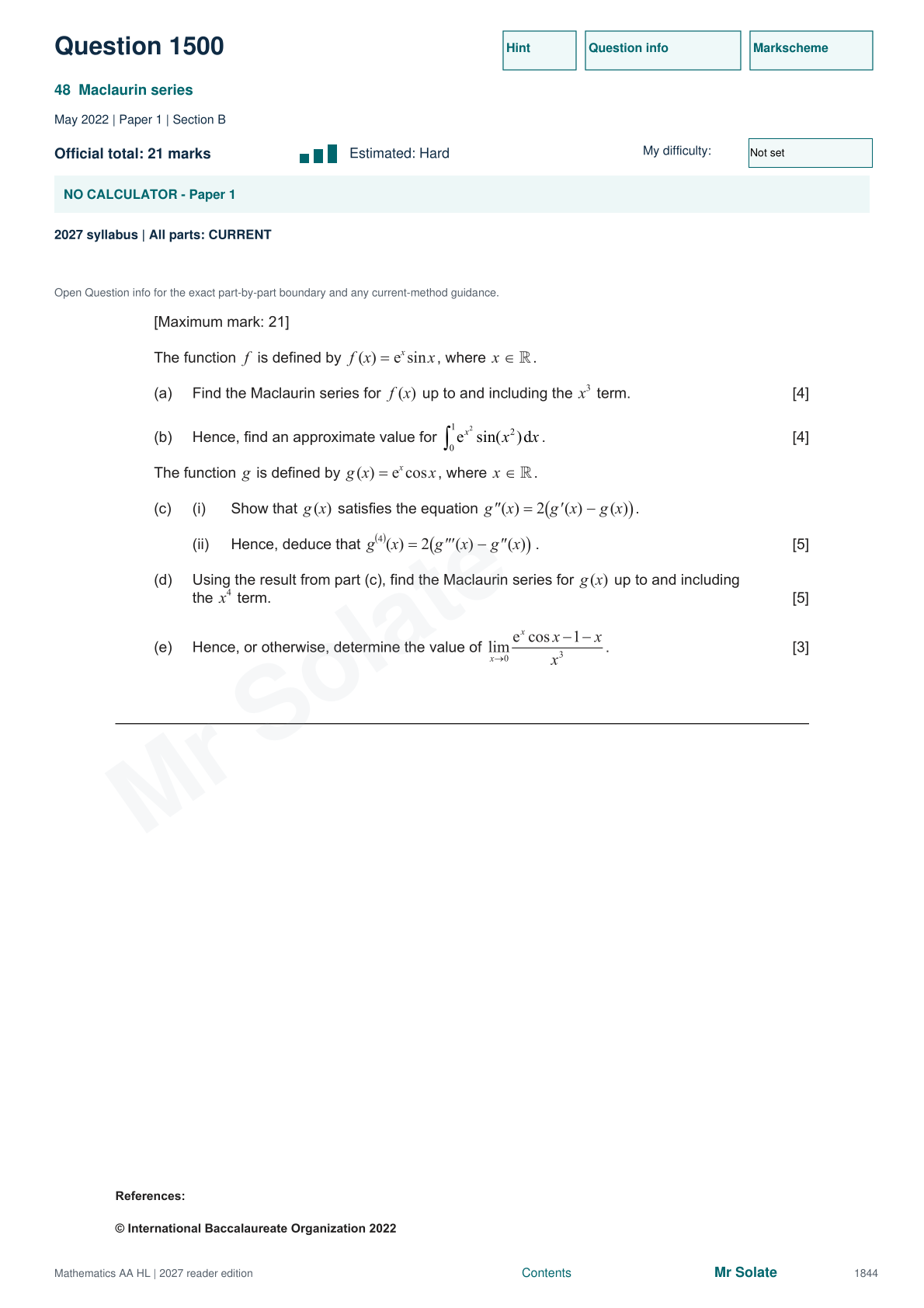
Question 1500
Apply the method to the original question.
Compatibility: This current-course AA HL question tests the listed current syllabus methods.
View the original question
Original page images preserve the equations and diagrams. Write your response before revealing the reasoning.
Reveal the revision reasoning
Multiplying the series of e^x and sin x gives f(x)=x+x²+x³/3+… through x³.
Thus e^(x²)sin(x²)≈x²+x⁴+x⁶/3. Integrating from 0 to 1 gives 1/3+1/5+1/21=61/105 as the requested approximation.
For g=e^x cos x, g′=e^x(cos x-sin x) and g″=-2e^x sin x=2(g′-g). Differentiating this relation twice yields g^(4)=2(g‴-g″).
At zero, g=1, g′=1 and g″=0. The recurrence gives g‴(0)=-2 and g^(4)(0)=-4.
Therefore g(x)=1+x-x³/3-x⁴/6+… through x⁴.
After subtracting 1+x and dividing by x³, the limit is -1/3.
Editorial revision reasoning. Check the original answer for its marking detail.
Close your notes first
Can you retrieve the method?
1. Coefficient of x³ from derivatives?
Check answer 1
f‴(0)/3!.
2. Which product terms contribute to x⁴?
Check answer 2
Those whose exponents sum to four.
3. Why distinguish ≈ from =?
Check answer 3
A finite truncation generally approximates the function rather than equalling it.
Before you move on
- Decide the target degree before expanding.
- Practise one derivative-generated series and one product or composition.
- For a limit, retain enough terms to survive all cancellations.
Your revision note
Record one missed cue, one corrected step and one question to retry. Saved only in this browser.