Start with the exam
What you need to be able to do
Sector problems are mainly boundary-reading problems. Decide whether the shaded region is a sector, a segment, a ring sector or an overlap before choosing formulas. The bank repeatedly asks for both area and perimeter; subtracting areas does not tell you which lengths make the perimeter. Draw radii to relevant endpoints, label the swept angle in radians, and trace the actual outer boundary with your finger before calculating.
Spend 3 minutes reading the overview and diagram, 7 minutes learning the question patterns, 5 minutes writing out the worked example, and 5 minutes on a bank question or recall check. Take longer when you need to; the full bank is here for later practice.
Recognise → set up → write
How the questions are set
A sector from area, arc or perimeter
Recognise it: A radius, arc length, angle or sector area is given.
- Use arc s=rθ and sector area A=r²θ/2 with θ in radians.
- For the perimeter of an ordinary sector, add the arc and both radii: P=rθ+2r.
- If one quantity is unknown, solve the given relation before substituting into the requested one. Keep exact π values when appropriate.
Write the formula with the indicated angle, especially if the shaded sector is reflex rather than the small labelled angle.
Degrees cannot be inserted directly into rθ or r²θ/2.
Segments and overlaps
Recognise it: The curved region lies between a chord and arc, or two circles overlap.
- A minor segment is sector minus the triangle formed by the two radii: A=r²(θ−sinθ)/2.
- Find θ from a half-chord right triangle or cosine rule when needed.
- For a lens, split at the common chord into one segment from each circle and add the two segment areas.
Show the sector area and triangle area separately before subtraction.
A segment is not a sector. If the relevant angle is reflex, confirm which region your subtraction actually describes.
Composite boundaries and folded sectors
Recognise it: An annular region, cone net or mixed straight/curved boundary appears.
- For an annular sector subtract areas, but add both arcs and the exposed radial gaps for perimeter.
- For a cone net, the sector’s arc becomes the base circumference. The sector radius becomes slant height, not vertical height.
- Use a right triangle to recover cone height if needed, and label the two different radii distinctly.
List each boundary piece in the perimeter expression; crossed-out interior construction lines should not be counted.
Subtracting two perimeters generally does not give the perimeter of the remaining region.
Write it before you reveal it
A worked exam-style example
Original teaching example, created for this lesson.
Original practice: a sector has radius 6 cm and angle π/3. Find its area, perimeter and minor-segment area.
Reveal the worked solution
- Arc=6(π/3)=2π cm. Sector area=36(π/3)/2=6π cm².
- Perimeter=12+2π cm, including both radii.
- The triangle area is 36sin(π/3)/2=9√3 cm². Subtract it from the sector.
Answer: Area 6π cm²; perimeter 12+2π cm; segment 6π−9√3 cm².
Check: The segment is positive and smaller than the sector. Area units are squared; perimeter units are not.
From your own collection
Apply it to past-paper questions
These questions anchor the patterns above. Attempt one without the answer, then compare your setup and conclusion with the reasoning. The linked reader contains the source answer and the question-specific syllabus review.
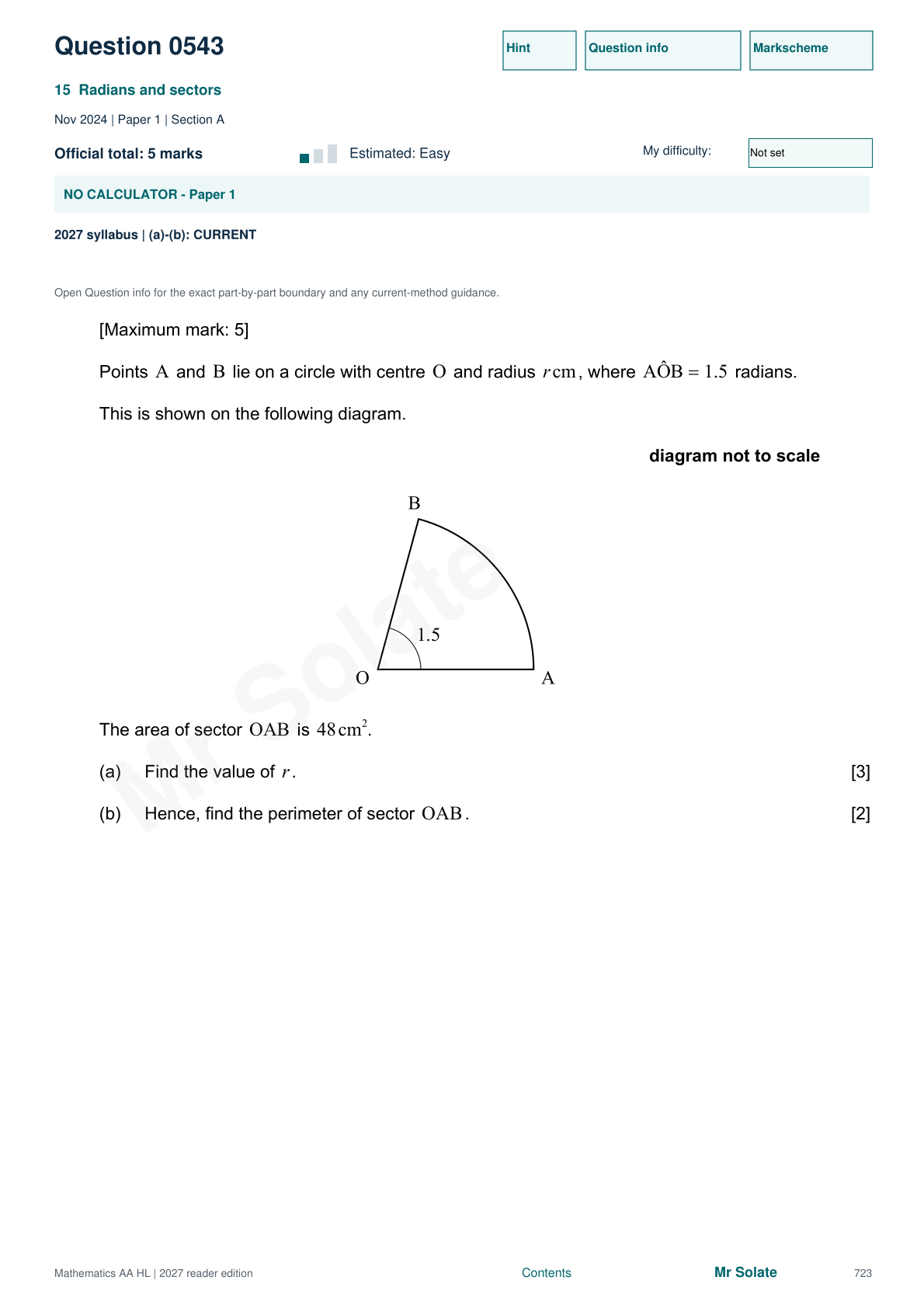
Question 543
Apply the method to the original question.
Compatibility: All parts test current AA HL content and can be solved using current syllabus methods.
View the original question
Original page images preserve the equations and diagrams. Write your response before revealing the reasoning.
Reveal the revision reasoning
The sector formula gives 48=(1/2)r²(1.5)=(3/4)r².
Hence r²=64 and r=8 cm, selecting the positive physical radius.
The arc length is rθ=8×1.5=12 cm. Adding two radii gives perimeter 12+16=28 cm.
Editorial revision reasoning. Check the original answer for its marking detail.
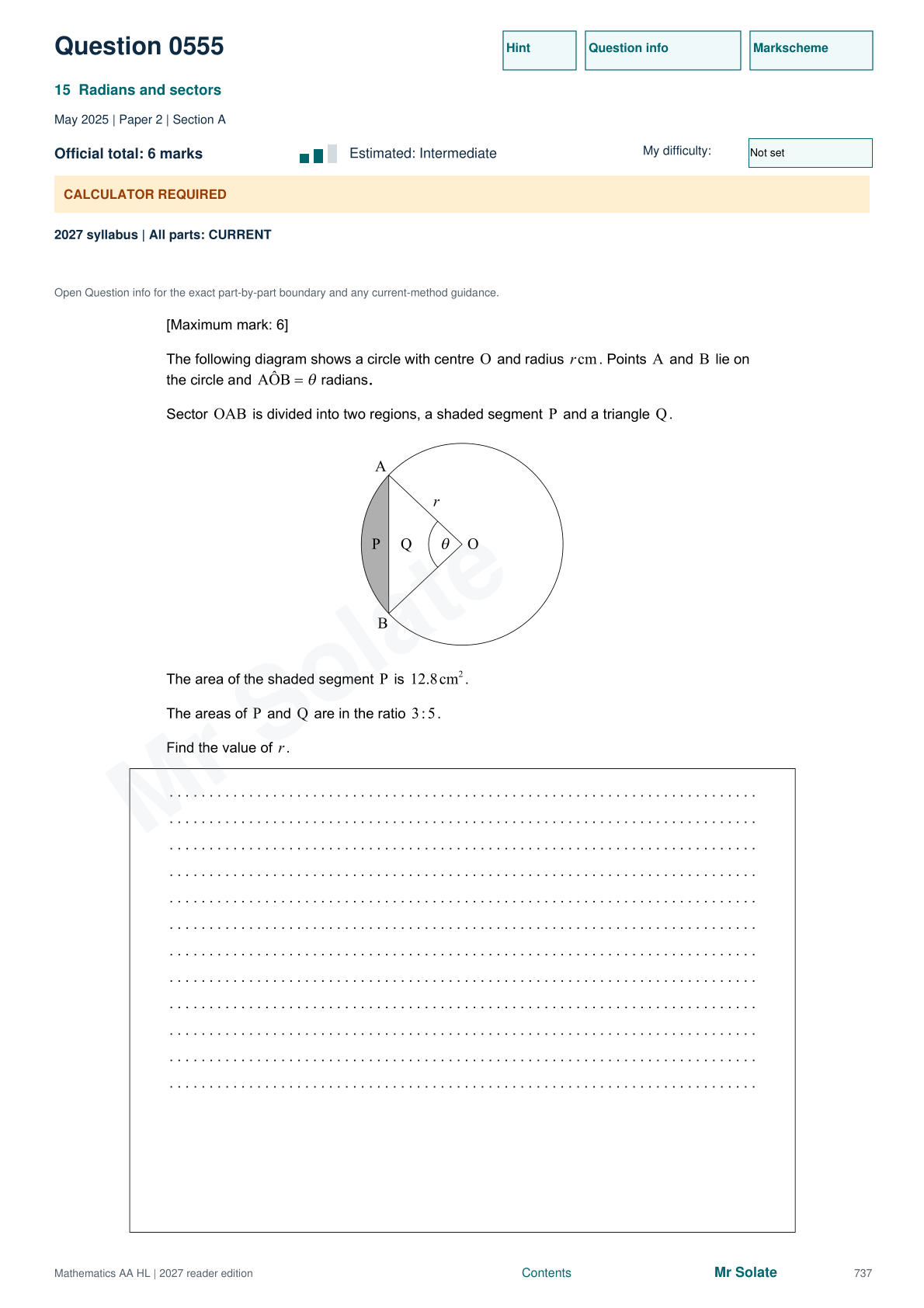
Question 555
Several linked steps in Segment and triangle areas, Eliminating a common radius, Numerical trigonometric equation.
Compatibility: The tested concepts and methods match the current AA HL syllabus; the original paper format and wording are retained.
View the original question
Original page images preserve the equations and diagrams. Write your response before revealing the reasoning.
Reveal the revision reasoning
The triangle area is (5/3)(12.8)=21.3333cm², so the sector area is 34.1333cm².
Use P=(r²/2)(θ−sinθ) and Q=(r²/2)sinθ. Their ratio yields (θ−sinθ)/sinθ=3/5.
Solve for the nonzero angle in the diagram, obtaining θ≈1.59934 radians.
Then r=√[25.6/(θ−sinθ)]≈6.53330≈6.53cm.
Editorial revision reasoning. Check the original answer for its marking detail.
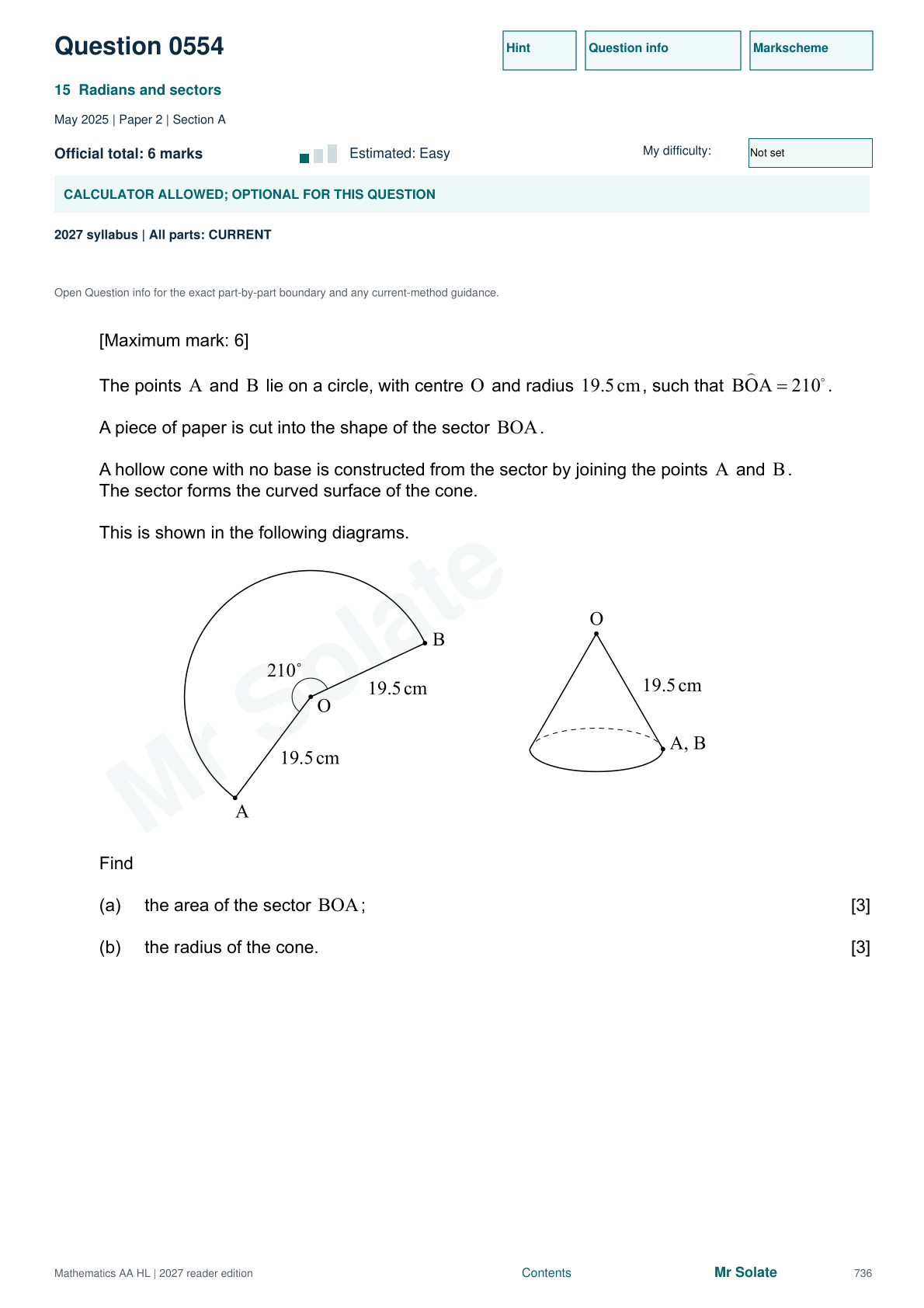
Question 554
Direct application of Sector area, Arc length and cone circumference.
Compatibility: The tested concepts and methods match the current AA HL syllabus; the original paper format and wording are retained.
View the original question
Original page images preserve the equations and diagrams. Write your response before revealing the reasoning.
Reveal the revision reasoning
The sector area is (210/360)π(19.5)²=3549π/16≈697cm².
Its arc length is (210/360)2π(19.5)=91π/4 cm.
Equate that arc to 2πr, obtaining r=91/8=11.375≈11.4cm.
Editorial revision reasoning. Check the original answer for its marking detail.
All 32 questions in this topic
Close your notes first
Can you retrieve the method?
1. What is the sector perimeter?
Check answer 1
rθ+2r, when both radii are on the boundary.
2. What changes when an angle is reflex?
Check answer 2
Use the swept reflex angle for the corresponding arc and sector.
3. In a cone net, what does the sector radius become?
Check answer 3
The cone’s slant height.
Before you move on
- Before calculation, label every arc centre and every angle in radians. A correct formula with the wrong central angle is still the wrong region.
- After calculation, compare the area with the containing sector or circle and check dimensional units.
Your revision note
Record one missed cue, one corrected step and one question to retry. Saved only in this browser.