Start with the exam
What you need to be able to do
Treat y as a function of x throughout an implicit relation. Differentiate the complete equation before substituting a point, collect every y′ term and then solve for the derivative. The resulting numerator and denominator have different geometric roles. Branch restrictions from the original curve remain relevant when finding tangent points.
Spend 3 minutes reading the overview and diagram, 7 minutes learning the question patterns, 5 minutes writing out the worked example, and 5 minutes on a bank question or recall check. Take longer when you need to; the full bank is here for later practice.
Recognise → set up → write
How the questions are set
Collect all derivative terms
Recognise it: The relation includes y², xy, eʸ or functions of both variables.
- Differentiate through y with a y′ factor: (y²)′=2yy′ and (eʸ)′=eʸy′.
- For xy, use y+xy′. For sin(xy), use cos(xy)(y+xy′). Combine product and chain rules where necessary.
- Collect y′ terms on one side and factor. Record denominator exclusions, then evaluate at a point checked in the original equation.
Show the differentiated equation before rearranging.
Substituting coordinates before differentiation destroys the varying relation.
Horizontal and vertical tangents
Recognise it: The question specifies zero gradient, vertical tangent or horizontal normal.
- For y′=N/D, a horizontal tangent requires N=0 and D≠0. Solve with the original curve equation.
- A vertical tangent requires careful investigation of D=0; when N≠0 it gives the vertical line through the point.
- If both N and D vanish, the fraction alone is inconclusive. Use the curve’s local behaviour or another representation and keep all admissible branches.
Show the simultaneous equations and the nonzero check.
A zero denominator is not a horizontal tangent. Squaring can introduce false candidates.
Normal, branch or second derivative
Recognise it: A sign restriction selects a point, or further differentiation is required.
- Use the original quadrant or domain condition to select a branch. Do not automatically choose a positive square root.
- For finite nonzero tangent slope m, use normal slope −1/m through the contact point. Handle vertical and horizontal cases separately.
- For y″, differentiate while y and y′ are still varying. Substitute known derivative expressions or point values at the appropriate stage.
State the branch condition, tangent gradient and final normal equation.
An external point on a normal is not necessarily the curve’s contact point.
Write it before you reveal it
A worked exam-style example
Original teaching example, created for this lesson.
Original example: find tangent and normal to x²+xy+y²=7 at (1,2).
Reveal the worked solution
- Check 1+2+4=7.
- Differentiate: 2x+y+xy′+2yy′=0.
- Thus y′=−(2x+y)/(x+2y), giving −4/5 at (1,2).
- The normal slope is 5/4.
Answer: Tangent y−2=−(4/5)(x−1); normal y−2=(5/4)(x−1).
Check: The slopes multiply to −1, and both lines contain the contact point.
From your own collection
Apply it to past-paper questions
These questions anchor the patterns above. Attempt one without the answer, then compare your setup and conclusion with the reasoning. The linked reader contains the source answer and the question-specific syllabus review.
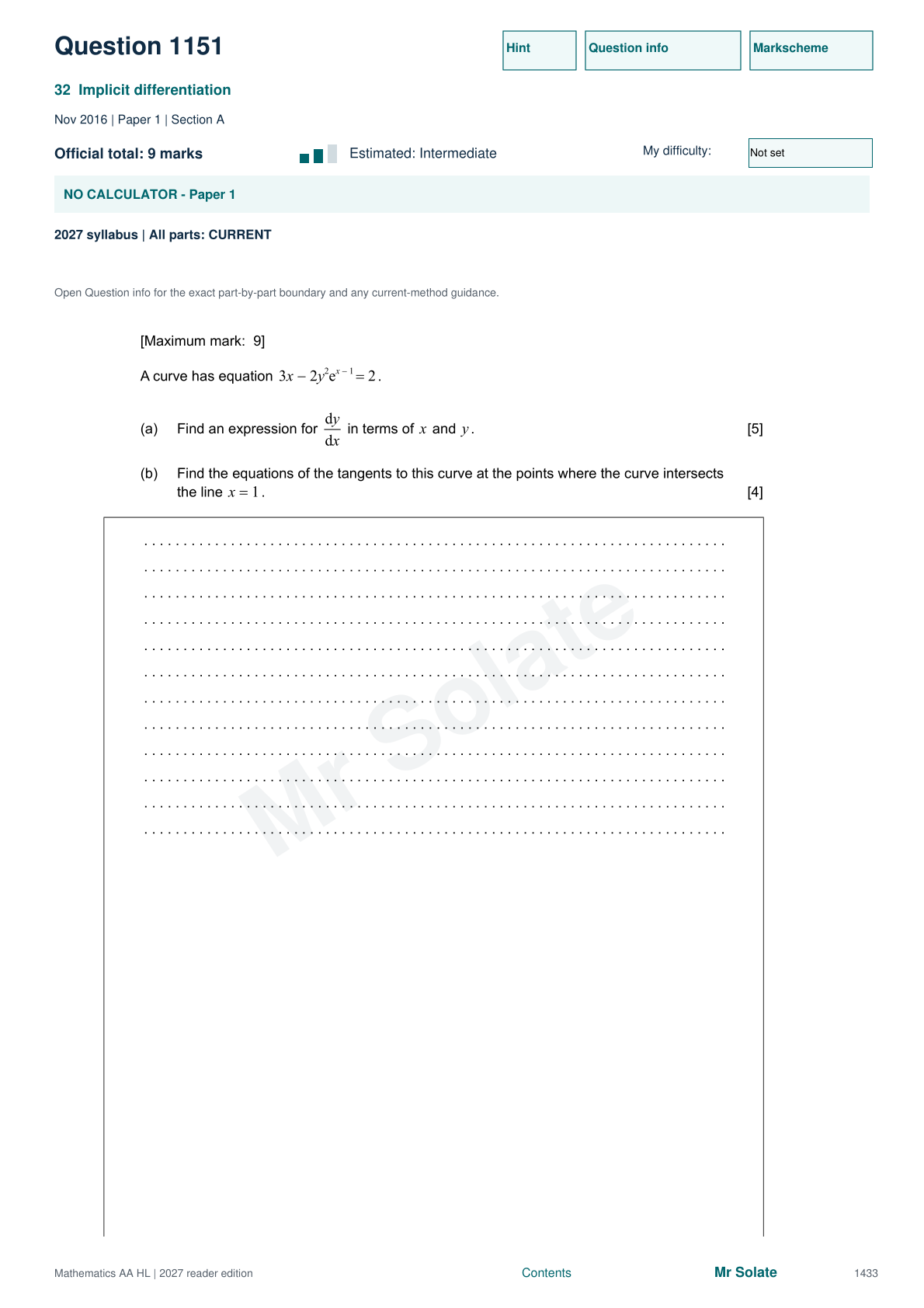
Question 1151
Several linked steps involving Implicit exponential product rule, Two tangent branches.
Compatibility: Current: All parts
View the original question
Original page images preserve the equations and diagrams. Write your response before revealing the reasoning.
Reveal the revision reasoning
- Differentiate 3x-2y²exp(x-1)=2, using a product rule on y²exp(x-1).
- At x=1 the curve gives y=±1/√2; the corresponding slopes are ±1/√2.
- Apply point-slope form separately; the tangents simplify to y=±x/√2.
Editorial revision reasoning. Check the original answer for its marking detail.
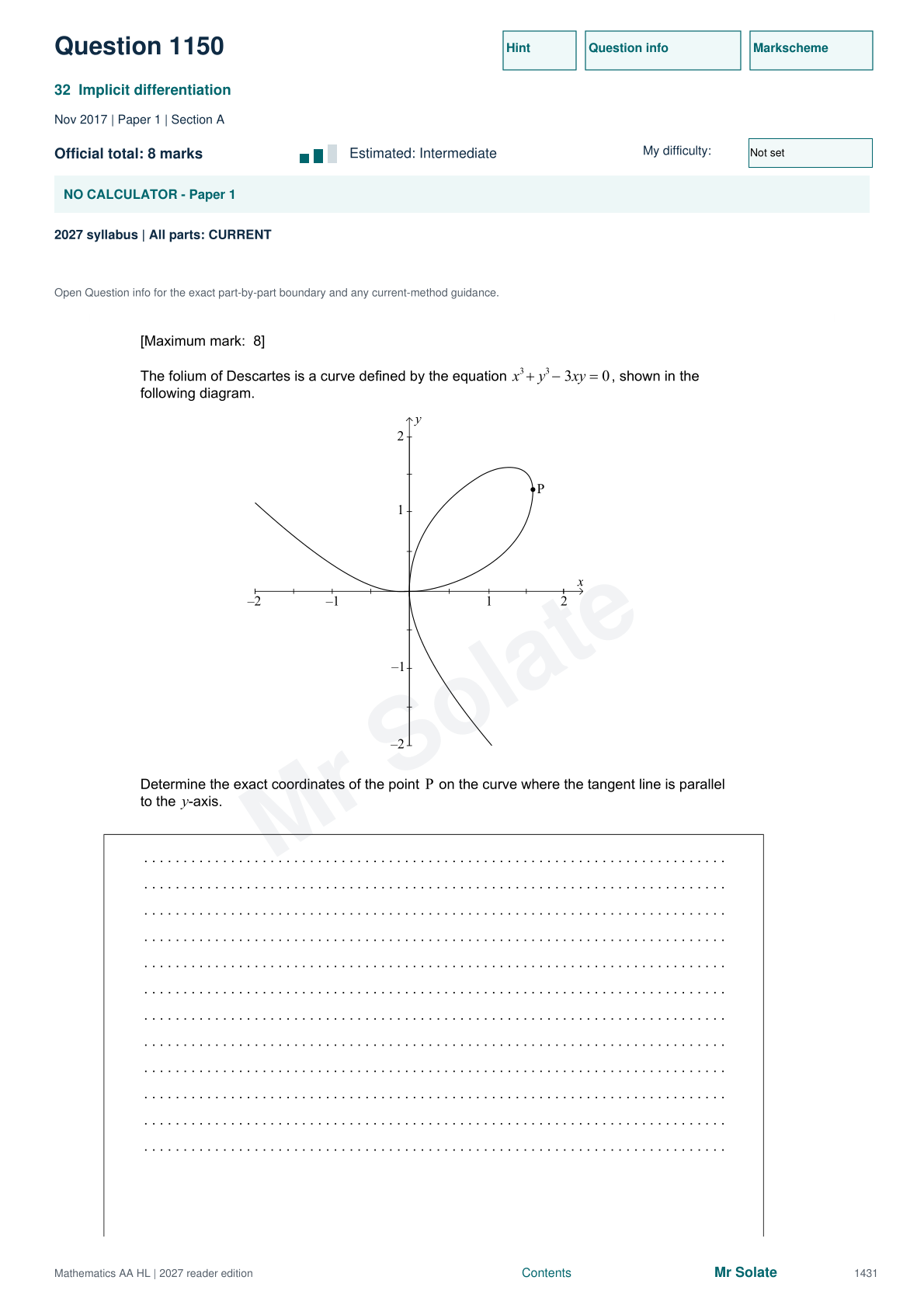
Question 1150
Several linked steps involving Implicit differentiation, Vertical tangent, Exact algebraic roots.
Compatibility: Current: All parts
View the original question
Original page images preserve the equations and diagrams. Write your response before revealing the reasoning.
Reveal the revision reasoning
- Differentiation gives y'=(y-x²)/(y²-x).
- Set y²=x and substitute into x³+y³-3xy=0.
- Exclude the origin, which is not P; y³=2 and x=y² give P=(cube root 4,cube root 2).
Editorial revision reasoning. Check the original answer for its marking detail.
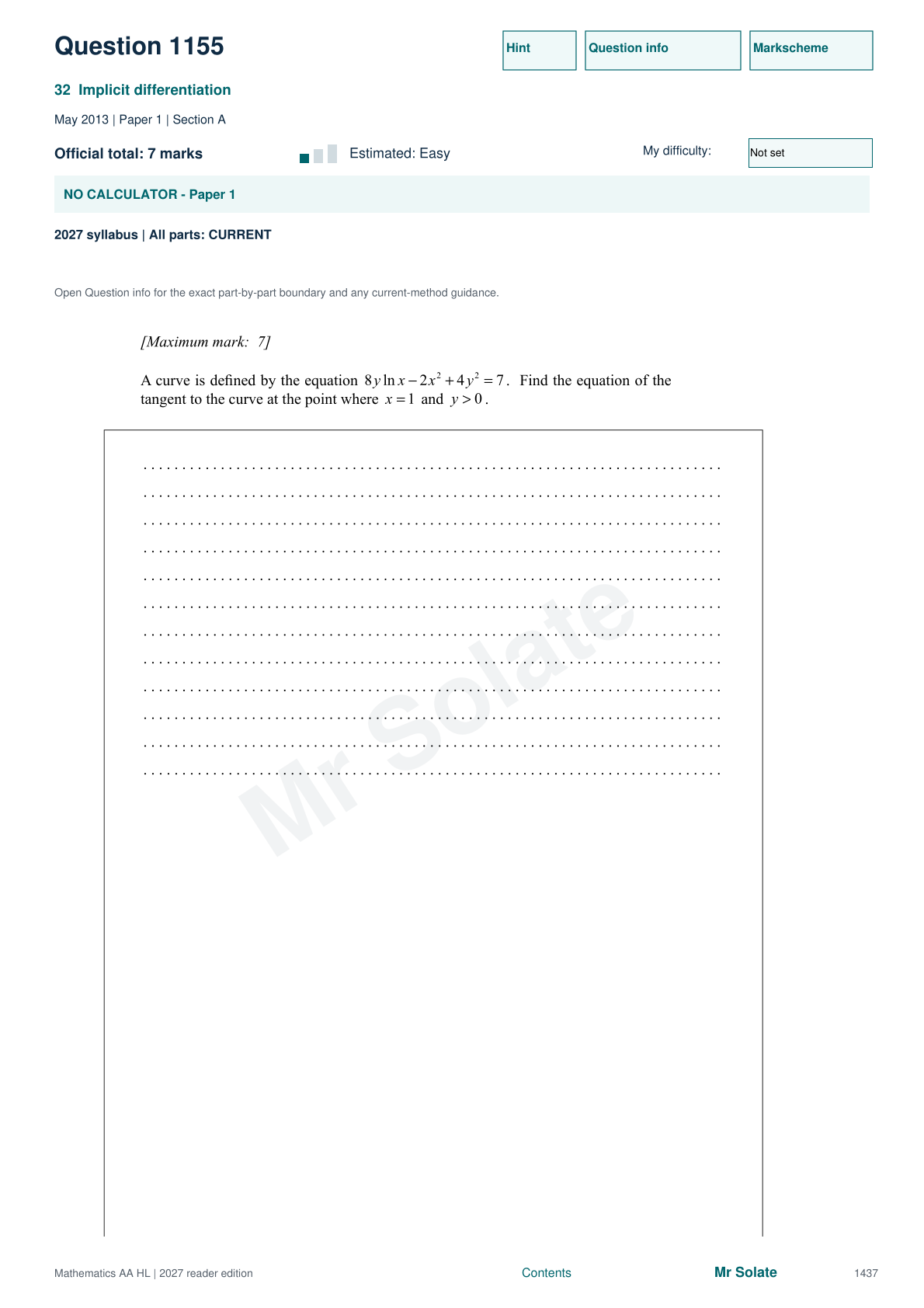
Question 1155
A short direct application of Implicit logarithmic product rule, Branch choice, Tangent equation.
Compatibility: Current: All parts
View the original question
Original page images preserve the equations and diagrams. Write your response before revealing the reasoning.
Reveal the revision reasoning
- The curve gives y²=9/4, so y=3/2 because y>0.
- Differentiate 8y ln x-2x²+4y²=7 to obtain 8y/x+8ln(x)y'-4x+8yy'=0.
- At (1,3/2), the slope is -2/3; use y-3/2=-(2/3)(x-1).
Editorial revision reasoning. Check the original answer for its marking detail.
All 35 questions in this topic
Close your notes first
Can you retrieve the method?
1. Derivative of xy?
Check answer 1
y+xy′.
2. Horizontal tangent conditions?
Check answer 2
N=0, D≠0, and the point lies on the curve.
3. Normal to a horizontal tangent?
Check answer 3
A vertical line.
Before you move on
- Collect y′ before numerical substitution.
- Check candidates against the original curve and derivative restrictions.
- Verify the contact point and perpendicular slopes.
Your revision note
Record one missed cue, one corrected step and one question to retry. Saved only in this browser.