Start with the exam
What you need to be able to do
Curve-feature questions connect derivatives to sketches, ranges and solution counts. Derivative zeros locate candidates; derivative signs classify them; the original function gives coordinates. Keep stationarity, inflection and global extremes separate. A sketch should assemble justified features, including domain exclusions and asymptotes, rather than merely copy a calculator image.
Spend 3 minutes reading the overview and diagram, 7 minutes learning the question patterns, 5 minutes writing out the worked example, and 5 minutes on a bank question or recall check. Take longer when you need to; the full bank is here for later practice.
Recognise → set up → write
How the questions are set
Stationary points and monotonic intervals
Recognise it: Find maxima, minima or increasing and decreasing regions.
- Solve f′=0 within the original domain and evaluate f at each retained input.
- Use a sign change of f′: positive to negative means local maximum; negative to positive means local minimum. A nonzero f″ at the point provides an alternative test.
- When f″=0, the test is inconclusive. Use derivative signs. For global extremes on a restricted interval, compare endpoints as well as stationary candidates.
Show the derivative equation and evidence for each classification, then report full coordinates.
A stationary point can be neither a maximum nor a minimum; an endpoint can be a global extreme without f′=0.
Inflection, asymptotes and range
Recognise it: The task asks for concavity, a sketch or possible function values.
- Find candidates from f″=0 or where f″ fails, then verify concavity changes at a point belonging to the curve.
- Combine intercepts, stationary points, asymptotes and end behaviour. A vertical asymptote marks an excluded input, not a point on the curve.
- For range, distinguish attained extrema from limiting values. Use an open bound for a value approached but never reached. Derivative-graph turning behaviour may reveal an inflection of the original function.
State the concavity change and label the evidence on the sketch.
f″=0 alone does not prove inflection, and an undefined point cannot be an inflection point of the curve.
Parameters and numbers of solutions
Recognise it: A family has prescribed stationary points or a horizontal line has several intersections.
- Translate a known point to f(a)=b, stationarity to f′(a)=0, and an inflection condition to f″(a)=0 with the required concavity behaviour.
- If f′ is quadratic, two distinct stationary inputs require positive discriminant, except when a parameter reduces its degree.
- For f(x)=k, compare the horizontal level with local extreme values and end behaviour. Equality with an extreme value produces a repeated contact and changes the distinct root count.
Identify the polynomial whose discriminant you use and why its roots matter.
The discriminants of f and f′ answer different questions. Check whether a leading coefficient can vanish.
Write it before you reveal it
A worked exam-style example
Original teaching example, created for this lesson.
Original example: analyse f(x)=x³−3x and determine when f(x)=k has three distinct real solutions.
Reveal the worked solution
- f′=3(x−1)(x+1), so stationary inputs are −1 and 1.
- f″=6x, giving local maximum (−1,2) and local minimum (1,−2).
- f″ changes sign at zero, giving inflection (0,0).
- A horizontal line crosses three times exactly when its level lies strictly between −2 and 2.
Answer: Stationary points (−1,2), (1,−2); inflection (0,0); three distinct roots for −2<k<2.
Check: The derivative signs +,−,+ confirm both classifications.
From your own collection
Apply it to past-paper questions
These questions anchor the patterns above. Attempt one without the answer, then compare your setup and conclusion with the reasoning. The linked reader contains the source answer and the question-specific syllabus review.
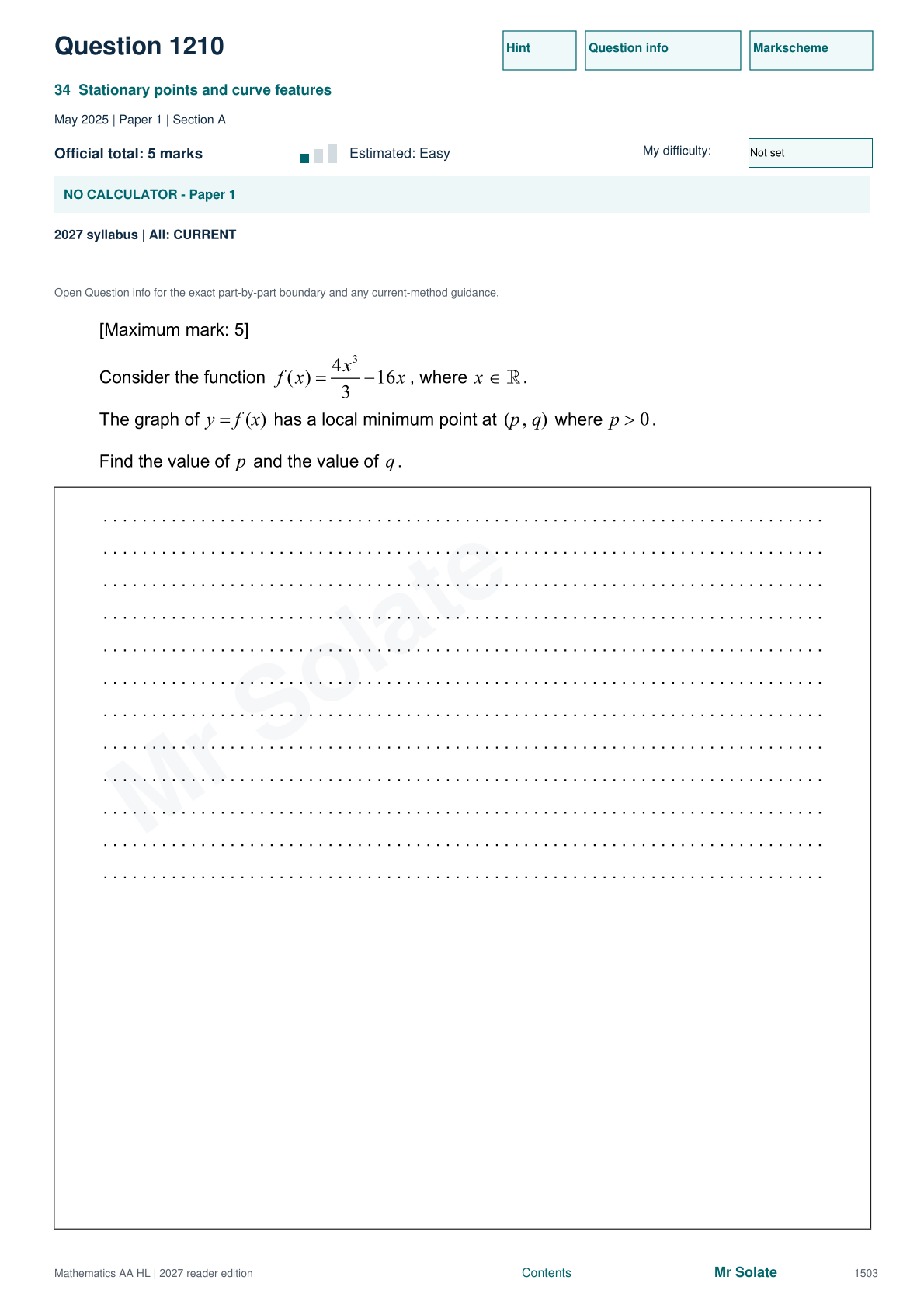
Question 1210
Apply the method to the original question.
Compatibility: All parts test current AA HL content and can be solved using current syllabus methods.
View the original question
Original page images preserve the equations and diagrams. Write your response before revealing the reasoning.
Reveal the revision reasoning
For f(x)=(4/3)x³-16x, the derivative is f′=4x²-16.
Set it to zero to obtain x=±2. The condition p>0 selects p=2.
Substitution gives q=f(2)=32/3-32=-64/3.
As a check, f″(2)=16>0, consistent with the stated local minimum.
Editorial revision reasoning. Check the original answer for its marking detail.
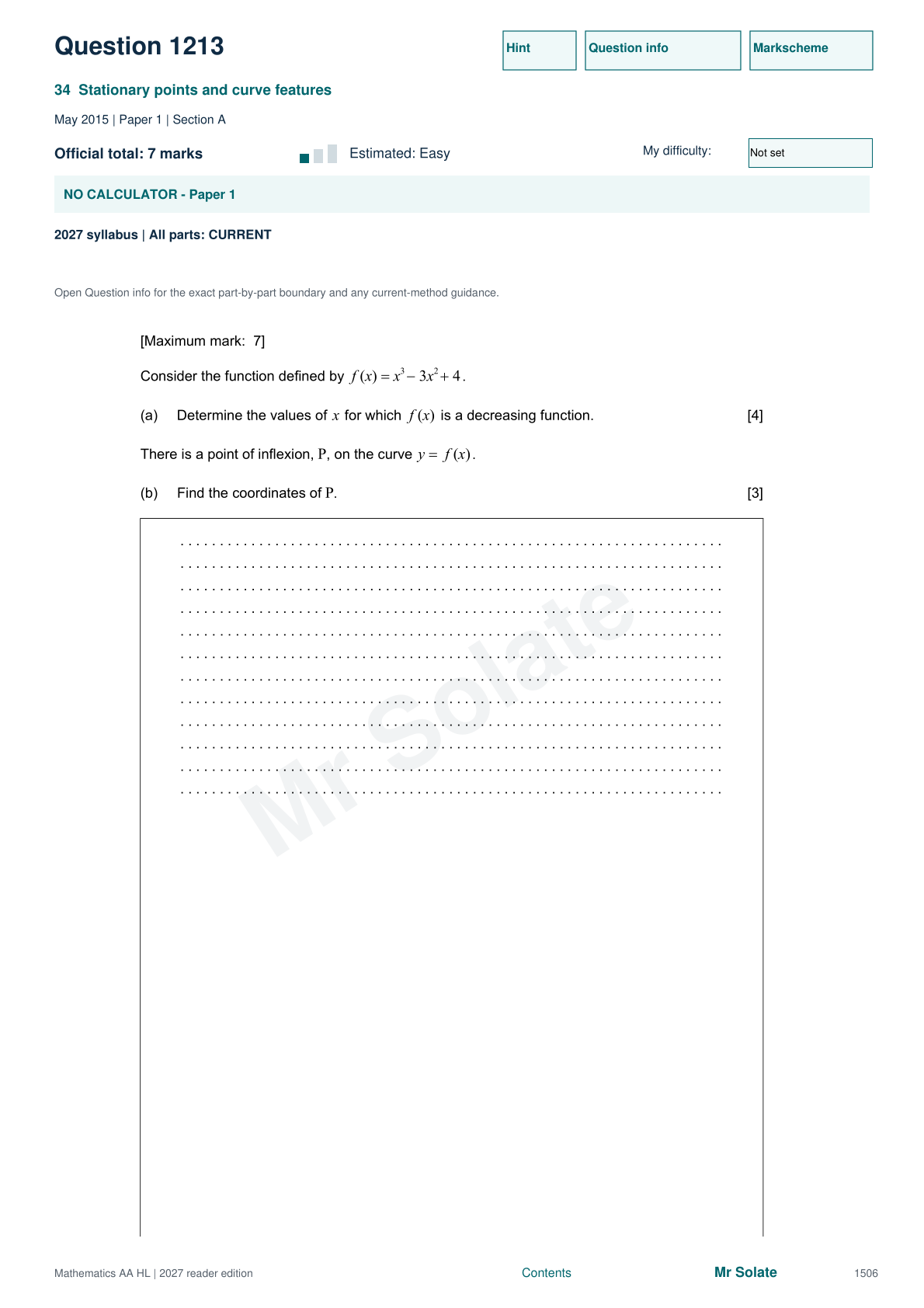
Question 1213
A short direct application of Derivative sign inequality, Inflexion coordinates.
Compatibility: Current: All parts
View the original question
Original page images preserve the equations and diagrams. Write your response before revealing the reasoning.
Reveal the revision reasoning
- Differentiate to get f'=3x(x-2).
- This upward quadratic is negative between its roots, so f decreases on 0<x<2.
- f''=6x-6 changes sign at x=1; substituting into f gives P=(1,2).
Editorial revision reasoning. Check the original answer for its marking detail.
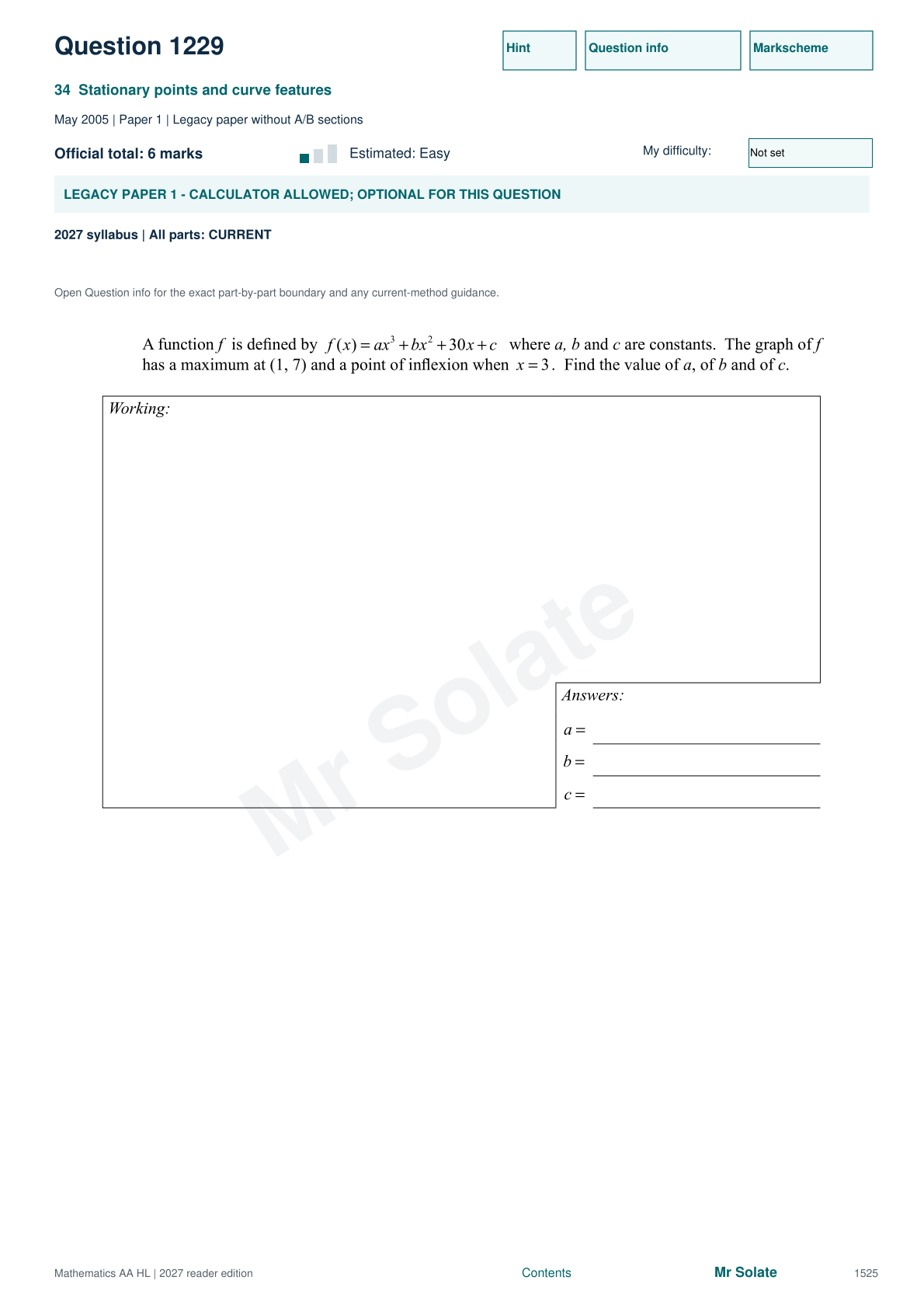
Question 1229
A short direct application of Polynomial coefficients, Stationary point, Inflexion constraints.
Compatibility: Current: All parts
View the original question
Original page images preserve the equations and diagrams. Write your response before revealing the reasoning.
Reveal the revision reasoning
- A maximum at x=1 gives f'(1)=3a+2b+30=0.
- An inflexion at x=3 gives f''(3)=18a+2b=0.
- Solve to get a=2,b=-18, then use f(1)=7 to find c=-7.
Editorial revision reasoning. Check the original answer for its marking detail.
All 45 questions in this topic
Close your notes first
Can you retrieve the method?
1. If f″=0 at a stationary point?
Check answer 1
Use another test; it is inconclusive.
2. What proves inflection?
Check answer 2
A change of concavity at a curve point.
3. What matters at interval boundaries?
Check answer 3
Endpoint values or limits.
Before you move on
- Create a derivative sign table before looking at a graph.
- Use extreme values, not just their inputs, for range and root counts.
- Check that every labelled feature is in the domain.
Your revision note
Record one missed cue, one corrected step and one question to retry. Saved only in this browser.