Start with the exam
What you need to be able to do
Identify what counts as success before choosing a binomial formula. This bank combines exact counts, tails, unknown parameters and repeated experiments. A probability from a normal or other earlier part may become the success probability in a new binomial count. Define the new variable explicitly so its count cannot be confused with the original measurement.
Spend 3 minutes reading the overview and diagram, 7 minutes learning the question patterns, 5 minutes writing out the worked example, and 5 minutes on a bank question or recall check. Take longer when you need to; the full bank is here for later practice.
Recognise → set up → write
How the questions are set
Translate the tail
Recognise it: A fixed number of independent trials has the same success probability.
- Write X~B(n,p) and define the success. Check fixed n, independence, two classifications per trial and constant p.
- Exactly r gives C(n,r)p^r(1−p)^(n−r). At least r gives 1−P(X≤r−1), while more than r gives 1−P(X≤r).
- For a≤X≤b, subtract cumulative probabilities at b and a−1. Write the symbolic event before entering the calculator.
Show the model, the event and the combination factor for an exact count.
A specified order has no combination factor. At least one is 1−P(X=0).
Recover parameters
Recognise it: The mean and variance, or a relation between neighbouring probabilities, are supplied.
- Use μ=np and σ²=np(1−p). Divide variance by mean to find 1−p, then recover n.
- For adjacent probabilities, divide the full masses and cancel common factorials and powers before solving.
- Check 0≤p≤1 and integer n. With rounded probabilities, inspect admissible integer candidates rather than treating the stated decimal as infinitely precise.
Show both moment equations or the full probability ratio before simplification.
Square a supplied standard deviation before using the variance formula.
Condition or find the minimum trial count
Recognise it: The wording contains given that or smallest n.
- Write P(A|B)=P(A∩B)/P(B). For a condition of at least one success, the denominator is 1−(1−p)^n.
- For probability at least c of one or more successes, solve 1−(1−p)^n≥c. Division by ln(1−p), a negative number, reverses an inequality.
- Check the final integer and its predecessor. For a more complicated tail, use an integer search when calculator use is permitted.
Show why n works and n−1 fails; this establishes the word smallest.
Rounding a logarithmic result to the nearest integer can violate the target probability.
Write it before you reveal it
A worked exam-style example
Original teaching example, created for this lesson.
Original example: p=1/4. Find exactly two successes in four trials and the smallest n giving at least a 90% chance of one success.
Reveal the worked solution
- P(X=2)=C(4,2)(1/4)²(3/4)²=27/128.
- Require 1−(3/4)^n≥0.9, hence n≥ln(0.1)/ln(0.75)≈8.004.
- For n=8 the probability is about 0.899887; for n=9 it is about 0.924915.
Answer: 27/128; the smallest n is 9.
Check: Eight narrowly fails, making the predecessor check essential.
From your own collection
Apply it to past-paper questions
These questions anchor the patterns above. Attempt one without the answer, then compare your setup and conclusion with the reasoning. The linked reader contains the source answer and the question-specific syllabus review.
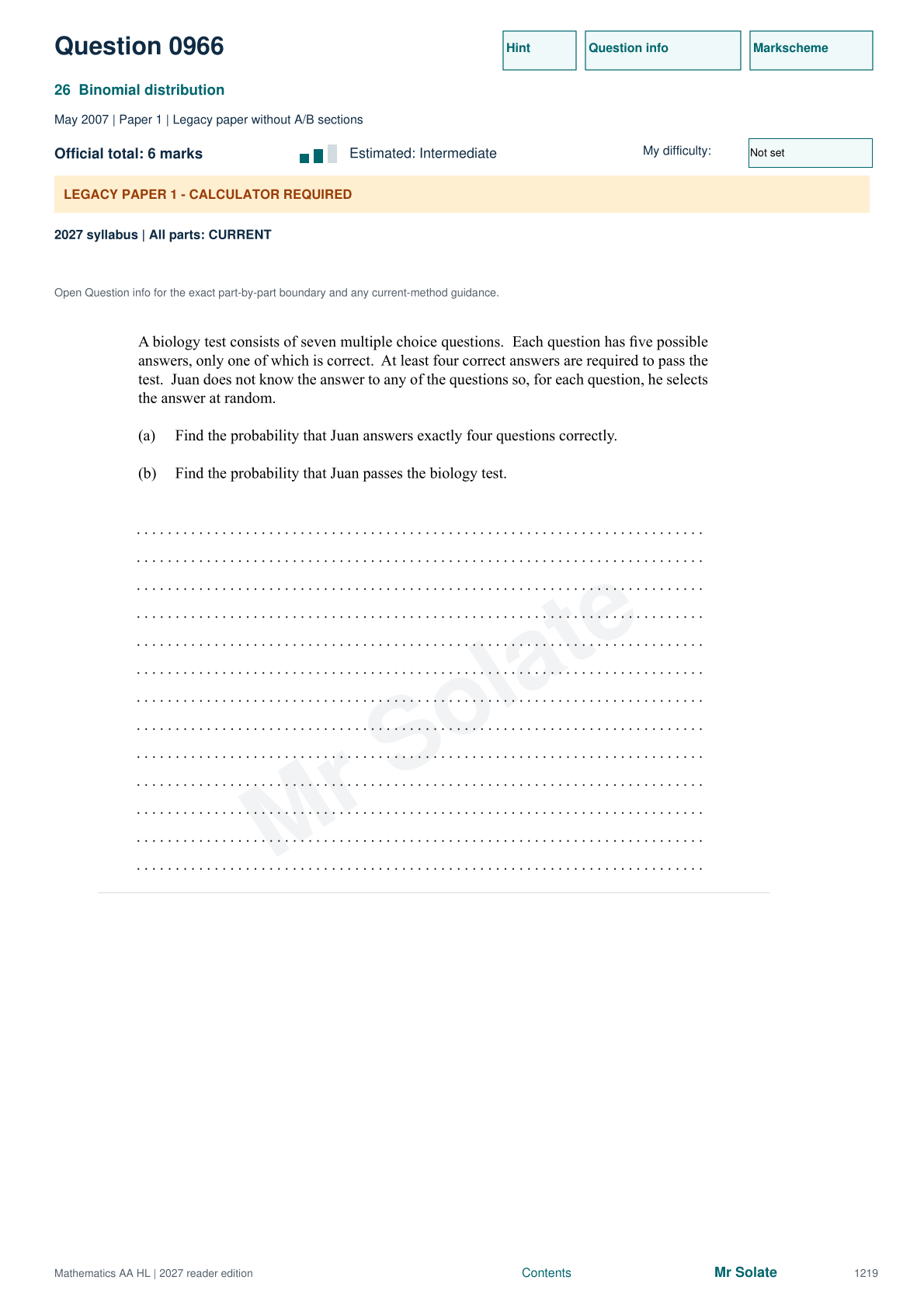
Question 966
Requires linking Binomial exact probability, Binomial upper tail.
Compatibility: All parts: The tested methods are current AA HL: Binomial exact probability, Binomial upper tail.
View the original question
Original page images preserve the equations and diagrams. Write your response before revealing the reasoning.
Reveal the revision reasoning
- Let X~Bin(7,1/5), since each question has five equally likely options.
- For exactly four use choose(7,4)(1/5)^4(4/5)^3.
- For passing sum the masses for 4 through 7, or use 1−P(X≤3).
- The exact-four probability is about 0.0287 and the pass probability about 0.0333.
Editorial revision reasoning. Check the original answer for its marking detail.
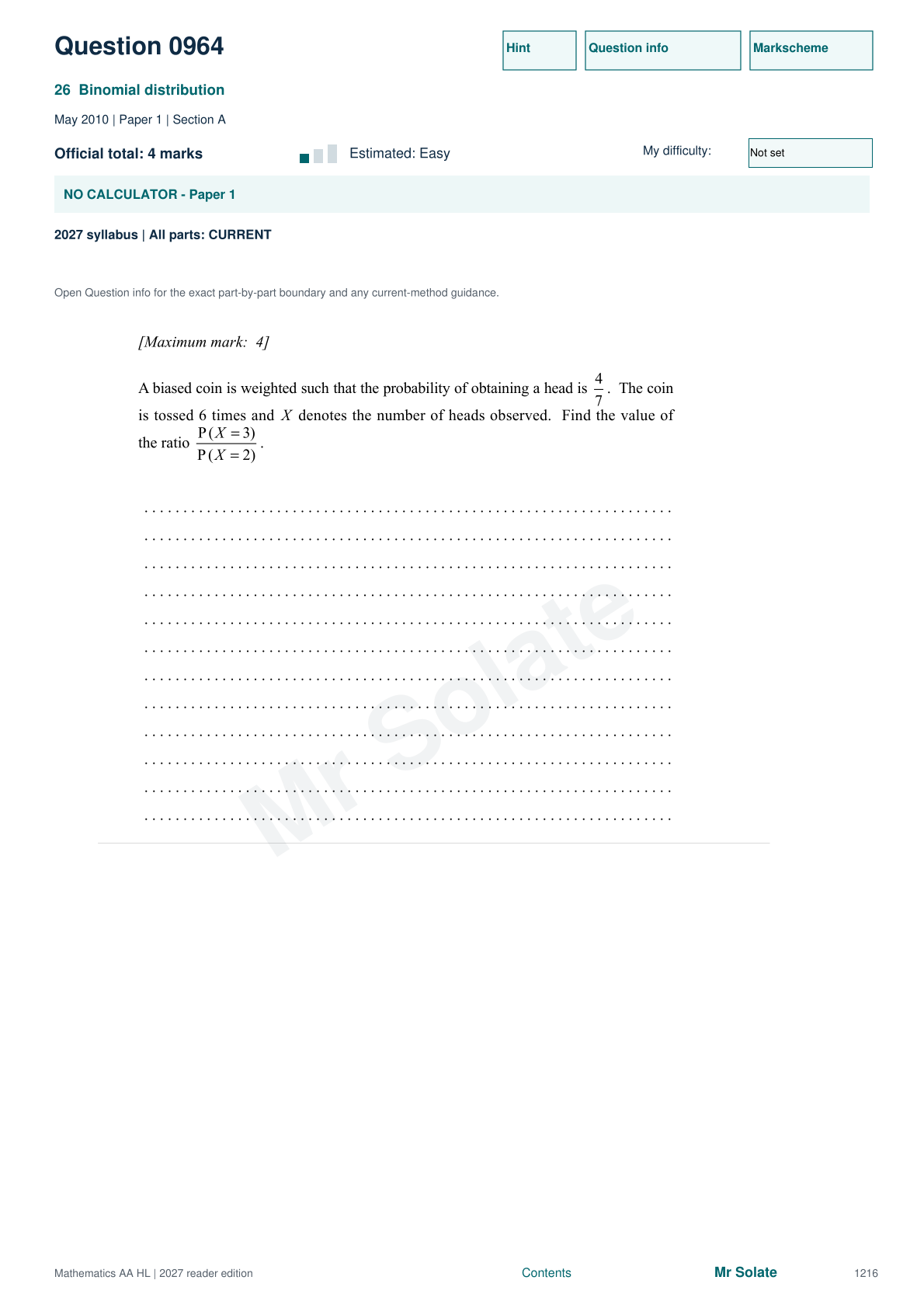
Question 964
Direct application of Ratio of binomial probabilities, Algebraic cancellation.
Compatibility: All parts: The tested methods are current AA HL: Ratio of binomial probabilities, Algebraic cancellation.
View the original question
Original page images preserve the equations and diagrams. Write your response before revealing the reasoning.
Reveal the revision reasoning
- For three heads the mass is 20(4/7)^3(3/7)^3.
- For two heads it is 15(4/7)^2(3/7)^4.
- Their ratio reduces to(20/15)×(4/3).
- Simplify to 16/9 without decimal approximation.
Editorial revision reasoning. Check the original answer for its marking detail.
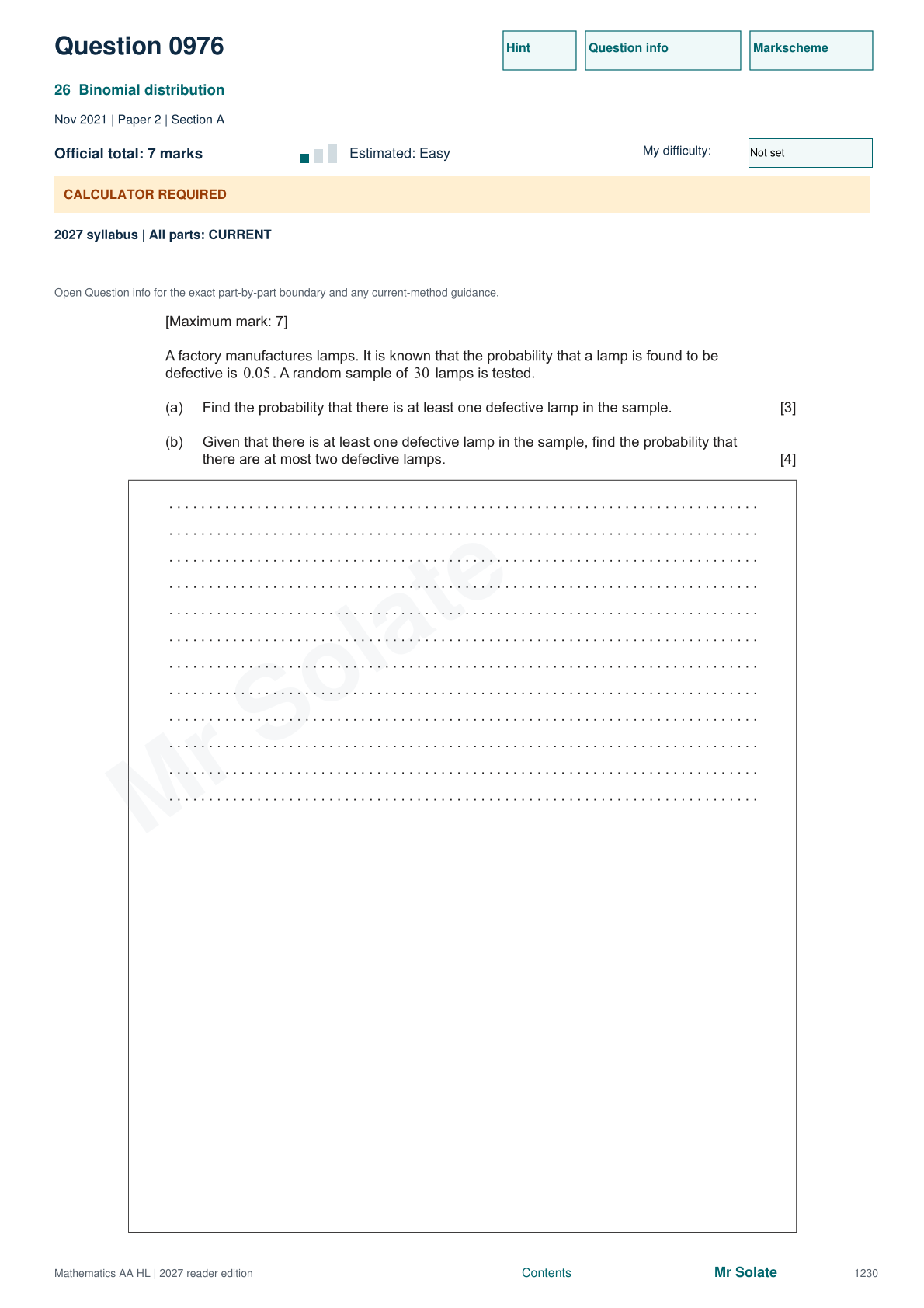
Question 976
Direct application of Binomial complement, Conditional binomial probability.
Compatibility: The tested concepts and methods match the current AA HL syllabus; the original paper format and wording are retained.
View the original question
Original page images preserve the equations and diagrams. Write your response before revealing the reasoning.
Reveal the revision reasoning
Let X∼Bin(30,0.05). The probability of at least one defect is 1−0.95³⁰≈0.785361.
The event at most two defects, together with at least one, is X=1 or X=2. Its probability is approximately 0.597540.
Divide by the conditioning probability: P(X≤2|X≥1)≈0.597540/0.785361≈0.761.
Editorial revision reasoning. Check the original answer for its marking detail.
All 26 questions in this topic
Close your notes first
Can you retrieve the method?
1. Write P(X≥5) as a complement.
Check answer 1
1−P(X≤4).
2. Which moments recover n and p?
Check answer 2
np and np(1−p).
3. Why check n−1?
Check answer 3
To establish minimality.
Before you move on
- Underline the success definition and the tail word.
- Practise exact count, parameter recovery and a threshold.
- Carry unrounded probabilities into later parts.
Your revision note
Record one missed cue, one corrected step and one question to retry. Saved only in this browser.