Start with the exam
What you need to be able to do
Parameter quadratics ask you to combine several conditions. “Two distinct positive roots” means real, distinct, and positive; the discriminant alone only handles the first two. The bank also disguises quadratics in e^x or ln x and uses tangency as a repeated root. First identify the actual quadratic variable and confirm its leading coefficient is nonzero. Then translate each requested property into a separate condition before intersecting the results.
Spend 3 minutes reading the overview and diagram, 7 minutes learning the question patterns, 5 minutes writing out the worked example, and 5 minutes on a bank question or recall check. Take longer when you need to; the full bank is here for later practice.
Recognise → set up → write
How the questions are set
Root number and tangency
Recognise it: The wording includes real roots, distinct roots, no roots or tangent.
- Write ax²+bx+c=0 and calculate Δ=b²−4ac. For a≠0 use Δ>0 for two distinct real roots, Δ=0 for a repeated root, Δ<0 for no real roots.
- For a line tangent to a curve, substitute the line into the curve and impose a repeated solution.
- If a depends on a parameter, examine a=0 separately because the equation then becomes linear or constant.
List a≠0 beside the discriminant condition before solving the parameter inequality.
A nonnegative discriminant allows a repeated root; “distinct” needs strict positivity.
Root signs and transformed roots
Recognise it: The question gives same-sign or opposite-sign roots, or asks for a new equation.
- Use α+β=−b/a and αβ=c/a. Opposite signs require product<0; both positive require positive sum and positive product, together with real roots.
- For reciprocal or shifted roots, form their new sum and product from the old ones.
- Construct x²−(new sum)x+(new product)=0, clearing fractions if helpful.
Keep the reality condition alongside sign conditions; sum and product alone do not guarantee real roots.
Reciprocal roots require the original product to be nonzero.
Quadratic substitutions and global positivity
Recognise it: A repeated exponential appears, or a quadratic must remain positive for every x.
- Set u=e^x>0 when appropriate, solve the quadratic in u, then retain only positive roots.
- For a quadratic positive for all real x, require a>0 and Δ<0; strict positivity excludes a touching zero.
- Complete the square when it exposes the minimum directly. Reapply any logarithm domain after solving.
State the substitute variable’s range before using the quadratic results.
A real root in u need not correspond to a real x if u must be positive.
Write it before you reveal it
A worked exam-style example
Original teaching example, created for this lesson.
Original practice: find k such that x²−4x+k=0 has two distinct positive roots.
Reveal the worked solution
- Distinct real roots require Δ=16−4k>0, so k<4.
- The root sum is 4, already positive. Their product is k, so k>0 makes the real roots have the same sign.
- Positive sum and positive product therefore force both to be positive.
Answer: 0<k<4.
Check: At k=0 one root is zero; at k=4 the roots coincide at 2. Both endpoints must be excluded.
From your own collection
Apply it to past-paper questions
These questions anchor the patterns above. Attempt one without the answer, then compare your setup and conclusion with the reasoning. The linked reader contains the source answer and the question-specific syllabus review.
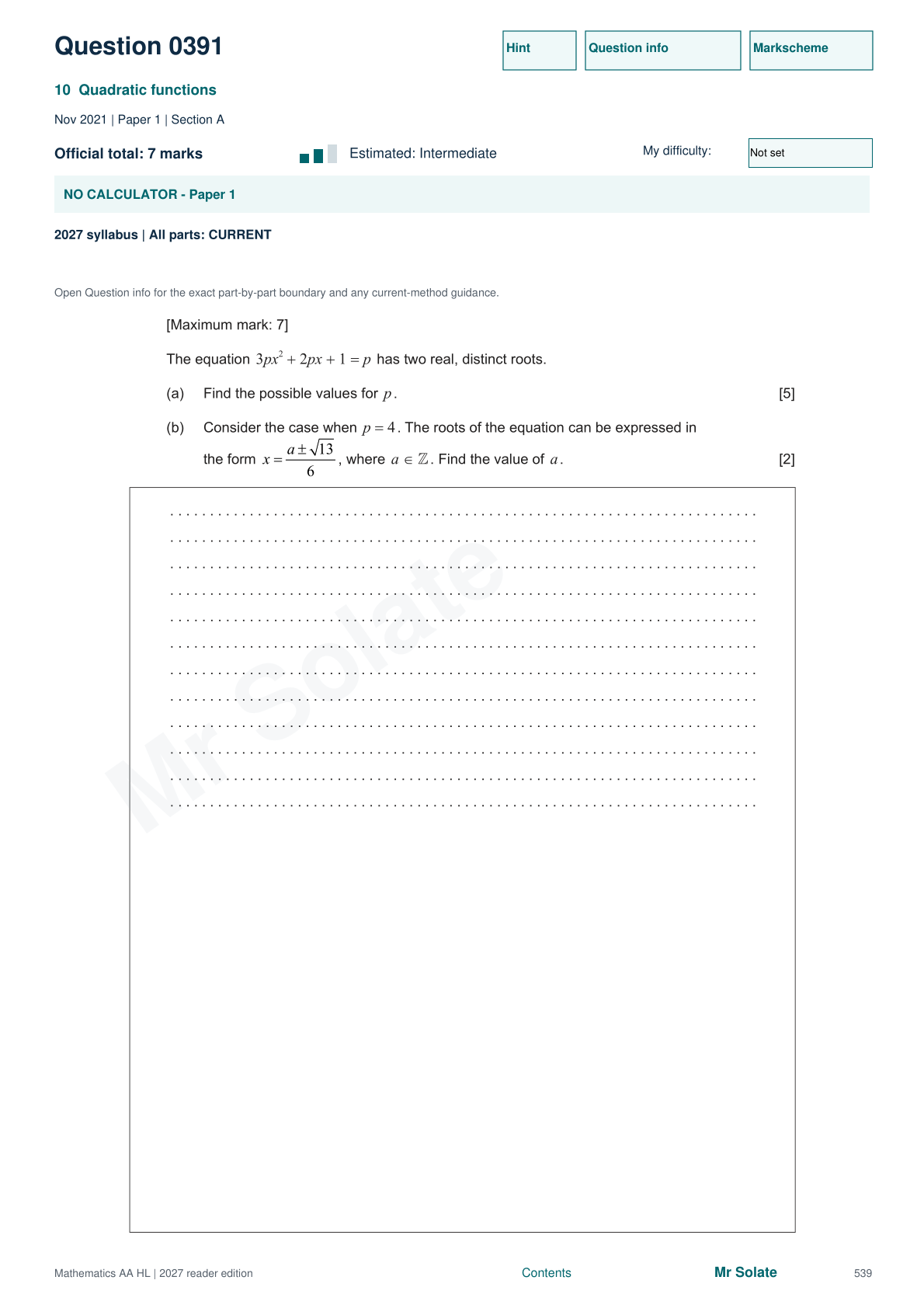
Question 391
Apply the method to the original question.
Compatibility: This AA HL question uses current syllabus methods in the references shown.
View the original question
Original page images preserve the equations and diagrams. Write your response before revealing the reasoning.
Reveal the revision reasoning
The equation is 3px²+2px+(1-p)=0. Its discriminant is 4p²-12p(1-p)=4p(4p-3).
Two distinct real roots require p(4p-3)>0, giving p<0 or p>3/4. These intervals also ensure p≠0, so the equation is genuinely quadratic.
For p=4, solve 12x²+8x-3=0 to get x=(-2±√13)/6. Therefore a=-2.
Editorial revision reasoning. Check the original answer for its marking detail.
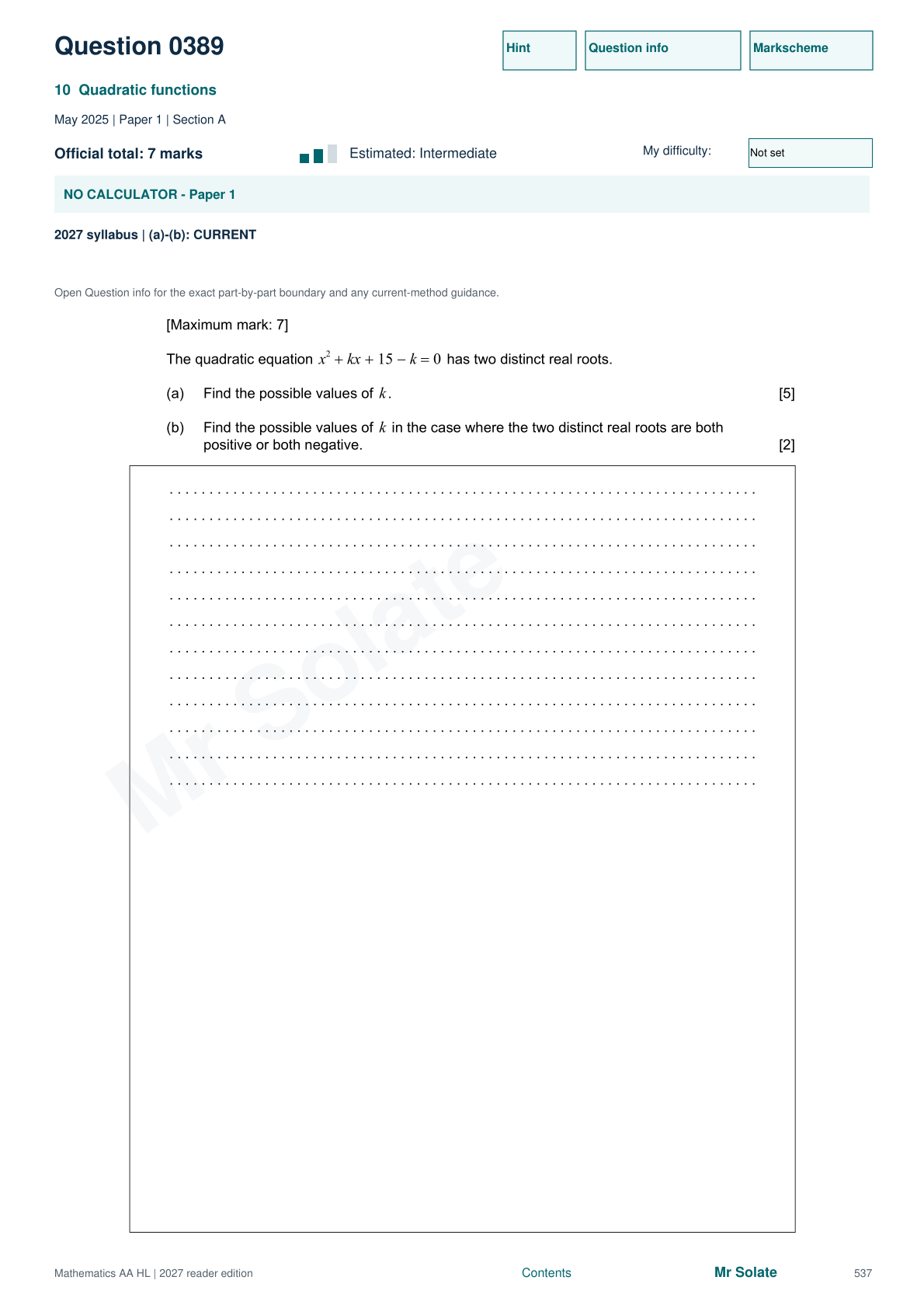
Question 389
Apply the method to the original question.
Compatibility: All parts test current AA HL content and can be solved using current syllabus methods.
View the original question
Original page images preserve the equations and diagrams. Write your response before revealing the reasoning.
Reveal the revision reasoning
The discriminant is k²-4(15-k)=k²+4k-60=(k+10)(k-6).
For it to be strictly positive, k<-10 or k>6.
Vieta’s relation gives root product 15-k. Two nonzero real roots have the same sign exactly when 15-k>0, so k<15.
Combine with part (a): k<-10 or 6<k<15. The first range gives positive roots and the second gives negative roots, since their sum is -k.
Editorial revision reasoning. Check the original answer for its marking detail.
Question 390
Apply the method to the original question.
Compatibility: All parts test current AA HL content and can be solved using current syllabus methods.
View the original question
Original page images preserve the equations and diagrams. Write your response before revealing the reasoning.

Reveal the revision reasoning
Let u=e^x>0. The equation becomes u²-3u+ln k=0, which also requires k>0.
Real roots require 9-4ln k≥0, so ln k≤9/4.
This condition does provide a positive root: the larger root (3+√(9-4ln k))/2 is positive.
Since the exponential function is increasing, the final range is 0<k≤e^(9/4).
Editorial revision reasoning. Check the original answer for its marking detail.
All 22 questions in this topic
Close your notes first
Can you retrieve the method?
1. Which condition represents a tangent?
Check answer 1
A repeated intersection root, usually Δ=0 after substitution.
2. Does Δ>0 imply both roots positive?
Check answer 2
No; their sum and product must also be checked.
3. What changes when a=0?
Check answer 3
The equation is no longer quadratic, so the usual discriminant classification does not apply.
Before you move on
- Write each verbal requirement as a separate inequality, then intersect the intervals. Show why excluded endpoints fail.
- For roots expressed through another function, test the substituted roots against that function’s range before recovering x.
Your revision note
Record one missed cue, one corrected step and one question to retry. Saved only in this browser.