Start with the exam
What you need to be able to do
Optimisation begins by constructing the quantity the question actually asks to maximise or minimise. The bank includes geometry, nearest points, travel times, costs and viewing angles. Write the objective, the constraint and the feasible interval before differentiating. A stationary candidate becomes an answer only after feasibility and the required global comparison are established.
Spend 3 minutes reading the overview and diagram, 7 minutes learning the question patterns, 5 minutes writing out the worked example, and 5 minutes on a bank question or recall check. Take longer when you need to; the full bank is here for later practice.
Recognise → set up → write
How the questions are set
Eliminate a dimension
Recognise it: A fixed perimeter, area or volume constrains a shape.
- Define variables and write the objective separately from the constraint. Include every relevant face or arc from the diagram.
- Use the constraint to express the objective in one variable. Determine its domain from positive dimensions and geometry.
- Differentiate, solve for feasible stationary candidates and substitute into the original objective. If the task asks for dimensions as well as the optimum, recover every dimension.
Show the geometric formula and the substitution producing the one-variable objective.
An open container and a closed container have different surface-area constraints. Omitting a face changes the answer.
Distance, time or cost
Recognise it: A moving point lies on a curve or route segments have different rates.
- For a nearest point, form D²=(x−a)²+(y−b)² and substitute the curve equation. Minimising D² minimises D because square root is increasing.
- For time, add length divided by speed for each segment. For cost, add length times its unit cost.
- Solve the resulting derivative equation in the feasible interval, then recover actual distance, time or cost and correct units.
Explain why squared distance is a valid substitute, or show each route contribution before combining.
Shortest distance need not mean shortest time when speeds differ. D² is not the final distance.
Prove the optimum
Recognise it: There are endpoints, several candidates or a viewing angle.
- A viewing angle often equals a difference of arctangents. Obtain each angle from its right triangle and use a consistent positive order.
- Compare feasible endpoints and all stationary values, or use a derivative sign argument showing the required behaviour throughout the interval.
- When calculator use is allowed, a numerical root finds a candidate. A comparison or sign argument is still needed to justify maximum or minimum.
Give the stationary equation, admissible input and a reason it produces the required optimum.
A second-derivative test proves a local result; another candidate or endpoint may give a better global value.
Write it before you reveal it
A worked exam-style example
Original teaching example, created for this lesson.
Original example: a rectangle has perimeter 20 cm. Find its greatest area.
Reveal the worked solution
- Let the sides be x and 10−x, with 0<x<10.
- A=x(10−x)=10x−x², so A′=10−2x.
- The stationary input is x=5. A=25−(x−5)² proves no other feasible input has greater area.
- Both sides are 5 cm.
Answer: Maximum area 25 cm².
Check: The limiting area at either degenerate boundary is zero, consistent with the interior maximum.
From your own collection
Apply it to past-paper questions
These questions anchor the patterns above. Attempt one without the answer, then compare your setup and conclusion with the reasoning. The linked reader contains the source answer and the question-specific syllabus review.
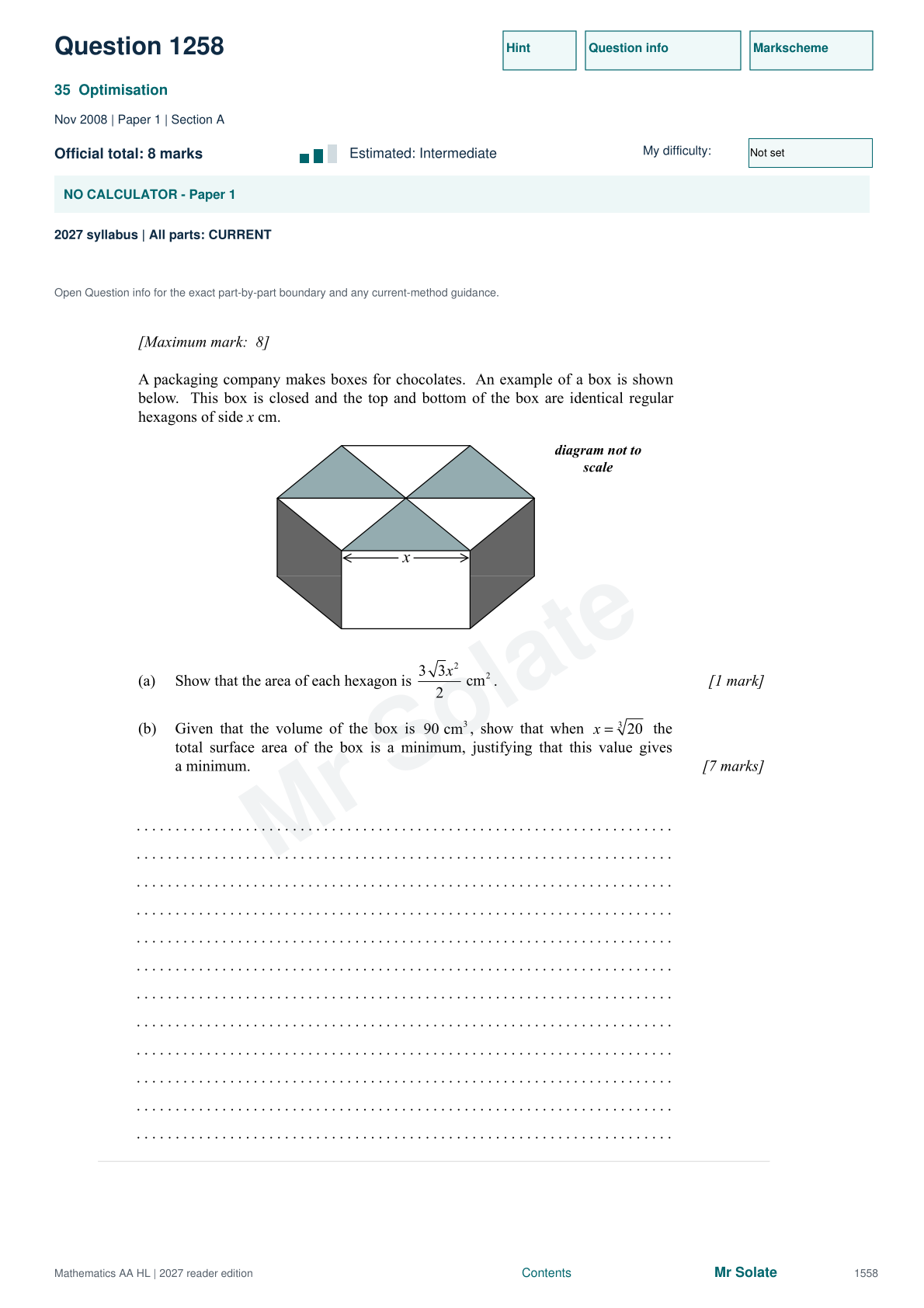
Question 1258
Several linked steps involving Regular-hexagon area, Prism volume, Surface-area minimum.
Compatibility: Current: All parts
View the original question
Original page images preserve the equations and diagrams. Write your response before revealing the reasoning.
Reveal the revision reasoning
- Each end has area (3√3/2)x². Use volume 90 to express h=60/(√3 x²).
- The closed prism surface area is 3√3 x²+6xh, so substitute h before differentiating.
- Setting the derivative to zero gives x³=20. The second derivative is positive for x>0, proving the minimum at cube root 20.
Editorial revision reasoning. Check the original answer for its marking detail.
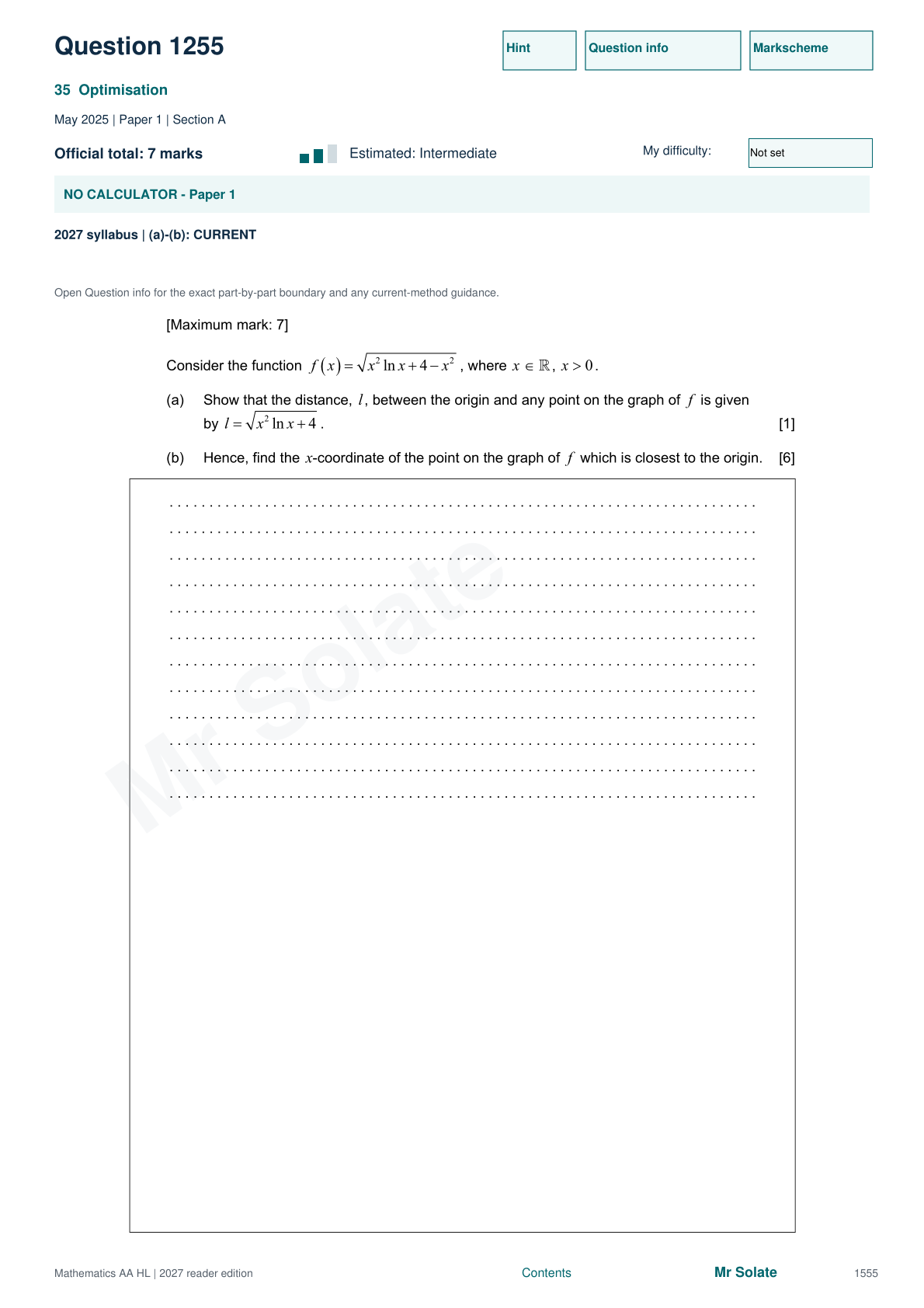
Question 1255
Apply the method to the original question.
Compatibility: All parts test current AA HL content and can be solved using current syllabus methods.
View the original question
Original page images preserve the equations and diagrams. Write your response before revealing the reasoning.
Reveal the revision reasoning
The distance formula gives l²=x²+[x²ln x-x²+4]=x²ln x+4, so l=√(x²ln x+4).
Because square root is increasing for positive inputs, minimising l is equivalent to minimising D=x²ln x+4.
Differentiate D to get D′=2xln x+x=x(2ln x+1). Since x>0, the zero-gradient condition becomes ln x=-1/2.
Thus the required x-coordinate is e^(-1/2)=1/√e.
D′ is negative below this point and positive above it, confirming the closest point.
Editorial revision reasoning. Check the original answer for its marking detail.
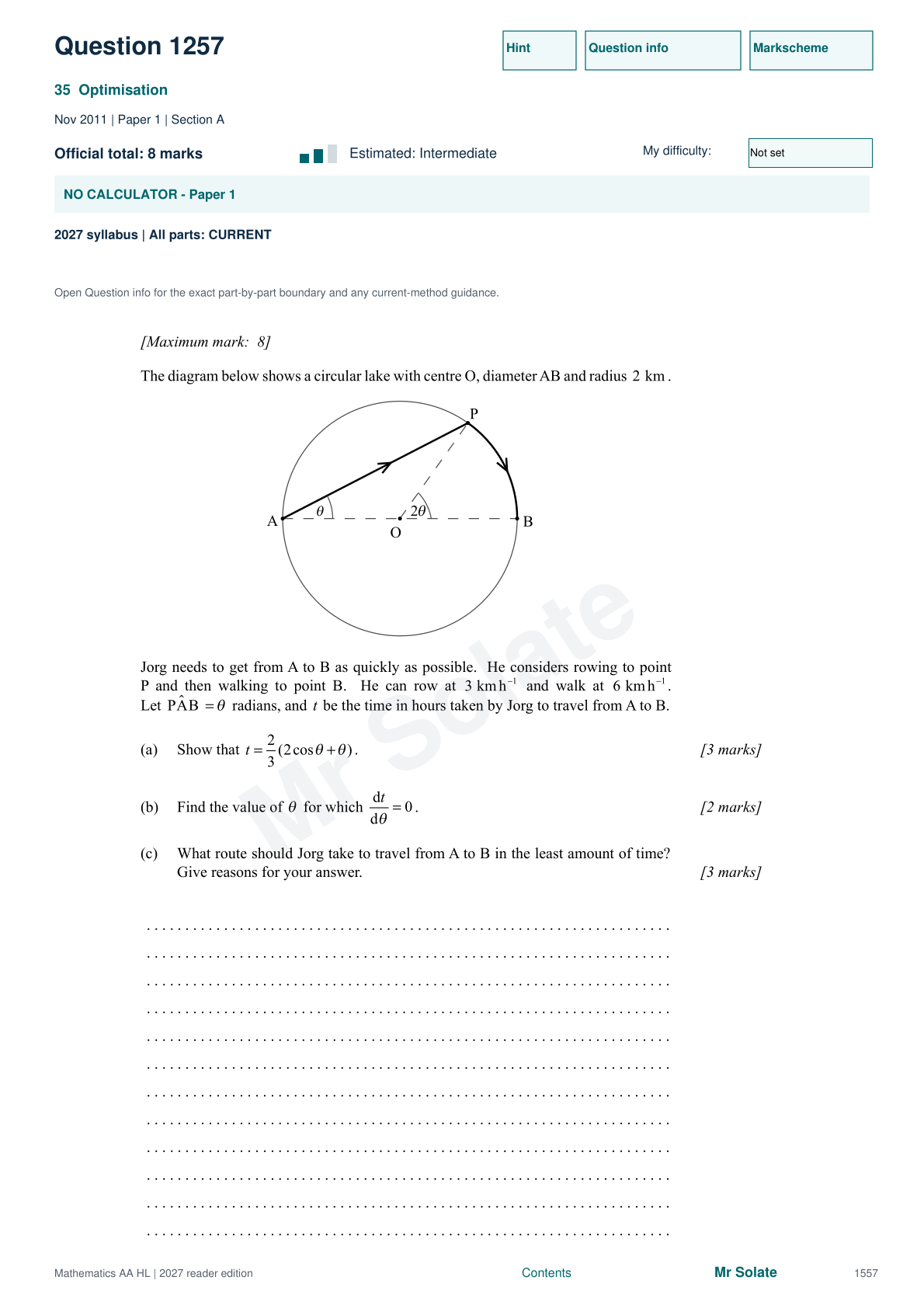
Question 1257
Several linked steps involving Circle chord and arc, Travel time, Stationary maximum.
Compatibility: Current: All parts
View the original question
Original page images preserve the equations and diagrams. Write your response before revealing the reasoning.
Reveal the revision reasoning
- The rowing chord is 4cos θ and the walking arc is 4θ, giving t=(2/3)(2cos θ+θ).
- Its derivative vanishes at θ=π/6, but the second derivative is negative there: this is a maximum.
- Compare all-rowing time 4/3 hours with all-walking time π/3 hours. Walking the semicircle is faster and minimises the journey.
Editorial revision reasoning. Check the original answer for its marking detail.
All 29 questions in this topic
Close your notes first
Can you retrieve the method?
1. Why minimise D²?
Check answer 1
Square root is increasing for nonnegative inputs.
2. What follows a stationary candidate?
Check answer 2
Feasibility and optimum justification.
3. Time for one segment?
Check answer 3
Length divided by speed.
Before you move on
- Write objective, constraint and domain first.
- Practise geometry and a distance or time model.
- Check whether the requested answer is a variable, an objective value or both.
Your revision note
Record one missed cue, one corrected step and one question to retry. Saved only in this browser.