Start with the exam
What you need to be able to do
Logarithm questions reward careful domain control more than long manipulation. Look for a repeated exponential or logarithm that can become a single algebraic variable. The bank uses changed bases, nested logarithms, equations in 2^x and percentage models. Begin by recording positive arguments and valid bases, then keep exact logarithmic forms until a decimal is explicitly useful. A numerical solution that violates an original logarithm is not a solution.
Spend 3 minutes reading the overview and diagram, 7 minutes learning the question patterns, 5 minutes writing out the worked example, and 5 minutes on a bank question or recall check. Take longer when you need to; the full bank is here for later practice.
Recognise → set up → write
How the questions are set
Change base and combine
Recognise it: Several logarithm bases, reciprocal logarithms or products of logs appear.
- Convert every logarithm into one convenient base: log_a b=ln b/ln a.
- Use log_a(xy)=log_a x+log_a y and log_a(x^k)=k log_a x on their valid domains. A sum inside an argument cannot be separated.
- If the base is itself unknown, record base>0 and base≠1 before multiplying by its logarithm.
Show one change-of-base line before collecting the common logarithmic unknown. This makes reciprocal factors and negative signs checkable.
log_(1/3)x=−log_3 x. Ignoring this sign can reverse the entire equation.
Substitute to expose algebra
Recognise it: The expression contains a^x and a^(2x), or ln x and (ln x)².
- Set t=a^x>0, or t=ln x with x>0. Rewrite every term, including shifted exponents such as a^(x+1)=at.
- Solve the resulting polynomial or rational equation and reject inadmissible t values before reversing the substitution.
- Recover x=log_a t or x=e^t, then substitute into the original equation, especially if logs were combined.
Write t>0 next to t=a^x; it explains immediately why a negative algebraic root is discarded.
The restriction t>0 applies to exponential substitution, but t=ln x can be any real number.
Growth, decay and comparison
Recognise it: A doubling time, percentage fall or exponential model is supplied.
- For N=N_0 e^(kt), use a ratio N/N_0 so that initial size cancels. Translate a 30% loss into remaining fraction 0.70.
- Take logs to obtain k=ln(fraction)/time, retaining its sign. Solve future times using the same units.
- When comparing models, solve within the stated interval. Comparing populations uses N; comparing growth rates uses derivatives.
State a time equation such as e^(8k)=0.89 before taking logs, rather than entering an unexplained calculator expression.
A decay constant k is negative in e^(kt); a model e^(−λt) instead uses positive λ.
Write it before you reveal it
A worked exam-style example
Original teaching example, created for this lesson.
Original practice: solve 4^x−5(2^x)+4=0.
Reveal the worked solution
- Set t=2^x>0, so 4^x=t².
- Factor t²−5t+4=(t−1)(t−4)=0.
- Both t=1 and t=4 are positive. Hence 2^x=1 or 2^x=4.
Answer: x=0 or x=2.
Check: At x=0 the original expression is 1−5+4=0. At x=2 it is 16−20+4=0. No logarithm of a negative root was required.
From your own collection
Apply it to past-paper questions
These questions anchor the patterns above. Attempt one without the answer, then compare your setup and conclusion with the reasoning. The linked reader contains the source answer and the question-specific syllabus review.
Question 77
Apply the method to the original question.
Compatibility: This AA HL question uses current syllabus methods in the references shown.
View the original question
Original page images preserve the equations and diagrams. Write your response before revealing the reasoning.

Reveal the revision reasoning
The left side is (1/2)log₃x. Also 1/(2log₂3)=(1/2)log₃2.
Expand log₃(4x³)=2log₃2+3log₃x.
The equation becomes -(5/2)log₃x=(5/2)log₃2, so log₃x=-log₃2.
Hence x=1/2, which satisfies x>0.
Editorial revision reasoning. Check the original answer for its marking detail.
Question 80
Direct use of Exponential quadratic; Surds. Since 4^x=(2^x)² and 2^(x+2)=4·2^x, obtain t²+4t−3=0.
Compatibility: All parts: The tested content remains current AA HL: Exponential quadratic; Surds; Logarithm inverse.
View the original question
Original page images preserve the equations and diagrams. Write your response before revealing the reasoning.

Reveal the revision reasoning
- Since 4^x=(2^x)² and 2^(x+2)=4·2^x, obtain t²+4t−3=0.
- The quadratic formula gives t=−2±√7.
- Only −2+√7 is positive, so x=log_2(−2+√7).
Editorial revision reasoning. Check the original answer for its marking detail.
Question 99
Requires coordinating Exponential growth model; Doubling time; Derivative rate. The population and its growth rate have different units.
Compatibility: All parts: The tested content remains current AA HL: Exponential growth model; Doubling time; Derivative rate.
View the original question
Original page images preserve the equations and diagrams. Write your response before revealing the reasoning.
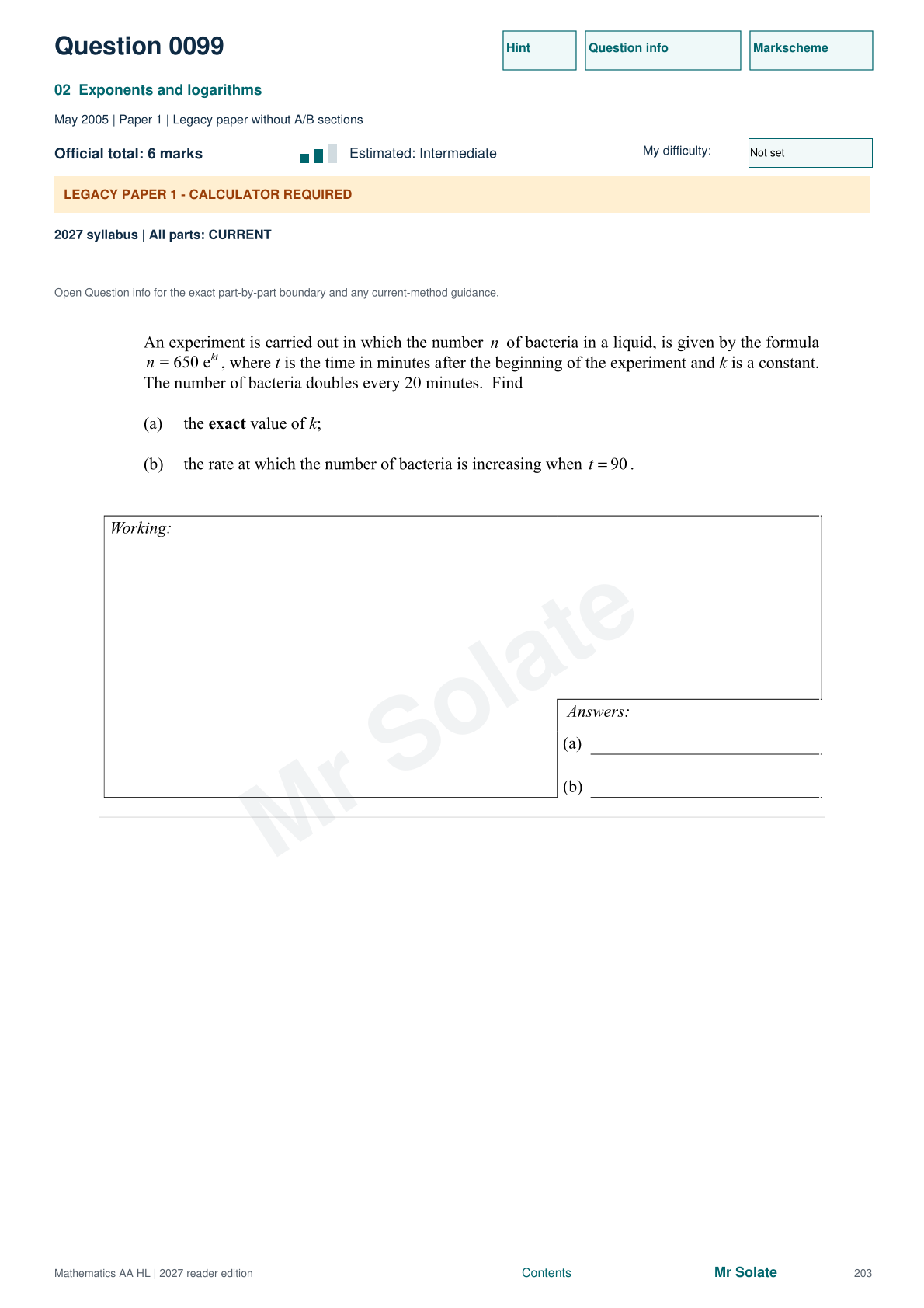
Reveal the revision reasoning
- At t=20, 1300=650e^(20k), so k=ln2/20.
- Differentiate n=650e^(kt) to get dn/dt=650ke^(kt).
- Substitute t=90 with the unrounded k to get about 510 bacteria per minute.
Editorial revision reasoning. Check the original answer for its marking detail.
All 37 questions in this topic
Close your notes first
Can you retrieve the method?
1. May ln(x+2) be written ln x+ln2?
Check answer 1
No; the product law applies to multiplication, not addition.
2. What is log_(1/2)8?
Check answer 2
−3, because (1/2)^(−3)=8.
3. If 40% has decayed, what fraction remains?
Check answer 3
0.60, so a decay equation uses the remaining fraction 0.60.
Before you move on
- Keep the original domain beside your algebra and recheck it after cancellation or squaring.
- In a non-calculator question, an exact logarithmic quotient is often the intended answer. Do not replace it prematurely with a rounded decimal.
Your revision note
Record one missed cue, one corrected step and one question to retry. Saved only in this browser.