Start with the exam
What you need to be able to do
Plane questions become manageable when you identify the normal vector early. The coefficients of ax+by+cz=d give normal (a,b,c), which controls perpendicular lines, distances and angles. The bank frequently reuses one cross product for a plane equation, area and reflection. Keep line directions distinct from plane normals, and remember that a line-plane angle is complementary to the angle between the line and the normal.
Spend 3 minutes reading the overview and diagram, 7 minutes learning the question patterns, 5 minutes writing out the worked example, and 5 minutes on a bank question or recall check. Take longer when you need to; the full bank is here for later practice.
Recognise → set up → write
How the questions are set
Construct a plane and intersect it
Recognise it: A plane contains three points, two intersecting directions or a given line and point.
- Form two independent vectors within the plane, then cross them to obtain a nonzero normal n.
- Use n·(r−a)=0 with a known point a; expand to Cartesian form if requested.
- Substitute a line r=p+tv into the plane to obtain a scalar equation for t. If it collapses to 0=0 the line lies in the plane; if contradictory it is parallel and disjoint.
Display the normal and the point used to determine the constant.
A zero cross product means the proposed directions are parallel and do not uniquely determine a plane.
Angles and common lines
Recognise it: Find an angle between planes or a line and plane, or their intersection.
- For plane-plane acute angle use cosθ=|n_1·n_2|/(|n_1||n_2|).
- For line-plane acute angle use sinθ=|v·n|/(|v||n|), or first find the angle to the normal and subtract from 90°.
- For intersecting planes, n_1×n_2 gives the common-line direction; solve the equations for one point.
Identify whether the requested angle is with the plane or its normal before applying inverse trig.
A direction alone is not a complete line equation; a point is also required.
Perpendicular distance and reflection
Recognise it: Find the nearest point on a plane or a mirror image.
- From Q, follow a normal line H=Q+tn and substitute into the plane to find its perpendicular foot.
- Distance is |H−Q|. For reflection use Q′=2H−Q because H is the midpoint.
- Verify H lies on the plane and Q′−Q is parallel to n.
Use the same foot for the distance and reflection rather than solving a second unrelated construction.
Doubling the position H is not enough; the reflection is 2H−Q.
Write it before you reveal it
A worked exam-style example
Original teaching example, created for this lesson.
Original practice: reflect Q=(1,2,5) in the plane z=1.
Reveal the worked solution
- The plane normal is n=(0,0,1). A normal line from Q is (1,2,5+t).
- At the plane, 5+t=1, so t=−4 and H=(1,2,1).
- The reflection is 2H−Q=(2,4,2)−(1,2,5).
Answer: Q′=(1,2,−3); distance to the plane is 4 units.
Check: The midpoint of Q and Q′ is (1,2,1), on the plane. Both points are 4 units from it.
From your own collection
Apply it to past-paper questions
These questions anchor the patterns above. Attempt one without the answer, then compare your setup and conclusion with the reasoning. The linked reader contains the source answer and the question-specific syllabus review.
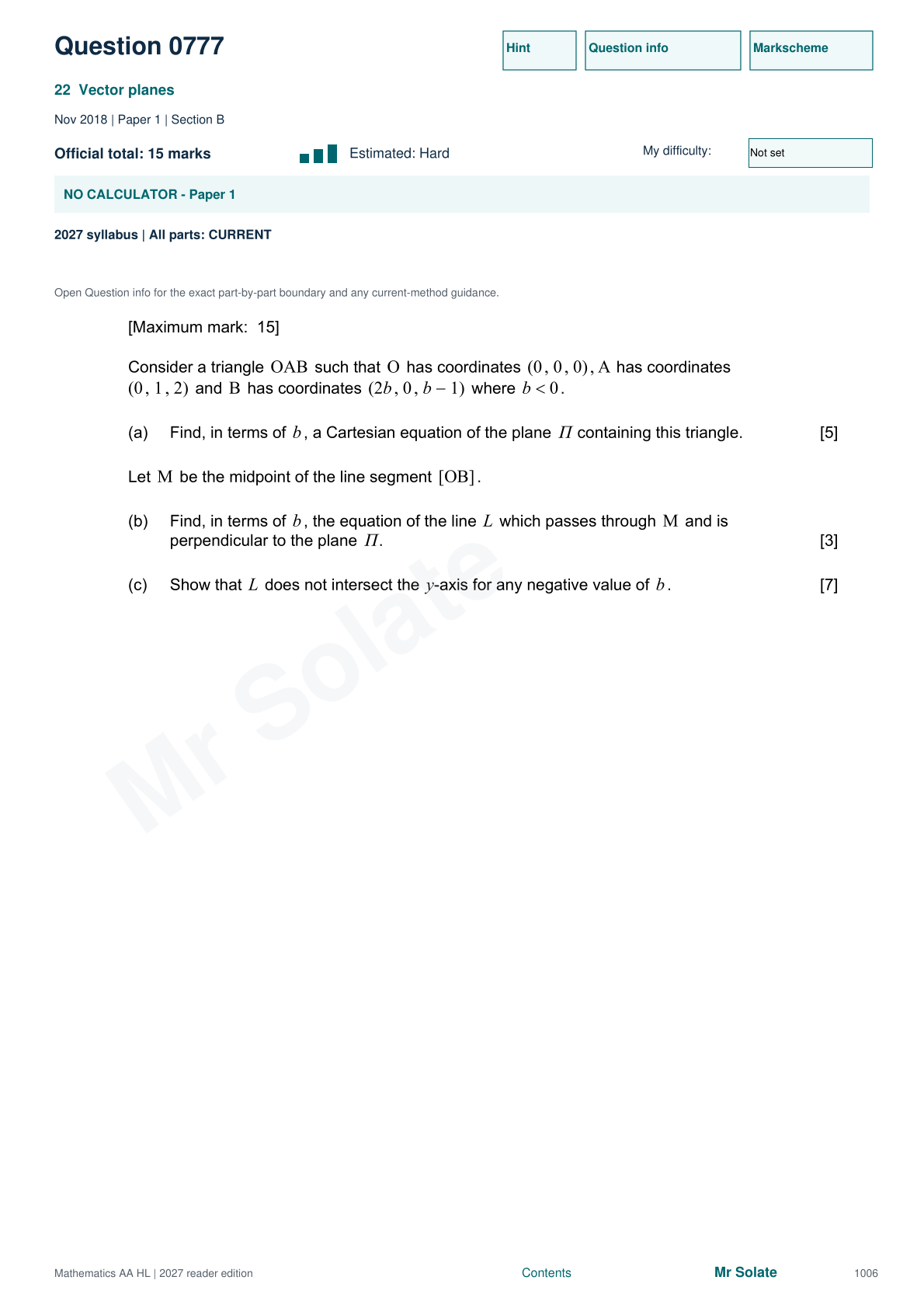
Question 777
Apply the method to the original question.
Compatibility: The required concepts and methods match current AA HL. The original source is a 2018 Mathematics HL paper.
View the original question
Original page images preserve the equations and diagrams. Write your response before revealing the reasoning.
Reveal the revision reasoning
OA=(0,1,2) and OB=(2b,0,b-1), so their cross product is (b-1,4b,-2b).
Because the plane passes through the origin, its equation is (b-1)x+4by-2bz=0.
M=(b,0,(b-1)/2). The normal line is r=M+t(b-1,4b,-2b).
An intersection with the y-axis would require b+t(b-1)=0, so t=-b/(b-1).
The simultaneous condition z=0 then gives (b-1)²+4b²=0. This sum of squares cannot vanish for b<0, so no intersection exists.
Editorial revision reasoning. Check the original answer for its marking detail.
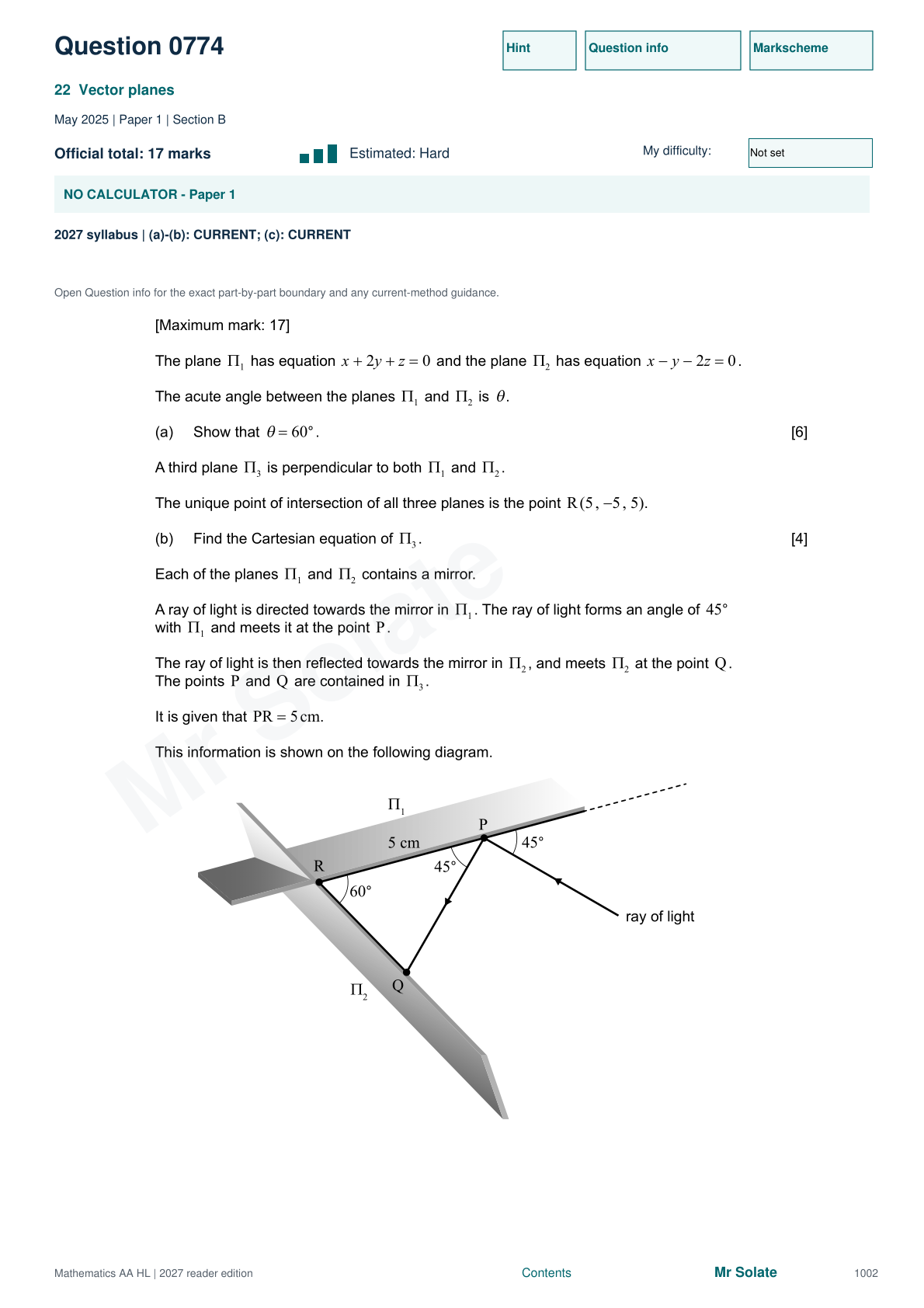
Question 774
Apply the method to the original question.
Compatibility: All parts test current AA HL content and can be solved using current syllabus methods.
View the original question
Original page images preserve the equations and diagrams. Write your response before revealing the reasoning.
Reveal the revision reasoning
Normals n₁=(1,2,1) and n₂=(1,-1,-2) have dot product -3 and magnitudes √6. Their directed angle is 120°, so the acute plane angle is 60°.
A normal to Π₃ is perpendicular to both normals: n₁×n₂=(-3,3,-3), parallel to (-1,1,-1).
Use R=(5,-5,5) to obtain -x+y-z=-15, equivalently x-y+z=15.
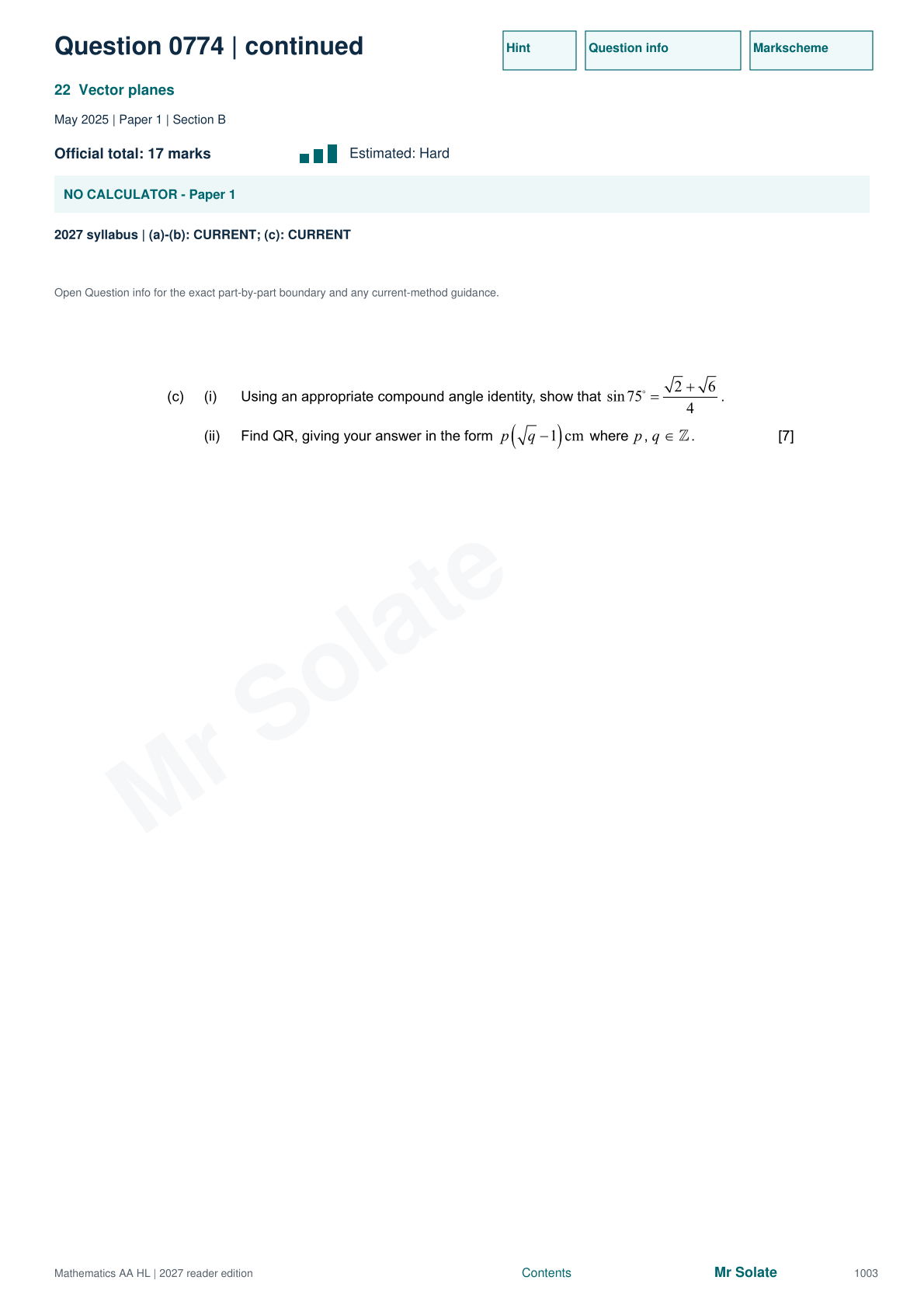
The compound identity gives sin75°=sin(30°+45°)=(√2+√6)/4.
In triangle PQR the angles are 60°,45°,75°. The sine rule gives QR/sin45°=5/sin75°.
Simplify and rationalise to QR=10/(1+√3)=5(√3-1) cm.
Editorial revision reasoning. Check the original answer for its marking detail.
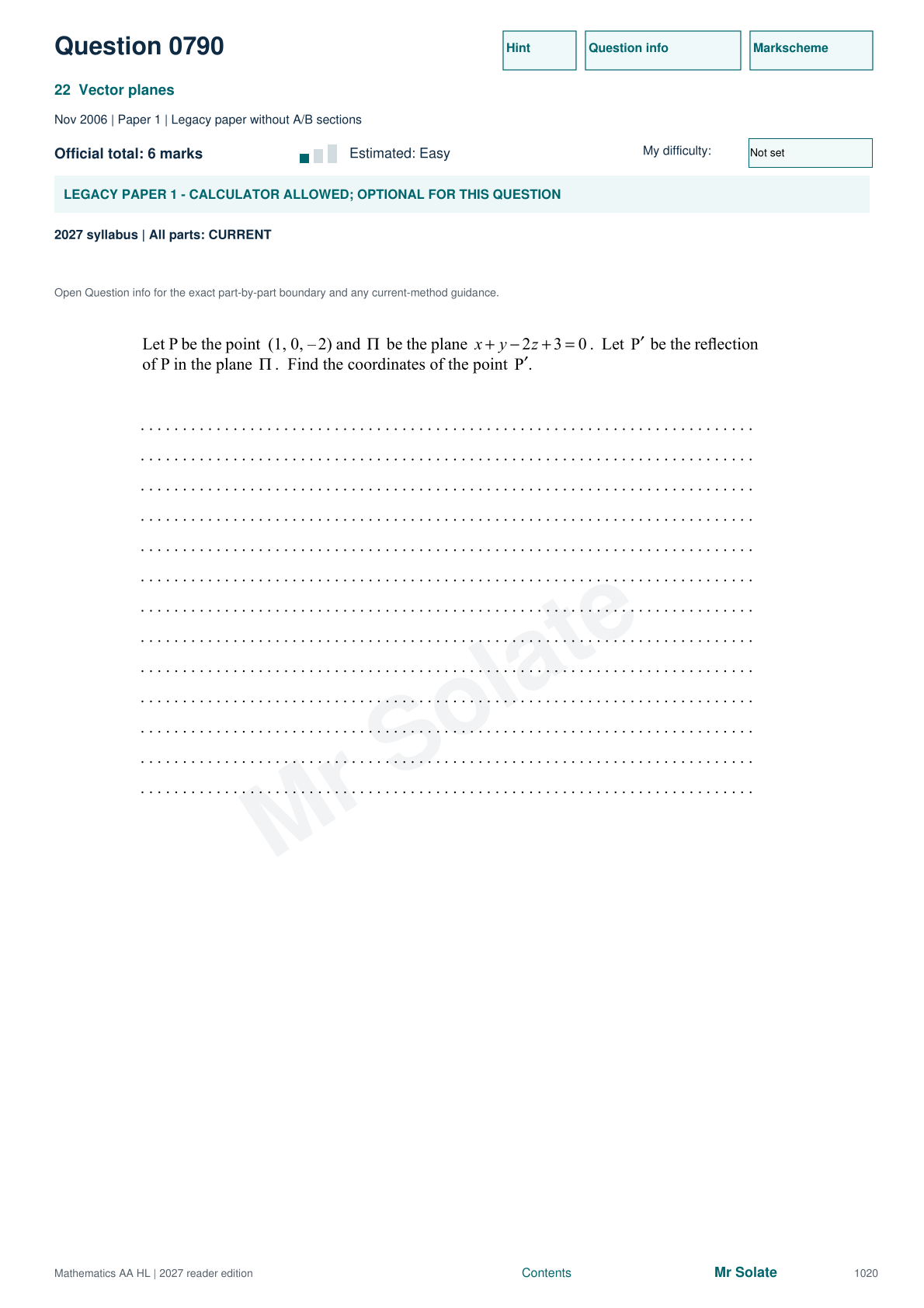
Question 790
Direct application of Reflection of a point, Normal line, Midpoint of reflected segment.
Compatibility: All parts: The tested methods are current AA HL: Reflection of a point, Normal line, Midpoint of reflected segment.
View the original question
Original page images preserve the equations and diagrams. Write your response before revealing the reasoning.
Reveal the revision reasoning
- The plane normal is (1,1,−2), so parametrize the normal line through P.
- Substitute into the plane equation to obtain the foot parameter.
- Double that displacement parameter from P to reach P′.
- Equivalently, if H is the foot, use P′=2H−P.
Editorial revision reasoning. Check the original answer for its marking detail.
All 61 questions in this topic
Close your notes first
Can you retrieve the method?
1. What is a normal to 2x−y+3z=7?
Check answer 1
(2,−1,3).
2. What does n_1×n_2 give for intersecting planes?
Check answer 2
A direction along their intersection line.
3. What is the reflection formula using foot H?
Check answer 3
Q′=2H−Q.
Before you move on
- Check a plane equation by substituting every supplied point, not merely the one used to determine the constant.
- For angles, report the requested acute or oriented interpretation; for reflection, verify the midpoint and normal direction.
Your revision note
Record one missed cue, one corrected step and one question to retry. Saved only in this browser.