Start with the exam
What you need to be able to do
Rational-function questions require a map of zeros, excluded inputs and asymptotes before sketching or solving inequalities. The bank includes reciprocal transformations, restricted inverses and oblique asymptotes. Factor first and record the original domain before cancelling. A simplified expression may conceal a hole, and multiplying an inequality by a variable denominator can reverse the sign. Keep the algebra and the graph consistent.
Spend 3 minutes reading the overview and diagram, 7 minutes learning the question patterns, 5 minutes writing out the worked example, and 5 minutes on a bank question or recall check. Take longer when you need to; the full bank is here for later practice.
Recognise → set up → write
How the questions are set
Sketch from structure
Recognise it: Find intercepts, asymptotes or the graph of a rational function.
- Factor numerator and denominator and list all original excluded inputs.
- Numerator zeros give intercepts only where the original denominator is nonzero. Uncancelled denominator zeros typically give vertical asymptotes; cancelled factors leave holes.
- Use division to write a polynomial plus a proper fraction. The polynomial gives the horizontal or oblique asymptote as the remainder fraction tends to zero.
Label asymptote equations and exact intercepts before drawing branches.
A denominator zero is not always a vertical asymptote if its factor cancels; the original exclusion still remains.
Solve inequalities safely
Recognise it: Compare a rational function with a constant or another function.
- Bring everything to one side and combine into a single fraction.
- Mark numerator zeros and denominator zeros on a number line. Test the sign in each interval, preserving every original exclusion.
- Include numerator zeros for ≤ or ≥ when valid; never include poles or holes.
A sign chart with critical values shows why the chosen intervals satisfy the inequality.
Cross-multiplying by x−a without knowing its sign can lose half the solution.
Inverse, reciprocal and range
Recognise it: The task asks for f^(−1), 1/f, or a restricted range.
- For an inverse, set y=f(x), solve for x and exchange names. Transfer the original range to the inverse domain.
- For a reciprocal, invert outputs at the same x: zeros of f become exclusions, while inherited exclusions remain.
- For a restricted range inspect allowed endpoints, asymptotes and stationary points; do not automatically use the full unrestricted range.
Write whether you are reversing the mapping or taking a reciprocal before starting.
A horizontal asymptote is not necessarily an excluded output for every rational function; check whether the curve actually attains that value.
Write it before you reveal it
A worked exam-style example
Original teaching example, created for this lesson.
Original practice: for f(x)=(2x+1)/(x−1), find asymptotes and solve f(x)>2.
Reveal the worked solution
- Divide to obtain f(x)=2+3/(x−1), x≠1.
- The vertical asymptote is x=1 and the horizontal asymptote is y=2.
- The inequality becomes 3/(x−1)>0. Since the numerator is positive, require x−1>0.
Answer: Asymptotes x=1 and y=2; solution x>1.
Check: At x=2, f=5>2; at x=0, f=−1<2. The excluded x=1 is not an endpoint solution.
From your own collection
Apply it to past-paper questions
These questions anchor the patterns above. Attempt one without the answer, then compare your setup and conclusion with the reasoning. The linked reader contains the source answer and the question-specific syllabus review.
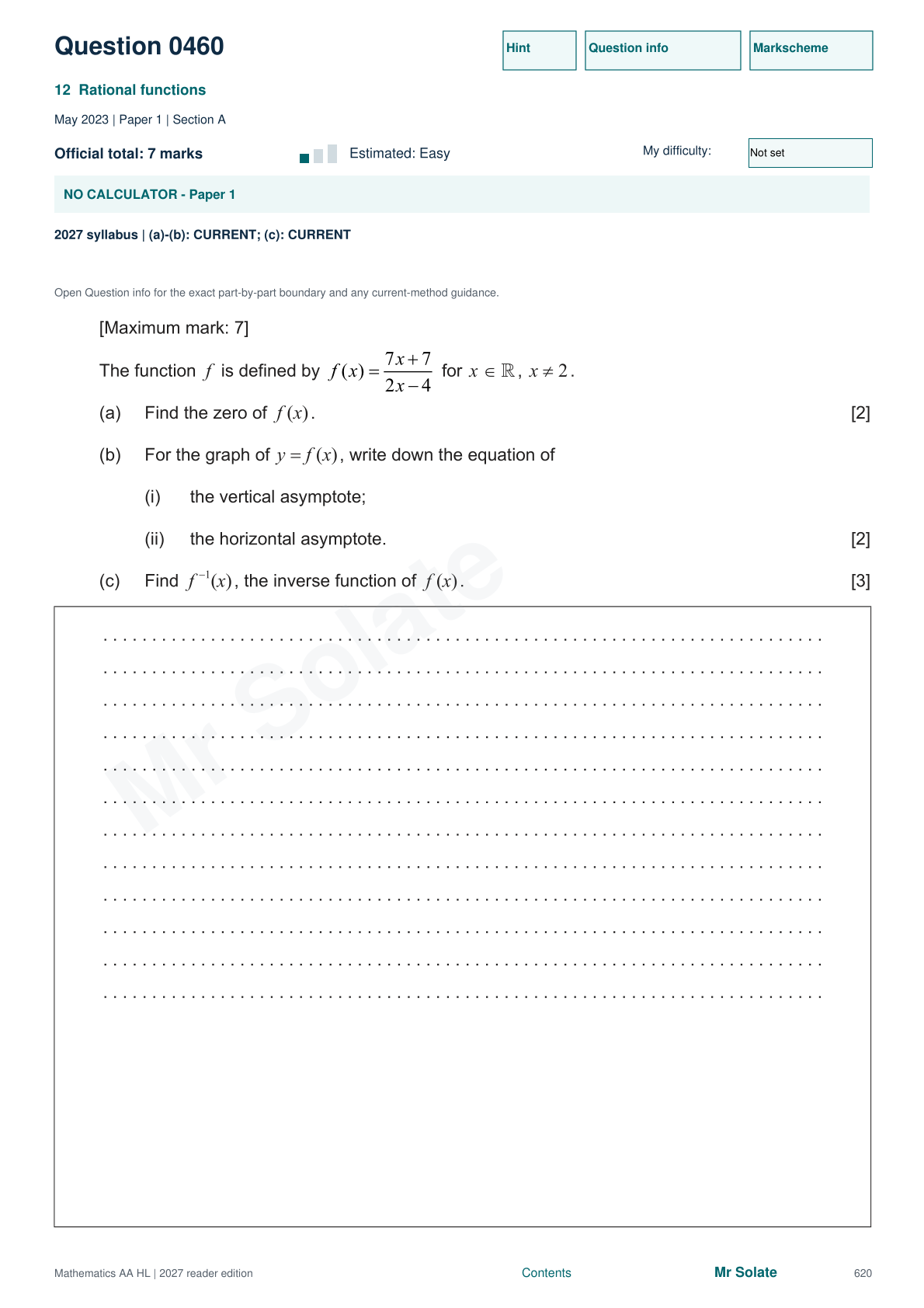
Question 460
Apply the method to the original question.
Compatibility: All parts test current AA HL content and can be solved using current syllabus methods.
View the original question
Original page images preserve the equations and diagrams. Write your response before revealing the reasoning.
Reveal the revision reasoning
A zero requires 7x+7=0 with a nonzero denominator, so x=-1.
The denominator vanishes at x=2 without cancellation, giving the vertical asymptote x=2. Equal numerator and denominator degrees give horizontal asymptote y=7/2.
From y=(7x+7)/(2x-4), collect x terms: x(2y-7)=4y+7.
Interchange input and output to obtain f⁻¹(x)=(4x+7)/(2x-7), with x≠7/2.
Editorial revision reasoning. Check the original answer for its marking detail.
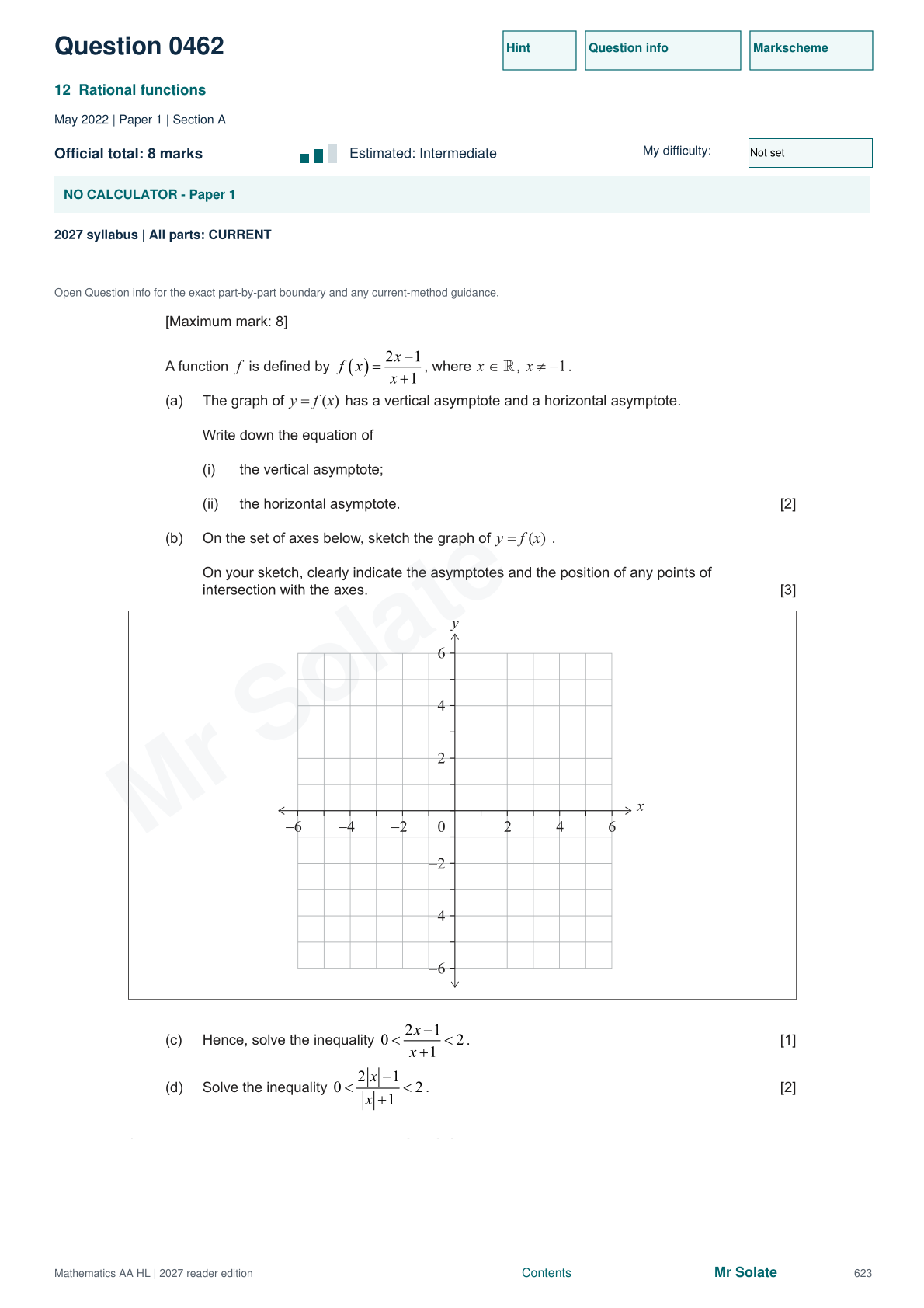
Question 462
Apply the method to the original question.
Compatibility: The listed concepts and solution methods are current AA HL content.
View the original question
Original page images preserve the equations and diagrams. Write your response before revealing the reasoning.
Reveal the revision reasoning
The asymptotes are x=-1 and y=2. The intercepts are (1/2,0) and (0,-1).
For x<-1 the branch lies above y=2. For x>-1 it rises from -∞ toward 2, crossing the two intercepts.
The condition 0<f(x)<2 holds exactly for x>1/2.
For the final inequality replace the graph input with abs(x). It requires abs(x)>1/2, so x<-1/2 or x>1/2.
Editorial revision reasoning. Check the original answer for its marking detail.
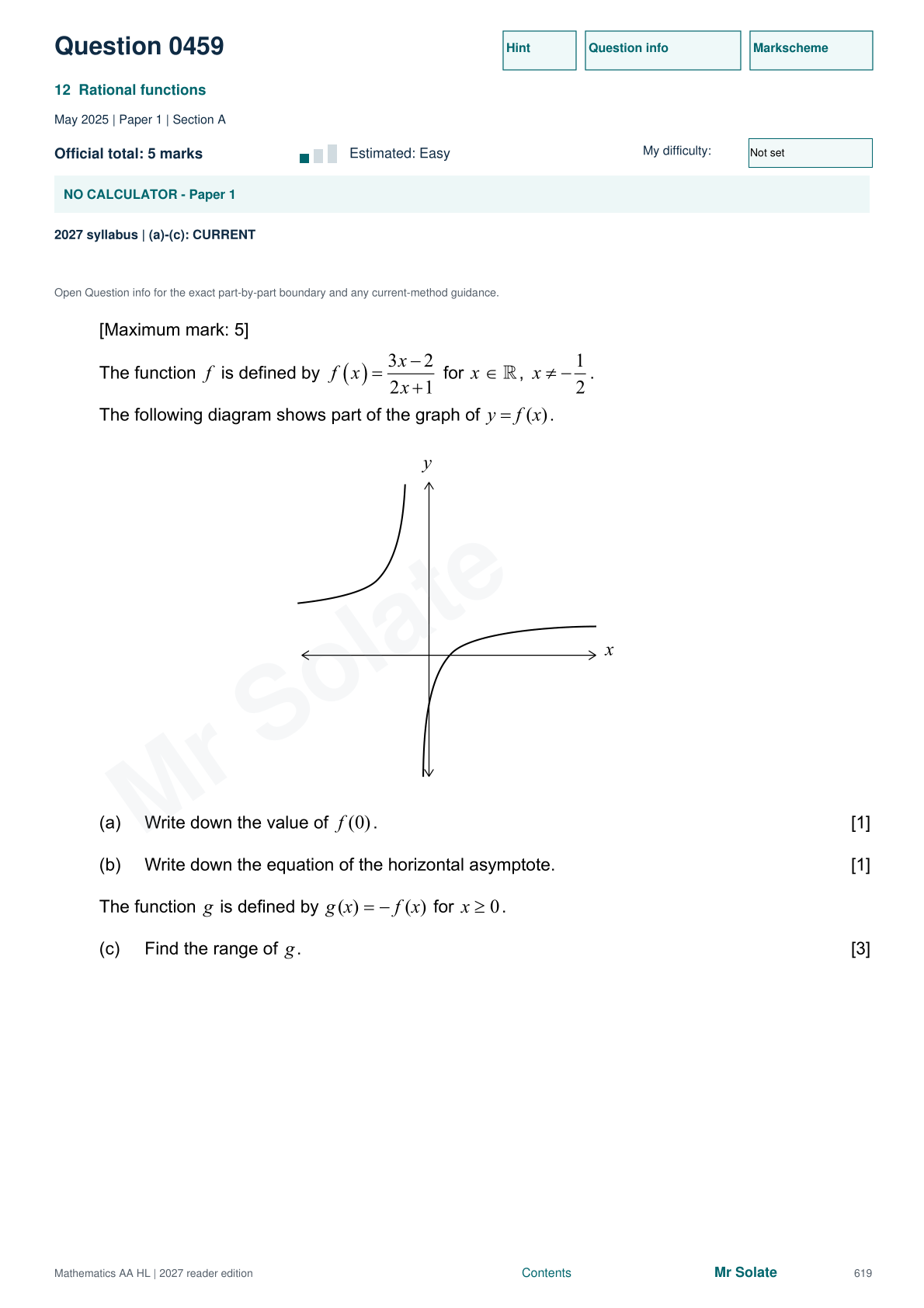
Question 459
Apply the method to the original question.
Compatibility: All parts test current AA HL content and can be solved using current syllabus methods.
View the original question
Original page images preserve the equations and diagrams. Write your response before revealing the reasoning.
Reveal the revision reasoning
Substitution gives f(0)=-2.
The numerator and denominator have equal degree, so the ratio of leading coefficients gives horizontal asymptote y=3/2.
On x≥0, f increases from -2 towards 3/2 without attaining the asymptote. Negating the output reflects this branch in the x-axis.
Thus g starts at 2 and tends down towards -3/2; its range is -3/2<g(x)≤2.
Editorial revision reasoning. Check the original answer for its marking detail.
All 28 questions in this topic
Close your notes first
Can you retrieve the method?
1. What happens when a common factor cancels?
Check answer 1
The original excluded input remains a hole unless an extension is explicitly defined.
2. Does 1/f mean f^(−1)?
Check answer 2
No. It means reciprocal outputs.
3. Can an excluded denominator zero enter a non-strict inequality answer?
Check answer 3
No, because the original expression is undefined there.
Before you move on
- Keep the original domain written beside every simplification. It remains relevant in a final inequality, inverse or transformed graph.
- Check a point on each branch of your sketch; asymptotes alone do not determine which side each branch occupies.
Your revision note
Record one missed cue, one corrected step and one question to retry. Saved only in this browser.