Start with the exam
What you need to be able to do
Cartesian complex questions are ordinary algebra with the extra rule i²=−1, but the final answer must separate real and imaginary components. The bank repeatedly tests conjugate denominators, real polynomial roots in conjugate pairs, and statements about a fraction being real or imaginary. Record whether polynomial coefficients are real before invoking conjugacy. For geometry, translate z=x+iy into coordinates and interpret modulus as distance.
Spend 3 minutes reading the overview and diagram, 7 minutes learning the question patterns, 5 minutes writing out the worked example, and 5 minutes on a bank question or recall check. Take longer when you need to; the full bank is here for later practice.
Recognise → set up → write
How the questions are set
Simplify a quotient
Recognise it: A complex denominator appears, or real and imaginary parts are requested.
- Multiply numerator and denominator by the conjugate of the entire denominator.
- Expand carefully using i²=−1. The denominator becomes a real sum of squares.
- Collect the result as a+bi and answer the requested component; Im(z) is b, not bi.
Show the conjugate multiplication so the source of the real denominator is visible.
The conjugate of a−bi is a+bi. Conjugating only one term or using i²=1 changes the result.
Unknown components and realness
Recognise it: A parameter makes an expression real, purely imaginary, or equal to another complex number.
- Write the expression as R+Ii, rationalizing first if necessary.
- For real values set I=0; for purely imaginary values set R=0, checking any nonzero wording separately.
- For equality, equate both components and solve simultaneously; keep denominator exclusions.
State “imaginary part equals zero” before the parameter equation. This connects the condition to the calculation.
An equation in complex numbers usually gives two real conditions, not one. Zero is both real and has zero real part, so read “nonzero” carefully.
Polynomial roots and loci
Recognise it: One non-real root of a real polynomial is given, or equal distances are specified.
- With real coefficients, include the conjugate root. Multiply the pair into (x−a)²+b².
- Use factor division or sum/product of roots to determine the remaining coefficients or roots.
- For a locus, write |z−(a+bi)|²=(x−a)²+(y−b)². Simplify equal-distance equations and describe the resulting line or circle.
Explicitly state that real coefficients justify the conjugate partner; then display the real quadratic factor.
Conjugate roots are not guaranteed when the polynomial has complex coefficients.
Write it before you reveal it
A worked exam-style example
Original teaching example, created for this lesson.
Original practice: express (3+4i)/(1−2i) in Cartesian form.
Reveal the worked solution
- Multiply by (1+2i)/(1+2i).
- The numerator becomes 3+6i+4i+8i²=−5+10i.
- The denominator is 1+4=5, so divide both components by 5.
Answer: −1+2i.
Check: Multiply back: (−1+2i)(1−2i)=−1+4i+4=3+4i.
From your own collection
Apply it to past-paper questions
These questions anchor the patterns above. Attempt one without the answer, then compare your setup and conclusion with the reasoning. The linked reader contains the source answer and the question-specific syllabus review.
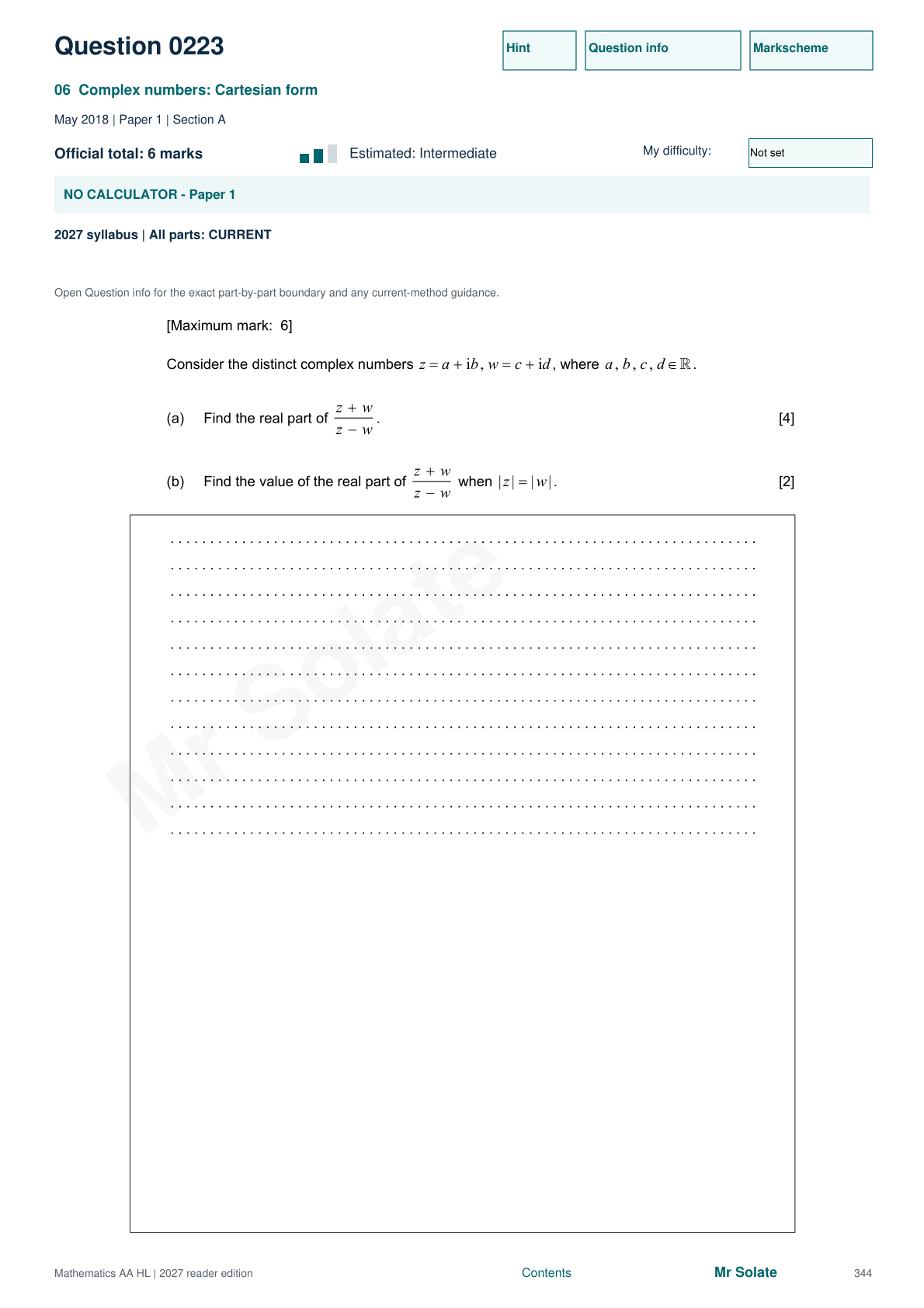
Question 223
Apply the method to the original question.
Compatibility: The tested concepts and formulas are retained in current AA HL. This source is a 2018 Mathematics HL paper.
View the original question
Original page images preserve the equations and diagrams. Write your response before revealing the reasoning.
Reveal the revision reasoning
The numerator is (a+c)+i(b+d), while the denominator is (a-c)+i(b-d).
Rationalising gives denominator (a-c)²+(b-d)². Its real numerator is (a+c)(a-c)+(b+d)(b-d).
Thus the real part is [a²+b²-c²-d²]/[(a-c)²+(b-d)²].
Equal moduli mean a²+b²=c²+d², so this real part is zero.
Editorial revision reasoning. Check the original answer for its marking detail.
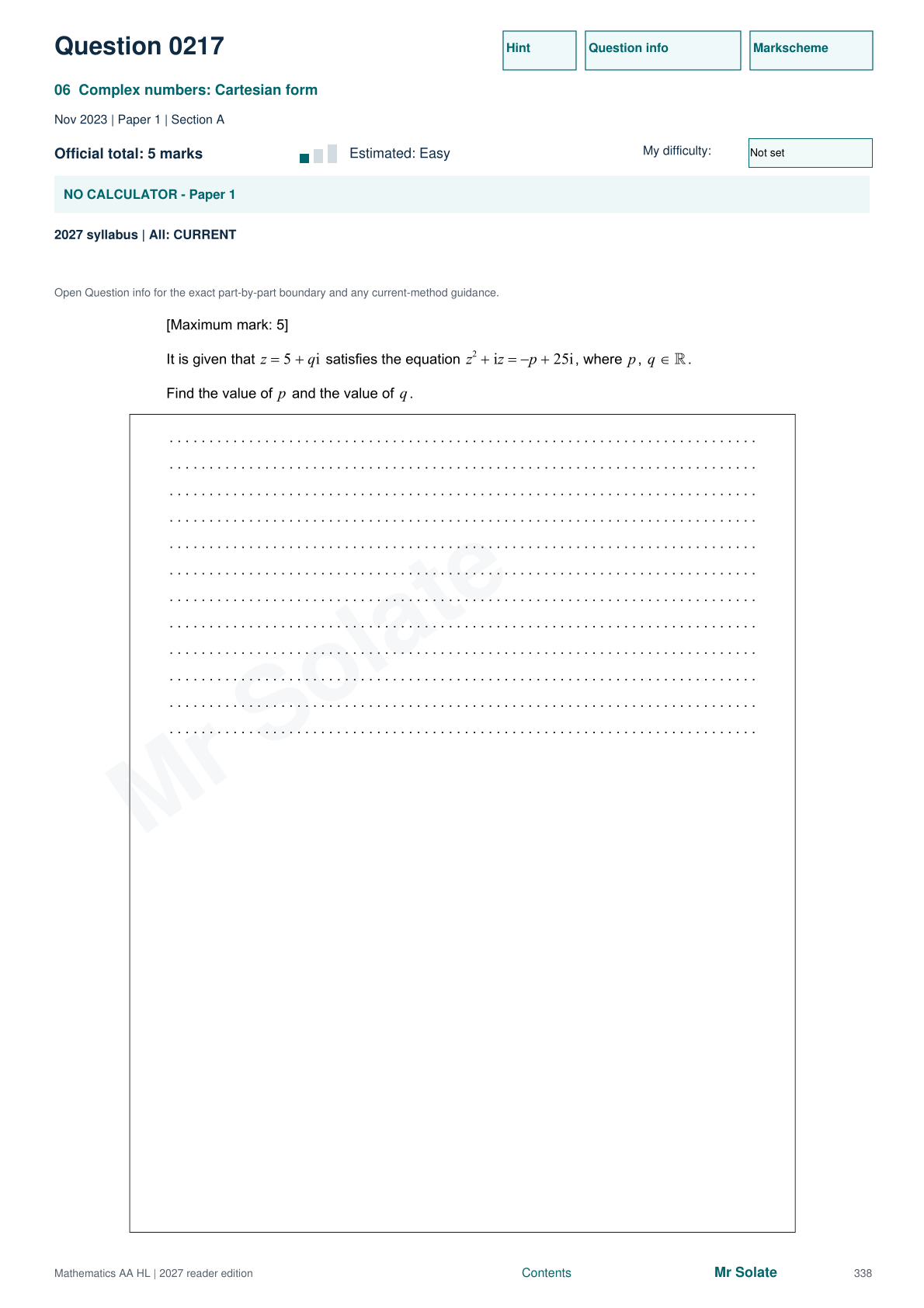
Question 217
Apply the method to the original question.
Compatibility: All parts test current AA HL content and can be solved using current syllabus methods.
View the original question
Original page images preserve the equations and diagrams. Write your response before revealing the reasoning.
Reveal the revision reasoning
Expand (5+qi)²+i(5+qi)=25-q²-q+(10q+5)i.
Equate imaginary parts with -p+25i: 10q+5=25, so q=2.
The real part gives 25-4-2=-p, hence p=-19.
Substitution recovers 19+25i on both sides.
Editorial revision reasoning. Check the original answer for its marking detail.
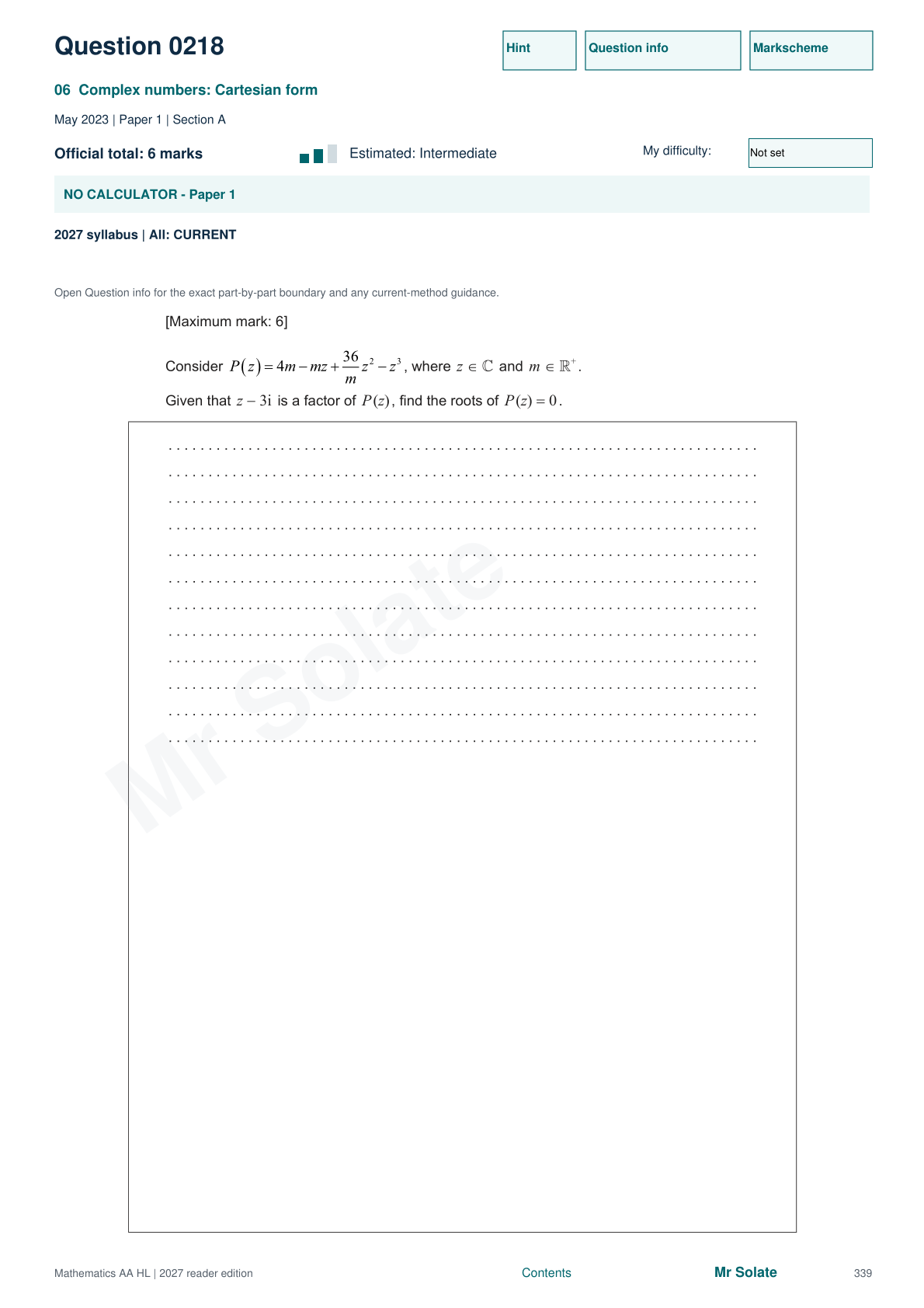
Question 218
Apply the method to the original question.
Compatibility: All parts test current AA HL content and can be solved using current syllabus methods.
View the original question
Original page images preserve the equations and diagrams. Write your response before revealing the reasoning.
Reveal the revision reasoning
The factor z-3i gives root 3i, and real coefficients imply that -3i is also a root.
Substitute z=3i into P(z)=4m-mz+(36/m)z²-z³. The imaginary part is 27-3m, so m=9.
With m=9 the polynomial is 36-9z+4z²-z³=-(z²+9)(z-4).
Therefore the complete root set is 3i,-3i,4.
Editorial revision reasoning. Check the original answer for its marking detail.
All 37 questions in this topic
Close your notes first
Can you retrieve the method?
1. What is the conjugate of −2+5i?
Check answer 1
−2−5i.
2. What is |3−4i|?
Check answer 2
5, from √(3²+4²).
3. If 2+i is a root of a real polynomial, what other root is guaranteed?
Check answer 3
2−i.
Before you move on
- Check a quotient by multiplying your answer by the original denominator. This catches sign errors quickly.
- For a locus, give the geometric description as well as an equation; for roots, check that the total multiplicities match the polynomial degree.
Your revision note
Record one missed cue, one corrected step and one question to retry. Saved only in this browser.