Start with the exam
What you need to be able to do
Integration questions ask you to recognise a useful derivative pattern or transform the integrand into one. The bank contains reverse chain rules, substitution, partial fractions and repeated or cyclic integration by parts. Inspect the expression before starting: a short algebraic rewrite can avoid unnecessary work. Keep exact constants and bounds visible, and check an indefinite answer by differentiating.
Spend 3 minutes reading the overview and diagram, 7 minutes learning the question patterns, 5 minutes writing out the worked example, and 5 minutes on a bank question or recall check. Take longer when you need to; the full bank is here for later practice.
Recognise → set up → write
How the questions are set
Reverse chain rule and substitution
Recognise it: A derivative-like factor accompanies a composite function.
- Look for f′(x)/f(x), a polynomial times a function of that polynomial, or a supplied substitution. Choose u and write du explicitly.
- Replace the complete integrand and differential, not just part of the expression. For a definite integral, change both limits into u-values or return fully to x before applying x-limits.
- For rational functions, divide first if necessary, then use partial fractions. Repeated linear factors need each power; irreducible quadratics need an appropriate linear numerator.
Show the substitution, differential and transformed bounds or complete back-substitution.
Mixing u-integrands with x-bounds is inconsistent. ∫f′/f gives ln|f| on suitable intervals, not ln f without considering sign.
Integration by parts
Recognise it: A product becomes simpler when one factor is differentiated.
- Use ∫u dv=uv−∫v du. Choose u so its derivative simplifies, often a polynomial, logarithm or inverse-trigonometric function.
- Repeat when a polynomial degree remains. For exponential-trigonometric products, the original integral may return; name it I and solve the resulting linear equation for I.
- For definite integrals, carry the boundary product and the remaining integral with consistent limits. If a previous part supplied a product derivative, rearrange that identity to recognise the required integral.
State u and dv or show the product identity being reversed. Keep the minus sign outside the complete remaining integral.
The second integral is subtracted. Repeated parts can reverse signs more than once.
Constants, conditions and exact evaluation
Recognise it: An antiderivative, initial value or exact definite result is required.
- Include C for an indefinite integral. If a derivative or second derivative is given, use each supplied condition to determine the corresponding constants after integration.
- For definite integration, evaluate F(b)−F(a) with brackets. Simplify logarithms only after both endpoint values are correct.
- Check by differentiating your proposed primitive. For inverse-trigonometric terms, verify the scaling factor in the argument and outside the function.
Show endpoint substitution or the equation used to determine C, rather than only the final formula.
A definite integral needs no arbitrary C, but integrating a second derivative twice introduces two constants.
Write it before you reveal it
A worked exam-style example
Original teaching example, created for this lesson.
Original example: find ∫x eˣ dx, then evaluate it from zero to one.
Reveal the worked solution
- Choose u=x and dv=eˣdx, so du=dx and v=eˣ.
- The primitive is xeˣ−∫eˣdx=eˣ(x−1)+C.
- At the endpoints, [eˣ(x−1)]₀¹=0−(−1)=1.
Answer: Primitive eˣ(x−1)+C; definite integral 1.
Check: Differentiating eˣ(x−1) gives eˣ(x−1)+eˣ=xeˣ.
From your own collection
Apply it to past-paper questions
These questions anchor the patterns above. Attempt one without the answer, then compare your setup and conclusion with the reasoning. The linked reader contains the source answer and the question-specific syllabus review.
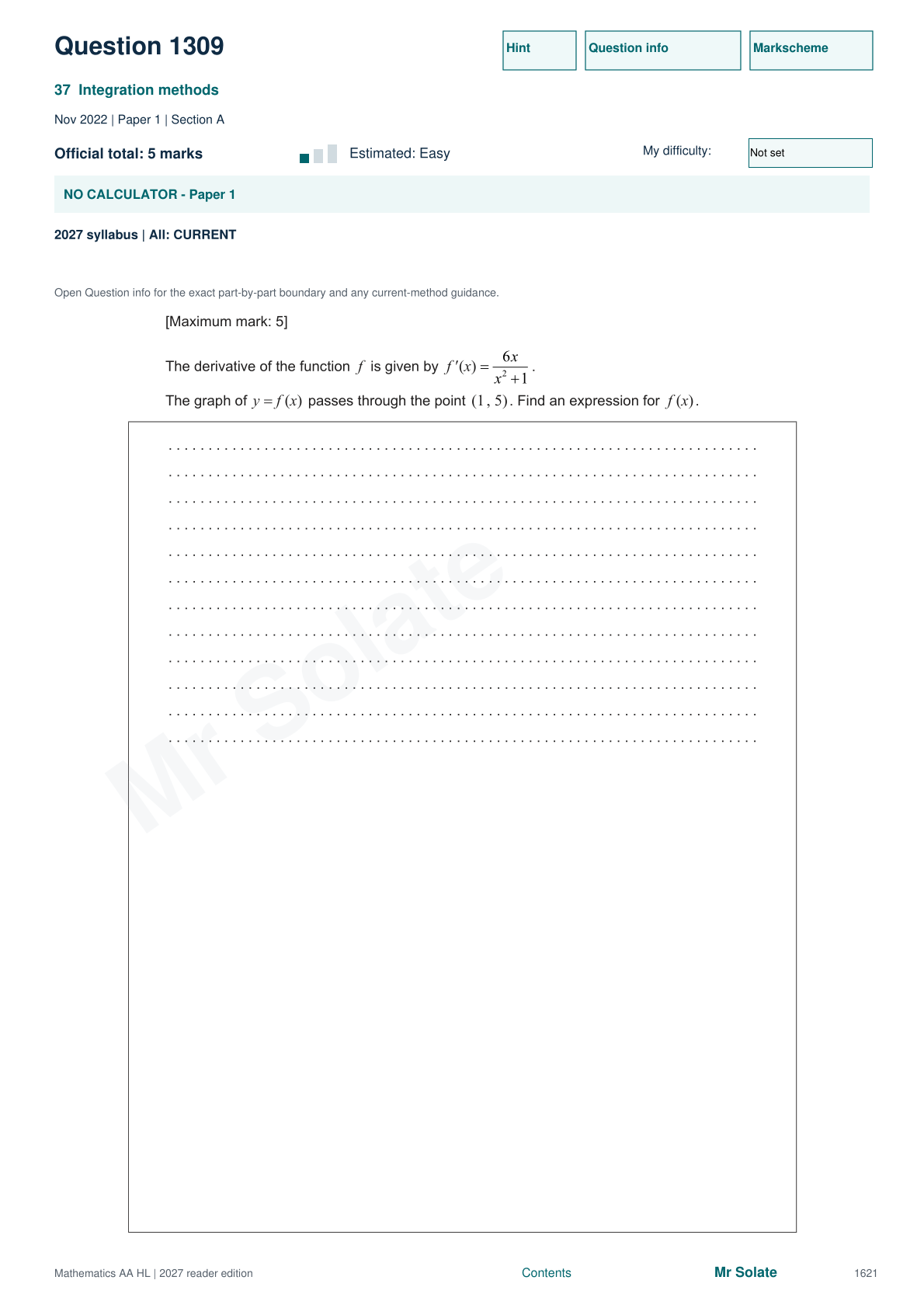
Question 1309
Apply the method to the original question.
Compatibility: All parts test current AA HL content and can be solved using current syllabus methods.
View the original question
Original page images preserve the equations and diagrams. Write your response before revealing the reasoning.
Reveal the revision reasoning
Since d(x²+1)/dx=2x, the integrand 6x/(x²+1) is three times a logarithmic derivative.
Integrating gives f(x)=3ln(x²+1)+C; x²+1 is positive for every real x.
Use the point (1,5): 5=3ln2+C, so C=5-3ln2.
Therefore f(x)=3ln(x²+1)+5-3ln2. Differentiation recovers the given derivative.
Editorial revision reasoning. Check the original answer for its marking detail.
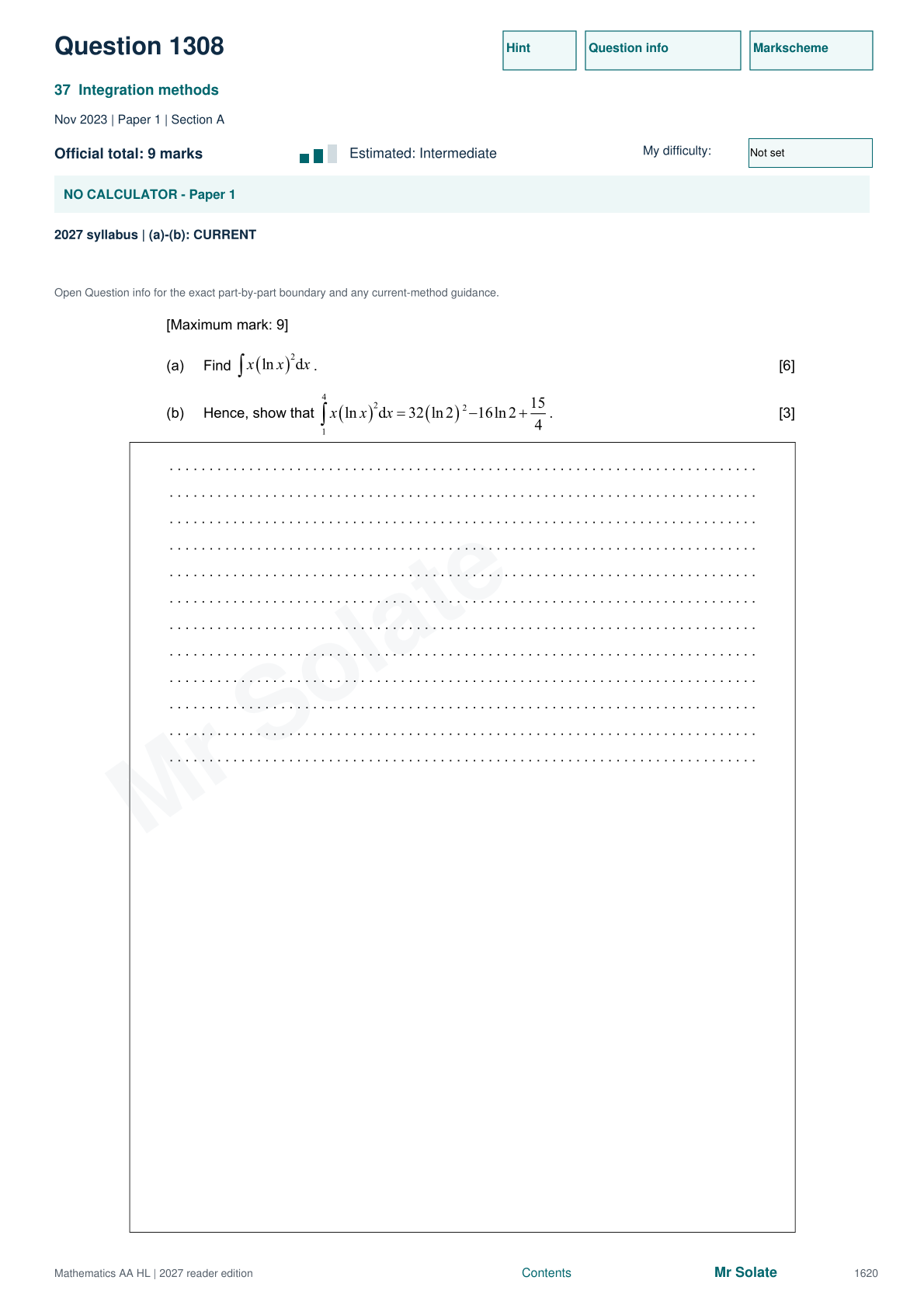
Question 1308
Apply the method to the original question.
Compatibility: All parts test current AA HL content and can be solved using current syllabus methods.
View the original question
Original page images preserve the equations and diagrams. Write your response before revealing the reasoning.
Reveal the revision reasoning
For I=∫x(ln x)² dx, choose u=(ln x)² and dv=x dx. This gives I=(x²/2)(ln x)²-∫x ln x dx.
Apply integration by parts again to the remaining integral, using u=ln x and dv=x dx: ∫x ln x dx=(x²/2)ln x-x²/4.
Hence I=(x²/2)(ln x)²-(x²/2)ln x+x²/4+C.
Evaluate from 1 to 4. The upper value is 8(ln4)²-8ln4+4, while the lower value is 1/4.
Using ln4=2ln2 gives 32(ln2)²-16ln2+15/4.
Editorial revision reasoning. Check the original answer for its marking detail.
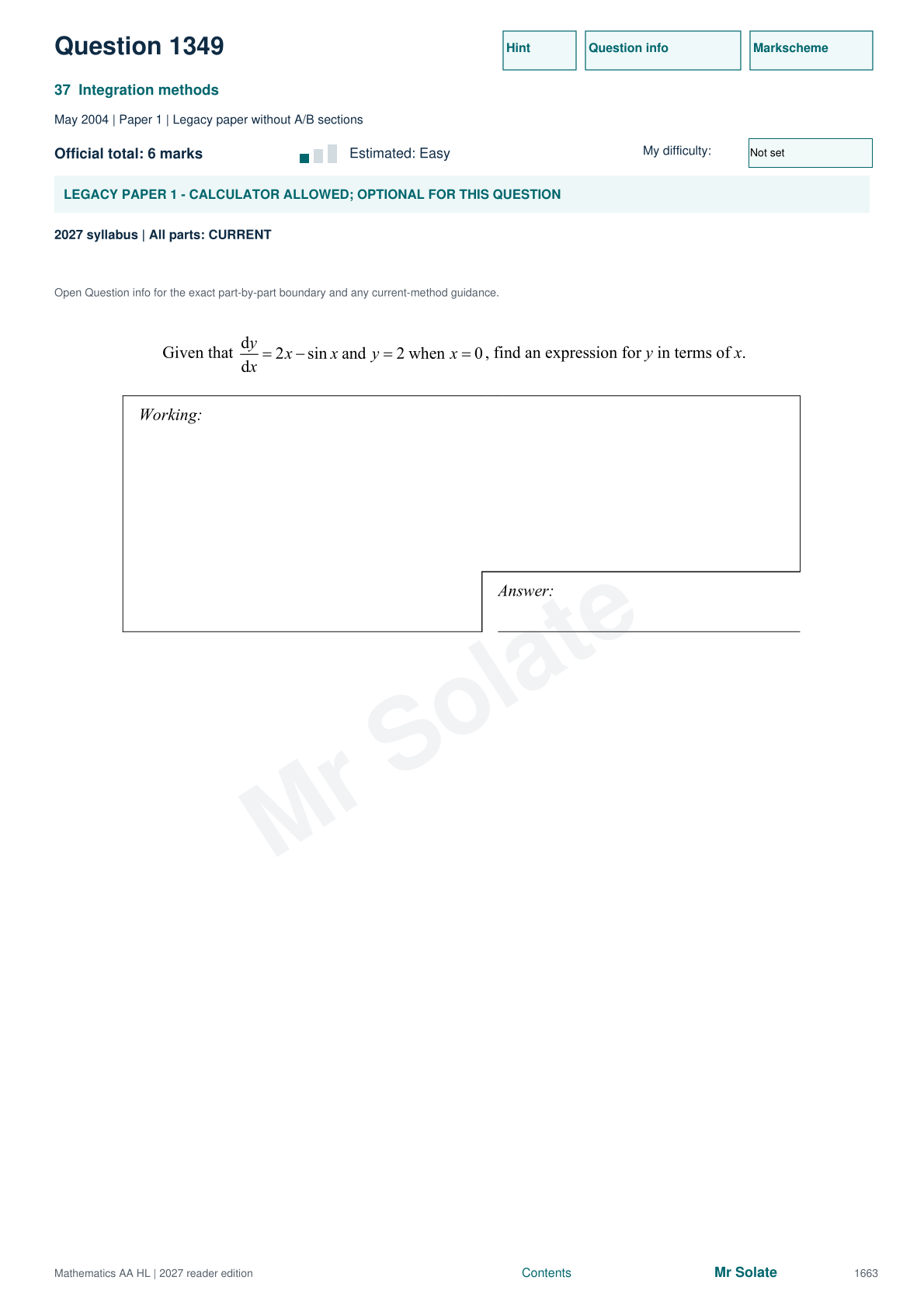
Question 1349
A short direct application of Antidifferentiation, Initial condition.
Compatibility: Current: All parts
View the original question
Original page images preserve the equations and diagrams. Write your response before revealing the reasoning.
Reveal the revision reasoning
- Integrate y'=2x-sin x to get y=x²+cos x+C.
- Use y=2 when x=0: 2=1+C.
- Thus y=x²+cos x+1.
Editorial revision reasoning. Check the original answer for its marking detail.
All 63 questions in this topic
Close your notes first
Can you retrieve the method?
1. What must change under definite substitution?
Check answer 1
The differential, integrand and bounds, unless you back-substitute first.
2. Derivative check for an antiderivative?
Check answer 2
Differentiate it and recover the integrand.
3. How many constants after integrating f″ twice?
Check answer 3
Two, determined by two appropriate conditions.
Before you move on
- Identify the method cue before calculating.
- Practise substitution and parts, then one mixed-method question.
- Differentiate your final primitive and inspect endpoint brackets.
Your revision note
Record one missed cue, one corrected step and one question to retry. Saved only in this browser.