Start with the exam
What you need to be able to do
Triangle problems are solved by matching the data to the correct relation. Three sides suggest cosine rule; a known opposite side-angle pair suggests sine rule; two sides and their included angle give area. The bank often hides a shared side across two triangles or gives an obtuse/acute condition that chooses a branch. Draw and label first, then write the relevant equation before substituting. Keep exact trigonometric values when the question supplies them.
Spend 3 minutes reading the overview and diagram, 7 minutes learning the question patterns, 5 minutes writing out the worked example, and 5 minutes on a bank question or recall check. Take longer when you need to; the full bank is here for later practice.
Recognise → set up → write
How the questions are set
Choose sine or cosine rule
Recognise it: Find a missing side or angle in a non-right triangle.
- With a known opposite pair, use a/sin A=b/sin B. With three sides or two sides and included angle, use c²=a²+b²−2ab cos C.
- Label opposite pairs carefully; the included angle must sit between the two sides in cosine rule.
- If two triangles share a side, calculate it once and carry full precision into the next triangle.
Write the rule with the actual side and angle labels before inserting values.
The side adjacent to an angle is not its opposite side. A drawing that is not to scale cannot select the correct angle branch.
Ambiguous triangles
Recognise it: A sine-rule calculation gives an angle and the data are SSA rather than SAS.
- If sin B=s, consider B=arcsin s and B=π−arcsin s.
- For each candidate, require A+B<π and positive side lengths. Use any acute/obtuse or length condition to select or retain cases.
- Calculate the requested length or area for each surviving triangle and label the cases.
Show the supplementary candidate even if it is then rejected with a clear angle-sum reason.
A positive discriminant in a side equation is not enough; both possible side roots must be positive and geometrically valid.
Area, exact values and bearings
Recognise it: An area or cosine is supplied, or directions appear in a word problem.
- Use area=ab sin C/2 with the included angle. If cos C is known, derive sin C with its triangle sign rather than approximating C.
- For bearings, draw north lines and convert clockwise bearings into the interior angle actually used.
- For elevation, separate vertical height from horizontal distance and use shared heights to connect right triangles.
Retain a line showing how the bearing or elevation gives the triangle angle.
The sine can correspond to acute and obtuse angles; area alone may not determine the cosine sign.
Write it before you reveal it
A worked exam-style example
Original teaching example, created for this lesson.
Original practice: two sides are 5 and 7 with included angle 60°. Find the opposite side and area.
Reveal the worked solution
- By cosine rule, c²=25+49−2(5)(7)(1/2)=39.
- Thus c=√39, taking the positive root for length.
- Area=(1/2)(5)(7)sin60°=35√3/4.
Answer: Opposite side √39 units; area 35√3/4 square units.
Check: The side lies between |7−5|=2 and 12, as the triangle inequality requires. The area is below 35/2, its maximum for these sides.
From your own collection
Apply it to past-paper questions
These questions anchor the patterns above. Attempt one without the answer, then compare your setup and conclusion with the reasoning. The linked reader contains the source answer and the question-specific syllabus review.
Question 642
Apply the method to the original question.
Compatibility: All parts test current AA HL content and can be solved using current syllabus methods.
View the original question
Original page images preserve the equations and diagrams. Write your response before revealing the reasoning.
Reveal the revision reasoning
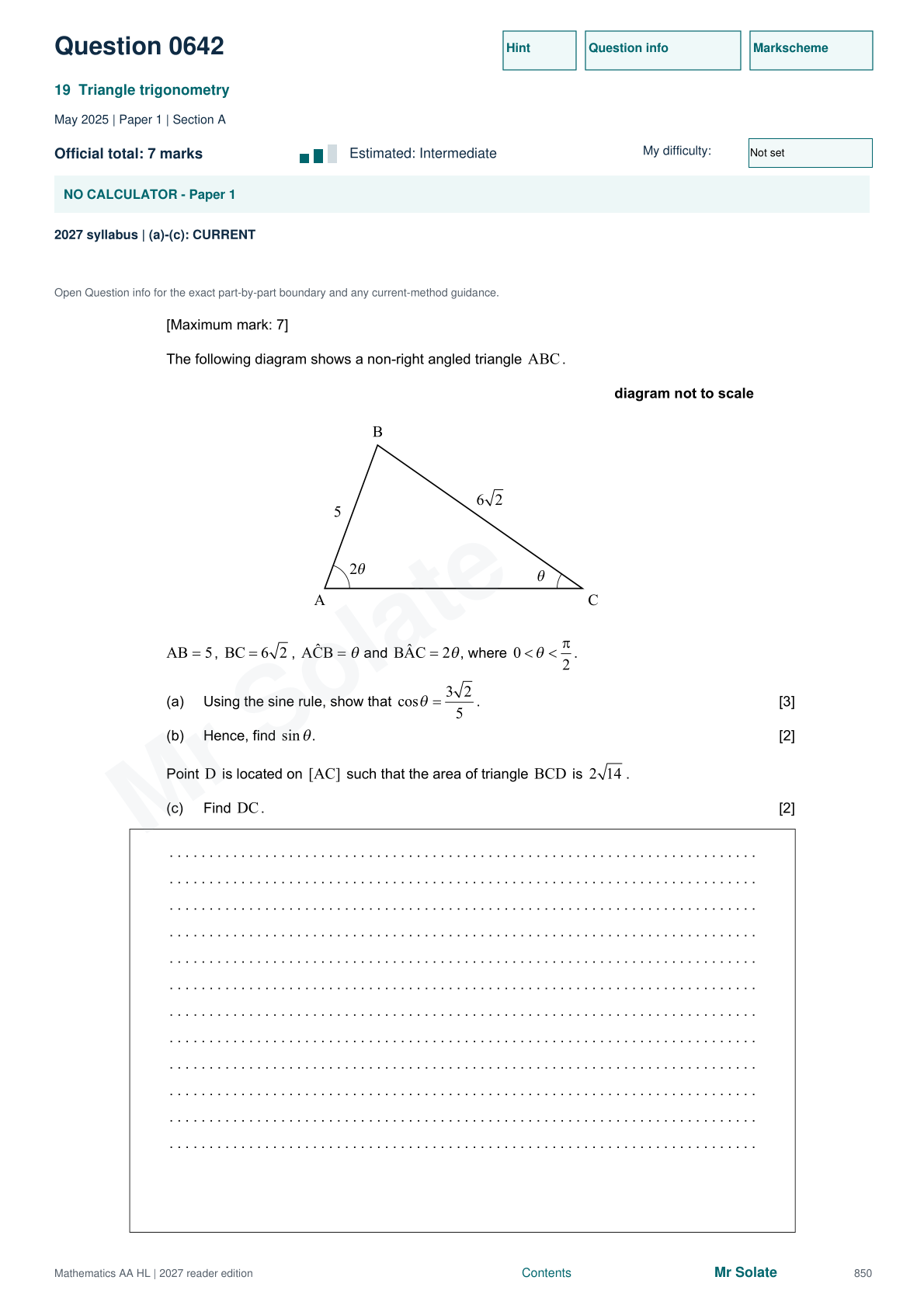
The sine rule gives sinθ/5=sin2θ/(6√2). Use sin2θ=2sinθcosθ and cancel nonzero sinθ to obtain cosθ=3√2/5.
Since θ is acute, sinθ is positive. Thus sinθ=√(1-18/25)=√7/5.
For triangle BCD, the angle at C remains θ. Its area is (1/2)(6√2)(DC)(√7/5).
Equating this to 2√14 and cancelling gives DC=10/3.
Editorial revision reasoning. Check the original answer for its marking detail.
Question 654
Requires linking Ambiguous sine rule, Two triangle areas, Difference of areas.
Compatibility: All parts: The tested methods are current AA HL: Ambiguous sine rule, Two triangle areas, Difference of areas.
View the original question
Original page images preserve the equations and diagrams. Write your response before revealing the reasoning.
Reveal the revision reasoning
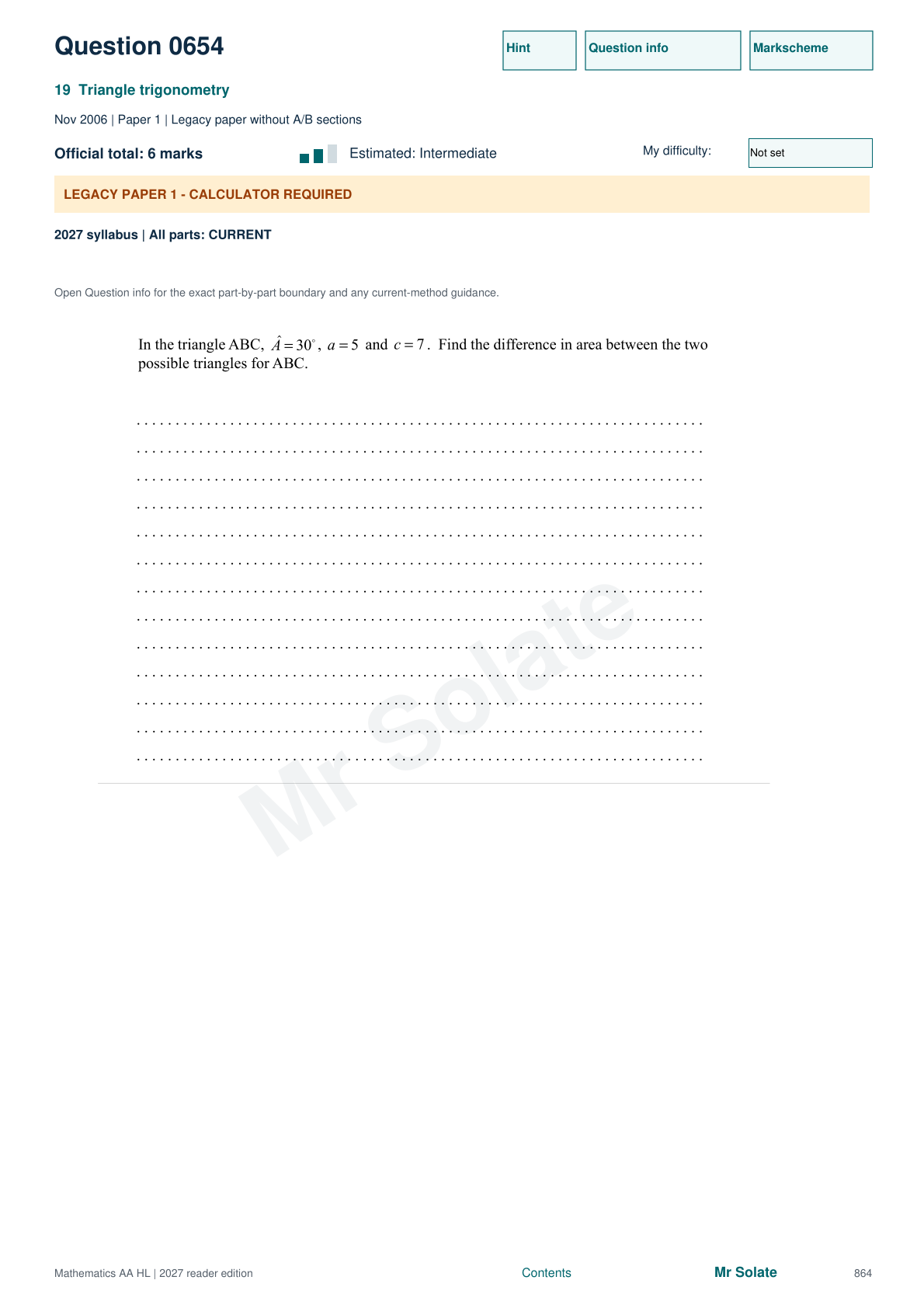
- Use sinC=7sin30°/5.
- Take both the acute angle and its supplement; subtract each along with A from 180° to find the two B values.
- Compute each area with (1/2)ac sinB.
- Subtract the smaller area from the larger one using unrounded angles.
Editorial revision reasoning. Check the original answer for its marking detail.
Question 644
Apply the method to the original question.
Compatibility: All parts test current AA HL content and can be solved using current syllabus methods.
View the original question
Original page images preserve the equations and diagrams. Write your response before revealing the reasoning.
Reveal the revision reasoning
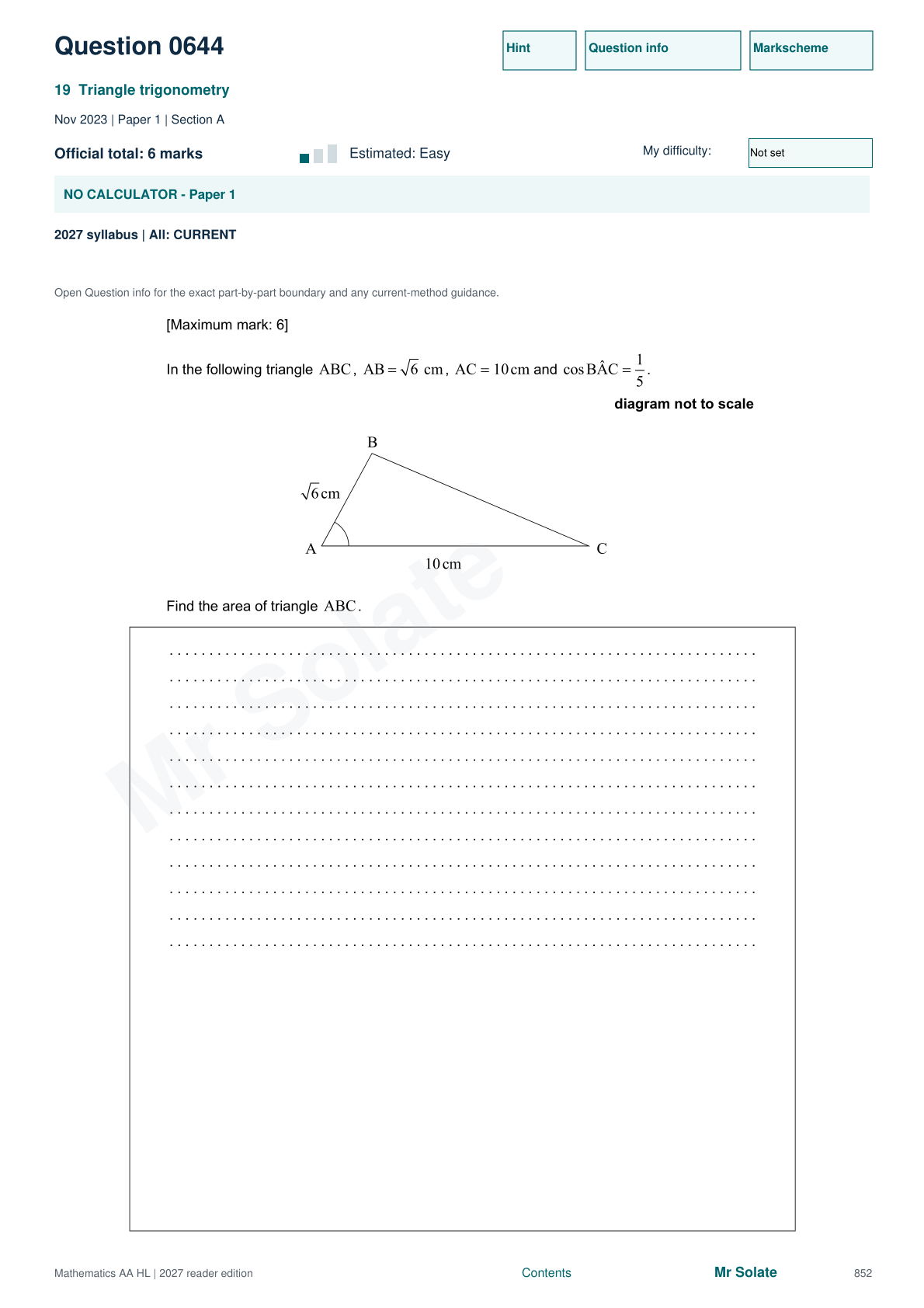
Let α be angle BAC. Since cosα=1/5, sin²α=1-1/25=24/25.
An interior triangle angle has positive sine, so sinα=√24/5=2√6/5.
The adjacent side lengths are √6 and 10, giving area (1/2)×√6×10×(2√6/5)=12 cm².
Editorial revision reasoning. Check the original answer for its marking detail.
All 43 questions in this topic
Close your notes first
Can you retrieve the method?
1. When is the sine-rule ambiguity possible?
Check answer 1
When the data allow two angles with the same sine, typically an SSA configuration.
2. Which angle goes in ab sinC/2?
Check answer 2
The angle included between sides a and b.
3. Does cosC<0 imply an acute angle?
Check answer 3
No; a triangle angle with negative cosine is obtuse.
Before you move on
- Check angle sums and the triangle inequality before accepting a numerical answer. These checks often reject an algebraically valid but impossible branch.
- Use exact surds until the final line and include length or area units as appropriate.
Your revision note
Record one missed cue, one corrected step and one question to retry. Saved only in this browser.