Start with the exam
What you need to be able to do
Volumes of revolution are cross-section questions. Identify the axis, decide whether a slice makes a disc or a washer, and measure radii from that axis. The bank includes inverse boundaries, shifted trigonometric curves and implicit branches. Draw a representative slice before integrating; it prevents most errors involving the variable, the radius and whether a hole remains.
Spend 3 minutes reading the overview and diagram, 7 minutes learning the question patterns, 5 minutes writing out the worked example, and 5 minutes on a bank question or recall check. Take longer when you need to; the full bank is here for later practice.
Recognise → set up → write
How the questions are set
Discs about a coordinate axis
Recognise it: A region touches the axis of rotation.
- About the x-axis, a vertical slice gives V=π∫y²dx. About the y-axis, use horizontal slices and V=π∫x²dy.
- Express radius in the integration variable. If the curve already gives y² or x², use that expression directly instead of introducing an unnecessary square root.
- Find bounds from the region, not merely from the curve’s full domain. Expand a squared sum correctly or use a trigonometric identity where needed.
Show the radius, slice variable and volume integral before evaluation.
Rotating about the y-axis does not mean simply replacing dx by dy while leaving x-dependent limits and radius.
Washers and holes
Recognise it: The region lies between two curves away from the rotation axis.
- Measure outer radius R and inner radius r from the axis. The slice area is π(R²−r²).
- Determine which boundary is farther from the axis on each interval. Solve relevant intersections and split if the ordering or cross-section changes.
- Integrate the difference of squared radii with the correct variable. For a shifted axis, use actual distances to that axis, not raw coordinate values.
State outer and inner radii explicitly and give the bounds that produce the specified solid.
π(R−r)² is not the area of a washer. Squaring the vertical gap gives the wrong solid.
Inverse or composite solids
Recognise it: An implicit curve, y-axis rotation or several geometric pieces appear.
- Solve for the radius branch required by the region. A square root or inverse function may have more than one algebraic branch; the diagram and domain select it.
- Separate a cone or cylinder contribution from a curved cap if that matches the geometry. Make sure the pieces do not overlap.
- For a related filling rate, differentiate the accumulated volume with respect to height and apply dV/dt=(dV/dh)(dh/dt). The cross-sectional area is the derivative factor.
Explain the branch choice and show each volume contribution before adding.
The farther branch is not always the chosen boundary. A geometric volume must be positive and have cubic units.
Write it before you reveal it
A worked exam-style example
Original teaching example, created for this lesson.
Original example: rotate the region under y=√x, from x=0 to x=4, about the x-axis.
Reveal the worked solution
- A vertical slice is a disc of radius √x.
- Its area is π(√x)²=πx.
- V=π∫₀⁴x dx=π[x²/2]₀⁴=8π.
Answer: Volume 8π cubic units.
Check: The region fits in a cylinder of radius two and length four, volume 16π; the computed volume is half of that.
From your own collection
Apply it to past-paper questions
These questions anchor the patterns above. Attempt one without the answer, then compare your setup and conclusion with the reasoning. The linked reader contains the source answer and the question-specific syllabus review.
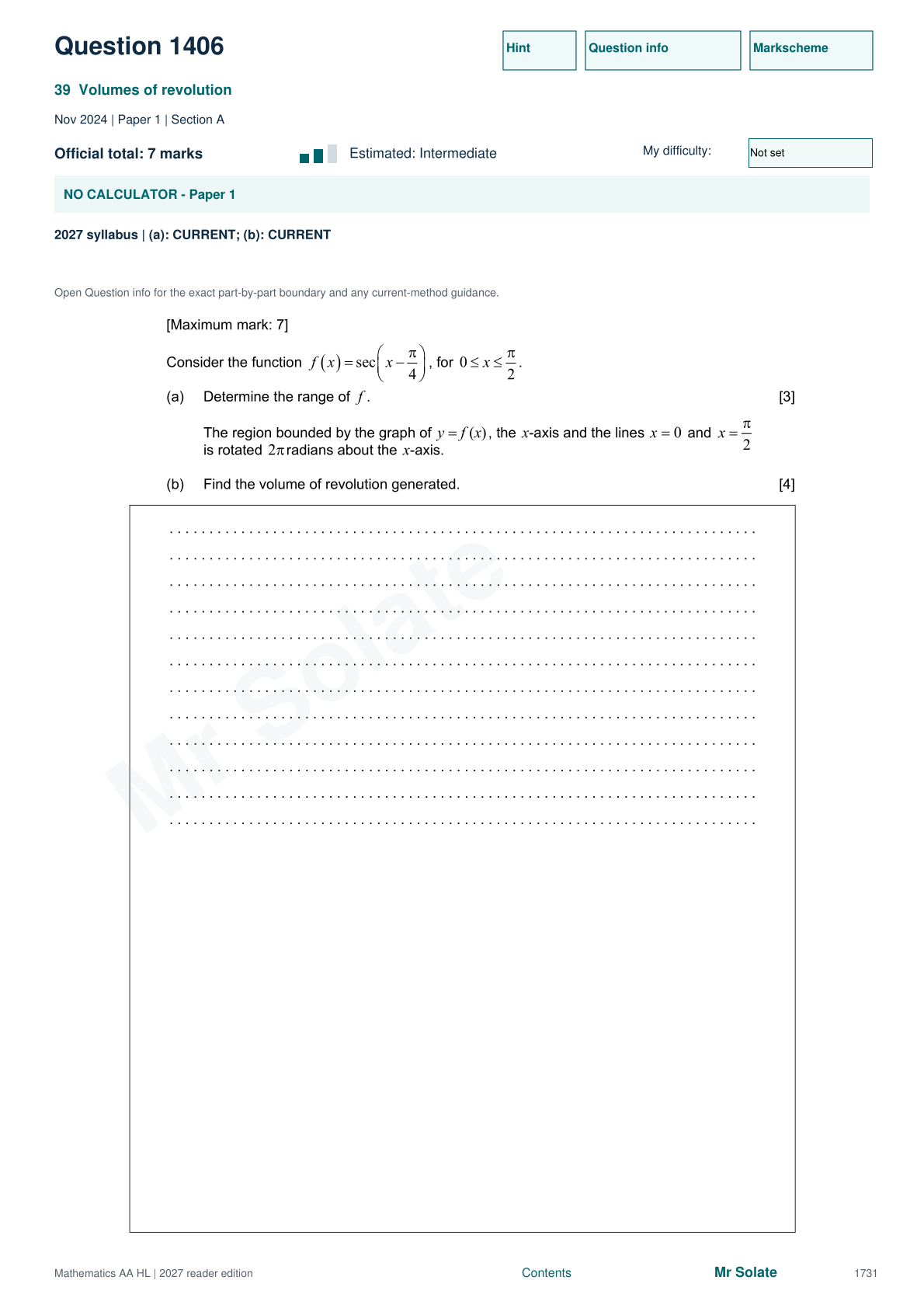
Question 1406
Apply the method to the original question.
Compatibility: All parts test current AA HL content and can be solved using current syllabus methods.
View the original question
Original page images preserve the equations and diagrams. Write your response before revealing the reasoning.
Reveal the revision reasoning
For x∈[0,π/2], let u=x-π/4, so u∈[-π/4,π/4]. Cos u lies between √2/2 and 1.
Therefore f=sec u has range [1,√2], with minimum at x=π/4 and maximum at both endpoints.
A revolution about the x-axis gives V=π∫₀^(π/2)sec²(x-π/4) dx.
Integrate to π[tan(x-π/4)]₀^(π/2)=π(1-(-1))=2π.
Editorial revision reasoning. Check the original answer for its marking detail.
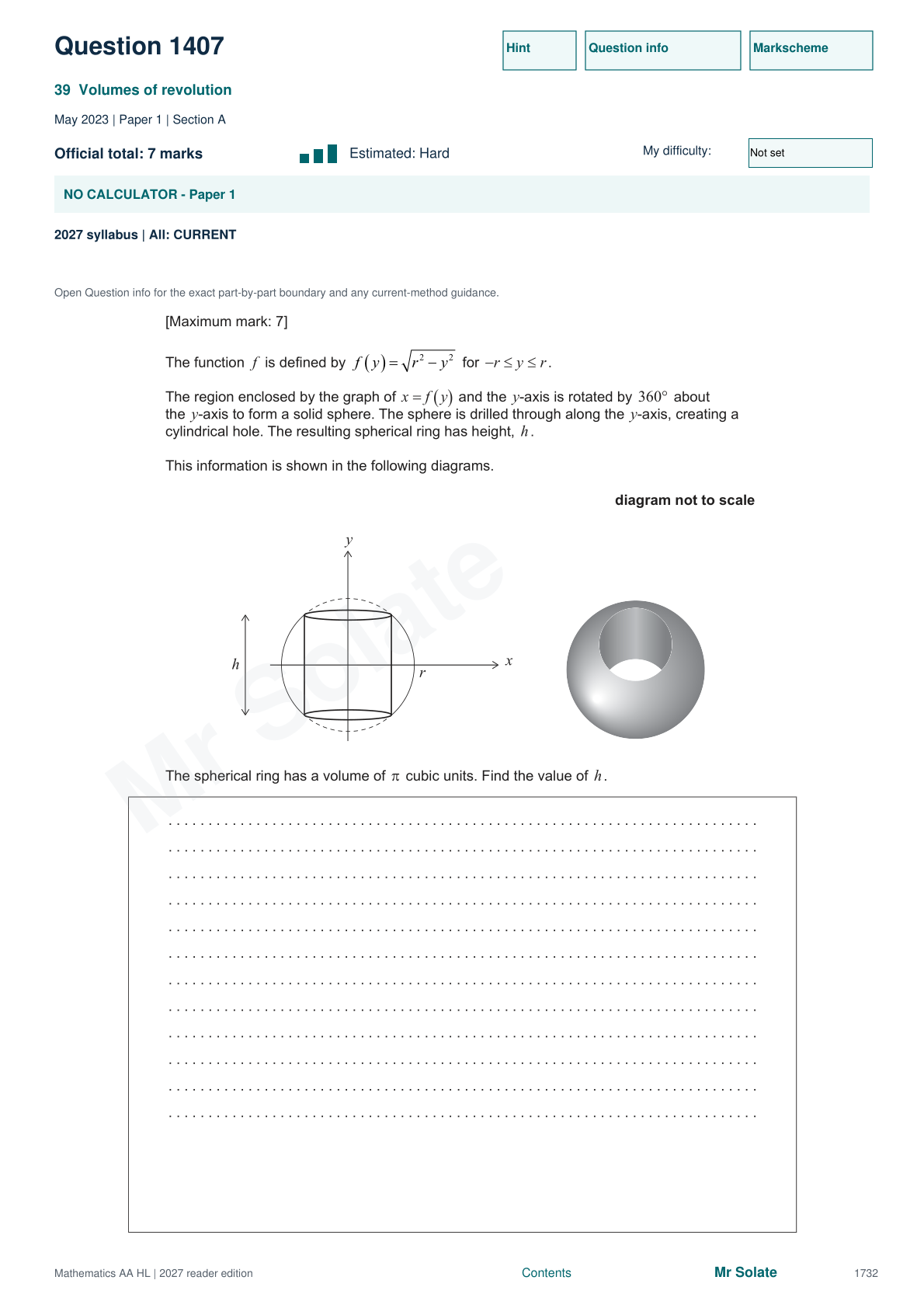
Question 1407
Apply the method to the original question.
Compatibility: All parts test current AA HL content and can be solved using current syllabus methods.
View the original question
Original page images preserve the equations and diagrams. Write your response before revealing the reasoning.
Reveal the revision reasoning
Let the cylindrical hole have radius R. At the ring’s top y=h/2, the sphere gives R²=r²-h²/4.
At height y, the washer’s outer squared radius is r²-y² and its inner squared radius is R². Their difference simplifies to h²/4-y².
Integrate V=π∫ from -h/2 to h/2 of (h²/4-y²) dy. The antiderivative is h²y/4-y³/3.
The result is πh³/6. Equating this to the given volume π yields h³=6, hence h=∛6.
Editorial revision reasoning. Check the original answer for its marking detail.
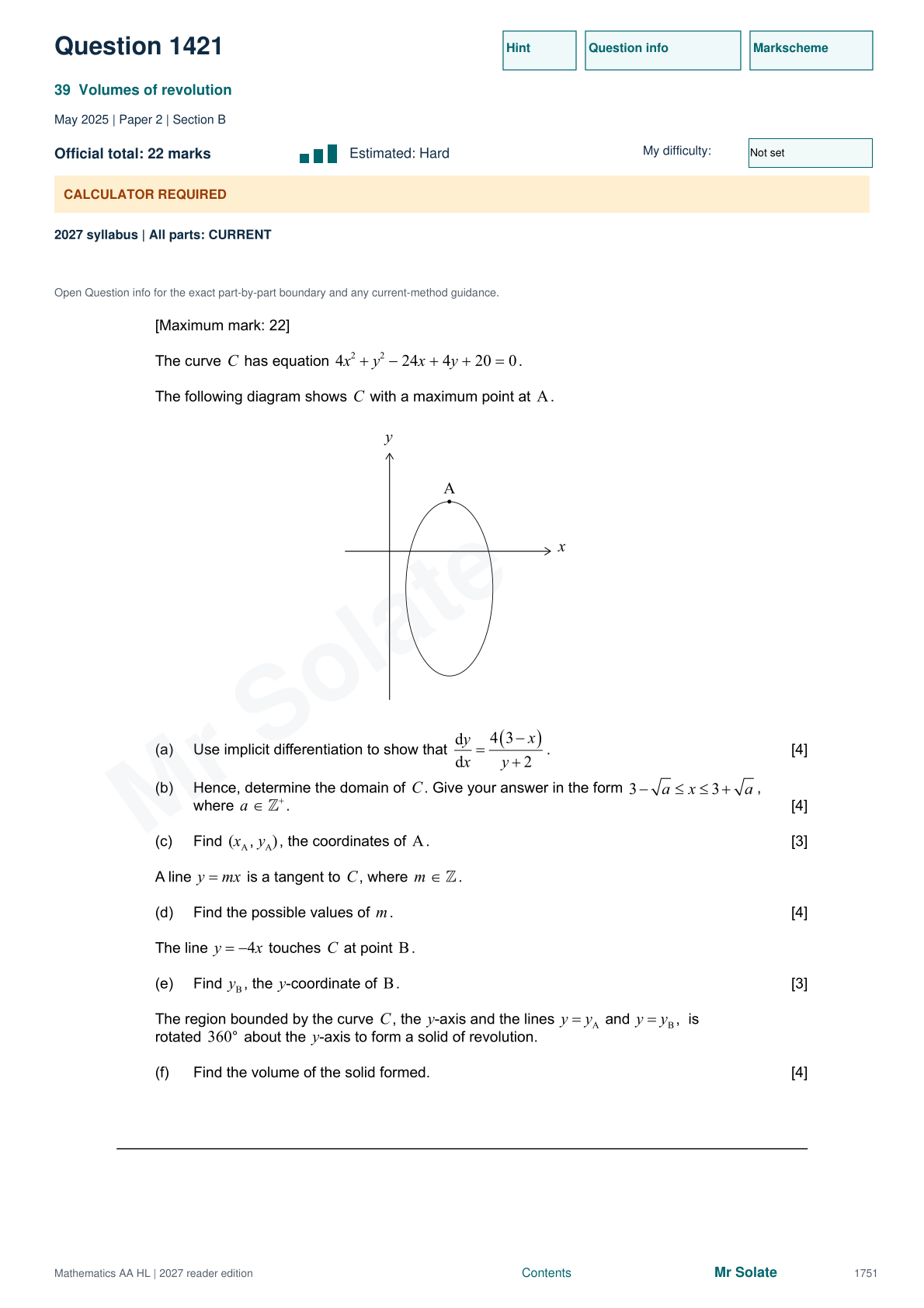
Question 1421
Extended linked reasoning in Implicit derivative, Ellipse extrema by algebra, Tangency discriminant.
Compatibility: The tested concepts and methods match the current AA HL syllabus; the original paper format and wording are retained.
View the original question
Original page images preserve the equations and diagrams. Write your response before revealing the reasoning.
Reveal the revision reasoning
Implicit differentiation gives 8x+2yy′−24+4y′=0, hence y′=4(3−x)/(y+2). Completing squares gives 4(x−3)²+(y+2)²=20.
At the horizontal extent, y=−2 and the tangent is vertical. Substitution gives x=3±√5, so the domain is [3−√5,3+√5].
A horizontal tangent requires x=3. Select the upper point A=(3,−2+2√5), since A is the maximum.
Substituting y=mx gives (4+m²)x²+(4m−24)x+20=0. Tangency requires zero discriminant, giving m=−4 or 1. For m=−4, the repeated contact point is x=1 and y_B=−4.
The near branch is x=3−(1/2)√[20−(y+2)²]. Rotating the region between it and the y-axis gives discs, not washers with a central hole.
Thus V=π∫₋₄^(−2+2√5)[3−(1/2)√(20−(y+2)²)]²dy≈29.7080≈29.7 cubic units.
Editorial revision reasoning. Check the original answer for its marking detail.
All 22 questions in this topic
Close your notes first
Can you retrieve the method?
1. Washer slice area?
Check answer 1
π(R²−r²).
2. Disc variable for y-axis rotation?
Check answer 2
Usually y, using x as radius.
3. What checks the units?
Check answer 3
The integral of area times thickness has cubic units.
Before you move on
- Sketch one slice and label its radii before every volume calculation.
- Practise a disc, washer and inverse-boundary example.
- Check bounds, branch choice and cubic units.
Your revision note
Record one missed cue, one corrected step and one question to retry. Saved only in this browser.