Start with the exam
What you need to be able to do
This chapter combines legacy matrix techniques with useful current linear-system practice. For the reader’s 2027 AA HL target, do not treat determinants, matrix inverses and matrix transformation theory as compulsory methods. Simultaneous linear equations remain useful: practise elimination and interpretation of unique, inconsistent or dependent systems. The bank’s part-by-part notes identify where an old question can be solved with current algebra.
Spend 3 minutes reading the overview and diagram, 7 minutes learning the question patterns, 5 minutes writing out the worked example, and 5 minutes on a bank question or recall check. Take longer when you need to; the full bank is here for later practice.
This collection contains content outside the current course, or a mixture of current and legacy skills. Use the compatibility note for each original question to decide which parts to practise for your exam.
Recognise → set up → write
How the questions are set
Current linear systems by elimination
Recognise it: Several equations constrain two or three unknowns.
- Arrange coefficients and constants consistently, then eliminate the same variable from two pairs of equations to obtain a smaller system.
- Back-substitute after solving the reduced system. If elimination gives 0=c with c≠0, there is no solution; if it gives 0=0, investigate dependence and any free variables.
- For a parameter, isolate exceptional values before dividing by a coefficient that may vanish. Substitute those values into the original equations and classify separately.
Show the elimination steps and state whether the solution is unique, nonexistent or a family.
A vanishing coefficient does not automatically mean infinitely many solutions; the constants decide consistency.
Legacy inverse and singularity methods
Recognise it: An old part explicitly asks for a determinant, inverse or matrix equation.
- For a legacy 2×2 matrix [[a,b],[c,d]], determinant is ad−bc. If nonzero, its inverse is (1/(ad−bc))[[d,−b],[−c,a]].
- Preserve multiplication order. AX=B gives X=A⁻¹B, whereas XA=B gives X=BA⁻¹. General matrices do not commute.
- For singular parameter values, solve the determinant equation and test all roots, retaining zero when valid. A supplied matrix identity can simplify powers without repeated multiplication.
Label this as a legacy method and show the determinant or correctly sided inverse multiplication.
You cannot move a matrix inverse across another matrix as if both were scalar numbers.
Legacy transformations and transferable coordinates
Recognise it: A supplied linear map transforms points, lines or a composite figure.
- Use the images of basis vectors to construct a supplied transformation matrix if the old task requires it. Apply the rightmost transformation first in a matrix product acting on column vectors.
- For a line image or preimage, express the coordinate map and eliminate the original parameter. This scalar-coordinate reasoning remains useful without memorising matrix classifications.
- For fixed points, equate image coordinates to original coordinates and solve the resulting linear system. Check whether the result is one point, a line or the whole plane.
Show the coordinate equations and the order of application. Distinguish an image from a preimage.
Reflection and rotation generally change when their order is reversed. An invariant line need not consist entirely of fixed points.
Write it before you reveal it
A worked exam-style example
Original teaching example, created for this lesson.
Original current-method example: solve x+y+z=6, x−y+z=2, and x+y−z=0 by elimination.
Reveal the worked solution
- Subtract the second equation from the first: 2y=4, so y=2.
- Subtract the third from the first: 2z=6, so z=3.
- The first equation then gives x=1.
- Substitute (1,2,3) in all three original equations.
Answer: Unique solution (x,y,z)=(1,2,3).
Check: The original left sides are 6, 2 and 0, exactly as required.
From your own collection
Apply it to past-paper questions
These questions anchor the patterns above. Attempt one without the answer, then compare your setup and conclusion with the reasoning. The linked reader contains the source answer and the question-specific syllabus review.
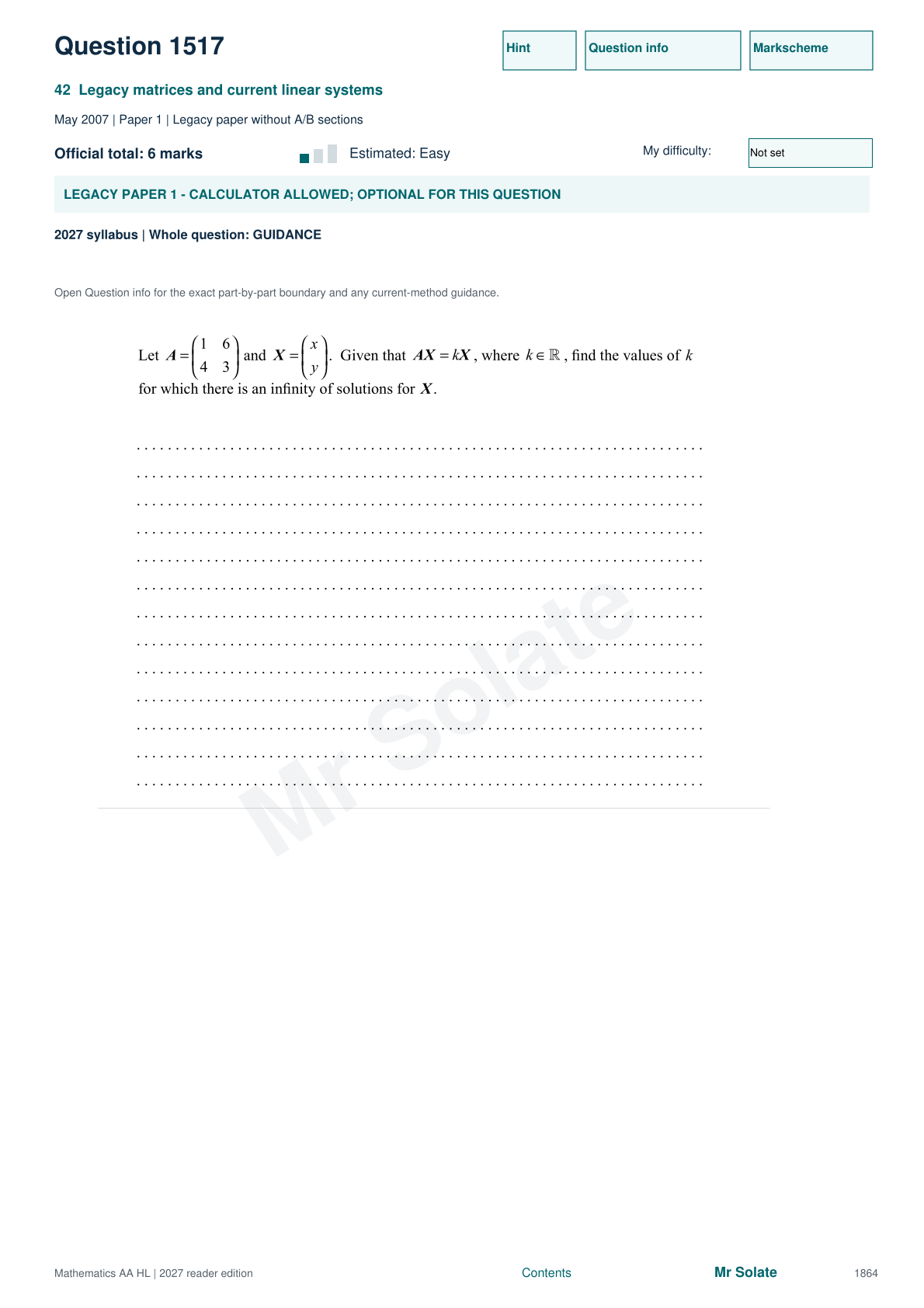
Question 1517
A short direct application of Homogeneous linear system, Parameter values giving infinitely many solutions, Quadratic factorisation.
Compatibility: With guidance: Whole question
View the original question
Original page images preserve the equations and diagrams. Write your response before revealing the reasoning.
Reveal the revision reasoning
- The equations are (1-k)x+6y=0 and 4x+(3-k)y=0. They always have the zero solution.
- For infinitely many solutions, they must be dependent so that one variable remains free. Eliminating y gives the parameter condition k^2-4k-21=0.
- Factor to get k=7 or k=-3. At either value, a nonzero solution can be scaled by any real constant, producing infinitely many solutions.
Editorial revision reasoning. Check the original answer for its marking detail.
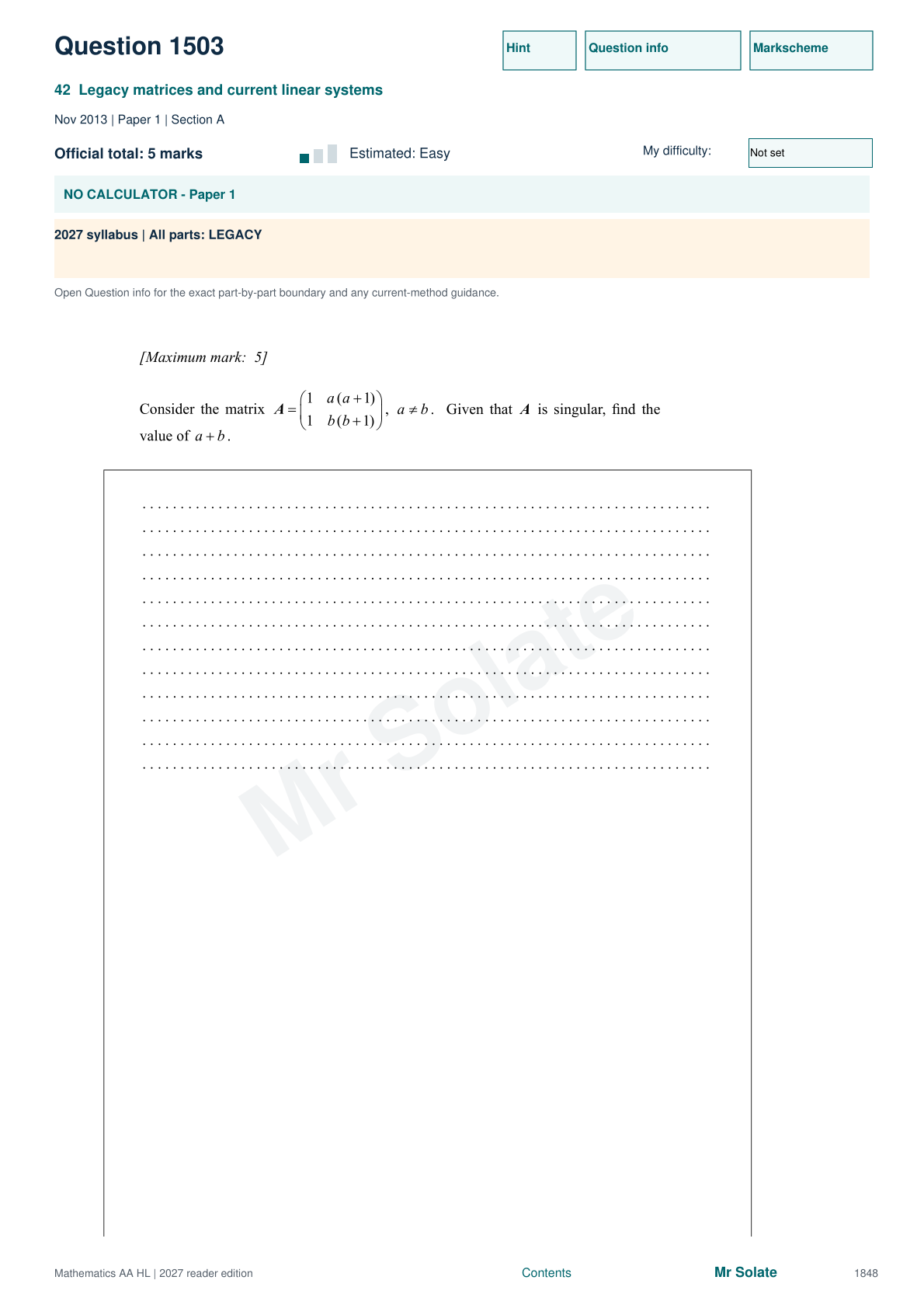
Question 1503
A short direct application of Singular matrix, Difference of squares, Factoring with a parameter restriction.
Compatibility: Legacy: All parts
View the original question
Original page images preserve the equations and diagrams. Write your response before revealing the reasoning.
Reveal the revision reasoning
- The determinant condition is b(b+1)-a(a+1)=0.
- Factor b^2-a^2+b-a as (b-a)(a+b+1).
- Since a differs from b, the first factor cannot vanish. Hence a+b=-1.
Editorial revision reasoning. Check the original answer for its marking detail.
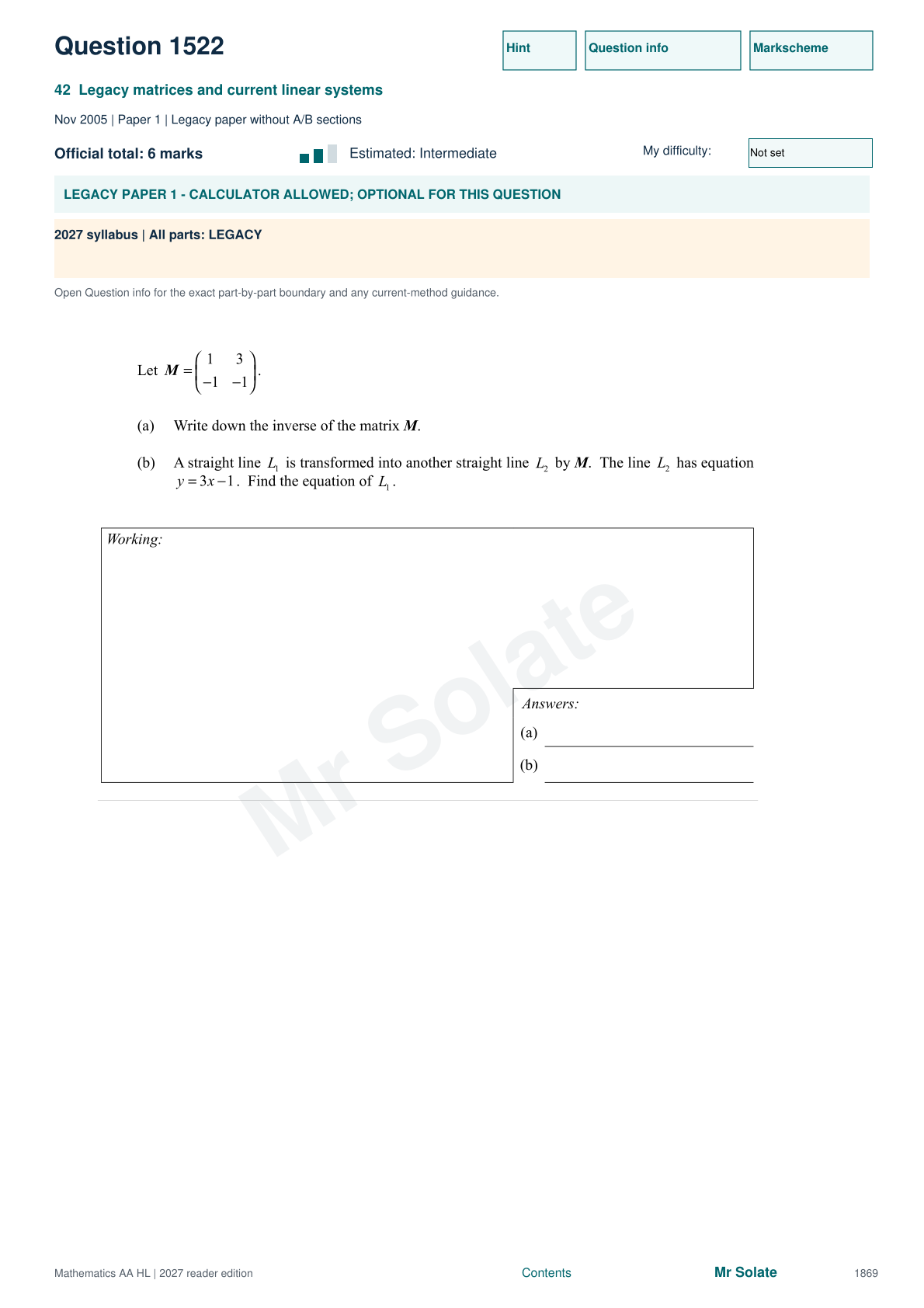
Question 1522
Several linked steps involving (a) Legacy inverse of a 2-by-2 matrix, (b) Preimage of a line, Eliminating a parameter.
Compatibility: Legacy: All parts
View the original question
Original page images preserve the equations and diagrams. Write your response before revealing the reasoning.
Reveal the revision reasoning
- Part (a) uses the 2-by-2 inverse rule. The inverse shown in the official working maps an image point back to its original point.
- Parameterise L2 by (t,3t-1). Multiplying by M^(-1) gives the point (1.5-5t,2t-0.5) on L1.
- Eliminate t between these two coordinates. The resulting line is 4x+10y-1=0. A different letter for the parameter prevents confusion with the final x-coordinate.
Editorial revision reasoning. Check the original answer for its marking detail.
All 46 questions in this topic
Close your notes first
Can you retrieve the method?
1. Does determinant zero alone classify consistency?
Check answer 1
No; check the constants in the equations.
2. Are matrix inverses compulsory current AA HL methods here?
Check answer 2
No; this matrix machinery is legacy.
3. How solve AX=B when A is invertible?
Check answer 3
Premultiply by A⁻¹: X=A⁻¹B.
Before you move on
- Prioritise elimination and system interpretation for current revision.
- Use the legacy label to avoid mistaking old matrix requirements for current ones.
- Verify every computed solution in the original equations.
Your revision note
Record one missed cue, one corrected step and one question to retry. Saved only in this browser.