Start with the exam
What you need to be able to do
Vector geometry begins by forming the correct displacement vectors. For angle ABC use BA and BC, both starting at B, rather than the position vectors of A and C. The bank repeatedly uses dot products for angles and perpendicularity, cross products for area and normals, and scalar parameters for points on segments. Name the vectors before calculating. This keeps the geometric meaning of each operation visible.
Spend 3 minutes reading the overview and diagram, 7 minutes learning the question patterns, 5 minutes writing out the worked example, and 5 minutes on a bank question or recall check. Take longer when you need to; the full bank is here for later practice.
Recognise → set up → write
How the questions are set
Dot product for angles and perpendicularity
Recognise it: Find an angle, prove perpendicularity or solve a parameter condition.
- Form the two directions from a common vertex. Compute u·v component by component.
- Use u·v=0 for nonzero perpendicular vectors, or cosθ=(u·v)/(|u||v|) for the angle between directed vectors.
- For an acute angle between lines use the absolute dot product; for an interior triangle angle preserve the actual vector directions.
Show both lengths and the dot product before taking inverse cosine.
Using AB instead of BA at vertex B gives a supplementary angle.
Cross product for area and normals
Recognise it: Find a triangle/parallelogram area or a vector perpendicular to a plane.
- Construct two sides sharing one vertex. Compute u×v and check its dot product with each original direction is zero.
- Parallelogram area is |u×v|; triangle area is half that.
- A cross product supplies a normal direction. Normalize only when a unit normal or a specific distance along it is needed.
Display the component cross product before taking its magnitude; the scalar area and vector normal are different outputs.
Reversing the cross-product order reverses the normal but not the area.
Division, projection and shortest distance
Recognise it: A point moves along a segment or a perpendicular foot is required.
- Write P=A+t(B−A). Segment membership means 0≤t≤1.
- For a projection onto direction v, write the projected displacement as tv and impose (a−tv)·v=0.
- When minimizing distance, minimize its square first; it has the same minimizer and avoids a square root derivative.
State the parameter interval and apply it after solving any perpendicularity equation.
A line solution with t outside [0,1] is not on the segment.
Write it before you reveal it
A worked exam-style example
Original teaching example, created for this lesson.
Original practice: A=(1,0,0), B=(3,0,0), C=(1,3,0). Find angle BAC and the triangle area.
Reveal the worked solution
- AB=(2,0,0), AC=(0,3,0). Their dot product is zero, so the angle is 90°.
- AB×AC=(0,0,6), with magnitude 6.
- Triangle area is half the magnitude.
Answer: Angle BAC=90°; area=3 square units.
Check: The ordinary base-height calculation gives (1/2)×2×3=3. The normal points along the z-axis, perpendicular to the xy-plane.
From your own collection
Apply it to past-paper questions
These questions anchor the patterns above. Attempt one without the answer, then compare your setup and conclusion with the reasoning. The linked reader contains the source answer and the question-specific syllabus review.
Question 685
Apply the method to the original question.
Compatibility: All parts test current AA HL content and can be solved using current syllabus methods.
View the original question
Original page images preserve the equations and diagrams. Write your response before revealing the reasoning.
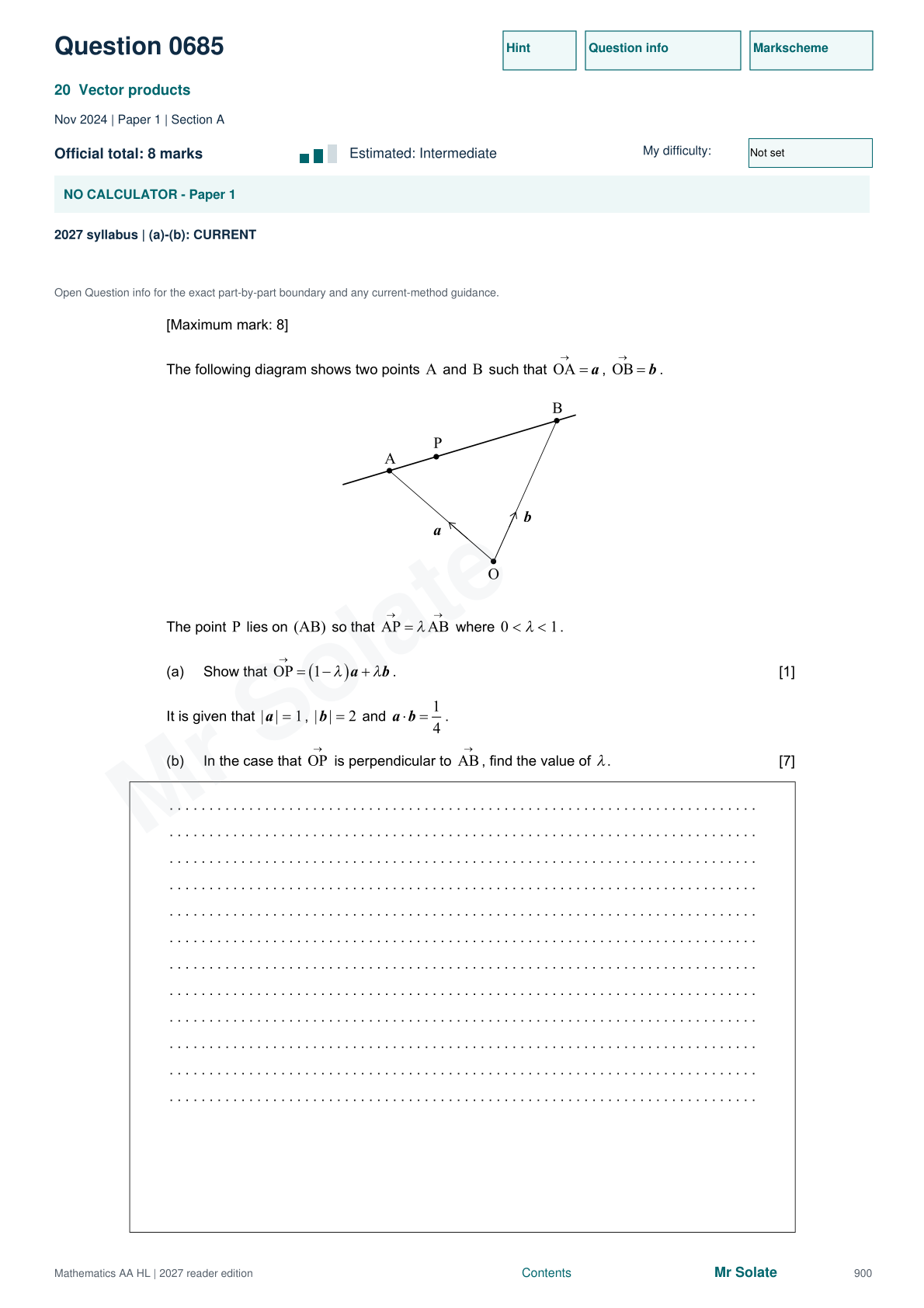
Reveal the revision reasoning
The vector route gives OP=OA+AP=a+λ(b-a)=(1-λ)a+λb.
Perpendicularity requires [(1-λ)a+λb]·(b-a)=0.
Expand to (1-λ)a·b-(1-λ)|a|²+λ|b|²-λa·b=0.
Substitute a·b=1/4, |a|²=1 and |b|²=4. Multiplying by 4 simplifies the equation to 18λ-3=0.
Hence λ=1/6, which lies inside the required interval (0,1).
Editorial revision reasoning. Check the original answer for its marking detail.
Question 692
Direct application of Cross product, Normal vector, Cartesian plane.
Compatibility: All parts: The tested methods are current AA HL: Cross product, Normal vector, Cartesian plane.
View the original question
Original page images preserve the equations and diagrams. Write your response before revealing the reasoning.
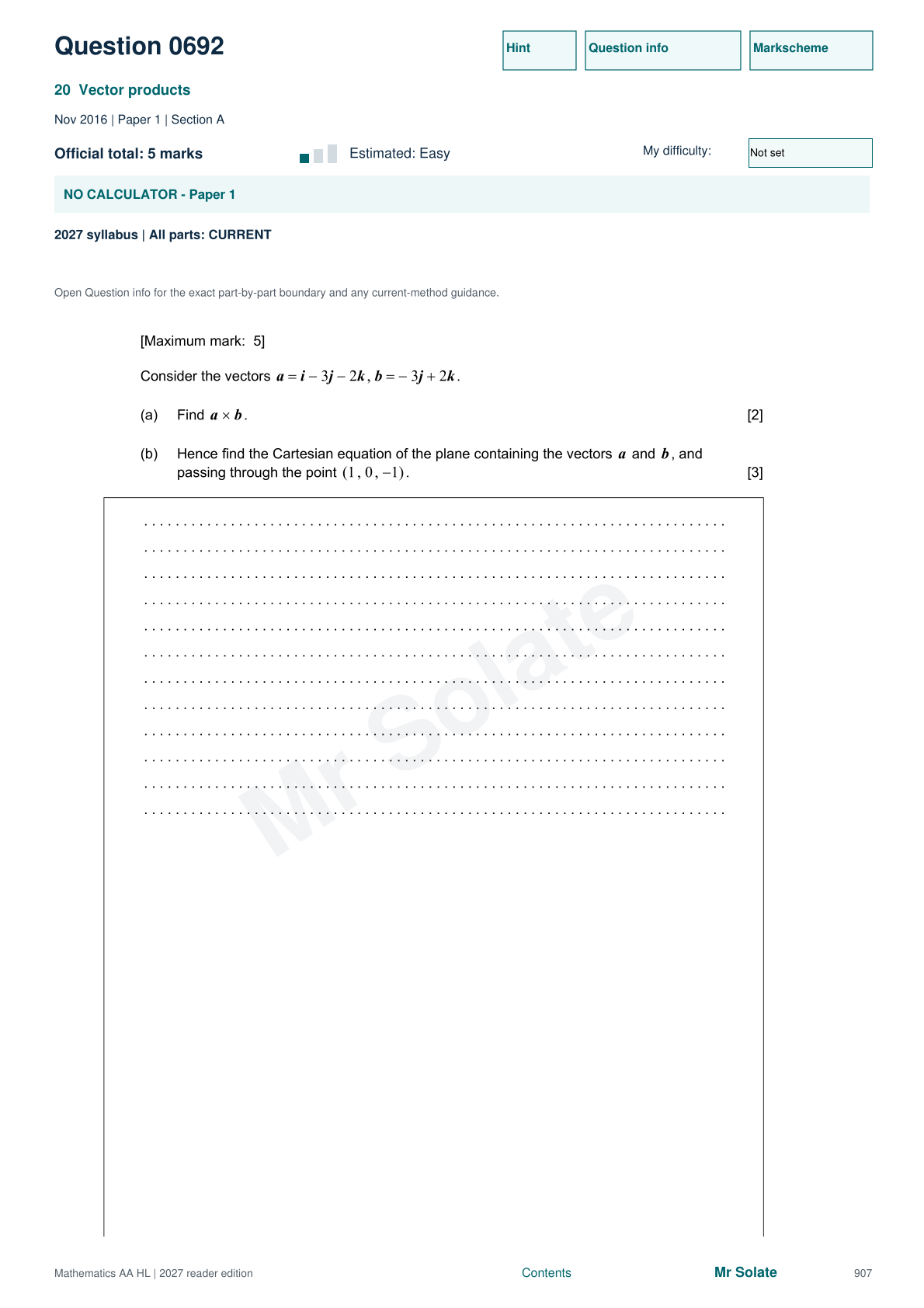
Reveal the revision reasoning
- Calculate a×b using the components of the two given vectors.
- Use that cross product as n in n·r=d.
- Substitute the point (1,0,−1) to find d.
- An overall nonzero multiple of the resulting plane equation is equivalent.
Editorial revision reasoning. Check the original answer for its marking detail.
Question 686
Apply the method to the original question.
Compatibility: All parts test current AA HL content and can be solved using current syllabus methods.
View the original question
Original page images preserve the equations and diagrams. Write your response before revealing the reasoning.
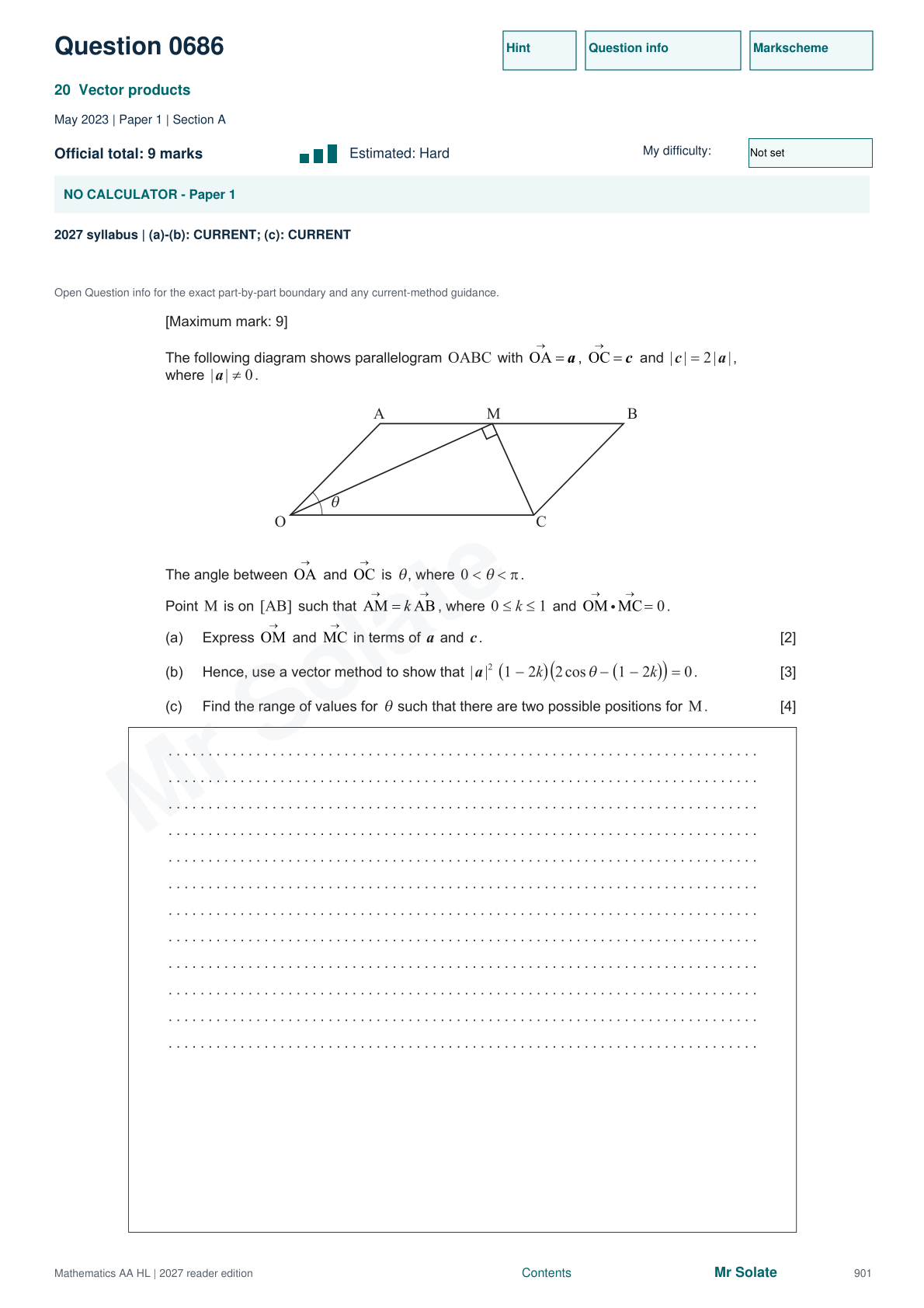
Reveal the revision reasoning
Since AB=c and AM=kc, OM=a+kc. Subtract this from OC to get MC=(1-k)c-a.
Expand OM·MC=(1-2k)a·c-|a|²+k(1-k)|c|².
Use |c|=2|a| and a·c=2|a|²cosθ. The result factors as |a|²(1-2k)[2cosθ-(1-2k)]=0.
Because |a|≠0, the possible positions have k=1/2 or k=1/2-cosθ.
The second position lies on AB when -1/2≤cosθ≤1/2, giving π/3≤θ≤2π/3. Exclude θ=π/2 because the two k values coincide there.
Editorial revision reasoning. Check the original answer for its marking detail.
All 53 questions in this topic
Close your notes first
Can you retrieve the method?
1. What vectors give angle ABC?
Check answer 1
BA and BC.
2. How does reversing a cross product change it?
Check answer 2
Its sign reverses; its magnitude remains the same.
3. What t values describe the segment A+t(B−A)?
Check answer 3
0≤t≤1.
Before you move on
- Before each product, write what it is meant to establish: angle, perpendicularity, area or normal. That determines whether to use a scalar or vector product.
- Check that an angle calculation does not involve a zero vector, since its direction and angle are undefined.
Your revision note
Record one missed cue, one corrected step and one question to retry. Saved only in this browser.