Start with the exam
What you need to be able to do
Trigonometric equations are usually algebraic equations in disguise. Choose an identity that converts everything into one trig function, factor, and then solve every surviving branch on the stated interval. The bank also uses identity proofs as preparation for later equations. Treat part (a) as a tool for part (b). Keep original denominator restrictions, and never divide by a trig factor until its zero case has been handled.
Spend 3 minutes reading the overview and diagram, 7 minutes learning the question patterns, 5 minutes writing out the worked example, and 5 minutes on a bank question or recall check. Take longer when you need to; the full bank is here for later practice.
Recognise → set up → write
How the questions are set
Reduce to a quadratic
Recognise it: The equation mixes sin²x, cos2x, tan²x or related expressions.
- Use cos2x=1−2sin²x or 2cos²x−1 depending on the other terms; use sec²x=1+tan²x for tangent equations.
- Factor the resulting polynomial in a temporary trig variable.
- Reject sine/cosine values outside [−1,1], then find all angles satisfying each valid value.
Show the identity replacement and factorization before listing angles.
Dividing by sin x or cos x can lose a zero branch. Factor instead.
Solve on a transformed interval
Recognise it: The angle is 2x, x+α or another linear expression.
- Transform the full interval for the angle first. For 0≤x<2π, an angle 2x ranges over 0≤2x<4π.
- List all branches and periodic repetitions inside that transformed interval.
- Undo the angle transformation and check original domain exclusions and endpoints.
Write the angle interval explicitly; it explains why more than two solutions may occur.
A calculator inverse trig value is only a principal value, not the complete solution set.
Prove identities and combine sine/cosine
Recognise it: Prove an identity, or rewrite a cosx+b sinx as a shifted single function.
- For an identity, transform one side using known formulas, showing each equality on the valid common domain.
- For Rcos(x−α), compare Rcosα=a and Rsinα=b, giving R=√(a²+b²) and a quadrant-correct α.
- Reuse the derived form for maximum values or equations, preserving restricted intervals.
An identity proof should end at the other side without assuming the desired equality as a starting fact.
Cancelling a denominator factor does not restore points where the original expression was undefined.
Write it before you reveal it
A worked exam-style example
Original teaching example, created for this lesson.
Original practice: solve 2sin²x−3sinx+1=0 for 0≤x<2π.
Reveal the worked solution
- Factor (2sinx−1)(sinx−1)=0.
- Thus sinx=1/2 or sinx=1.
- The first value gives x=π/6 and 5π/6; the second gives x=π/2.
Answer: x=π/6, π/2, 5π/6.
Check: Each value lies in the interval. At sinx=1/2, 2(1/4)−3/2+1=0; at sinx=1, 2−3+1=0.
From your own collection
Apply it to past-paper questions
These questions anchor the patterns above. Attempt one without the answer, then compare your setup and conclusion with the reasoning. The linked reader contains the source answer and the question-specific syllabus review.
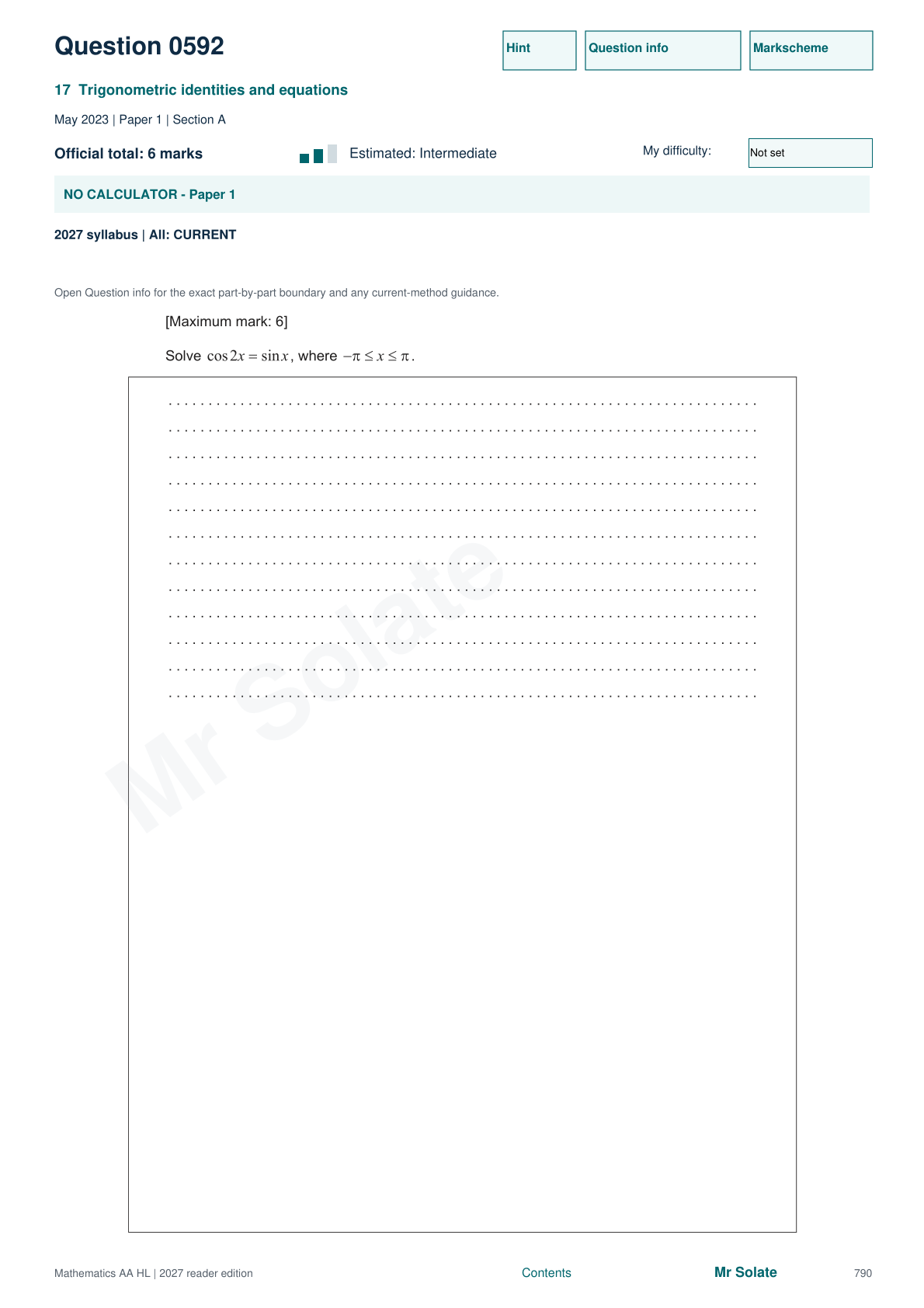
Question 592
Apply the method to the original question.
Compatibility: All parts test current AA HL content and can be solved using current syllabus methods.
View the original question
Original page images preserve the equations and diagrams. Write your response before revealing the reasoning.
Reveal the revision reasoning
Use cos2x=1-2sin²x to form 2sin²x+sin x-1=0.
Factor as (2sin x-1)(sin x+1)=0, giving sin x=1/2 or sin x=-1.
On [-π,π], sin x=1/2 gives π/6 and 5π/6; sin x=-1 gives -π/2.
State all three values and show the algebra, since unsupported solutions do not demonstrate the required method.
Editorial revision reasoning. Check the original answer for its marking detail.
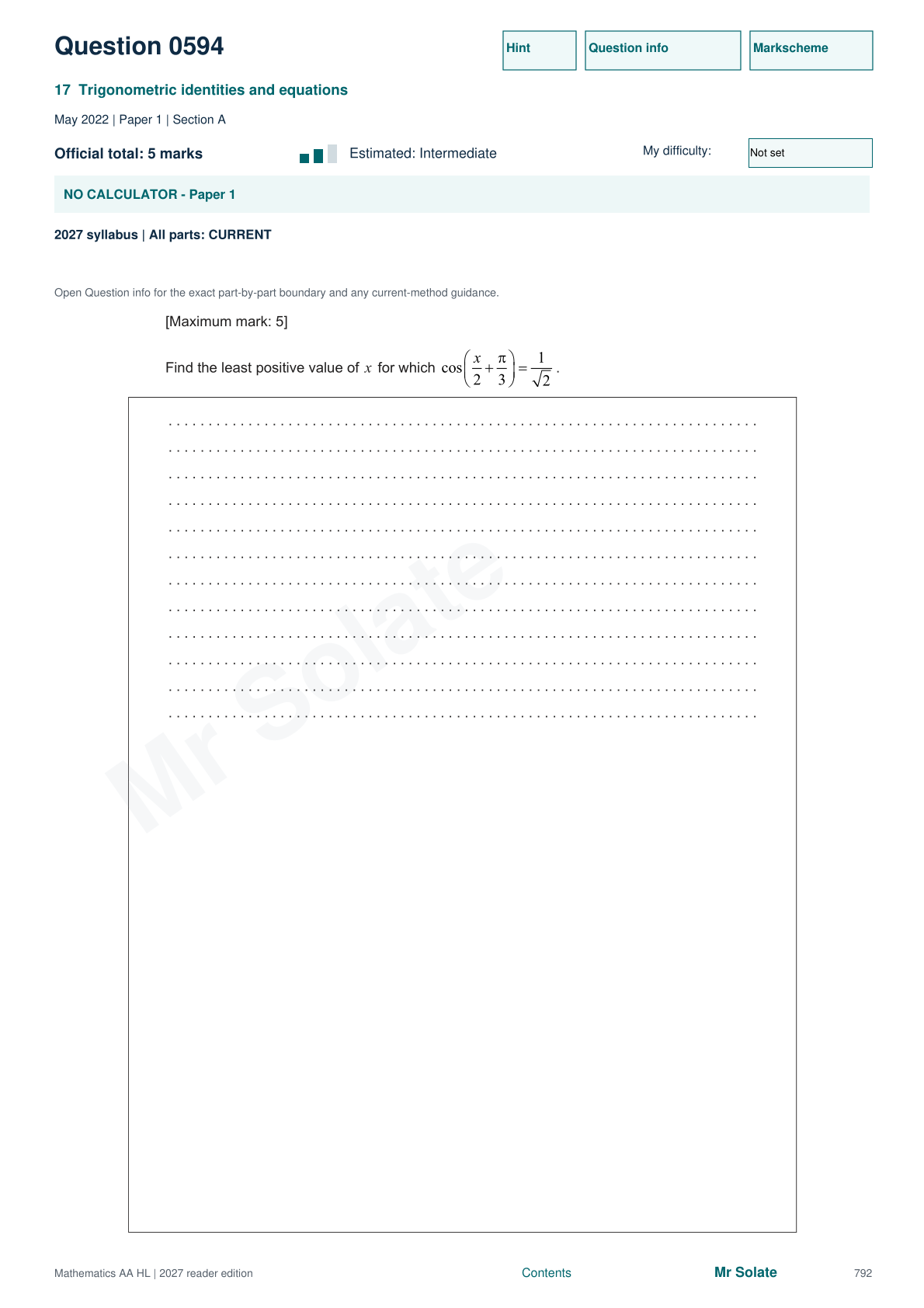
Question 594
Apply the method to the original question.
Compatibility: The listed concepts and solution methods are current AA HL content.
View the original question
Original page images preserve the equations and diagrams. Write your response before revealing the reasoning.
Reveal the revision reasoning
Let θ=x/2+π/3. Then cosθ=1/√2 at θ=±π/4+2kπ.
The angle π/4 gives a negative x and cannot be used. The next admissible angle above π/3 is 7π/4.
Solve x/2+π/3=7π/4 to obtain x=17π/6, the least positive value.
Editorial revision reasoning. Check the original answer for its marking detail.
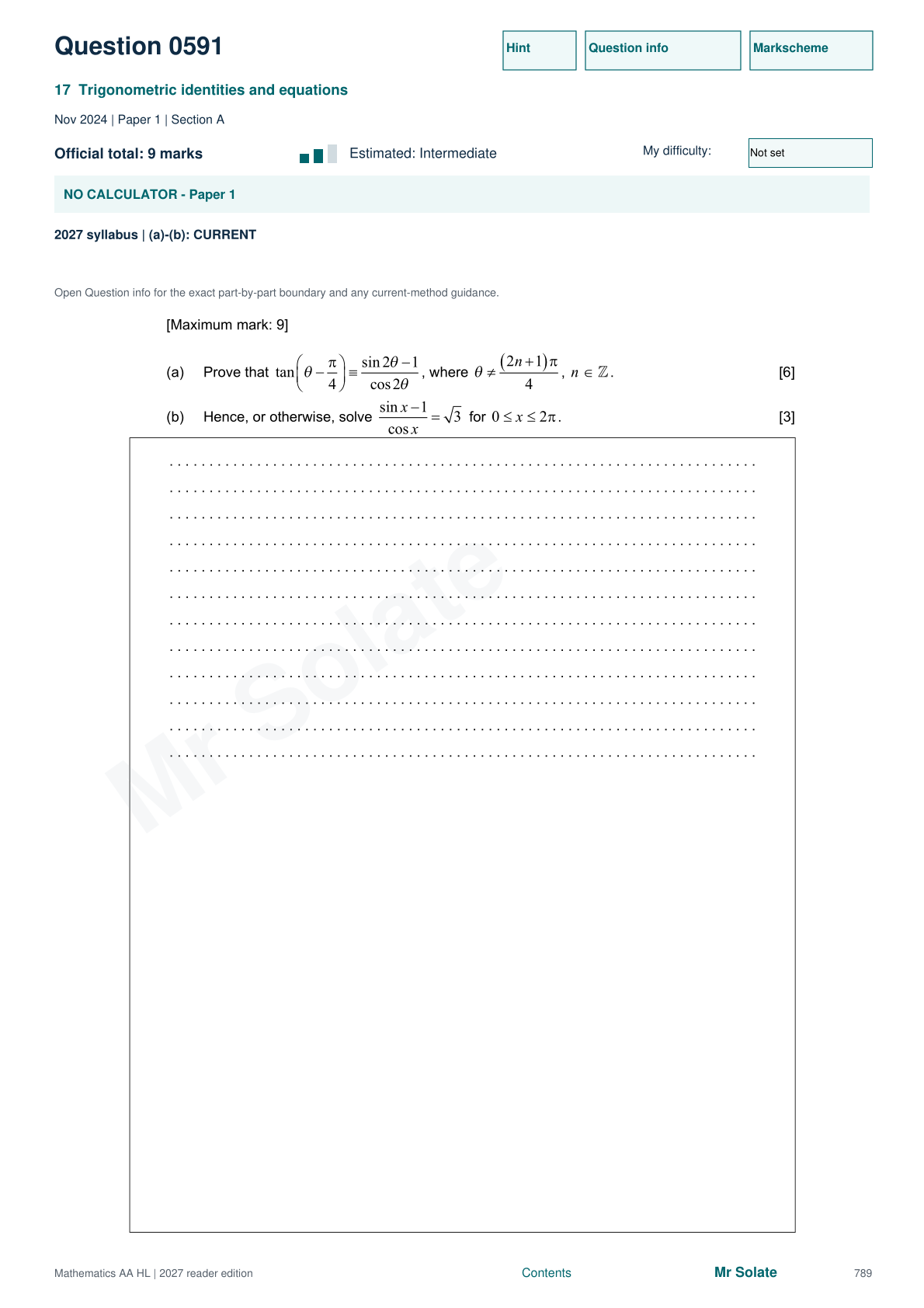
Question 591
Apply the method to the original question.
Compatibility: All parts test current AA HL content and can be solved using current syllabus methods.
View the original question
Original page images preserve the equations and diagrams. Write your response before revealing the reasoning.
Reveal the revision reasoning
Expand tan(θ-π/4) as (sinθ-cosθ)/(cosθ+sinθ). This route avoids dividing by cosθ alone.
Multiply numerator and denominator by cosθ-sinθ. The numerator becomes 2sinθcosθ-1 and the denominator becomes cos²θ-sin²θ.
Double-angle identities give (sin2θ-1)/cos2θ, as required on the stated domain.
For part (b), set θ=x/2. The equation becomes tan(x/2-π/4)=√3, so x/2-π/4=π/3+nπ.
Thus x=7π/6+2nπ. The only value in [0,2π] is 7π/6, and it does not make cos x zero.
Editorial revision reasoning. Check the original answer for its marking detail.
All 44 questions in this topic
Close your notes first
Can you retrieve the method?
1. Why factor instead of dividing by sinx?
Check answer 1
Division would discard solutions where sinx=0.
2. What interval does 2x cover if 0≤x≤π?
Check answer 2
0≤2x≤2π.
3. How is R found in a cosx+b sinx?
Check answer 3
R=√(a²+b²).
Before you move on
- Circle each algebraic trig value before solving angles. Count the branches using a unit-circle sketch and inspect interval endpoints separately.
- Substitute candidate angles into the original expression when denominators or squaring were involved.
Your revision note
Record one missed cue, one corrected step and one question to retry. Saved only in this browser.