Start with the exam
What you need to be able to do
A linear-system question often wants a classification, not just a numerical solution. Elimination reveals whether the equations identify one point, leave a free parameter, or contradict one another. The bank frequently includes a parameter controlling these cases. Keep that parameter symbolic until you identify the exceptional values. A calculator solution can support ordinary numerical work, but an error message does not prove whether there are no solutions or infinitely many.
Spend 3 minutes reading the overview and diagram, 7 minutes learning the question patterns, 5 minutes writing out the worked example, and 5 minutes on a bank question or recall check. Take longer when you need to; the full bank is here for later practice.
Recognise → set up → write
How the questions are set
Solve a numerical system
Recognise it: Three linear equations or a word problem giving three totals appears.
- Define each unknown with units if it represents a price or quantity.
- Eliminate one variable from two pairs of equations, solve the resulting two-variable system, then back-substitute.
- Check all three original equations; this detects arithmetic slips and equations entered in the wrong variable order.
Label operations, for example E_3−2E_1. Write the reduced equations instead of only giving calculator outputs.
Changing variable order between rows silently changes the system.
Find exceptional parameter values
Recognise it: The question asks for no unique solution, consistency or parameter restrictions.
- Eliminate without dividing by a parameter expression until necessary. A final equation may have form A(k)z=B(k).
- If A(k)≠0, the final variable is determined. If A(k)=0, substitute each exceptional k into the reduced and original equations.
- Distinguish 0=nonzero, which is impossible, from 0=0, which merely removes a constraint.
Show both the vanishing coefficient and the resulting constant at each exceptional value.
A zero coefficient alone does not prove infinitely many solutions; another equation may still contradict the system.
Describe infinitely many solutions
Recognise it: Elimination leaves a redundant row and fewer independent equations than variables.
- Choose a free variable such as z=t, then express every other variable in terms of t.
- State the full solution triple, with t ranging over the real numbers unless the context restricts it.
- Verify by substituting the general triple into every original equation, not just one selected example.
Write (x,y,z)=base point+t(direction). This shows the line of solutions and includes all choices.
A single solution at the exceptional parameter is not a description of the full solution set.
Write it before you reveal it
A worked exam-style example
Original teaching example, created for this lesson.
Original practice: solve x+y+z=6, x−y+z=2, and 2x+2z=8.
Reveal the worked solution
- Subtract the second equation from the first to get 2y=4, so y=2.
- The first equation then gives x+z=4. The third equation is exactly twice this relation.
- Set z=t. Then x=4−t and y=2.
Answer: (x,y,z)=(4−t,2,t), t real; infinitely many solutions.
Check: Substitution gives 6, 2 and 8 in the three equations for every t. No extra condition fixes t.
From your own collection
Apply it to past-paper questions
These questions anchor the patterns above. Attempt one without the answer, then compare your setup and conclusion with the reasoning. The linked reader contains the source answer and the question-specific syllabus review.
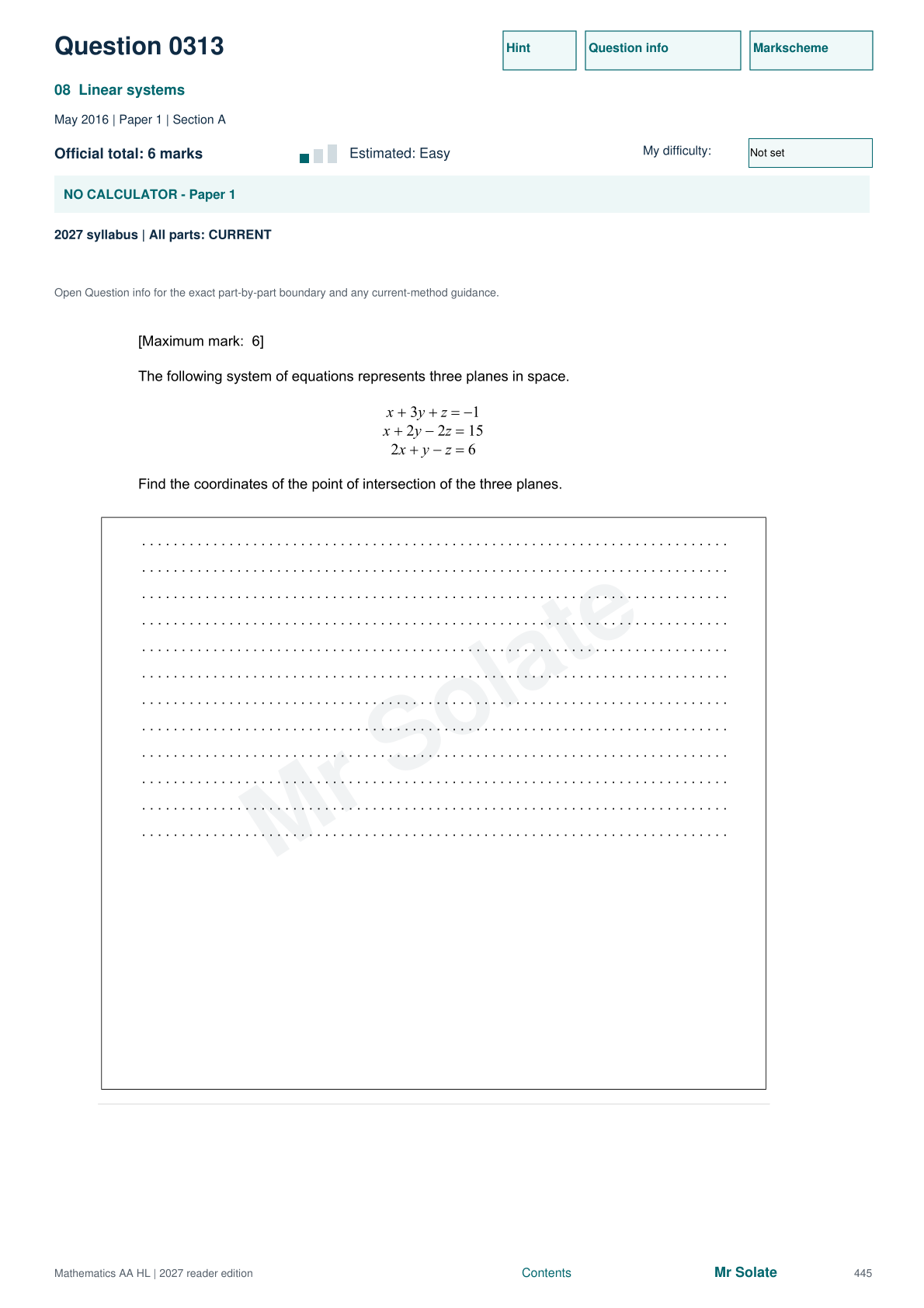
Question 313
Direct use of Three simultaneous linear equations; Intersection point. Elimination gives y+3z=−16 and −5y−3z=8.
Compatibility: All parts: The tested content remains current AA HL: Three simultaneous linear equations; Intersection point.
View the original question
Original page images preserve the equations and diagrams. Write your response before revealing the reasoning.
Reveal the revision reasoning
- Elimination gives y+3z=−16 and −5y−3z=8.
- Add these to find y=2, then z=−6.
- Back-substitution gives x=−1.
- Thus the common point is (−1,2,−6).
Editorial revision reasoning. Check the original answer for its marking detail.
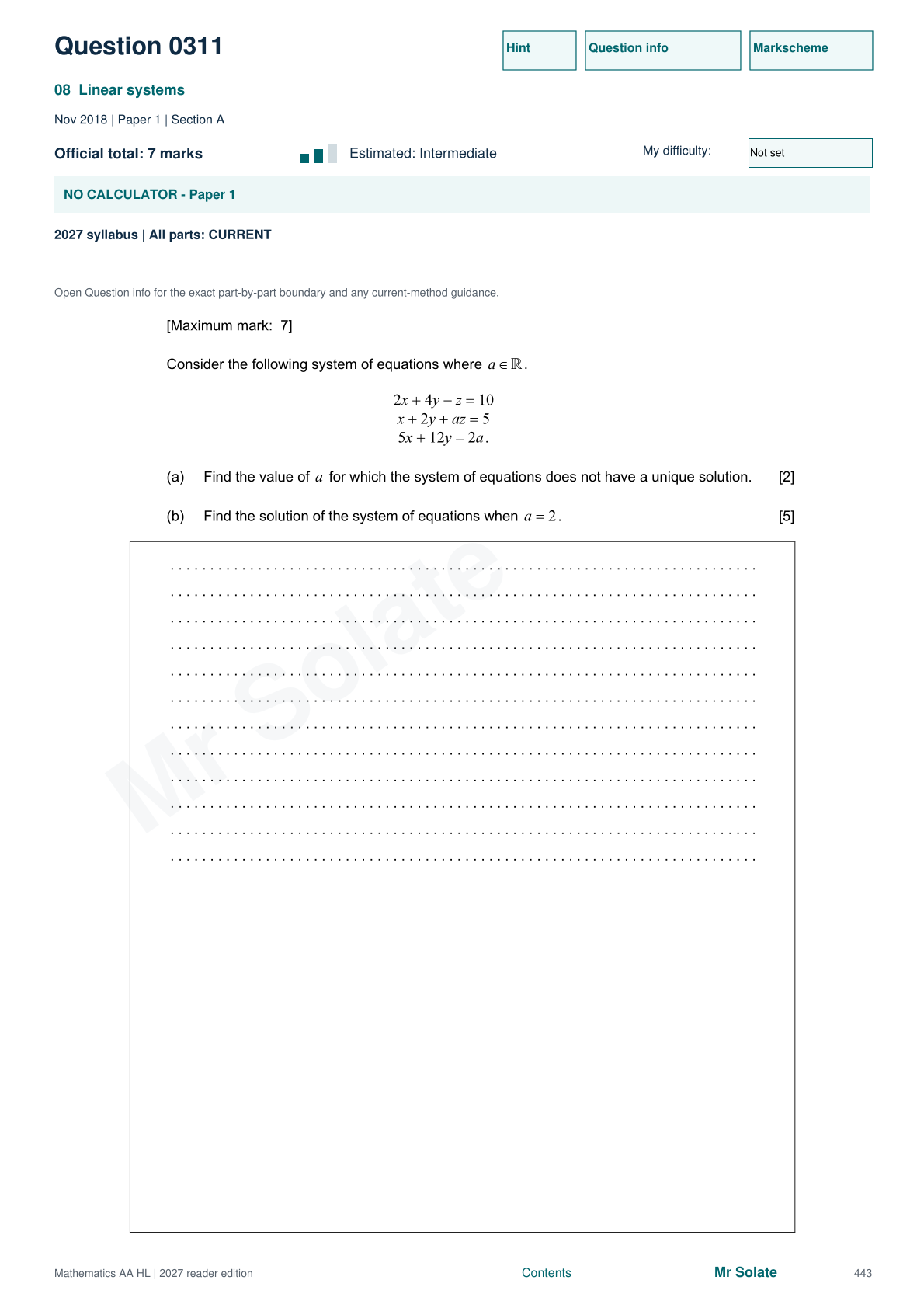
Question 311
Apply the method to the original question.
Compatibility: The required concepts and methods match current AA HL. The original source is a 2018 Mathematics HL paper.
View the original question
Original page images preserve the equations and diagrams. Write your response before revealing the reasoning.
Reveal the revision reasoning
Subtracting twice equation two from equation one gives -(1+2a)z=0.
When a=-1/2, the first two equations coincide. The remaining independent equation leaves one free variable, so the system is not unique.
When a=2, the same subtraction gives z=0. Then x+2y=5 and 5x+12y=4.
Eliminate x to obtain 2y=-21, hence y=-21/2 and x=26.
Editorial revision reasoning. Check the original answer for its marking detail.
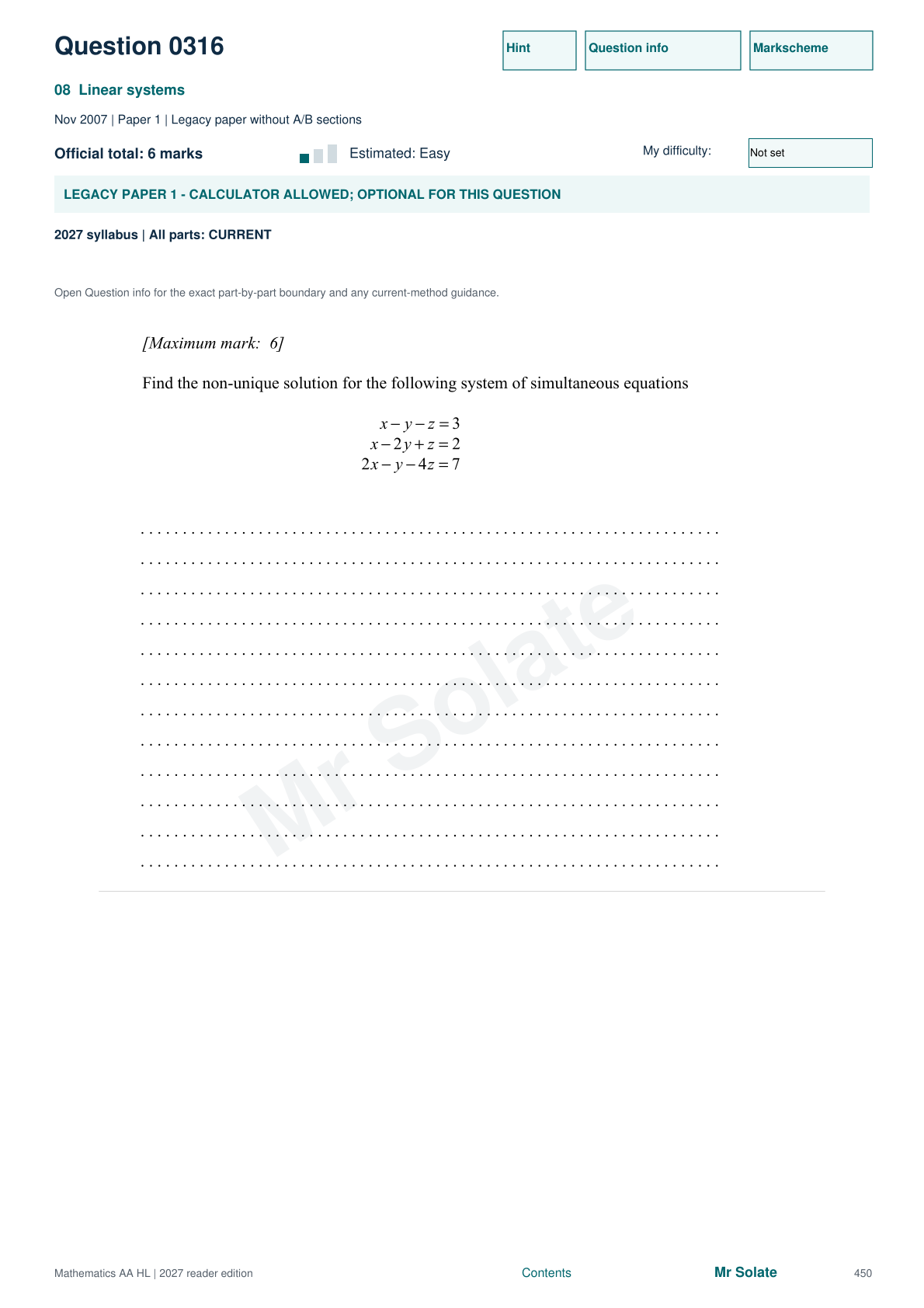
Question 316
Direct use of Dependent linear system; Free parameter. Elimination leaves only two independent equations.
Compatibility: All parts: The tested content remains current AA HL: Dependent linear system; Free parameter; General solution.
View the original question
Original page images preserve the equations and diagrams. Write your response before revealing the reasoning.
Reveal the revision reasoning
- Elimination leaves only two independent equations.
- Set z=t and solve the remaining relations for y and x.
- This gives y=2t+1 and x=3t+4, with z=t.
- Every real t gives a solution, so a single numerical triple is incomplete.
Editorial revision reasoning. Check the original answer for its marking detail.
All 22 questions in this topic
Close your notes first
Can you retrieve the method?
1. What does a reduced row 0=5 mean?
Check answer 1
The system is inconsistent and has no solution.
2. What does 0=0 mean?
Check answer 2
That row is redundant; inspect the remaining independent equations.
3. Why avoid dividing by k−2 immediately?
Check answer 3
It would remove the exceptional case k=2 before it has been examined.
Before you move on
- Keep a separate short line for every exceptional parameter value. State no solution, one solution or infinitely many solutions with its reason.
- In applications, check positivity or integer constraints after solving the algebraic system.
Your revision note
Record one missed cue, one corrected step and one question to retry. Saved only in this browser.