Start with the exam
What you need to be able to do
Inverse trigonometric functions return principal angles, so their ranges are part of the calculation. The bank uses sums and differences of arctangents, arccos graphs and equations where squaring can add extraneous roots. Introduce angle names and write their principal ranges before applying a compound-angle identity. Finding equal sines, cosines or tangents does not automatically prove two angles are equal.
Spend 3 minutes reading the overview and diagram, 7 minutes learning the question patterns, 5 minutes writing out the worked example, and 5 minutes on a bank question or recall check. Take longer when you need to; the full bank is here for later practice.
Recognise → set up → write
How the questions are set
Principal values and graphs
Recognise it: Simplify arcsin(sinθ), sketch arccos or find inverse-trig domains.
- Use arcsin values in [−π/2,π/2], arccos in [0,π], and arctan in (−π/2,π/2).
- Find the principal angle with the same trig value, rather than simply cancelling inverse symbols.
- For arcsin/arccos input expressions require values between −1 and 1; transform endpoints on the graph.
State the principal range used when selecting a value.
arccos(cosθ)=θ only when θ lies in the arccos principal range.
Sum and difference of inverse angles
Recognise it: An expression such as arctan a+arctan b appears.
- Let A=arctan a and B=arctan b. Then tan A=a and tan B=b.
- Use tan(A+B)=(a+b)/(1−ab), provided the denominator is nonzero; handle a zero denominator through angle information.
- Locate A+B before identifying the angle. If its tangent is negative but the sum is positive and obtuse, use the second-quadrant angle.
Show a range or quadrant argument after the compound-angle calculation.
Taking arctan of a tangent can shift a sum by π.
Equations and exact triangle values
Recognise it: An inverse-trig equation leads to radicals or a sum of arccos terms.
- Name each inverse expression as an angle in its principal range, then express sine or cosine through a right triangle or identity.
- Apply the compound formula with the correct square-root signs.
- If you square to remove radicals, test every candidate in the original inverse-trig equation.
Write the sign choice, such as sin A≥0 for A∈[0,π], before replacing sine by √(1−cos²A).
Squaring may preserve the algebraic relation while losing the required angle sum.
Write it before you reveal it
A worked exam-style example
Original teaching example, created for this lesson.
Original practice: evaluate arctan(1/2)+arctan(1/3).
Reveal the worked solution
- Let the two angles be A and B. Both are positive and less than π/4, so 0<A+B<π/2.
- tan(A+B)=[1/2+1/3]/[1−1/6]=(5/6)/(5/6)=1.
- The unique angle in (0,π/2) with tangent 1 is π/4.
Answer: π/4.
Check: The range argument excludes π/4+π and makes the inverse step valid.
From your own collection
Apply it to past-paper questions
These questions anchor the patterns above. Attempt one without the answer, then compare your setup and conclusion with the reasoning. The linked reader contains the source answer and the question-specific syllabus review.
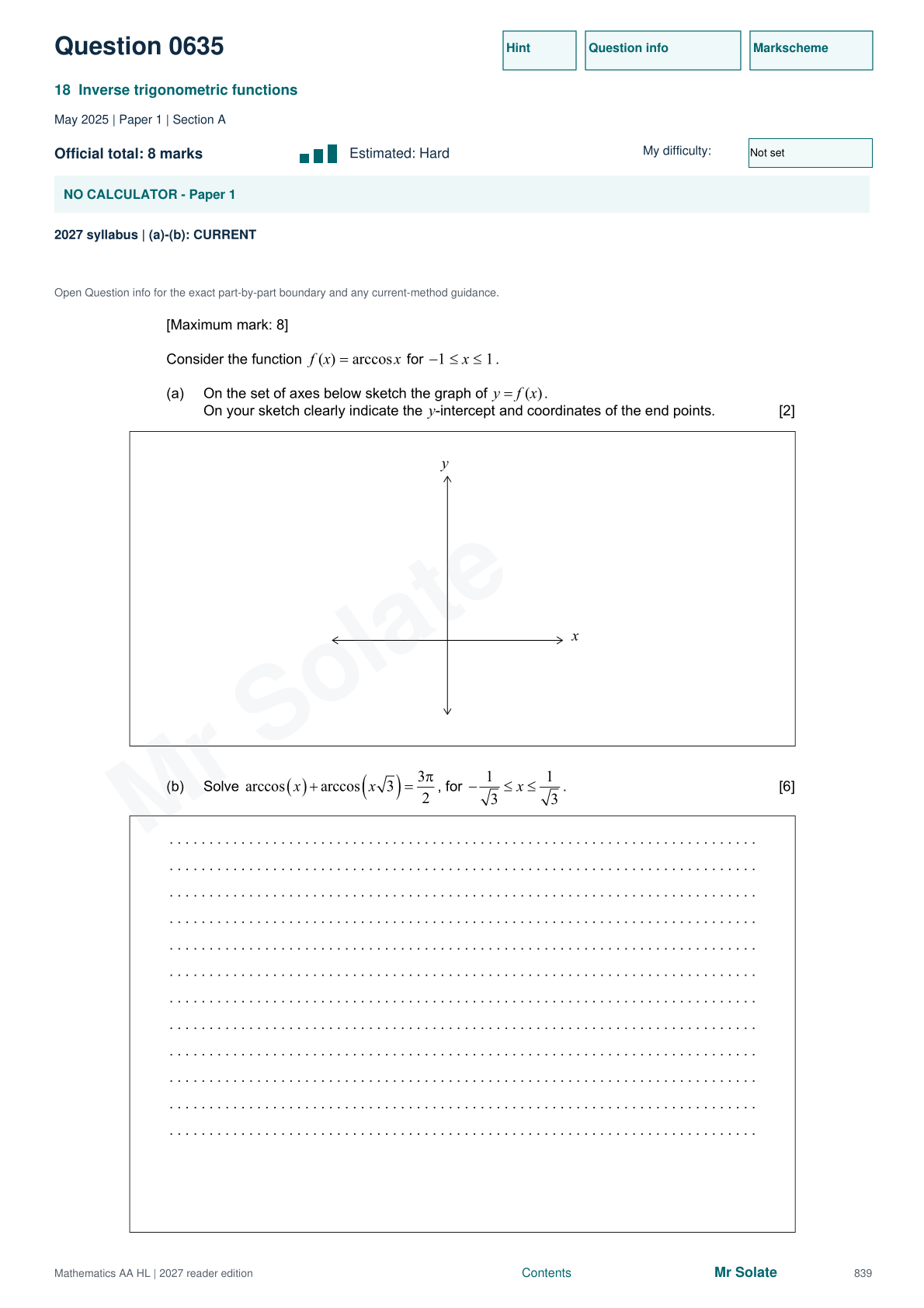
Question 635
Apply the method to the original question.
Compatibility: All parts test current AA HL content and can be solved using current syllabus methods.
View the original question
Original page images preserve the equations and diagrams. Write your response before revealing the reasoning.
Reveal the revision reasoning
The principal arccos curve decreases from (-1,π) through (0,π/2) to (1,0).
Let A=arccos x and B=arccos(√3x). Their sines are nonnegative, giving sin A=√(1-x²) and sin B=√(1-3x²).
Taking cosine of A+B=3π/2 yields √3x²-√((1-x²)(1-3x²))=0.
Squaring gives 3x⁴=1-4x²+3x⁴, so x=±1/2.
For x=1/2 both angles are acute and their sum is π/2, not 3π/2. For x=-1/2 they are 2π/3 and 5π/6, summing to 3π/2.
Thus x=-1/2 is the sole solution in [-1/√3,1/√3].
Editorial revision reasoning. Check the original answer for its marking detail.
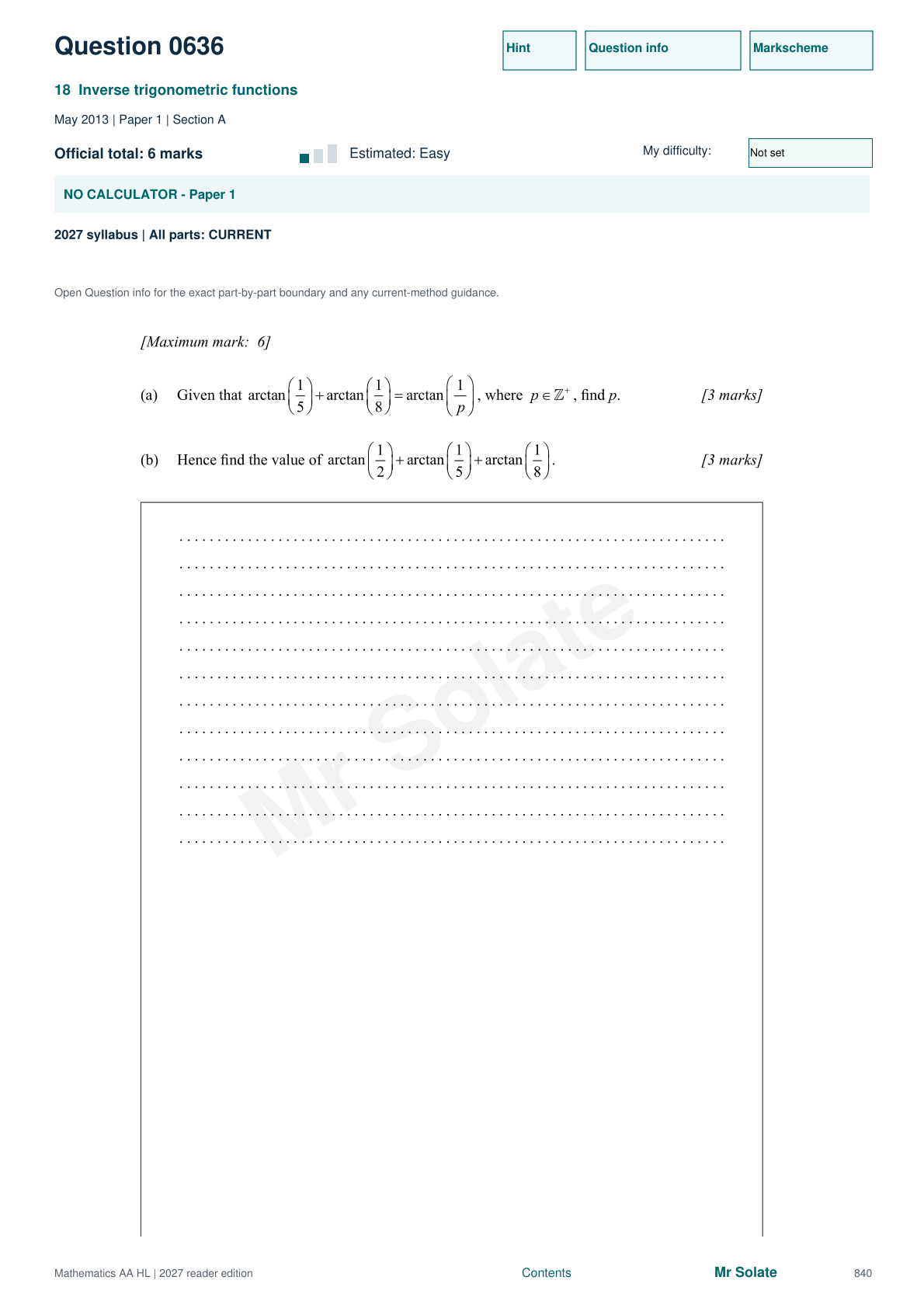
Question 636
Direct application of Tangent addition identity, Exact inverse-trigonometric sum.
Compatibility: All parts: The tested methods are current AA HL: Tangent addition identity, Exact inverse-trigonometric sum.
View the original question
Original page images preserve the equations and diagrams. Write your response before revealing the reasoning.
Reveal the revision reasoning
- Apply tan(A+B) to A=arctan(1/5) and B=arctan(1/8).
- Simplify the rational result to 1/3, so compare with 1/p.
- Combine arctan(1/2) with arctan(1/3) using the same addition formula.
- The sum is acute and has tangent 1, identifying the exact angle.
Editorial revision reasoning. Check the original answer for its marking detail.
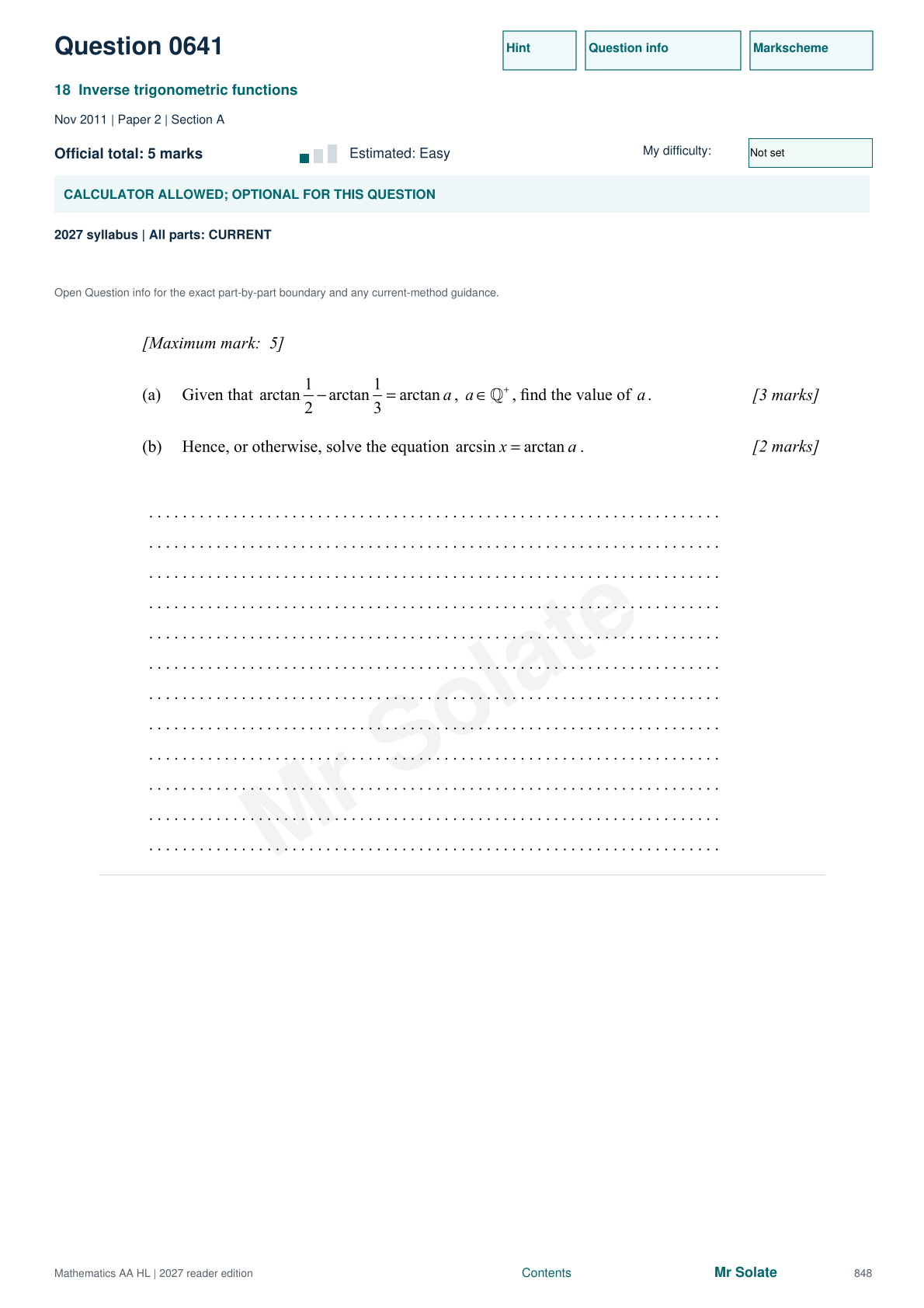
Question 641
Direct application of Tangent subtraction, Inverse-trigonometric composition, Right-triangle ratios.
Compatibility: All parts: The tested methods are current AA HL: Tangent subtraction, Inverse-trigonometric composition, Right-triangle ratios.
View the original question
Original page images preserve the equations and diagrams. Write your response before revealing the reasoning.
Reveal the revision reasoning
- Use tan(A−B)=(tanA−tanB)/(1+tanA tanB) with tangents 1/2 and 1/3.
- This gives a=1/7.
- For θ=arctan(1/7), use opposite side 1, adjacent side 7 and hypotenuse sqrt50.
- Since arcsin x=θ, take x=sinθ.
Editorial revision reasoning. Check the original answer for its marking detail.
Close your notes first
Can you retrieve the method?
1. What is the range of arccos?
Check answer 1
[0,π].
2. What is arcsin(sin(5π/6))?
Check answer 2
π/6, the principal angle with sine 1/2.
3. Why check a candidate after squaring?
Check answer 3
Squaring can introduce a value with the wrong radical sign or principal-angle relation.
Before you move on
- Draw a small triangle for exact sine/cosine of an arctangent; its sides are the tangent numerator, denominator and hypotenuse.
- Attach an interval to every named inverse angle. It is often the shortest justification for the final answer.
Your revision note
Record one missed cue, one corrected step and one question to retry. Saved only in this browser.