Start with the exam
What you need to be able to do
These questions turn a probability table into several connected answers. First distinguish each value of X from its probability, then choose the correct weighted sum. The bank includes missing probabilities, dice maxima, waiting times and winnings. A stated mean is an equation; an expected value need not be a possible individual outcome.
Spend 3 minutes reading the overview and diagram, 7 minutes learning the question patterns, 5 minutes writing out the worked example, and 5 minutes on a bank question or recall check. Take longer when you need to; the full bank is here for later practice.
Recognise → set up → write
How the questions are set
Complete a distribution
Recognise it: A probability table contains an unknown constant or missing entries.
- List distinct outcomes and combine repeated die labels into one outcome with the appropriate probability.
- Use Σp=1. If a mean is given, add Σxp=μ and solve the simultaneous equations.
- Test every candidate against all probabilities being between zero and one. A valid algebraic root need not produce a valid distribution.
Show the normalisation and mean equations before solving. Explain any rejected candidate by a specific probability restriction.
A negative coefficient is not automatically invalid; check the resulting probabilities.
Moments and winnings
Recognise it: Find an expected score, variance, standard deviation or net payoff.
- Build columns xp and x²p. Their sums are E(X) and E(X²). Compute Var(X)=E(X²)−[E(X)]².
- For Y=aX+b, use E(Y)=aE(X)+b and Var(Y)=a²Var(X). A fixed entry fee changes the mean but not the variance.
- For probability above the mean, compare every allowed outcome with the unrounded mean and add only qualifying probabilities.
Display the weighted sum using actual outcome values, then state the requested statistic with units.
E(X²) is not the square of E(X). Standard deviation is the square root of variance.
Build a maximum or waiting-time distribution
Recognise it: The variable is constructed from two dice or repeated trials.
- For a maximum M, begin with P(M≤m)=P(both outcomes≤m). Multiply individual cumulative probabilities only under independence.
- Recover a mass by P(M=m)=P(M≤m)−P(M≤m−1). For a sum, count all ordered pairs producing that sum.
- For a waiting time, define whether the successful trial is included. Without replacement, update each branch probability as the sample changes.
Show the event or ordered-pair table behind the probability. This is the justification for the distribution you later use.
Sampling without replacement does not give independent trials with a fixed success probability.
Write it before you reveal it
A worked exam-style example
Original teaching example, created for this lesson.
Original example: X takes 0, 1, 2 with probabilities k, 2k, k. Find the mean, variance and expected net payoff 3X−2.
Reveal the worked solution
- 4k=1 gives k=1/4.
- E(X)=0(1/4)+1(1/2)+2(1/4)=1.
- E(X²)=1/2+4/4=3/2; Var(X)=3/2−1=1/2.
- E(3X−2)=3(1)−2=1.
Answer: k=1/4, mean 1, variance 1/2, expected net payoff 1.
Check: The distribution is symmetric about 1, agreeing with its mean.
From your own collection
Apply it to past-paper questions
These questions anchor the patterns above. Attempt one without the answer, then compare your setup and conclusion with the reasoning. The linked reader contains the source answer and the question-specific syllabus review.
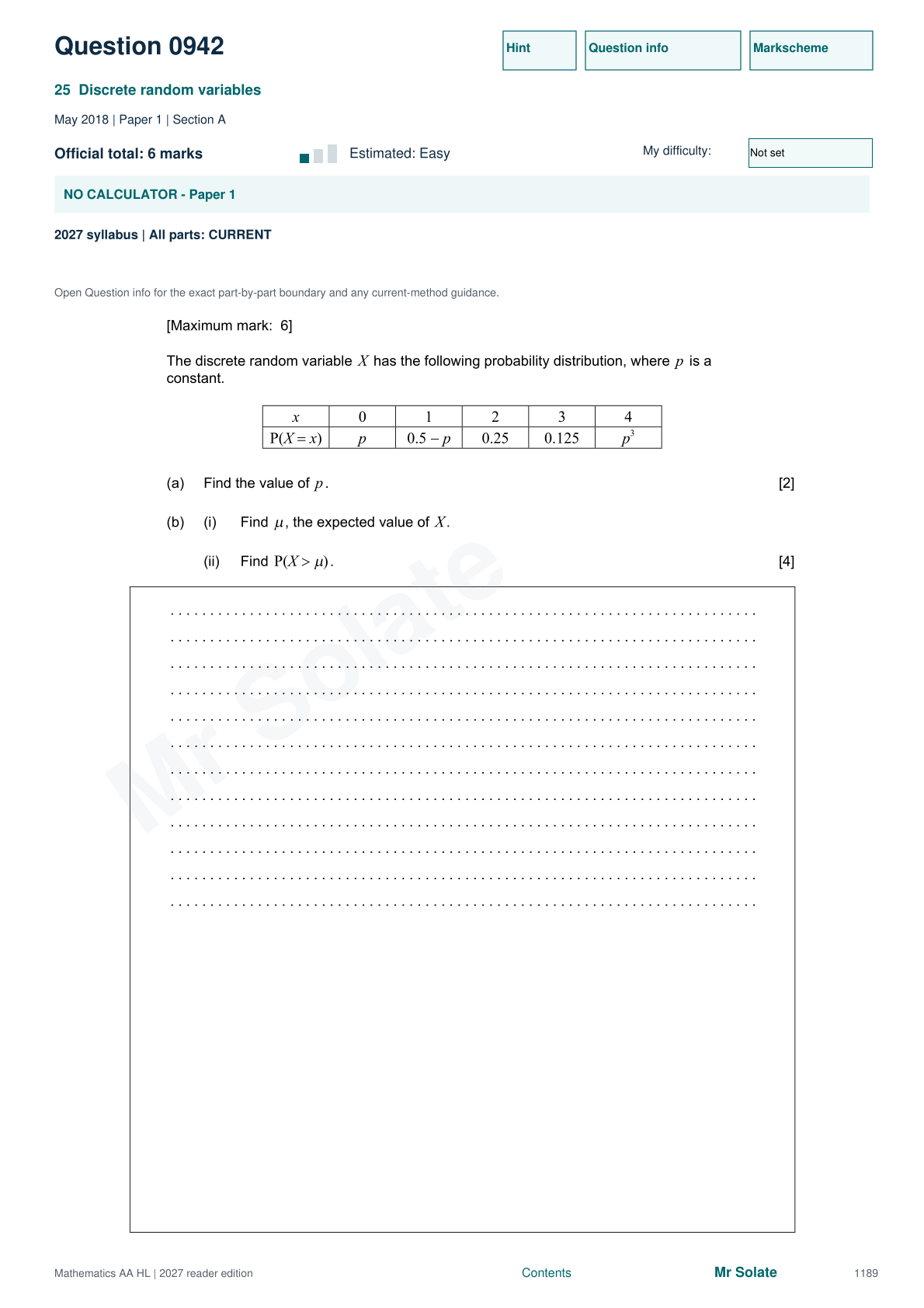
Question 942
Apply the method to the original question.
Compatibility: The tested concepts and formulas are retained in current AA HL. This source is a 2018 Mathematics HL paper.
View the original question
Original page images preserve the equations and diagrams. Write your response before revealing the reasoning.
Reveal the revision reasoning
Adding all five probabilities gives 0.875+p³=1, so p³=0.125 and p=0.5.
The resulting probabilities at 0,1,2,3,4 are 1/2,0,1/4,1/8,1/8.
The expectation is 0+0+2/4+3/8+4/8=11/8.
The outcomes exceeding 11/8 are 2,3,4, so P(X>µ)=1/4+1/8+1/8=1/2.
Editorial revision reasoning. Check the original answer for its marking detail.
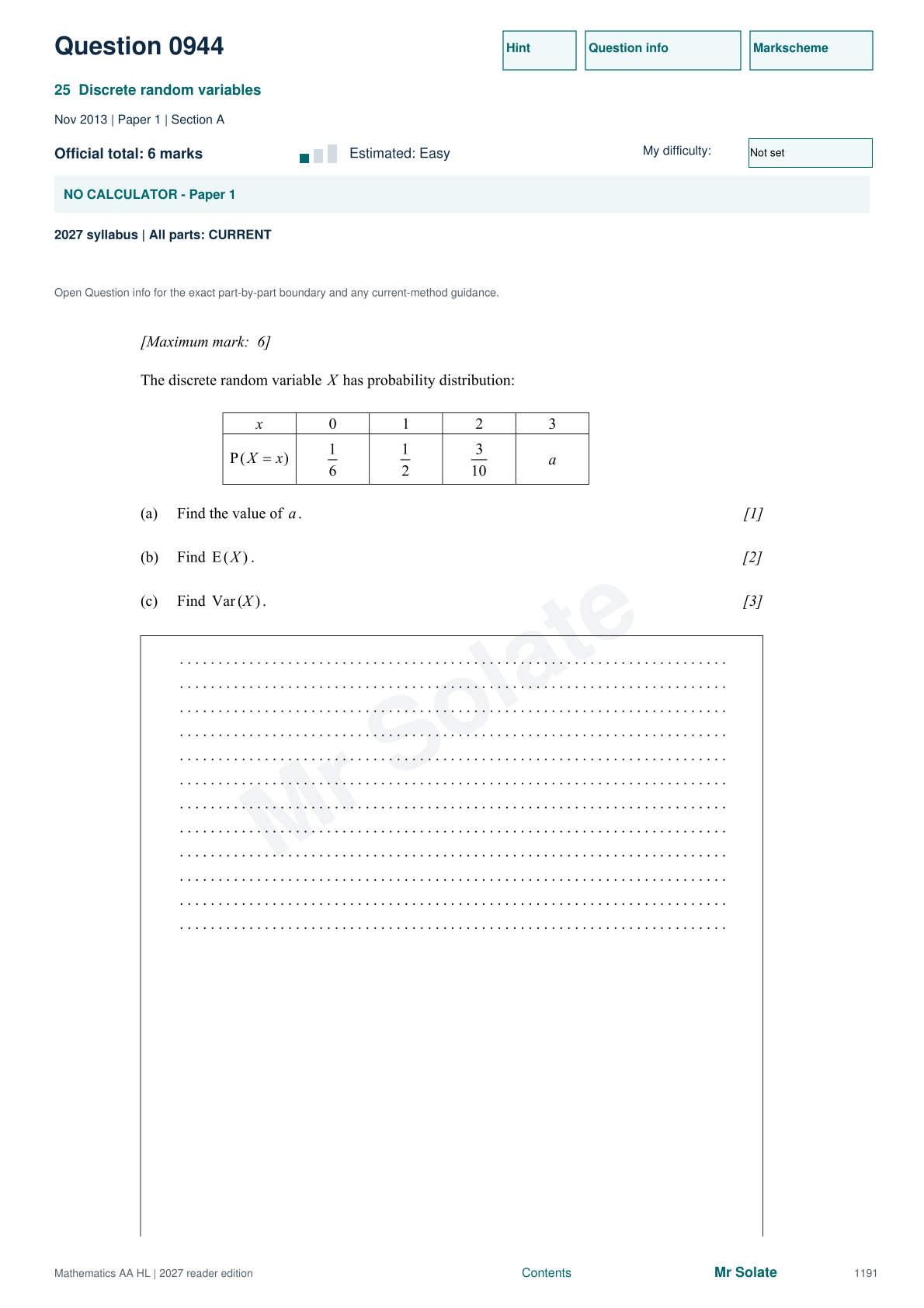
Question 944
Direct application of Missing probability, Discrete first and second moments.
Compatibility: All parts: The tested methods are current AA HL: Missing probability, Discrete first and second moments.
View the original question
Original page images preserve the equations and diagrams. Write your response before revealing the reasoning.
Reveal the revision reasoning
- Subtract 1/6+1/2+3/10 from one to obtain a=1/30.
- Calculate E(X)=1(1/2)+2(3/10)+3(1/30)=6/5.
- Calculate E(X²)=1/2+4(3/10)+9(1/30)=2.
- Subtract (6/5)² to give variance 14/25.
Editorial revision reasoning. Check the original answer for its marking detail.
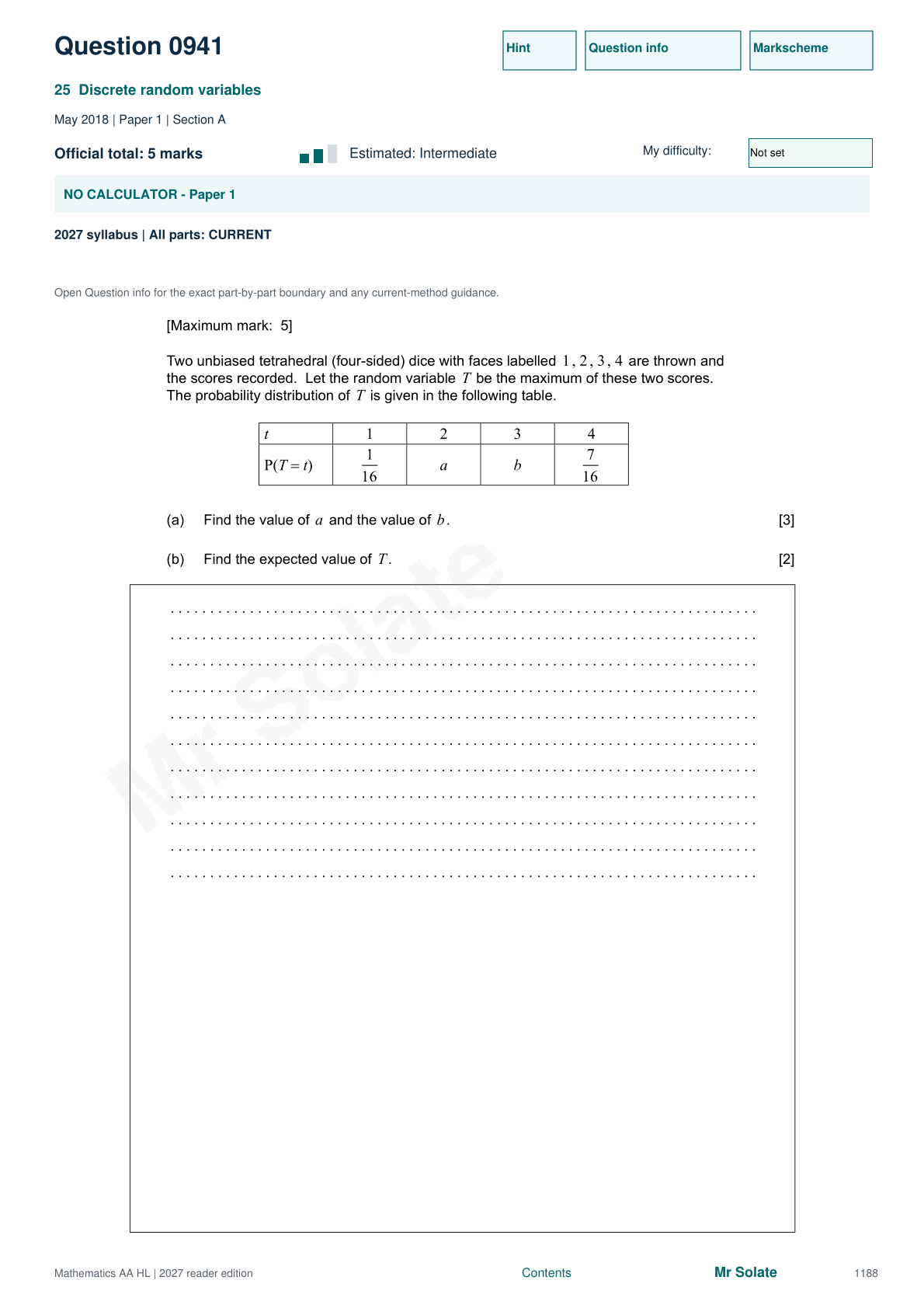
Question 941
Apply the method to the original question.
Compatibility: All tested methods remain in current AA HL; the original question is from the 2018 Mathematics HL syllabus.
View the original question
Original page images preserve the equations and diagrams. Write your response before revealing the reasoning.
Reveal the revision reasoning
The two independent fair four-sided dice produce 16 equally likely ordered pairs.
There are t² pairs with maximum at most t. Subtract (t-1)² to obtain 2t-1 pairs with maximum exactly t.
Thus a=3/16 and b=5/16; together with the given entries the probabilities sum to 1.
Weight each possible maximum by its probability: E(T)=(1+6+15+28)/16=25/8.
Editorial revision reasoning. Check the original answer for its marking detail.
All 23 questions in this topic
Close your notes first
Can you retrieve the method?
1. What normalises a distribution?
Check answer 1
The sum of all probabilities is one.
2. Does a fixed fee change variance?
Check answer 2
No; subtracting a constant does not change spread.
3. How do you recover a maximum mass from its CDF?
Check answer 3
Subtract consecutive cumulative probabilities.
Before you move on
- Reproduce both moment formulas without looking.
- Attempt one table question and one constructed-distribution question.
- Check support, probability bounds and whether a payoff is gross or net.
Your revision note
Record one missed cue, one corrected step and one question to retry. Saved only in this browser.