Start with the exam
What you need to be able to do
The legacy Geometry option includes conic focal properties, Ceva, Menelaus, harmonic division and classical circle theorems. These are not all compulsory current AA HL facts. Coordinate algebra, similarity, distance and implicit differentiation remain useful transferable methods. Read the old question’s supplied definitions and the bank’s part-by-part notes, then separate what can be derived from current methods from what requires a legacy theorem.
Spend 3 minutes reading the overview and diagram, 7 minutes learning the question patterns, 5 minutes writing out the worked example, and 5 minutes on a bank question or recall check. Take longer when you need to; the full bank is here for later practice.
This collection contains content outside the current course, or a mixture of current and legacy skills. Use the compatibility note for each original question to decide which parts to practise for your exam.
Recognise → set up → write
How the questions are set
Build a locus from distances or midpoints
Recognise it: A moving point is equidistant from a focus and line, or a midpoint traces a curve.
- Introduce coordinates for the moving point and express the defining distances. Square only after identifying nonnegative lengths and keep any geometric restrictions.
- For a midpoint M=(u,v) between fixed A=(a,b) and moving P, write P=(2u−a,2v−b) before substitution into the original locus.
- Complete squares to identify centre and axes of a conic when required. Keep translation terms: scaling a locus does not generally leave its centre unchanged.
Show the coordinate substitution that connects the original point and the locus point.
Simply halving coefficients does not find a midpoint locus. A squared distance equation may need its original geometric condition checked.
Tangent and normal to a conic
Recognise it: An implicit curve or line-touching condition is given.
- Differentiate implicitly for a tangent gradient when the current calculus method applies. Use the curve point in the line equation and take a negative reciprocal for a finite nonzero normal slope.
- Alternatively substitute a proposed line into the conic; a repeated intersection root gives a tangency discriminant condition.
- If the question invokes a focal reflection or conic tangent theorem, mark that fact as legacy unless it is supplied. Do not replace a required proof by citing an unestablished property.
Give the derivative or repeated-root equation and explain which geometric contact it represents.
A line’s slope matching a derivative at an unrelated point does not prove tangency.
Ratios, concurrency and circle reasoning
Recognise it: An old part asks for three lines to meet, collinearity or harmonic division.
- Label the triangle sides and division points before applying a legacy ratio theorem. Use a consistent directed-ratio convention for exterior points.
- For Ceva with D on BC, E on CA, F on AB, concurrency is linked to (BD/DC)(CE/EA)(AF/FB)=1 in the usual internal configuration; explain the appropriate converse when proving concurrency.
- For circle arguments, identify equal tangents, cyclic quadrilateral angles or similar triangles explicitly. Build a chain of justified ratios rather than assuming the conclusion from the drawing.
Name the theorem and map each ratio or angle to labelled points.
Ceva concerns concurrency; Menelaus concerns collinearity. Exterior configurations require care with directed signs.
Write it before you reveal it
A worked exam-style example
Original teaching example, created for this lesson.
Original extension example: find the locus equidistant from focus (0,1) and directrix y=−1, then its tangent at (2,1).
Reveal the worked solution
- For P=(x,y), the focus distance is √(x²+(y−1)²); the line distance is |y+1|.
- Squaring gives x²+(y−1)²=(y+1)², hence y=x²/4.
- Differentiate y′=x/2, giving slope 1 at (2,1).
- The tangent is y−1=x−2.
Answer: Locus y=x²/4; tangent y=x−1.
Check: At (2,1), both defining distances equal two. Substituting the tangent gives a repeated root at x=2.
From your own collection
Apply it to past-paper questions
These questions anchor the patterns above. Attempt one without the answer, then compare your setup and conclusion with the reasoning. The linked reader contains the source answer and the question-specific syllabus review.
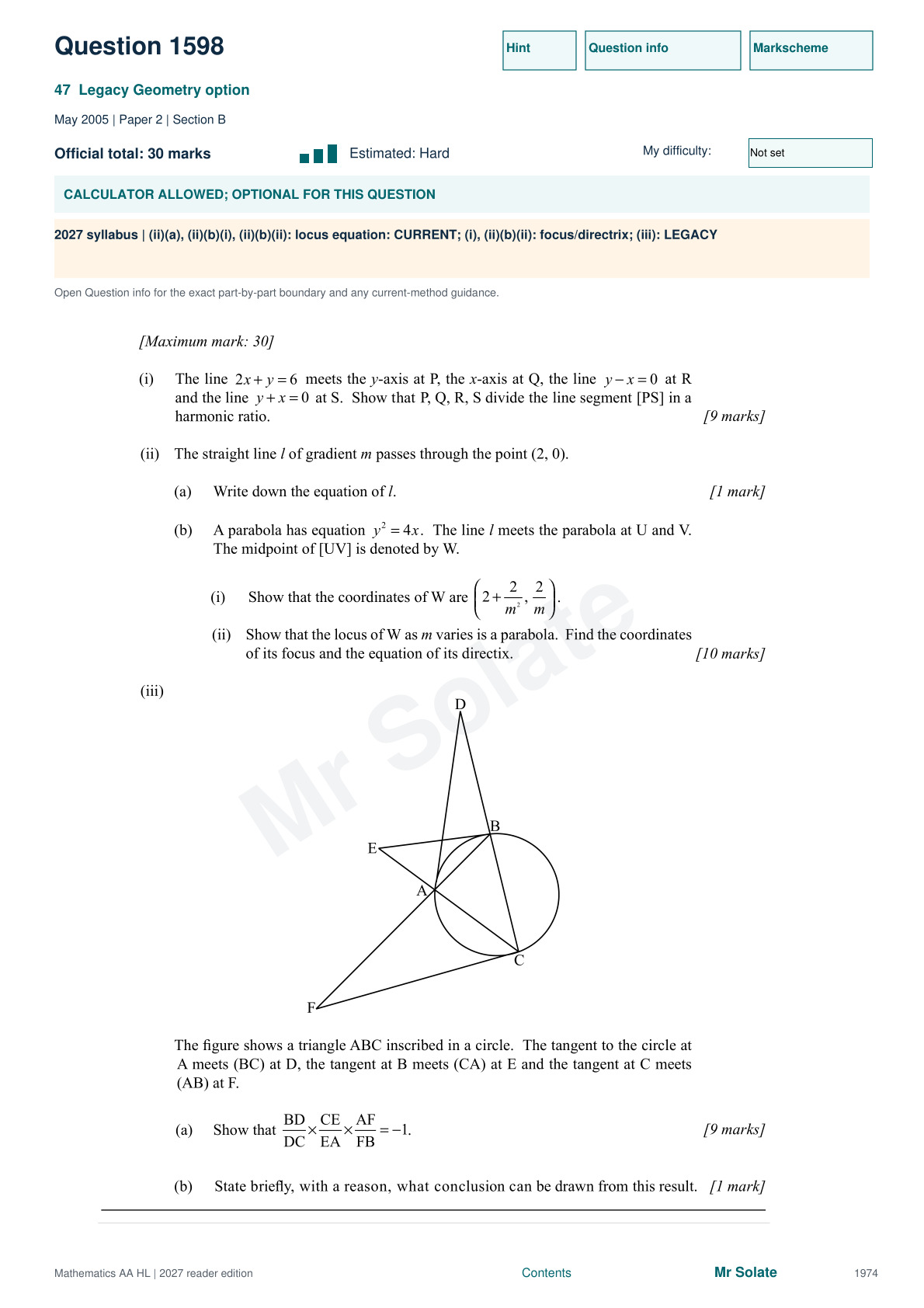
Question 1598
Extended reasoning linking Harmonic division, Line intersections, Vieta and chord midpoint locus.
Compatibility: Current: (ii)(a), (ii)(b)(i), (ii)(b)(ii): locus equation; Legacy: (i), (ii)(b)(ii): focus/directrix; (iii)
View the original question
Original page images preserve the equations and diagrams. Write your response before revealing the reasoning.
Reveal the revision reasoning
- (i) The intersections are P=(0,6), Q=(3,0), R=(2,2), S=(6,-6). Their directed division ratios have magnitudes 2 with opposite signs, proving harmonic division.
- (ii) The line is y=m(x-2). Substitute into y^2=4x: the root sum is 4(1+m^2)/m^2, so the midpoint has x=2+2/m^2 and y=2/m. Eliminating m gives y^2=2(x-2). Its focus is (5/2,0) and directrix x=3/2.
- For finite nonzero m, the vertex (2,0) is a limiting midpoint rather than an attained one; including the vertical chord completes that parabola. The historical answer names the underlying conic.
- (iii) Tangent-secant powers and similar triangles express the magnitude of (BD/DC)(CE/EA)(AF/FB) as a product of squared side ratios; all cancel to 1. Track the directed external divisions to obtain -1. The converse of Menelaus then proves D,E,F are collinear.
Editorial revision reasoning. Check the original answer for its marking detail.
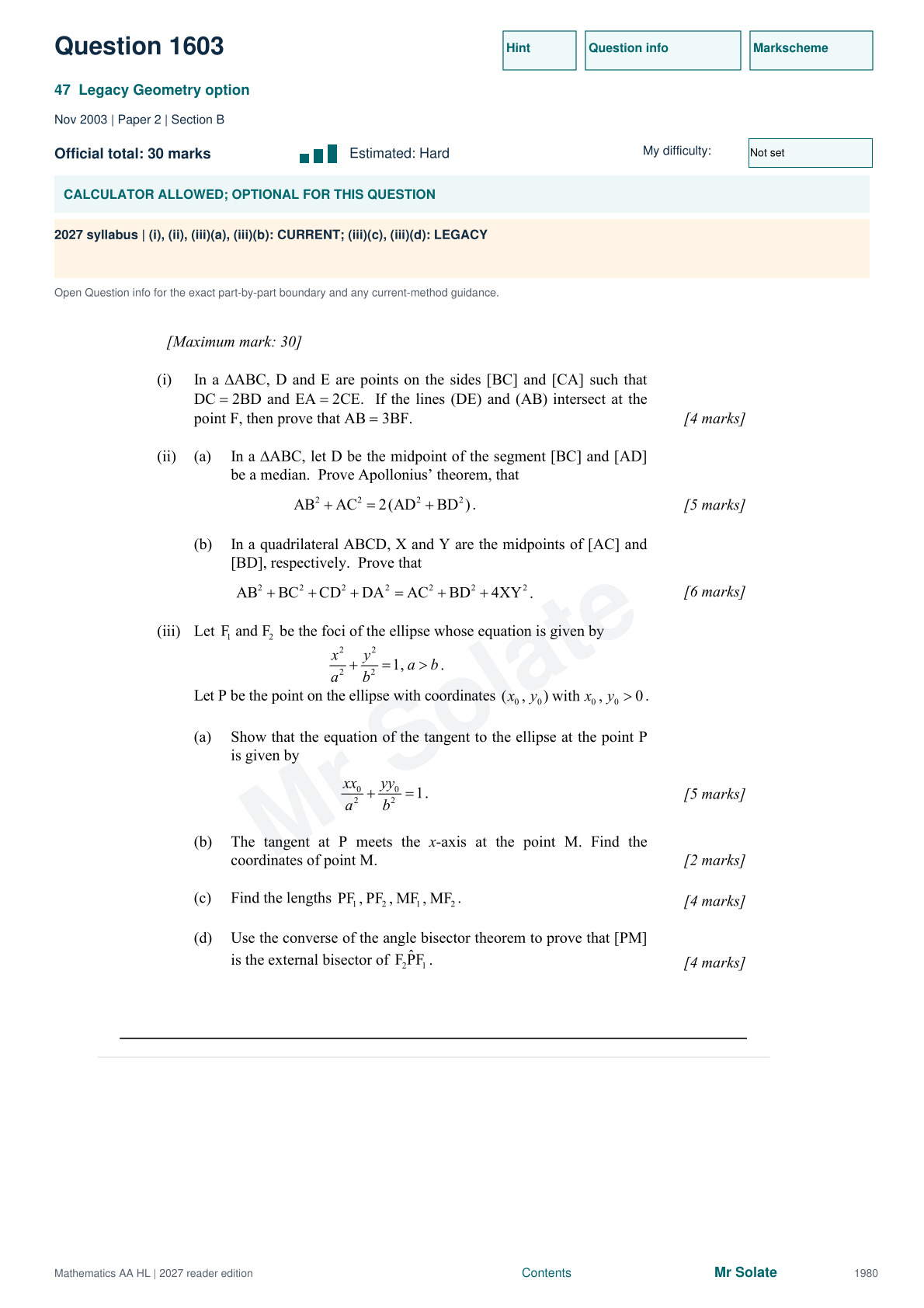
Question 1603
Extended reasoning linking Collinearity and section ratios, Cosine-rule proof of Apollonius, Quadrilateral midpoint identity.
Compatibility: Current: (i), (ii), (iii)(a), (iii)(b); Legacy: (iii)(c), (iii)(d)
View the original question
Original page images preserve the equations and diagrams. Write your response before revealing the reasoning.
Reveal the revision reasoning
- (i) Menelaus gives the directed ratio AF/FB=-4 from BD/DC=1/2 and CE/EA=1/2. With B between A and F, AF=4BF in lengths, so AB=AF-BF=3BF. The same result can be obtained by coordinates.
- (ii)(a) Apply the cosine rule in ABD and ACD. Their angles at D are supplementary and BD=DC, so adding cancels the cosine terms and proves Apollonius. (b) Apply this result in ABC and ADC using midpoint X, then in BXD using midpoint Y. Replace 2AX by AC and 2BY by BD to obtain the stated four-side identity.
- (iii) Implicit differentiation gives slope -b^2*x0/(a^2*y0). The tangent equation simplifies using the equation of P to xx0/a^2+yy0/b^2=1; setting y=0 gives M=(a^2/x0,0).
- Let e=sqrt(a^2-b^2)/a, F1=(ae,0), F2=(-ae,0). Then PF1=a-ex0, PF2=a+ex0, while MF1=(a/x0)(a-ex0) and MF2=(a/x0)(a+ex0). The equal ratios prove the external angle-bisector claim by its converse.
Editorial revision reasoning. Check the original answer for its marking detail.
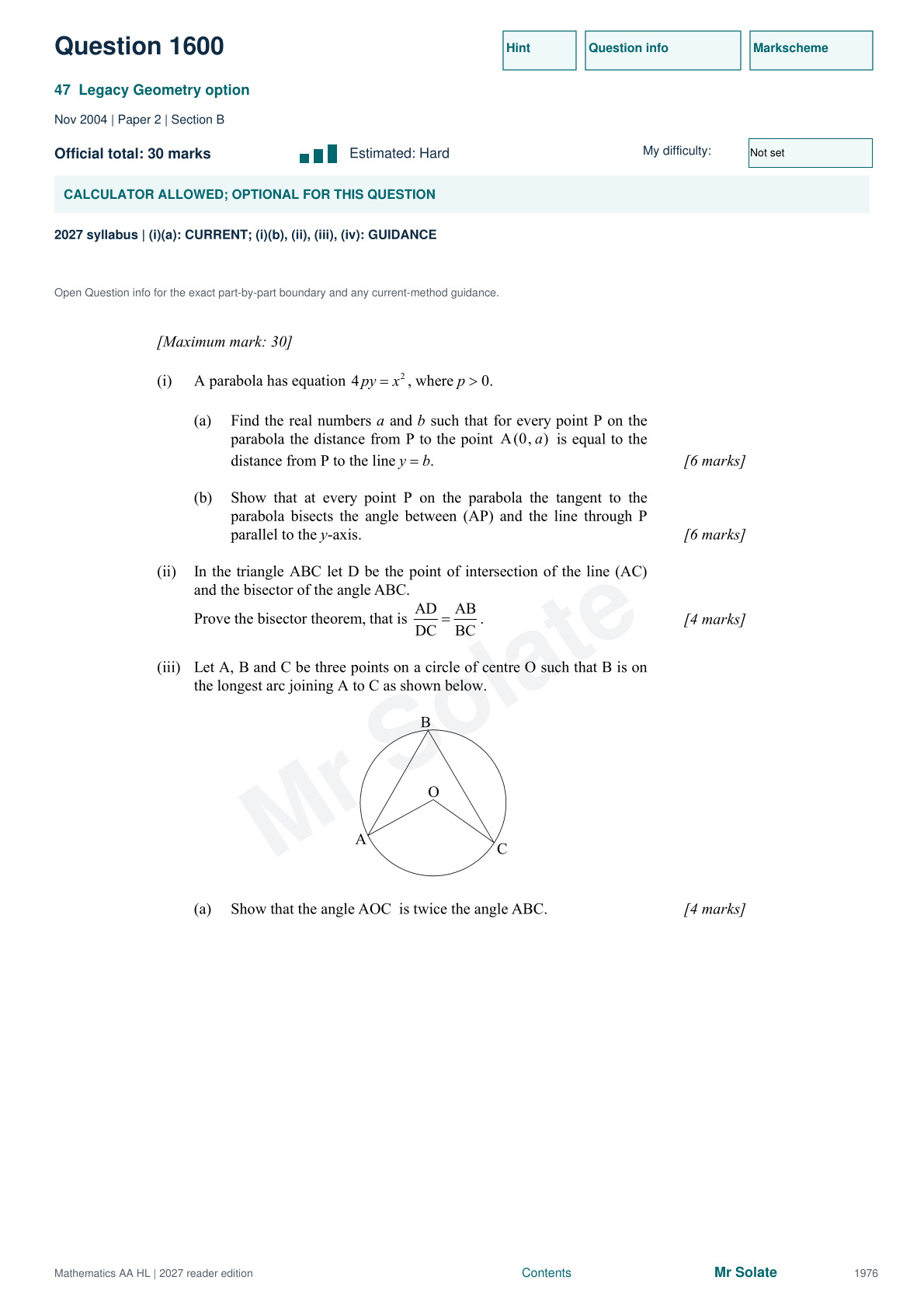
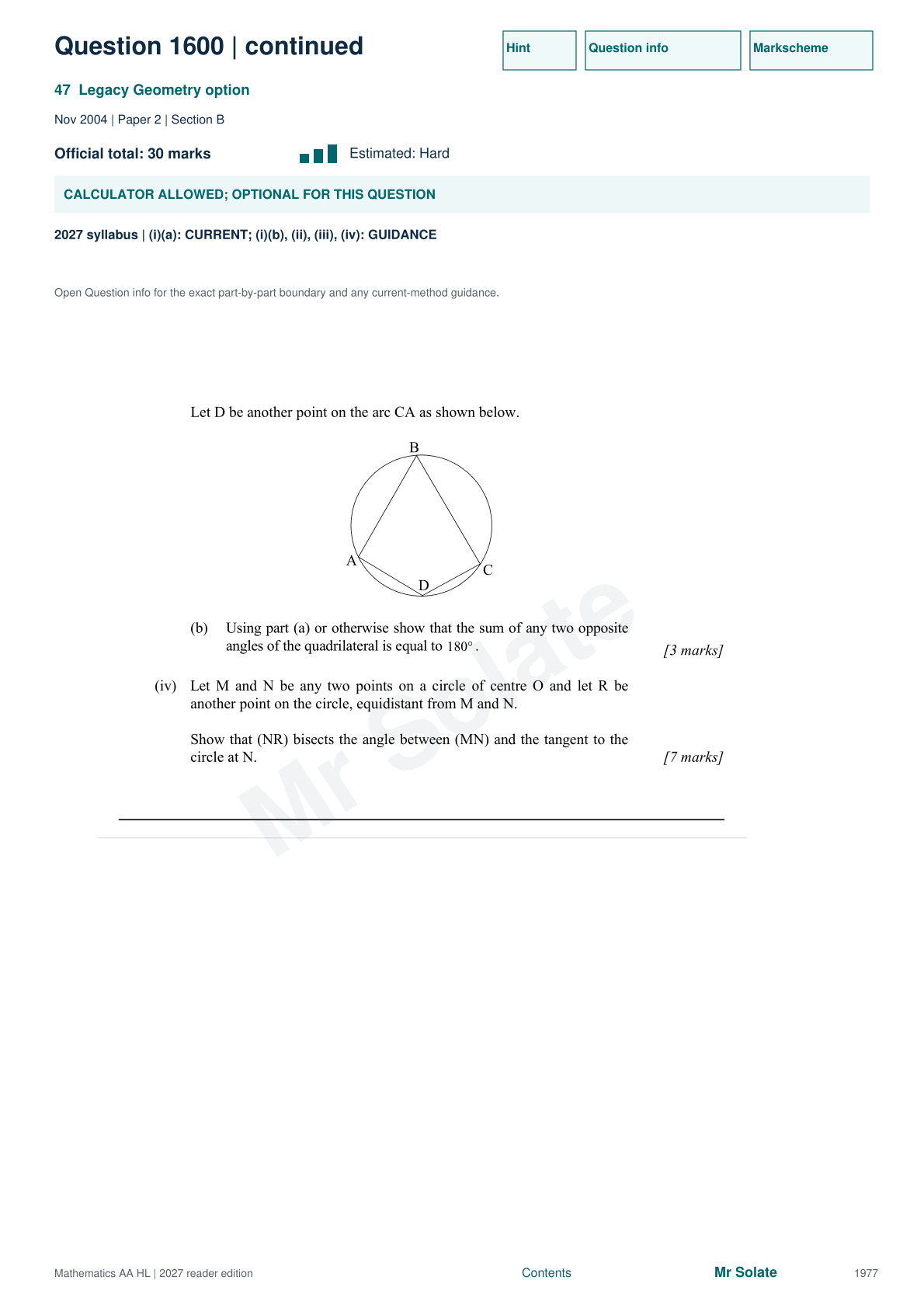
Question 1600
Extended reasoning linking Equal-distance coefficient comparison, Parabola tangent reflection property, Angle-bisector theorem proof.
Compatibility: Current: (i)(a); With guidance: (i)(b), (ii), (iii), (iv)
View the original question
Original page images preserve the equations and diagrams. Write your response before revealing the reasoning.
Reveal the revision reasoning
- (i)(a) Substitute x^2=4py into x^2+(y-a)^2=(y-b)^2. Comparing coefficients gives -2a+4p=-2b and a^2=b^2; since p>0, a=p and b=-p.
- (b) At P=(x0,y0), the tangent meets the y-axis at B=(0,-y0). The parabola equation gives AP^2=(y0+p)^2=AB^2, so APB is isosceles. With the line through P parallel to the y-axis, alternate angles give the tangent-bisector result; the vertex case follows directly from symmetry.
- (ii) A current trigonometric proof compares the areas of ABD and CBD. Their common altitude to AC gives ratio AD/DC; their equal half-angles at B give ratio AB/BC. Equating these proves the bisector theorem.
- (iii) Join O to the endpoints and extend BO to a diameter. Equal-radius triangles show each central angle is twice its inscribed angle; add or subtract according to the diagram. Opposite cyclic angles then sum to half a full turn, or 180 degrees.
- (iv) RM=RN makes triangle RMN isosceles. Combine the doubled central angle with triangle RON and the radius perpendicular to the tangent to show angle RNM equals the angle between NR and that tangent.
Editorial revision reasoning. Check the original answer for its marking detail.
All 12 questions in this topic
Close your notes first
Can you retrieve the method?
1. Midpoint substitution for fixed (a,b)?
Check answer 1
P=(2u−a,2v−b).
2. What does Ceva address?
Check answer 2
Concurrency of three cevians.
3. How can a discriminant prove tangency?
Check answer 3
A zero discriminant gives a repeated intersection root in the appropriate quadratic.
Before you move on
- Prioritise current coordinate and calculus methods.
- Label every ratio and angle before using a legacy theorem.
- Check squared equations against the original distances and branch conditions.
Your revision note
Record one missed cue, one corrected step and one question to retry. Saved only in this browser.