Start with the exam
What you need to be able to do
A definite integral is signed accumulation; a geometric area is nonnegative. Many questions in this bank require finding intersections, deciding which curve is above and splitting at sign changes. Those decisions establish the method. A calculator can evaluate a correctly formed integral, but it cannot replace the explanation of why those boundaries and that integrand represent the requested region.
Spend 3 minutes reading the overview and diagram, 7 minutes learning the question patterns, 5 minutes writing out the worked example, and 5 minutes on a bank question or recall check. Take longer when you need to; the full bank is here for later practice.
Recognise → set up → write
How the questions are set
Area between curves
Recognise it: Two boundaries enclose a region.
- Solve f(x)=g(x) for the relevant intersections. Use a sketch or test value to identify the upper curve between them.
- Integrate upper minus lower. If the order switches inside the region, split at each crossing and reverse the difference as needed.
- When horizontal slices are simpler, write boundaries as x-functions of y and integrate right minus left with dy. Keep the chosen variable consistent.
Show intersection values and the signed difference on each interval before evaluation.
Subtracting one entire integral from another without checking curve order can cancel two positive regions.
Area versus signed integral
Recognise it: The curve crosses the axis or an absolute-value graph appears.
- Locate zeros of the integrand and split at sign changes. Total area is the sum of the absolute contributions, equivalent to integrating |f|.
- Use symmetry only after identifying whether the function is odd, even or has equal geometric lobes. An odd function over a symmetric interval can have integral zero and positive total area.
- For modulus functions, write the appropriate branch on each interval. Preserve exact roots where available and enough numerical precision elsewhere.
Make the sign split visible. State whether the result is signed accumulation or geometric area.
Taking the absolute value of the final signed integral does not recover total area when cancellation occurred.
Accumulation and unknown boundaries
Recognise it: An integral defines a function or the area determines an endpoint.
- For F(x)=∫ from a to x of f(t)dt, use F′(x)=f(x). Increasing or decreasing behaviour of F follows the sign of f.
- For an unknown boundary, write an area equation before solving. If the graph changes sign while the boundary moves, select the correct branch structure.
- Use linearity and interval additivity to combine known integrals. A translated variable changes both its formula and its bounds.
State the integral equation and relevant interval before numerical solving.
The integrand f determines the slope of F, not its height. A zero of f is only a stationary candidate for F.
Write it before you reveal it
A worked exam-style example
Original teaching example, created for this lesson.
Original example: find the area between y=x and y=x² on their bounded region.
Reveal the worked solution
- Intersections satisfy x=x², so x=0 or 1.
- For 0<x<1, x>x², hence A=∫₀¹(x−x²)dx.
- A=[x²/2−x³/3]₀¹=1/2−1/3=1/6.
Answer: Area =1/6 square units.
Check: The maximum vertical gap is 1/4 over a width of one, so area 1/6 is a plausible value below 1/4.
From your own collection
Apply it to past-paper questions
These questions anchor the patterns above. Attempt one without the answer, then compare your setup and conclusion with the reasoning. The linked reader contains the source answer and the question-specific syllabus review.
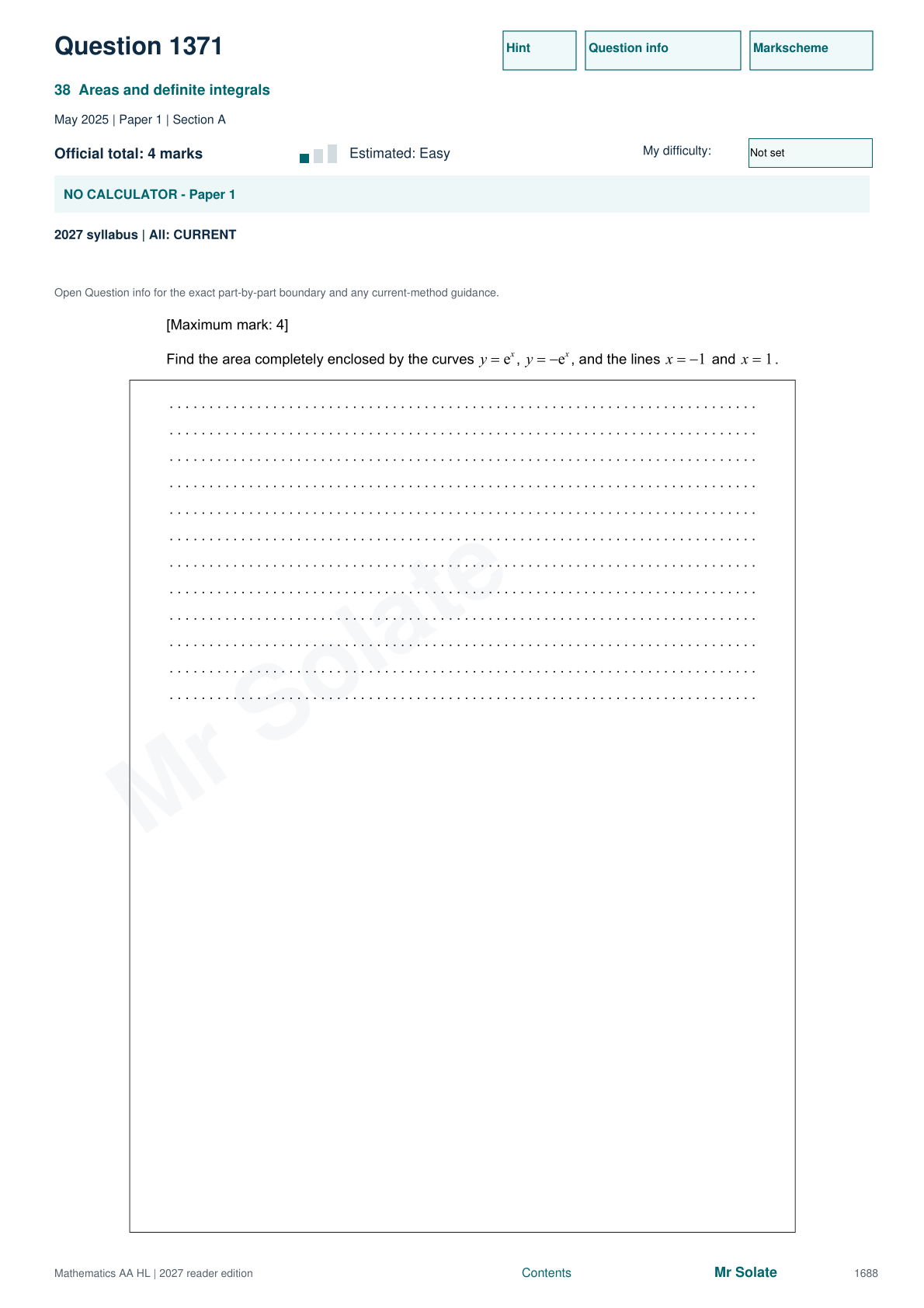
Question 1371
Apply the method to the original question.
Compatibility: All parts test current AA HL content and can be solved using current syllabus methods.
View the original question
Original page images preserve the equations and diagrams. Write your response before revealing the reasoning.
Reveal the revision reasoning
For every real x, e^x is positive and -e^x is negative, so their vertical separation is 2e^x.
The enclosed area is ∫ from -1 to 1 of 2e^x dx.
Its antiderivative is 2e^x, giving area 2(e-e⁻¹).
Editorial revision reasoning. Check the original answer for its marking detail.
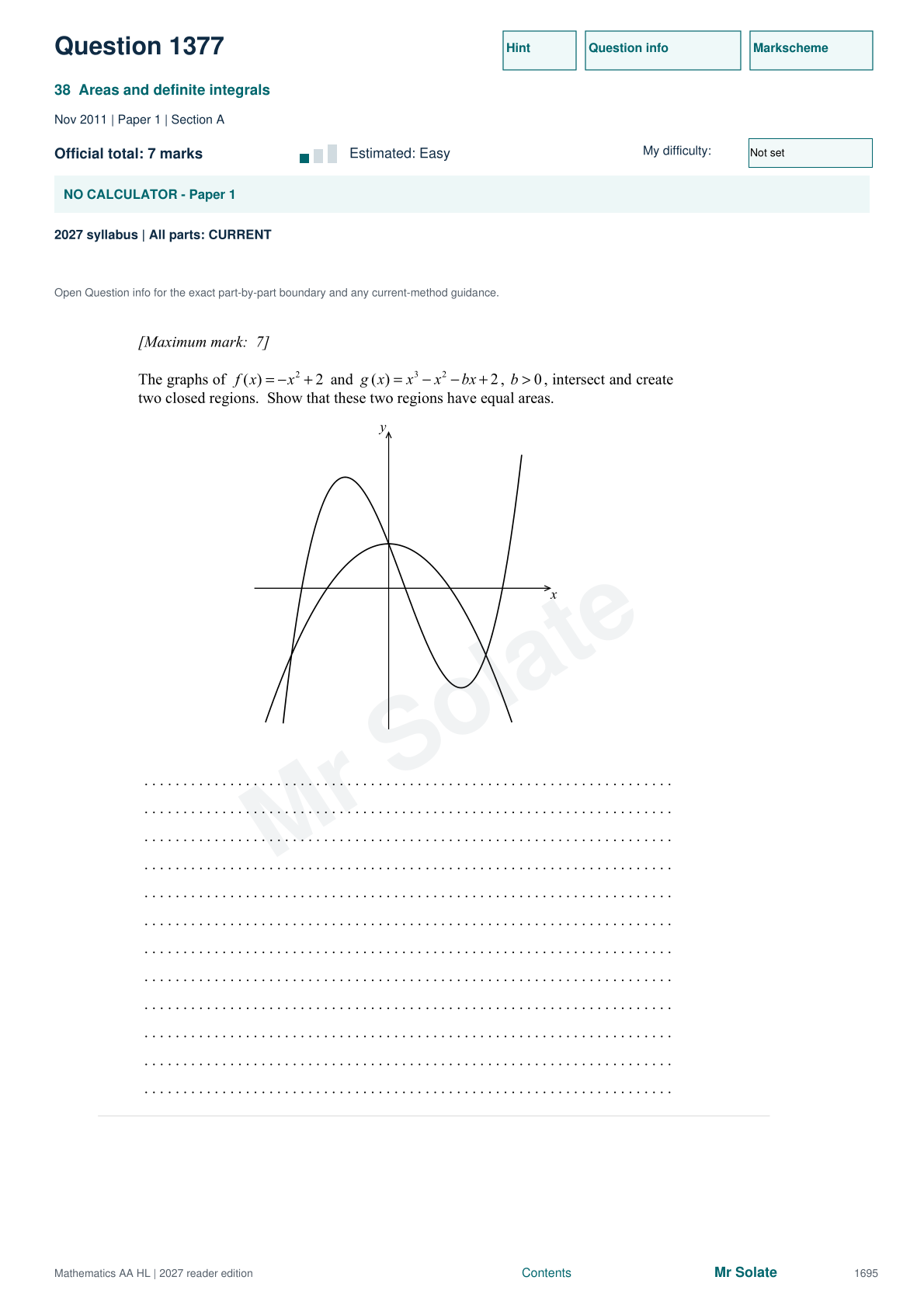
Question 1377
A short direct application of Polynomial intersections, Odd difference, Equal-area proof.
Compatibility: Current: All parts
View the original question
Original page images preserve the equations and diagrams. Write your response before revealing the reasoning.
Reveal the revision reasoning
- The intersections satisfy x(x²-b)=0, hence x=-√b,0,√b.
- On the left interval integrate x³-bx; on the right integrate its negative.
- Each integral equals b²/4, proving equal positive areas. Equivalently, the difference is odd on symmetric intervals.
Editorial revision reasoning. Check the original answer for its marking detail.
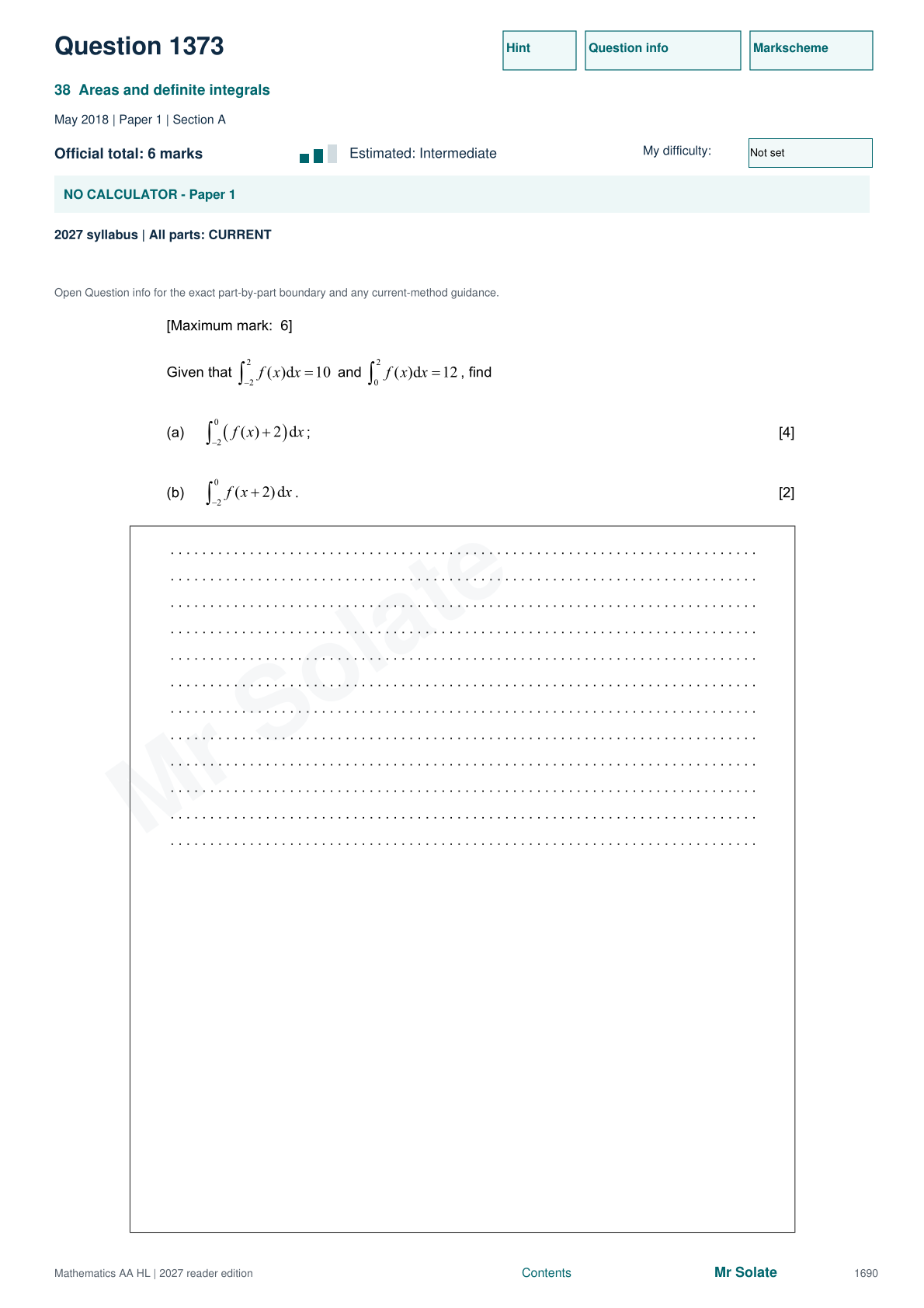
Question 1373
Apply the method to the original question.
Compatibility: All tested methods remain in current AA HL; the original question is from the 2018 Mathematics HL syllabus.
View the original question
Original page images preserve the equations and diagrams. Write your response before revealing the reasoning.
Reveal the revision reasoning
Since the integral from -2 to 2 is 10 and that from 0 to 2 is 12, the integral of f from -2 to 0 is -2.
The constant 2 integrated over an interval of length 2 contributes 4. Hence part (a) equals -2+4=2.
For part (b), put u=x+2. The endpoints -2 and 0 become 0 and 2, and du=dx.
The transformed integral is the given integral of f(u) from 0 to 2, so its value is 12.
Editorial revision reasoning. Check the original answer for its marking detail.
All 35 questions in this topic
Close your notes first
Can you retrieve the method?
1. Can a signed integral be zero with positive total area?
Check answer 1
Yes, positive and negative contributions can cancel.
2. Horizontal slice integrand?
Check answer 2
Right boundary minus left boundary.
3. Derivative of ∫ₐˣf(t)dt?
Check answer 3
f(x), where the fundamental theorem applies.
Before you move on
- Find boundaries and signs before integrating.
- Practise a two-region total area and a horizontal-slice problem.
- Check final area is nonnegative and each interval is counted once.
Your revision note
Record one missed cue, one corrected step and one question to retry. Saved only in this browser.