Start with the exam
What you need to be able to do
The Sets, Relations and Groups option is legacy extension material. These old questions reward precise definitions and short proofs rather than examples alone. A few calculations can suggest a property, but a universal claim needs an argument for arbitrary elements or an exhaustive finite table. Practise the reasoning only when choosing extension work; this is not a list of compulsory current AA HL group-theory facts.
Spend 3 minutes reading the overview and diagram, 7 minutes learning the question patterns, 5 minutes writing out the worked example, and 5 minutes on a bank question or recall check. Take longer when you need to; the full bank is here for later practice.
This collection contains content outside the current course, or a mixture of current and legacy skills. Use the compatibility note for each original question to decide which parts to practise for your exam.
Recognise → set up → write
How the questions are set
Sets and equivalence relations
Recognise it: A relation is defined by a formula, congruence or shared property.
- For a set identity, track an arbitrary element through membership statements or shade the relevant Venn regions. Complements depend on the stated universal set.
- For equivalence, prove reflexivity, symmetry and transitivity separately. Use arbitrary elements; a single failed property disproves equivalence.
- To describe classes, fix a representative and solve the relation for all elements related to it. Distinct equivalence classes partition the set without overlap.
Name each property and give the associated general argument or explicit counterexample.
Symmetry does not imply transitivity. Testing a few numerical pairs does not prove a property for all elements.
Verify a group operation
Recognise it: An unusual binary operation or operation table is supplied.
- Check closure and associativity, then solve for an identity e satisfying a★e=e★a=a.
- Find inverses relative to that identity, not automatically relative to zero or one. Prove each inverse stays in the specified set.
- For a finite table, identity rows and columns reveal e; inverse positions produce e. For an algebraic operation, write and compare (a★b)★c and a★(b★c).
State the underlying set and each axiom used. A counterexample can settle a failed group claim efficiently.
Commutativity is not a group axiom. An operation can be associative without every element having an inverse.
Orders, subgroups and maps
Recognise it: An old part asks for element orders, a subgroup or an isomorphism.
- Compute an element’s order as the least positive power yielding the identity. In modular multiplication, only invertible residue classes belong to the unit group.
- To prove a subgroup, use a suitable subgroup criterion with nonemptiness and closure under products and inverses. A union of subgroups need not be a subgroup.
- For an isomorphism, prove the map is bijective and preserves the operation. A matching table pattern suggests the map but does not replace those checks.
Identify identity and operation before discussing powers, and show the operation-preserving equation.
Equal set sizes alone do not establish an isomorphism; structure must be preserved.
Write it before you reveal it
A worked exam-style example
Original teaching example, created for this lesson.
Original extension example: on the real numbers define a★b=a+b+1. Find the identity and inverse of a, and check associativity.
Reveal the worked solution
- Identity satisfies a+e+1=a, hence e=−1.
- An inverse b satisfies a+b+1=−1, so b=−a−2.
- (a★b)★c=a+b+c+2 and a★(b★c)=a+b+c+2.
- Closure holds because sums of real numbers remain real.
Answer: Identity −1; inverse of a is −a−2; the operation is associative.
Check: For a=2, the inverse is −4 and 2★(−4)=−1, the required identity.
From your own collection
Apply it to past-paper questions
These questions anchor the patterns above. Attempt one without the answer, then compare your setup and conclusion with the reasoning. The linked reader contains the source answer and the question-specific syllabus review.
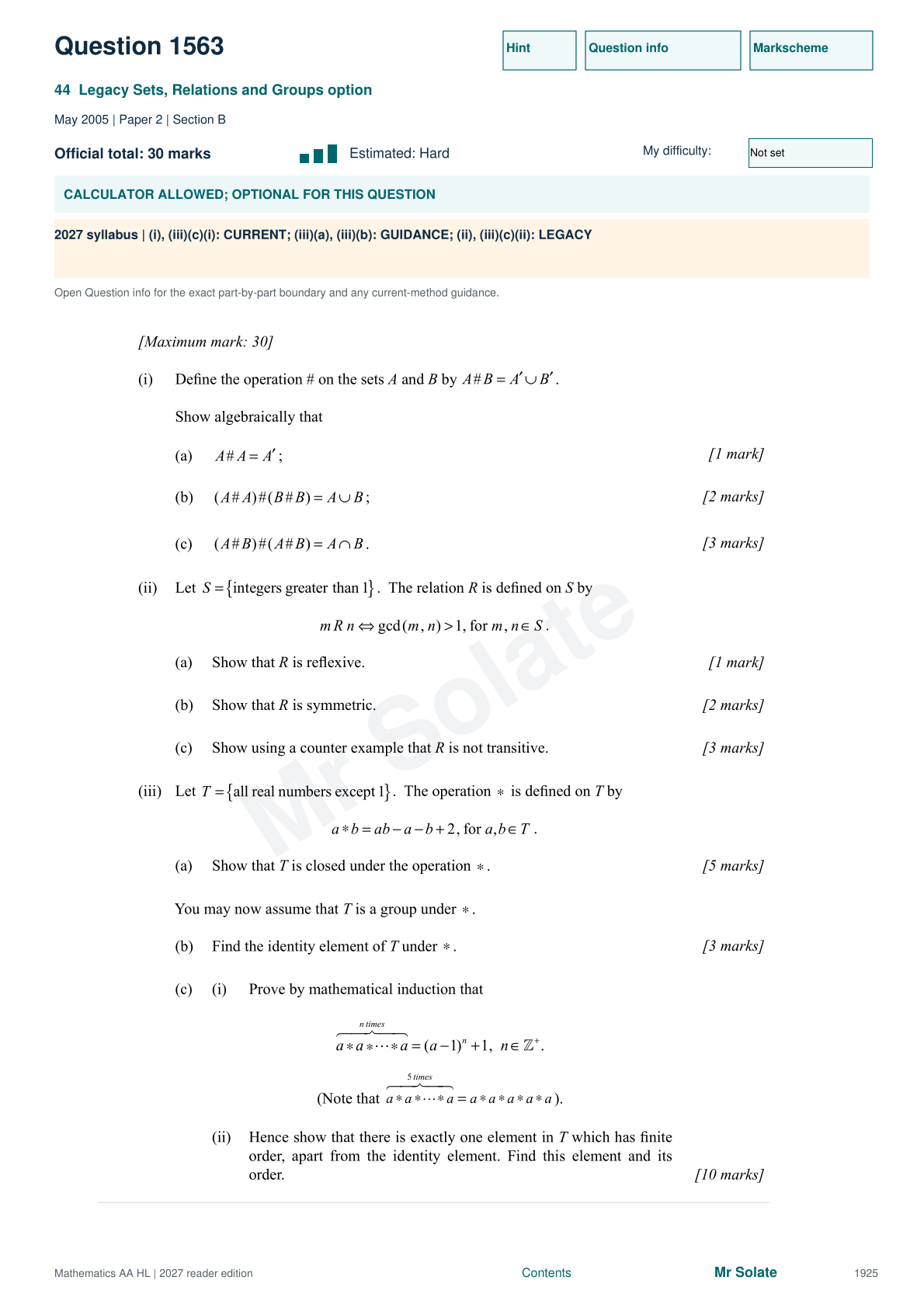
Question 1563
Extended reasoning linking Set operations and complements (i), Nontransitive gcd relation (ii), Shifted multiplicative group (iii).
Compatibility: Current: (i), (iii)(c)(i); With guidance: (iii)(a), (iii)(b); Legacy: (ii), (iii)(c)(ii)
View the original question
Original page images preserve the equations and diagrams. Write your response before revealing the reasoning.
Reveal the revision reasoning
- A#A=A′. Therefore(A#A)#(B#B)=A∪B, while applying # to two identical A#B expressions complements A′∪B′ and gives A∩B.
- For integers greater than1, gcd(a,a)=a>1 and gcd(a,b)=gcd(b,a), giving reflexivity and symmetry.
- Transitivity fails: gcd(25,15)=5 and gcd(15,21)=3, but gcd(25,21)=1.
- For *, (a*b)−1=(a−1)(b−1)≠0 since neither input equals1; this proves closure in T. The identity is2.
- Verify the one-factor case, then multiply the assumed value(a−1)^k+1 by a under * to obtain(a−1)^(k+1)+1, completing induction.
- Finite order requires(a−1)^n=1. Over the reals only a−1=1 or−1 is possible; excluding identity2 leaves a=0, which has order2.
Editorial revision reasoning. Check the original answer for its marking detail.
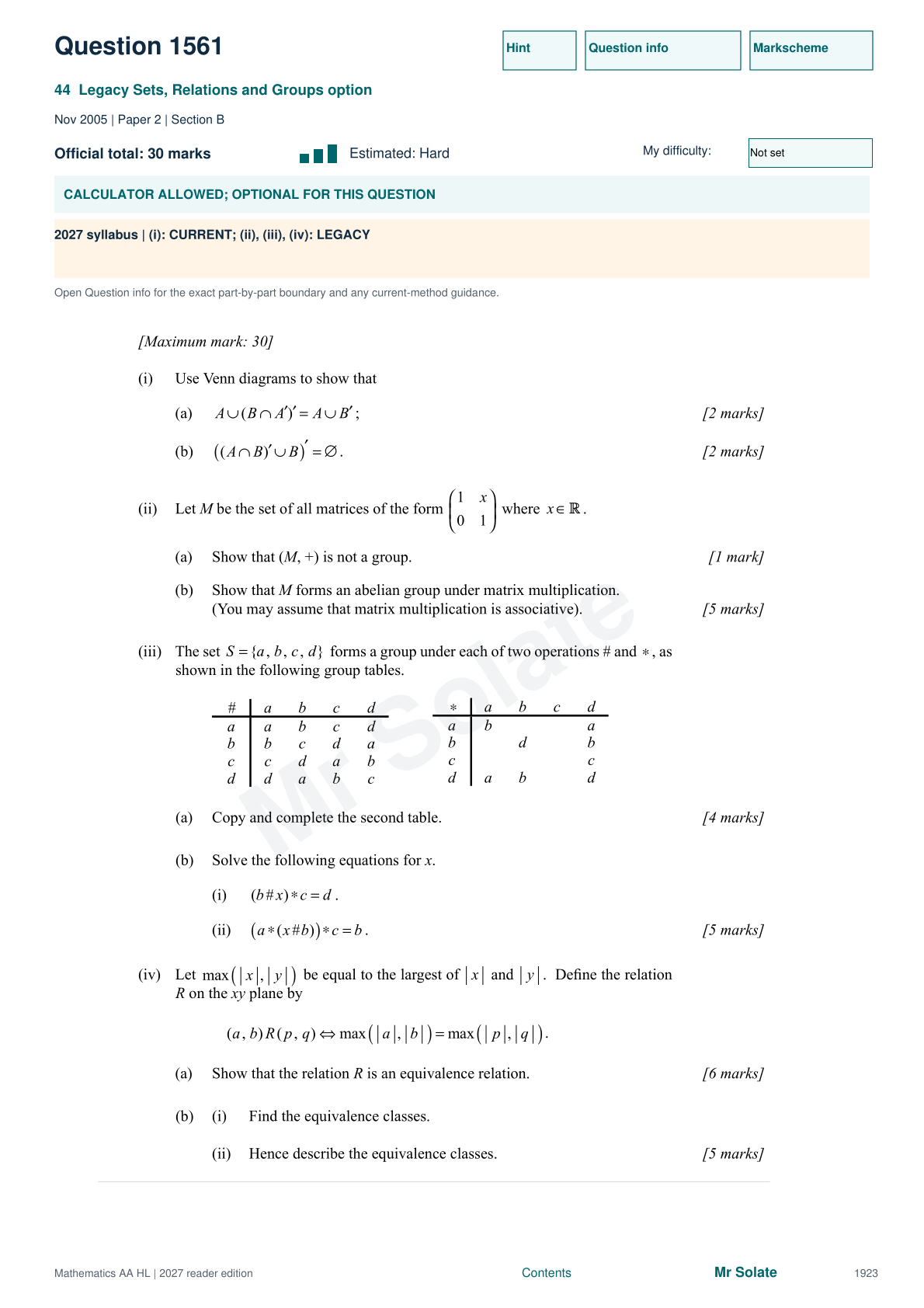
Question 1561
Extended reasoning linking Venn-diagram complement identities (i), Unipotent matrix group (ii), Two operation tables and equations (iii).
Compatibility: Current: (i); Legacy: (ii), (iii), (iv)
View the original question
Original page images preserve the equations and diagrams. Write your response before revealing the reasoning.
Reveal the revision reasoning
- De Morgan and absorption show A∪(B∩A′)′=A∪B′. Also(A∩B)′∪B is the universal set, so its complement is empty.
- Matrix addition fails closure because diagonal entries become2. Multiplication adds the upper-right parameters, so closure and commutativity follow; identity has parameter0 and the inverse has parameter−x.
- Complete the * table using identity d and the group constraints: its rows in a,b,c,d order are(b,c,d,a),(c,d,a,b),(d,a,b,c),(a,b,c,d).
- Use the appropriate table at each operation: (b#x)*c=d gives x=d, and(a*(x#b))*c=b gives x=a.
- Equality of max(abs(x),abs(y)) proves reflexivity, symmetry and transitivity.
- For c>0, the class is the boundary of the square with sides x=±c and y=±c, restricted to the other coordinate in[−c,c]; c=0 gives{(0,0)}.
Editorial revision reasoning. Check the original answer for its marking detail.
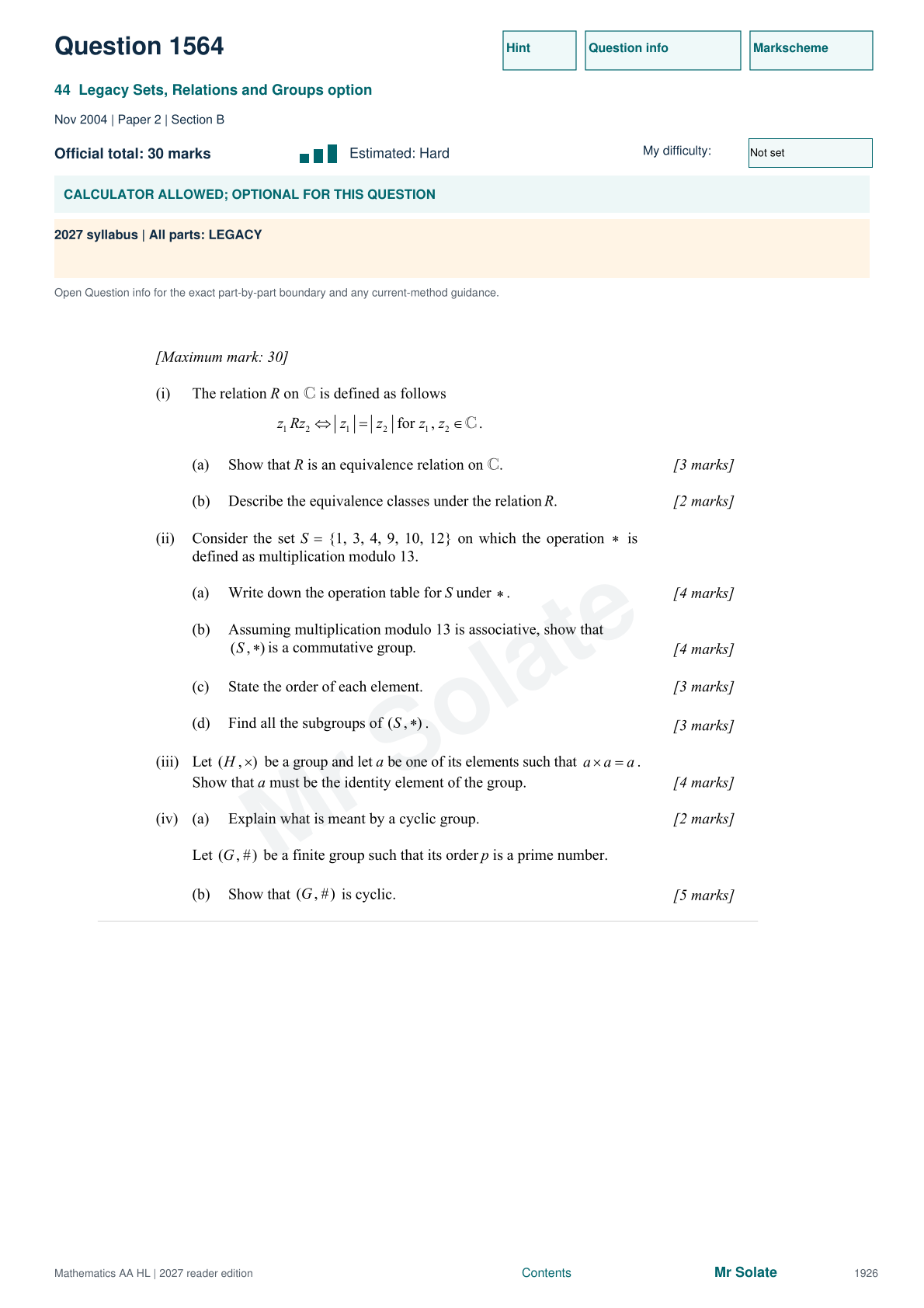
Question 1564
Extended reasoning linking Equal-modulus equivalence relation (i), Multiplication group modulo13 (ii), Idempotents in a group (iii).
Compatibility: Legacy: All parts
View the original question
Original page images preserve the equations and diagrams. Write your response before revealing the reasoning.
Reveal the revision reasoning
- Equality of complex moduli is reflexive, symmetric and transitive. Each positive modulus gives a circle centred at0; modulus0 gives the singleton{0}.
- Complete the multiplication table modulo13 for{1,3,4,9,10,12}. Closure and inverses are visible, identity is1, and integer multiplication gives commutativity.
- Orders are1 for1,2 for12,3 for3 and9, and6 for4 and10.
- Since4 generates the group, the subgroups are{1},{1,12},{1,3,9}, and the whole group.
- If a×a=a, multiply by a⁻¹ and use associativity to obtain a=e.
- For a group of prime order p, any nonidentity element generates a subgroup whose order divides p and is not1. Its order must be p, so it generates the entire group.
Editorial revision reasoning. Check the original answer for its marking detail.
All 12 questions in this topic
Close your notes first
Can you retrieve the method?
1. Three equivalence properties?
Check answer 1
Reflexive, symmetric, transitive.
2. Is commutativity required for a group?
Check answer 2
No.
3. What must an isomorphism preserve?
Check answer 3
The operation, as well as being bijective.
Before you move on
- Label the set and operation at the start.
- Distinguish a proof from a suggestive example.
- Use a concrete counterexample when a universal property fails.
Your revision note
Record one missed cue, one corrected step and one question to retry. Saved only in this browser.