Start with the exam
What you need to be able to do
Counting starts with defining one outcome. A team is an unordered collection; a photograph is an ordered row. The same people therefore lead to different calculations. The bank emphasises blocks, gaps, excluded combinations and assigning people to labelled places. Write a short explanation for each factor so the examiner can see that every valid arrangement is counted once. Do not start by choosing a factorial and hoping the wording fits it.
Spend 3 minutes reading the overview and diagram, 7 minutes learning the question patterns, 5 minutes writing out the worked example, and 5 minutes on a bank question or recall check. Take longer when you need to; the full bank is here for later practice.
Recognise → set up → write
How the questions are set
Selection or arrangement
Recognise it: People are selected, digits are chosen, or labelled seats and positions are filled.
- Ask whether swapping two selected objects changes the outcome. If no, use C(n,r); if yes, use an ordered count n!/(n−r)!.
- Choose constrained positions first, then fill remaining positions. Labelled cars or named children make allocations distinct.
- For increasing digits, each chosen digit set has one increasing order, so a combination may replace an apparent permutation.
Write “choose four members” beside C(n,4), or “fill three ordered positions” beside n(n−1)(n−2).
Never divide by r! after already using a combination. Do not use independent choices when repetition is forbidden.
Together and separated
Recognise it: Named people must sit together, or one group must be separated by another.
- For a required adjacent pair, treat the pair as one block when arranging units, then multiply by its internal orders.
- For separation, arrange the unrestricted group first and mark its gaps, including both end gaps if permitted.
- Choose the required gaps and arrange the separated people within them. Explain whether “not together” excludes one block or every adjacent pair.
For two named people together in a row of five: 4! arrangements of units, multiplied by 2! inside the block.
Three people “not all together” is different from three people “pairwise non-adjacent”. Read the exact restriction.
Complement and disjoint cases
Recognise it: The condition says at least one, mixed team, neither, or a divisibility condition.
- Count the unrestricted outcome space, then subtract a clearly defined invalid set when that is shorter.
- For a mixed team, subtract all-one-group teams separately. If using cases, make them mutually exclusive and collectively exhaustive.
- If the question asks for probability, divide by the total number of equally likely outcomes of the same kind.
Show total−invalid before evaluating the arithmetic. For categories that overlap, correct the double subtraction rather than silently adding case counts.
Do not mix a permutation numerator with a combination denominator: they count different sample spaces.
Write it before you reveal it
A worked exam-style example
Original teaching example, created for this lesson.
Original practice: choose a four-person team from five women and four men, with at least one of each.
Reveal the worked solution
- The total number of teams is C(9,4)=126.
- Invalid all-women teams number C(5,4)=5. Invalid all-men teams number C(4,4)=1.
- The two invalid sets cannot overlap, so subtract both.
Answer: 126−5−1=120 teams.
Check: An alternative count is C(5,1)C(4,3)+C(5,2)C(4,2)+C(5,3)C(4,1)=20+60+40=120.
From your own collection
Apply it to past-paper questions
These questions anchor the patterns above. Attempt one without the answer, then compare your setup and conclusion with the reasoning. The linked reader contains the source answer and the question-specific syllabus review.
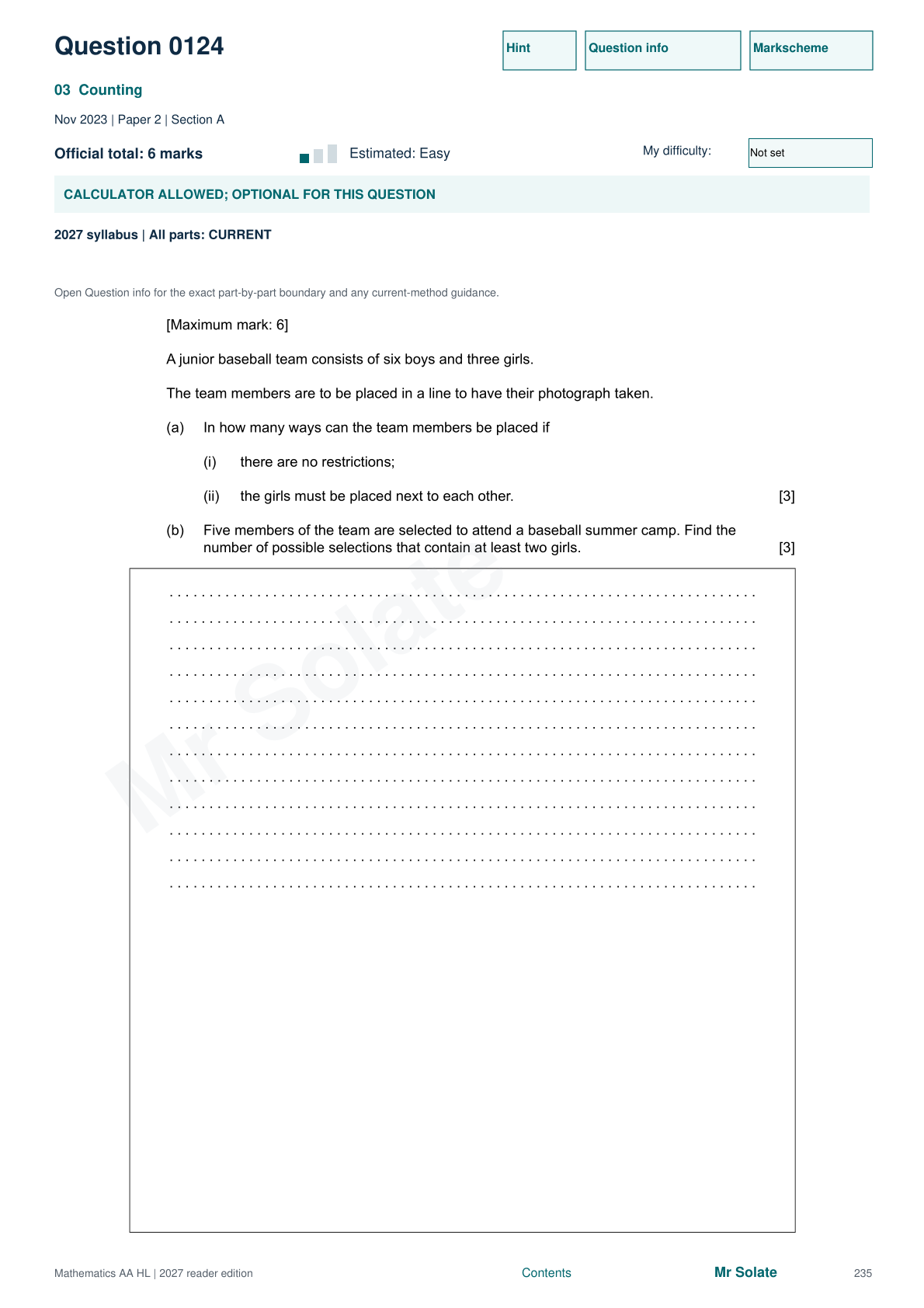
Question 124
Direct application of Unrestricted permutations, Adjacent block arrangements, At-least selection casework.
Compatibility: The tested concepts and methods match the current AA HL syllabus; the original paper format and wording are retained.
View the original question
Original page images preserve the equations and diagrams. Write your response before revealing the reasoning.
Reveal the revision reasoning
With no restrictions, the nine distinct players can be arranged in 9!=362880 ways.
If the girls are together, regard them as one block among six boys: 7! positions for the objects and 3! internal orders, giving 30240.
For five camp members with at least two girls, count exactly two and exactly three girls.
The total is C(3,2)C(6,3)+C(3,3)C(6,2)=60+15=75.
Editorial revision reasoning. Check the original answer for its marking detail.
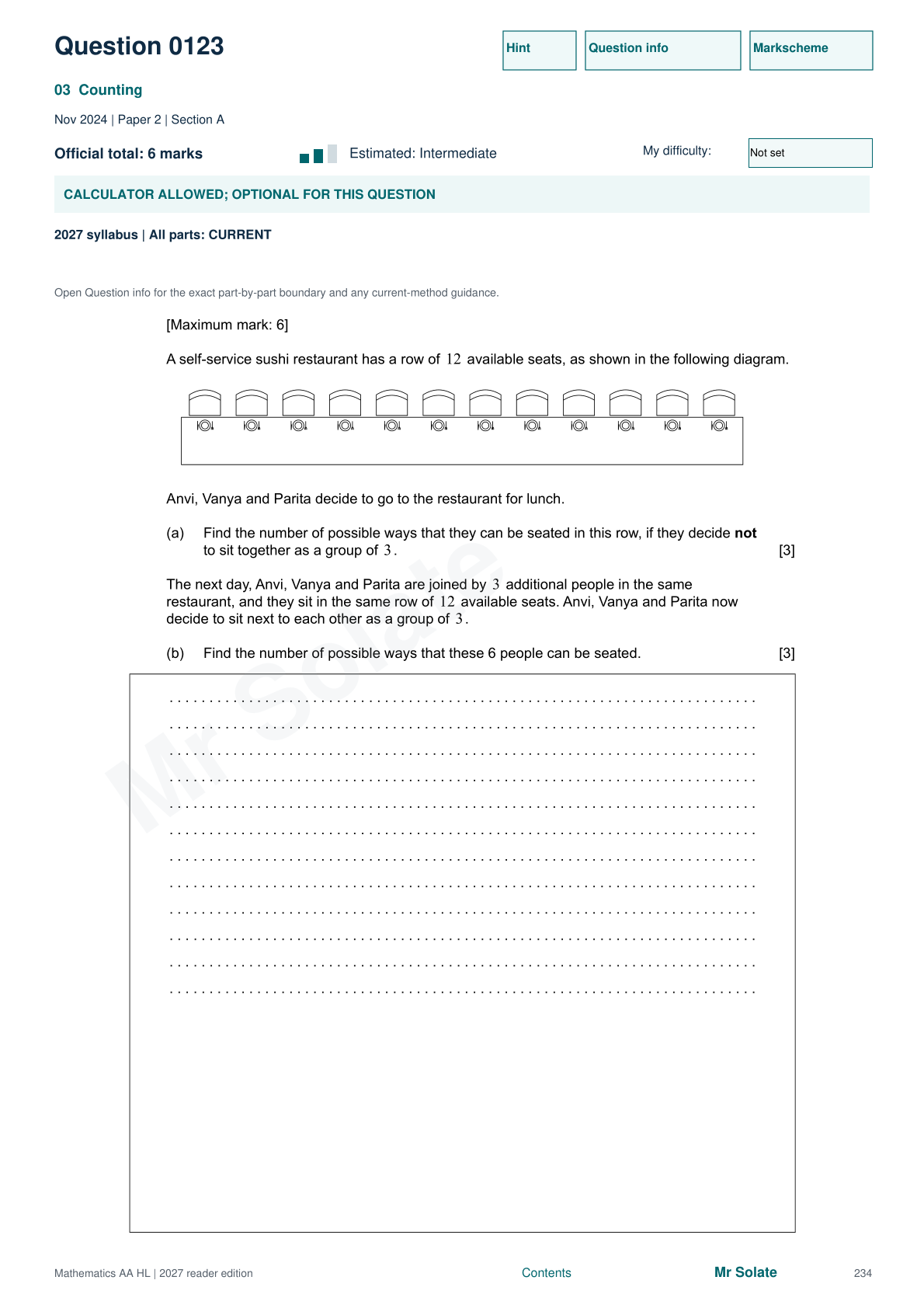
Question 123
Several linked steps in Complementary seating count, Adjacent triple block, Distinct remaining-person placements.
Compatibility: The tested concepts and methods match the current AA HL syllabus; the original paper format and wording are retained.
View the original question
Original page images preserve the equations and diagrams. Write your response before revealing the reasoning.
Reveal the revision reasoning
The three named people have 12P3=1320 unrestricted seatings. A consecutive triple has ten possible starting seats and 3! internal orders, giving 60.
Therefore the number not all together is 1320−60=1260.
With three additional distinct people, first place the original triple in 60 ways. Nine seats remain for the other three, with 9P3=504 arrangements.
The total is 60×504=30240.
Editorial revision reasoning. Check the original answer for its marking detail.
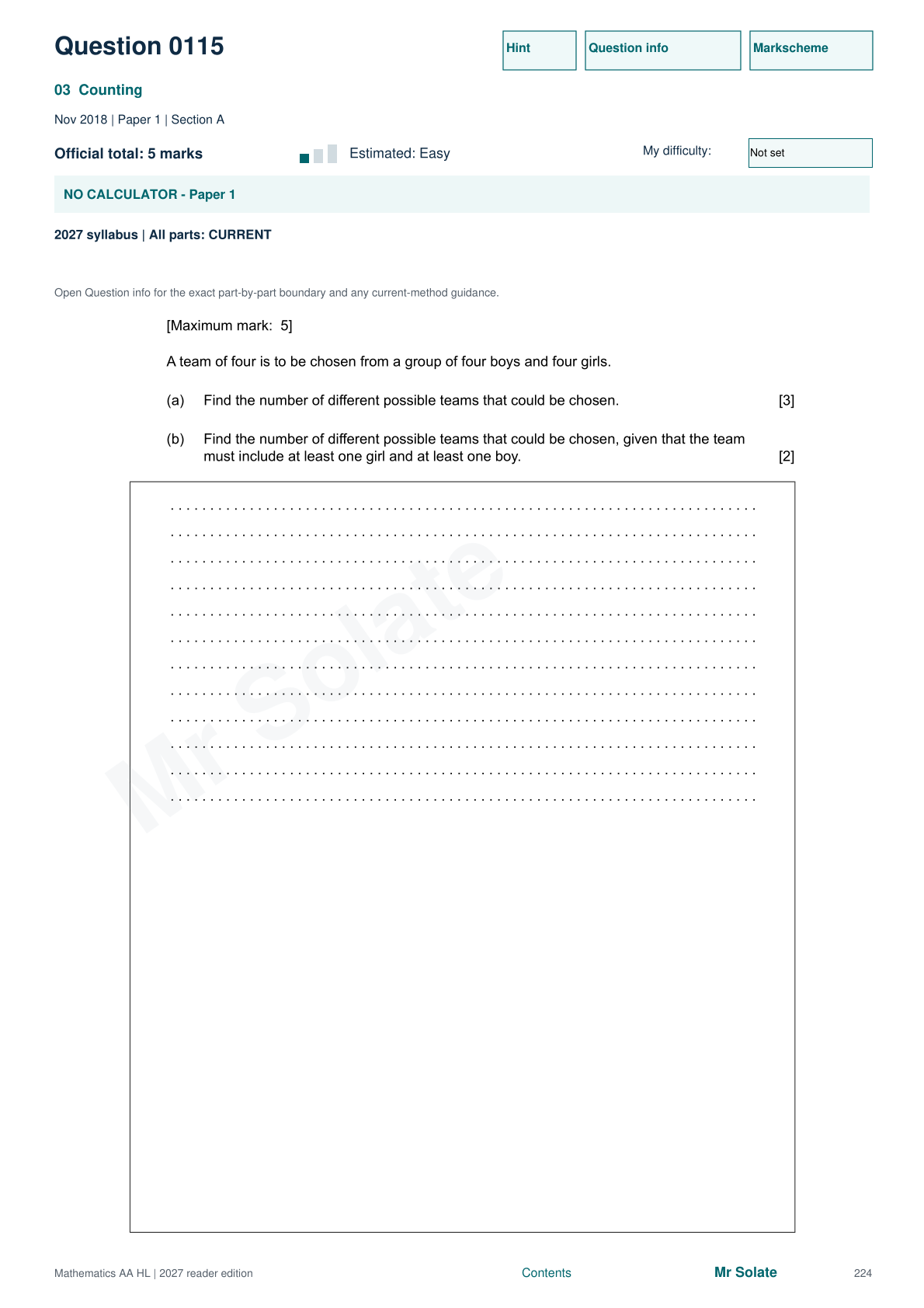
Question 115
Apply the method to the original question.
Compatibility: The required concepts and methods match current AA HL. The original source is a 2018 Mathematics HL paper.
View the original question
Original page images preserve the equations and diagrams. Write your response before revealing the reasoning.
Reveal the revision reasoning
Team membership is unordered, so the total is 8 choose 4=70.
A team fails the condition only if it contains all four boys or all four girls.
There is exactly one team of each excluded type, leaving 70-1-1=68.
Editorial revision reasoning. Check the original answer for its marking detail.
All 25 questions in this topic
Close your notes first
Can you retrieve the method?
1. Does choosing a captain make a committee count ordered?
Check answer 1
It adds a distinguished role: choose the committee then choose its captain, or choose the captain first consistently.
2. How many gaps surround a row of four people?
Check answer 2
Five, including both ends.
3. When is complement counting particularly useful?
Check answer 3
When the unwanted condition is easier to count, such as no women in an at-least-one-woman team.
Before you move on
- Write a one-sentence definition of an outcome before using a formula. Then check that your units are teams, rows, allocations or numbers throughout.
- After counting by cases, ask whether a single example can belong to two cases. If it can, make the cases exclusive or correct the overlap.
Your revision note
Record one missed cue, one corrected step and one question to retry. Saved only in this browser.