Start with the exam
What you need to be able to do
Use polar form when a question contains powers, roots or rotations. Multiplication changes modulus multiplicatively and argument additively, so an expression that is unpleasant in Cartesian form can become a short angle calculation. The bank also connects roots to polygons and areas. Keep all root arguments before applying restrictions such as quadrant or principal argument; a single calculator angle will not list every root.
Spend 3 minutes reading the overview and diagram, 7 minutes learning the question patterns, 5 minutes writing out the worked example, and 5 minutes on a bank question or recall check. Take longer when you need to; the full bank is here for later practice.
Recognise → set up → write
How the questions are set
Convert and calculate powers
Recognise it: A number has a simple modulus and angle, or a large integer power is required.
- Compute r=√(a²+b²) and determine θ from the quadrant, not just tan^(−1)(b/a).
- Write z=r(cosθ+i sinθ) or re^(iθ). Then z^n=r^n e^(inθ).
- For products add angles; for quotients subtract angles. Reduce to the requested argument interval only at the end.
State the modulus and a quadrant-consistent argument before using de Moivre.
An arctangent output can differ from the correct argument by π. Negative real factors contribute an extra π rotation.
Find every nth root
Recognise it: Solve z^n=w, possibly after shifting z by a constant.
- Write w=Re^(iφ). The roots are R^(1/n)e^[i(φ+2πk)/n], k=0,…,n−1.
- List all n arguments and check their equal spacing. If w involves z−c, solve for that temporary variable first and then translate every root.
- Apply interval or quadrant conditions after creating the full root set.
Include the integer range for k; without it the formula does not clearly give the distinct requested roots.
Dividing one principal argument by n gives only one root. Translating roots changes their centre, not their spacing relative to that centre.
Geometry and real powers
Recognise it: Roots form a polygon, midpoints are used, or z^n must be real/positive.
- For z^n real, require nθ to be an integer multiple of π; for positive real require an even multiple of π.
- Use common root modulus as a radius. Adjacent vertices differ by 2π/n; split polygon areas into triangles with area r²sin(2π/n)/2.
- For midpoints, use (z_1+z_2)/2; addition is usually easiest in Cartesian form or by factoring a common exponential.
Distinguish “real” from “positive real” in the angle equation before selecting the least power.
Arguments are periodic. Equal tangents do not prove equal principal angles without a range check.
Write it before you reveal it
A worked exam-style example
Original teaching example, created for this lesson.
Original practice: solve z³=8 and locate the roots.
Reveal the worked solution
- Write 8=8e^(2πki). Each cube root has modulus 2.
- The arguments are 0, 2π/3 and 4π/3.
- Convert using exact sine and cosine values.
Answer: z=2, −1+i√3, −1−i√3.
Check: There are exactly three distinct roots, all with modulus 2 and separated by 120°. Cubing each triples its argument to a whole turn.
From your own collection
Apply it to past-paper questions
These questions anchor the patterns above. Attempt one without the answer, then compare your setup and conclusion with the reasoning. The linked reader contains the source answer and the question-specific syllabus review.
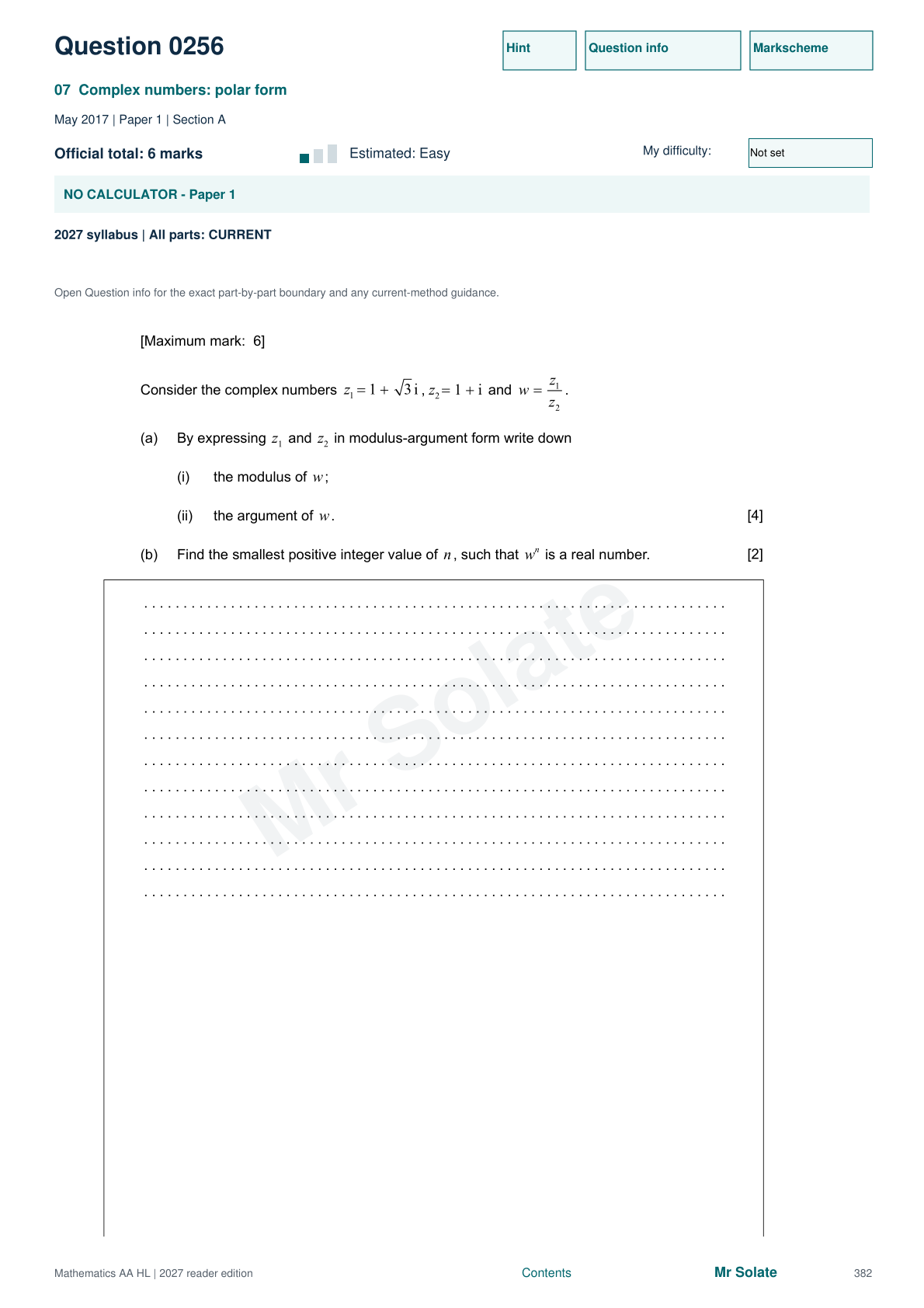
Question 256
Direct use of Complex quotient in polar form; Real powers. z_1=2 cis(π/3) and z_2=√2 cis(π/4).
Compatibility: All parts: The tested content remains current AA HL: Complex quotient in polar form; Real powers.
View the original question
Original page images preserve the equations and diagrams. Write your response before revealing the reasoning.
Reveal the revision reasoning
- z_1=2cis(π/3) and z_2=√2cis(π/4).
- Thus |w|=√2 and argw=π/12.
- A real power requires nπ/12 to be a multiple of π.
- The smallest positive integer is n=12.
Editorial revision reasoning. Check the original answer for its marking detail.
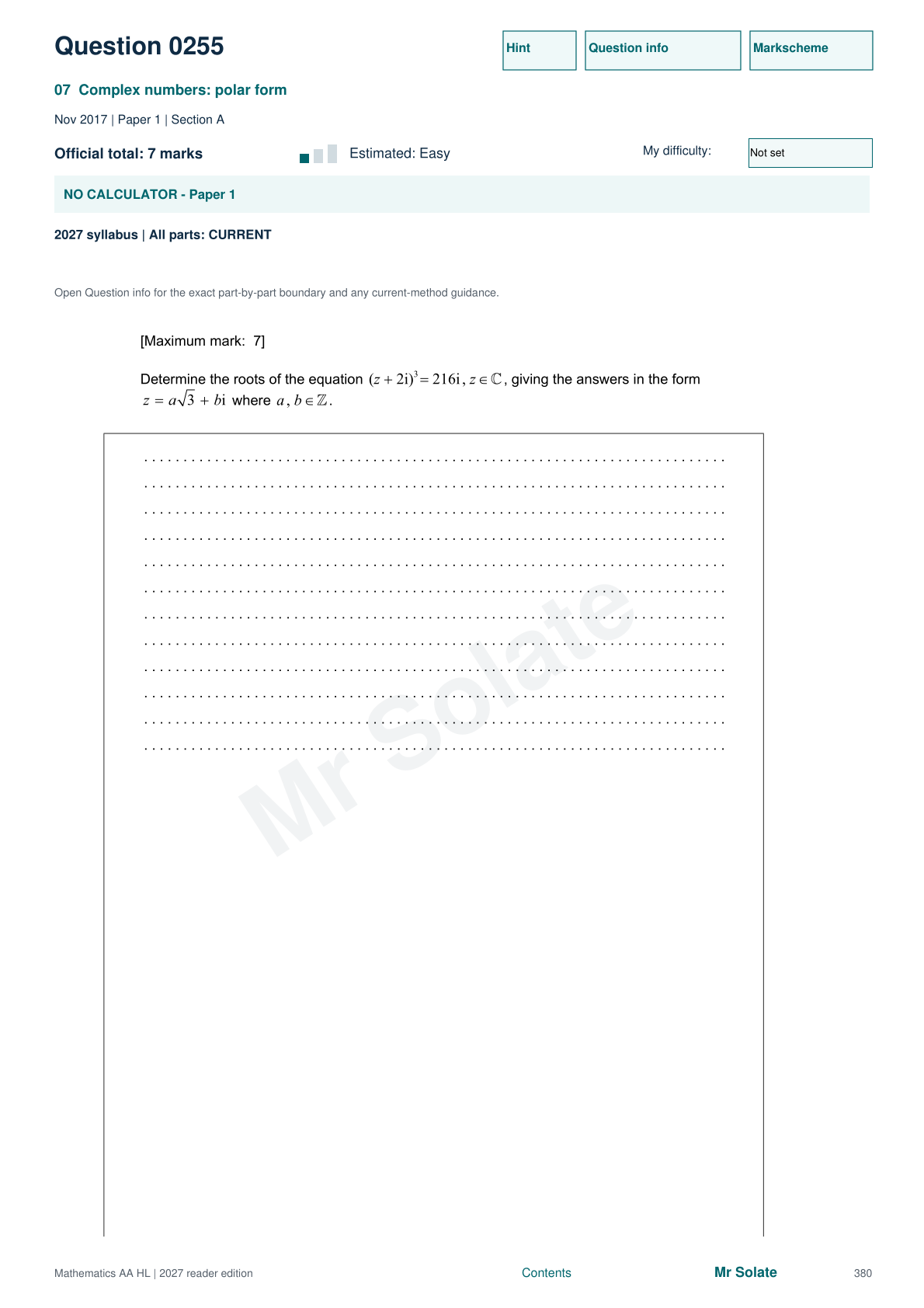
Question 255
Direct use of Shifted complex cube roots; Cartesian form. Then w³=216i, whose roots have modulus 6 and arguments π/6,5π/6,3π/2.
Compatibility: All parts: The tested content remains current AA HL: Shifted complex cube roots; Cartesian form.
View the original question
Original page images preserve the equations and diagrams. Write your response before revealing the reasoning.

Reveal the revision reasoning
- Then w³=216i, whose roots have modulus 6 and arguments π/6,5π/6,3π/2.
- Their Cartesian forms are 3√3+3i,−3√3+3i,−6i.
- Subtract 2i from each to obtain z=3√3+i,−3√3+i,−8i.
Editorial revision reasoning. Check the original answer for its marking detail.
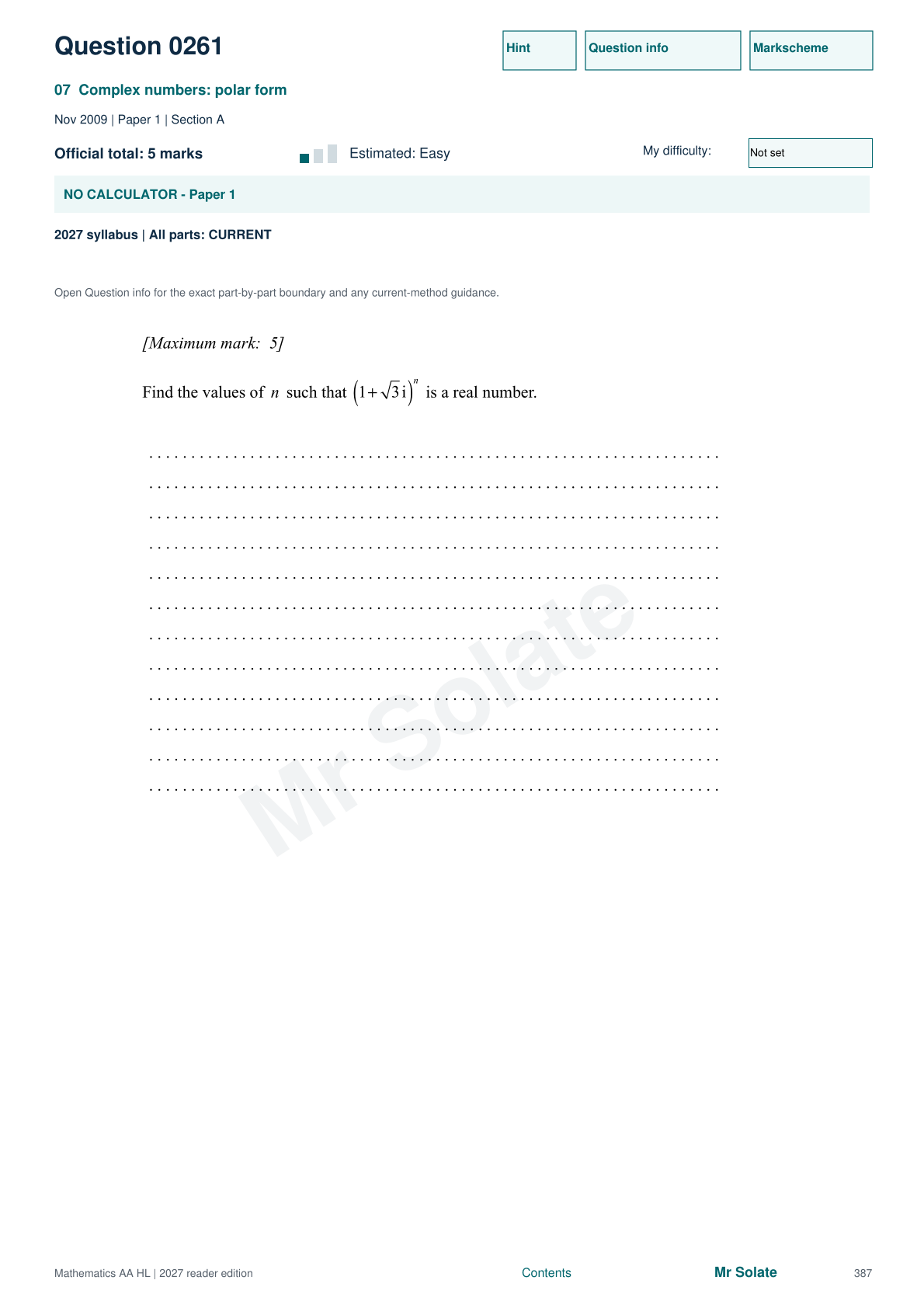
Question 261
Direct use of Powers of a complex number; Real-axis condition. 1+i√3=2 cis(π/3).
Compatibility: All parts: The tested content remains current AA HL: Powers of a complex number; Real-axis condition.
View the original question
Original page images preserve the equations and diagrams. Write your response before revealing the reasoning.
Reveal the revision reasoning
- 1+i√3=2cis(π/3).
- Its nth power is 2^n cis(nπ/3).
- Require sin(nπ/3)=0, giving n=3k for the allowed integer values.
Editorial revision reasoning. Check the original answer for its marking detail.
All 57 questions in this topic
Close your notes first
Can you retrieve the method?
1. What happens to the argument on multiplication?
Check answer 1
The arguments add, modulo a full turn.
2. How far apart are five roots of a nonzero complex number?
Check answer 2
2π/5 in argument.
3. Is a real power necessarily positive?
Check answer 3
No. Odd multiples of π give negative real values.
Before you move on
- Draw a quick Argand diagram when selecting roots by quadrant; it is safer than comparing unfamiliar angle fractions mentally.
- When converting back, preserve exact surds in non-calculator work and verify the modulus independently.
Your revision note
Record one missed cue, one corrected step and one question to retry. Saved only in this browser.