Start with the exam
What you need to be able to do
Treat transformations as instructions applied to coordinates. Inside changes affect x; outside changes affect y. The bank includes translations, input and output absolute values, reciprocals and combinations where order matters. Before drawing a full curve, map two labelled points, any corner or turning point, and all asymptotes. A correct rough shape without these anchors is harder to assess and easier to reflect in the wrong direction.
Spend 3 minutes reading the overview and diagram, 7 minutes learning the question patterns, 5 minutes writing out the worked example, and 5 minutes on a bank question or recall check. Take longer when you need to; the full bank is here for later practice.
Recognise → set up → write
How the questions are set
Map points through scales and shifts
Recognise it: The graph changes to a f(b(x−h))+k.
- An original point (u,v) maps to (h+u/b,av+k), assuming b≠0. Derive this by setting b(x−h)=u.
- Map intercepts, vertices and domain endpoints individually. An input reflection has b<0; an output reflection has a<0.
- Transform asymptote equations as well as points. State the scale and the direction in a verbal description.
Write the coordinate mapping before sketching; it resolves whether a horizontal factor is b or 1/b.
f(2x) compresses horizontal distances by 1/2, not stretches them by 2.
Absolute-value transformations
Recognise it: The task contains |f(x)|, f(|x|), or piecewise modulus expressions.
- For |f(x)| retain nonnegative portions and reflect negative portions across the x-axis.
- For f(|x|), retain the original x≥0 half and reflect it into x<0. The original left half is not used.
- For algebraic moduli, split at zeros of the expressions inside each absolute value, then solve or sketch each interval.
State which half or portion is retained before reflecting. Label the corner where the sign changes.
Input and output absolute values perform different operations and usually give different graphs.
Reciprocals and intersections
Recognise it: Sketch 1/f(x), compare transformed graphs, or count solutions at a horizontal level.
- For a reciprocal, keep x and replace each nonzero height y by 1/y. Original zeros become exclusions and typically vertical asymptotes.
- Track inherited holes and asymptotes carefully. A reciprocal is not a reflection in y=x.
- For a number-of-solutions question, count intersections and treat levels through turning points or endpoints separately.
Show invariant heights y=1 and y=−1 when useful, then label new asymptotes.
Do not count a tangency twice or include an excluded endpoint merely because it lies on the drawn boundary.
Write it before you reveal it
A worked exam-style example
Original teaching example, created for this lesson.
Original practice: (2,3) lies on y=f(x). Find its image on y=−2f(3(x−1))+4.
Reveal the worked solution
- Set 3(x−1)=2, giving x=5/3.
- Transform the height: y=−2(3)+4=−2.
- The mapped point is an exact coordinate pair; the horizontal and vertical steps act independently.
Answer: (5/3,−2).
Check: At x=5/3 the inner input is exactly 2, so the original function value is 3 and the transformed height is −2.
From your own collection
Apply it to past-paper questions
These questions anchor the patterns above. Attempt one without the answer, then compare your setup and conclusion with the reasoning. The linked reader contains the source answer and the question-specific syllabus review.
Question 502
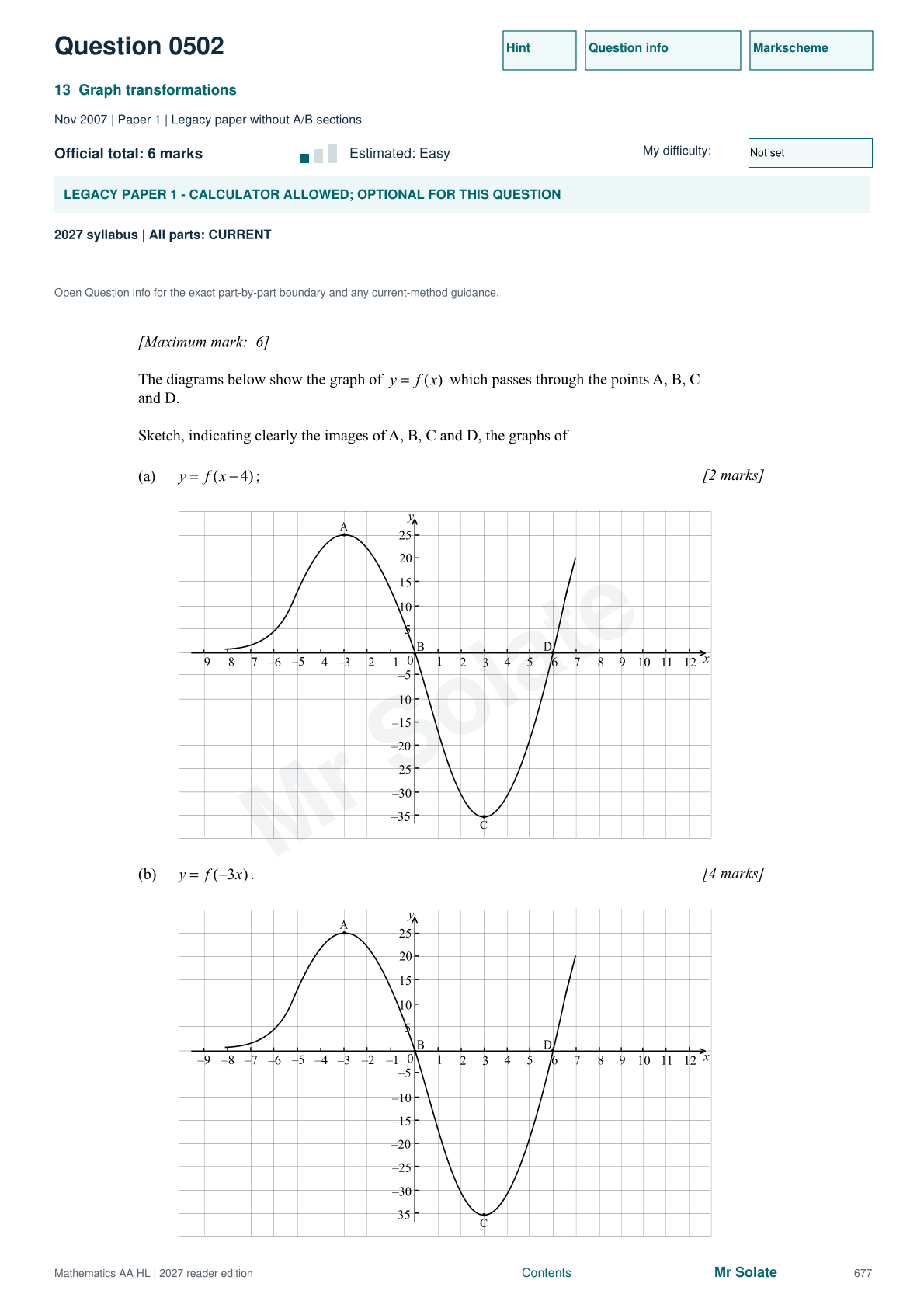
Direct use of Horizontal translation; Negative input scale. For f(x−4), each point (u,v) becomes (u+4,v).
Compatibility: All parts: The tested content remains current AA HL: Horizontal translation; Negative input scale; Point mapping.
View the original question
Original page images preserve the equations and diagrams. Write your response before revealing the reasoning.
Reveal the revision reasoning
- For f(x−4), each point (u,v) becomes (u+4,v).
- Thus A,B,C,D become (1,25),(4,0),(7,−35),(10,0).
- For f(−3x), each point (u,v) becomes (−u/3,v), combining reflection in the y-axis with horizontal scale 1/3.
- The labelled images are (1,25),(0,0),(−1,−35),(−2,0).
- Join the points with the corresponding reflected or translated shape.
Editorial revision reasoning. Check the original answer for its marking detail.
Question 487
Apply the method to the original question.
Compatibility: All parts test current AA HL content and can be solved using current syllabus methods.
View the original question
Original page images preserve the equations and diagrams. Write your response before revealing the reasoning.
Reveal the revision reasoning
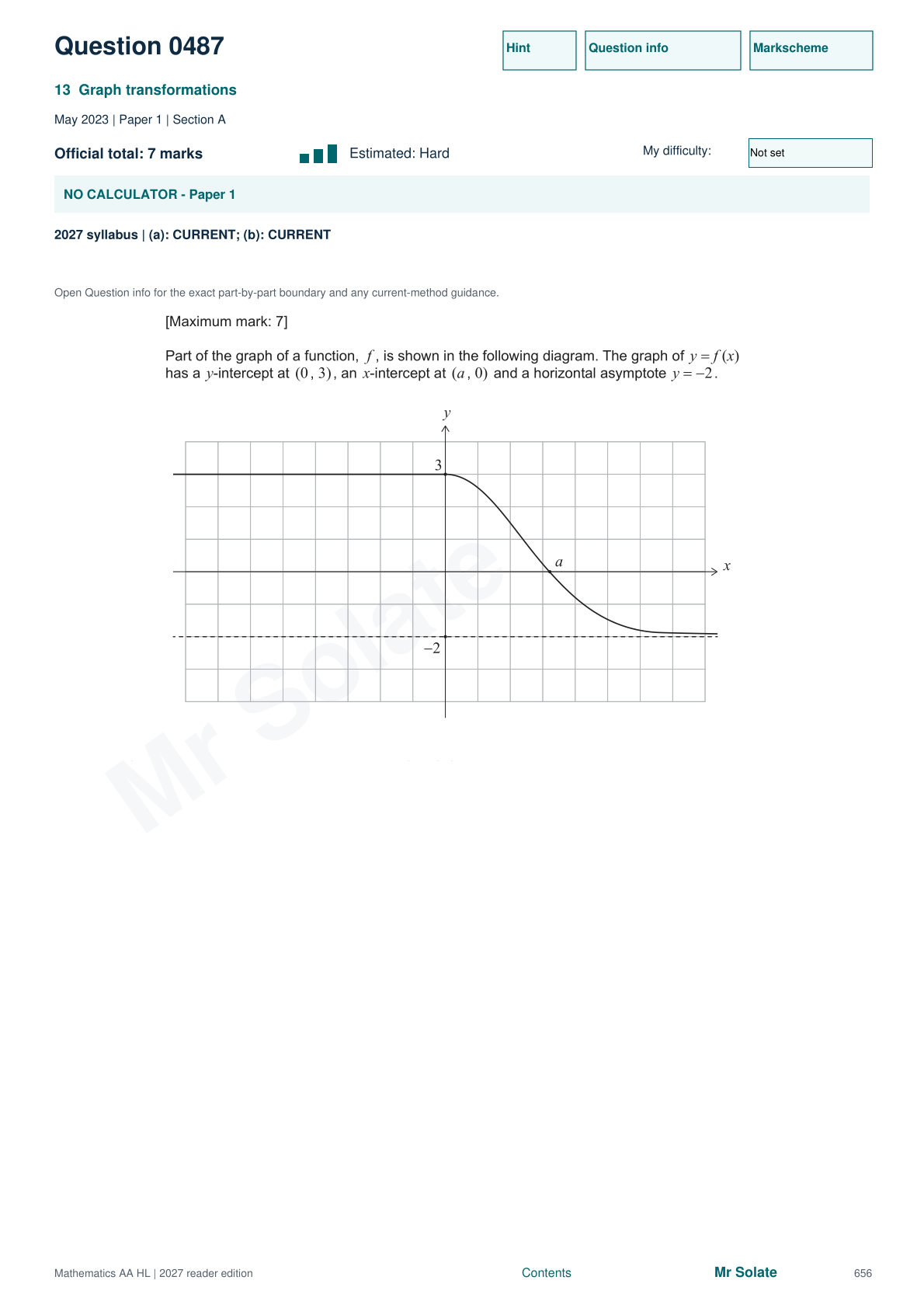
For f(|x|), keep the original right half and reflect it in the y-axis. The original left half is discarded.
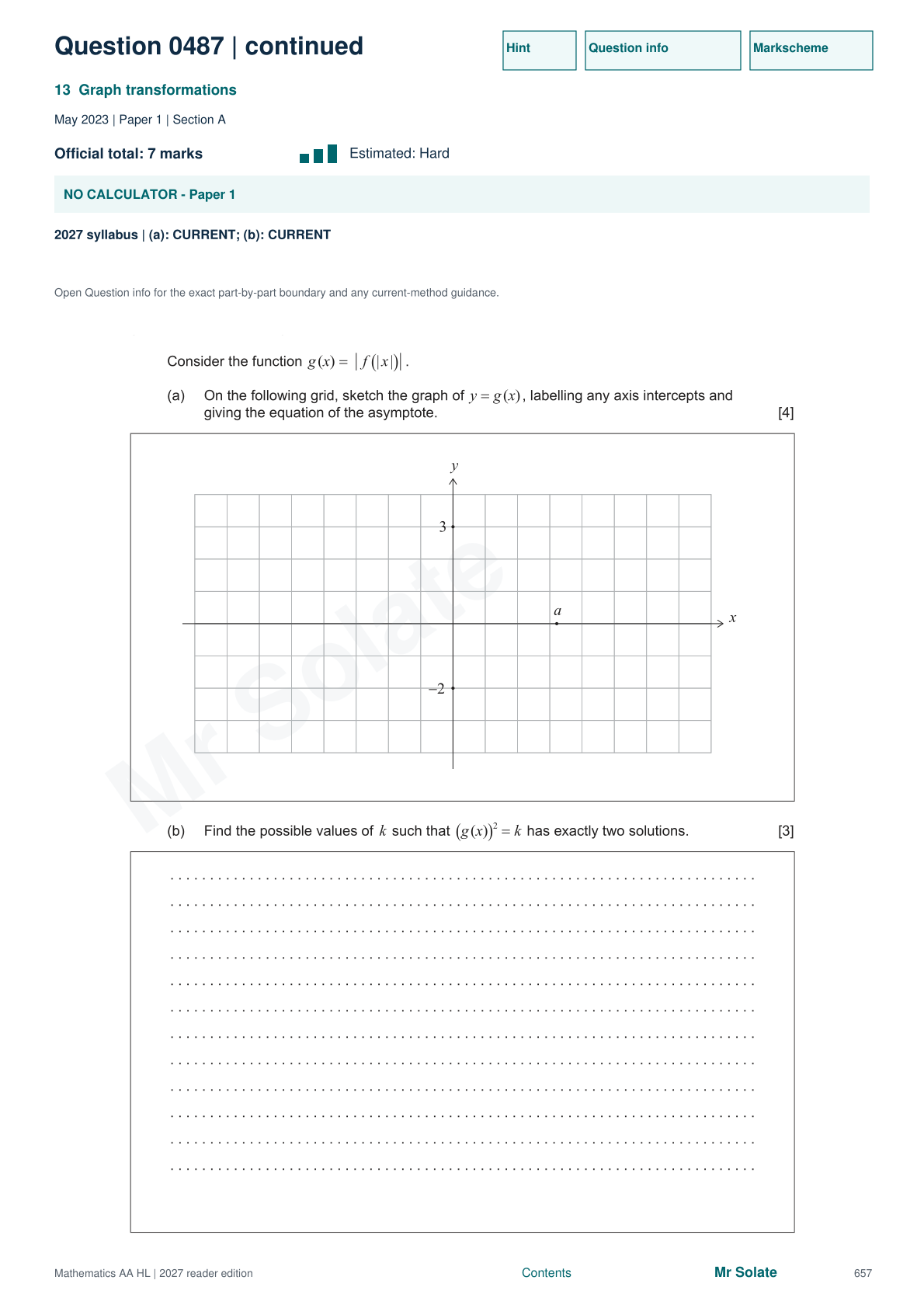
The outer absolute value reflects all remaining negative portions upwards. The resulting even graph has maximum (0,3), cusps at (±a,0), and horizontal asymptote y=2 approached from below.
Because g≥0, solve g²=k by intersecting g with y=√k, for k≥0.
At k=0 there are two roots. For 0<k<4 there are four; for 4≤k<9 there are exactly two. At k=9 there is one, and larger k gives none.
Thus the answer is k=0 or 4≤k<9.
Editorial revision reasoning. Check the original answer for its marking detail.
Question 495
Several linked steps in Reciprocal points and poles; Derivative graph from extrema. Key distinction: The derivative image of a stationary point has height zero, not the original y-coordinate.
Compatibility: All parts: The tested content remains current AA HL: Reciprocal points and poles; Derivative graph from extrema.
View the original question
Original page images preserve the equations and diagrams. Write your response before revealing the reasoning.
Reveal the revision reasoning
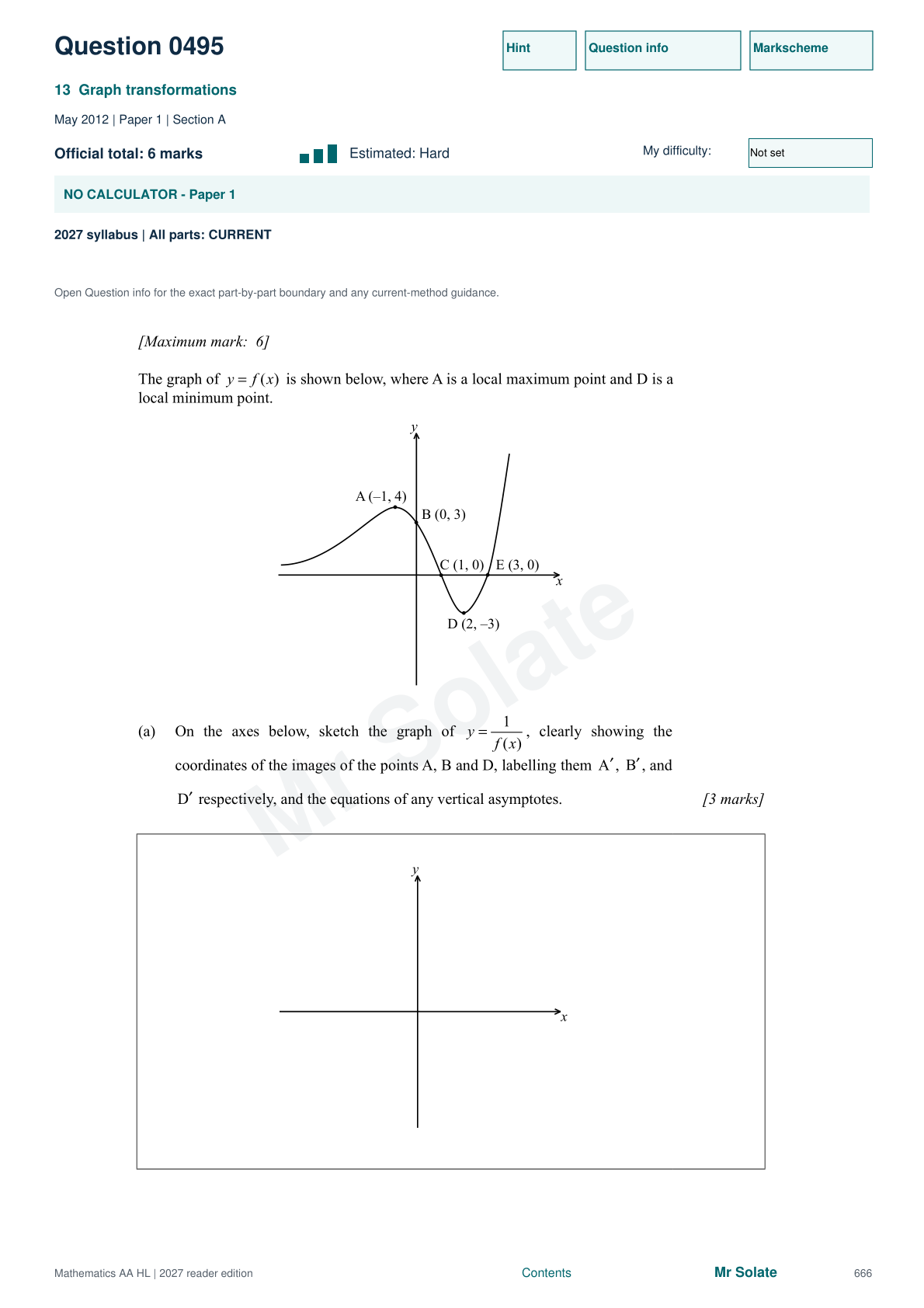
- The reciprocal maps A,B,D to (−1,1/4),(0,1/3),(2,−1/3).
- The original zeros give vertical asymptotes x=1 and x=3; maintain the signs of each original branch.
- In the derivative graph, A and D become zeros (−1,0),(2,0).
- Because f increases then decreases then increases, f′ is positive before −1, negative between −1 and 2, and positive after 2.
- Match changes in steepness to a local minimum and maximum of f′, with its right-hand flattening giving horizontal asymptote zero.
Editorial revision reasoning. Check the original answer for its marking detail.
All 39 questions in this topic
Close your notes first
Can you retrieve the method?
1. What happens to (u,v) under f(x−4)?
Check answer 1
It becomes (u+4,v).
2. Which half is copied in f(|x|)?
Check answer 2
The original right half, x≥0.
3. What is fixed under reciprocal height transformation?
Check answer 3
Heights 1 and −1, where the original function is defined.
Before you move on
- After sketching, test one labelled point directly in the transformed formula. This catches reversed horizontal shifts.
- When transformations occur in a stated sequence, apply them in that sequence or derive the final formula; scales and shifts need not commute.
Your revision note
Record one missed cue, one corrected step and one question to retry. Saved only in this browser.