Start with the exam
What you need to be able to do
A proof question asks you to establish a statement, so examples alone are insufficient. Induction is especially useful when the next case can be built from the previous one. The bank also contains direct proof, contradiction and counterexamples: use the method requested, and otherwise choose the shortest valid argument. In induction, the mark-bearing structure is a verified starting case, a precise hypothesis, a genuinely derived next case and a conclusion over the stated integers.
Spend 3 minutes reading the overview and diagram, 7 minutes learning the question patterns, 5 minutes writing out the worked example, and 5 minutes on a bank question or recall check. Take longer when you need to; the full bank is here for later practice.
Recognise → set up → write
How the questions are set
Induction for sums and recurrences
Recognise it: Prove a formula for all positive integers, often containing a sum, factorial or recurrence.
- Verify the first permitted integer; it may be 2 or 3 rather than 1. Evaluate both sides explicitly.
- Assume the full claim for n=k. Start the next case from the old sum plus the exact next term, or substitute into the recurrence.
- Replace the old expression using the hypothesis, simplify to the claimed formula with k+1, then conclude by induction.
Write S_(k+1)=S_k+next term before substituting. For factorials, expose a common factorial rather than cancelling incompatible expressions.
Do not assume the k+1 statement and merely rearrange it into itself. Checking several examples is not the induction step.
Divisibility and inequalities
Recognise it: A power expression must be divisible by an integer, or an inequality must hold for all n.
- For divisibility, write the next expression as a multiple of the assumed expression plus an obvious multiple of the divisor.
- For an inequality, preserve its direction when multiplying; justify that the multiplier is positive.
- Show the bridge from your resulting bound to the desired k+1 bound. A weaker bound does not complete the proof.
If E_k=dm, write E_(k+1)=cE_k+dq=d(cm+q), with integers identified.
Do not replace a strict inequality by equality, or multiply by an expression of unknown sign.
Direct proof, contradiction and counterexamples
Recognise it: The task asks to prove parity, divisibility or disprove a universal statement.
- Represent even integers as 2m and odd integers as 2m+1. Expand and exhibit the required integer form.
- For contradiction, state the exact negation, derive an impossibility such as a negative square, then reject the assumption.
- To disprove a universal claim, give one valid counterexample and explicitly show how it fails.
A statement “divisible by 12” should end as 12 times an integer, not merely as a decimal quotient.
Assuming a stronger statement than the negation can leave cases unproved. A counterexample must lie inside the claimed domain.
Write it before you reveal it
A worked exam-style example
Original teaching example, created for this lesson.
Original practice: prove 1+3+…+(2n−1)=n² for n≥1.
Reveal the worked solution
- For n=1, the sum is 1=1².
- Assume S_k=k² for an arbitrary positive integer k.
- Then S_(k+1)=S_k+[2(k+1)−1]=k²+2k+1=(k+1)².
- The base case holds and the implication from k to k+1 holds, so the statement follows for every integer n≥1.
Answer: The identity is proved by mathematical induction.
Check: The added term is 2k+1, not 2k−1. The proof explicitly uses the hypothesis exactly once.
From your own collection
Apply it to past-paper questions
These questions anchor the patterns above. Attempt one without the answer, then compare your setup and conclusion with the reasoning. The linked reader contains the source answer and the question-specific syllabus review.
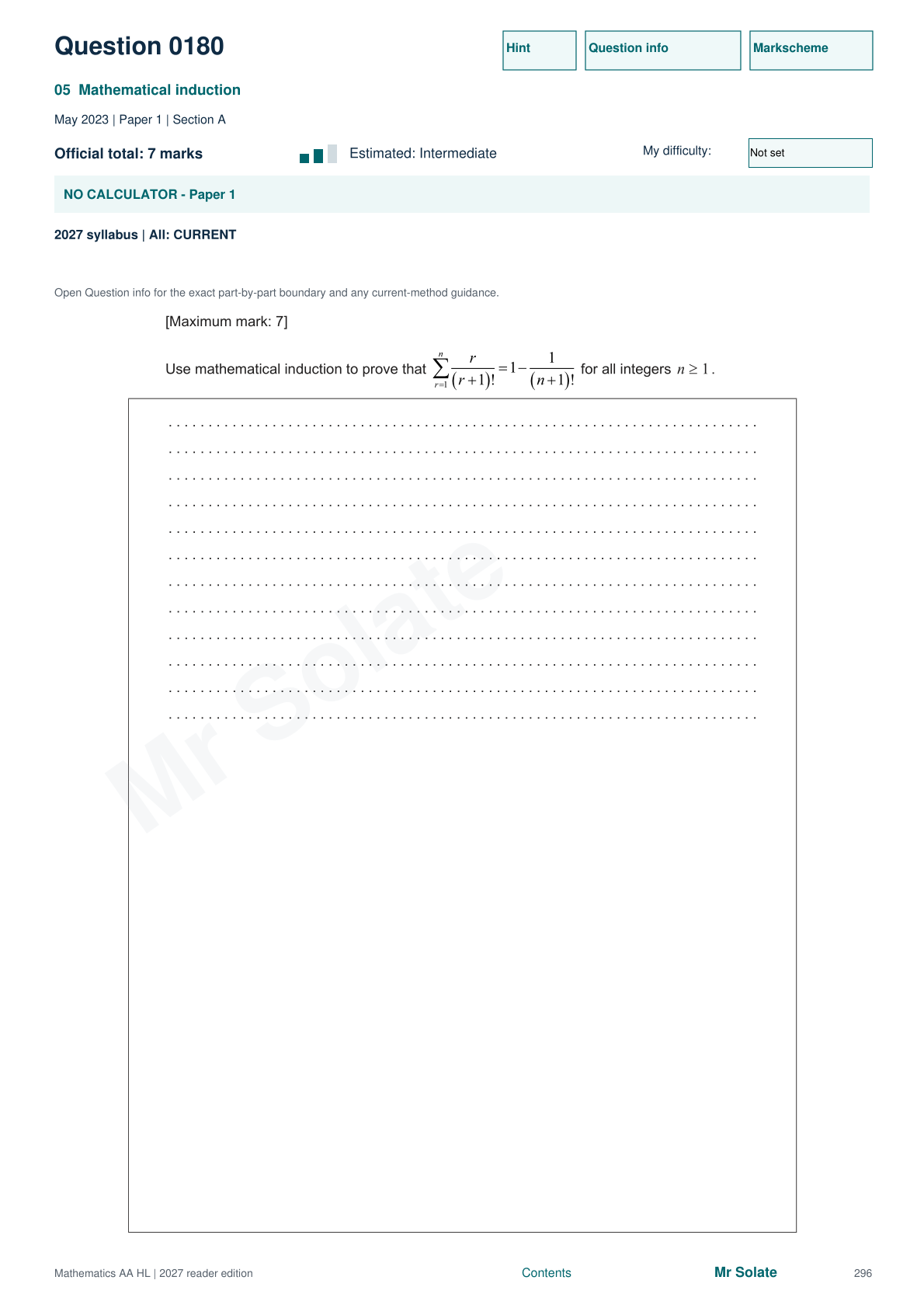
Question 180
Apply the method to the original question.
Compatibility: All parts test current AA HL content and can be solved using current syllabus methods.
View the original question
Original page images preserve the equations and diagrams. Write your response before revealing the reasoning.
Reveal the revision reasoning
At n=1, the sum is 1/2! and the right side is 1-1/2!, both equal to 1/2.
Assume Σ from r=1 to k of r/(r+1)! equals 1-1/(k+1)!.
Add the next term (k+1)/(k+2)!, obtaining 1-1/(k+1)!+(k+1)/(k+2)!.
Since (k+2)!=(k+2)(k+1)!, the last two terms combine to -1/(k+2)!. This is exactly the required formula with n=k+1.
Conclude that the verified base case and implication establish the identity for every integer n≥1.
Editorial revision reasoning. Check the original answer for its marking detail.
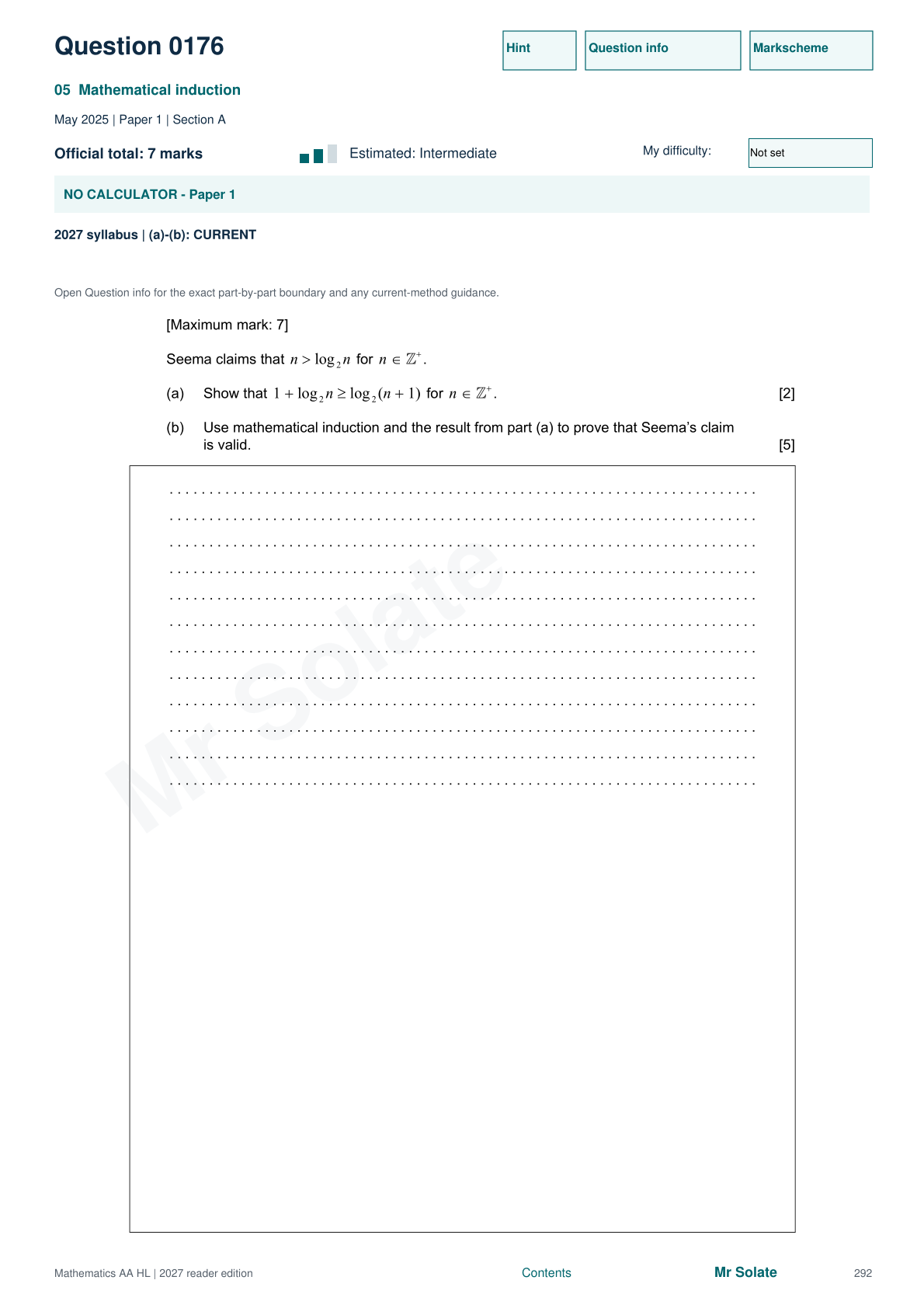
Question 176
Apply the method to the original question.
Compatibility: All parts test current AA HL content and can be solved using current syllabus methods.
View the original question
Original page images preserve the equations and diagrams. Write your response before revealing the reasoning.
Reveal the revision reasoning
For n≥1, 2n≥n+1. Since log₂ is increasing, log₂(2n)≥log₂(n+1).
Log laws give log₂(2n)=1+log₂n, proving part (a).
For the base case n=1, 1>log₂1=0.
Assume k>log₂k. Adding 1 gives k+1>1+log₂k, while part (a) gives 1+log₂k≥log₂(k+1).
Combining them establishes k+1>log₂(k+1). State the induction conclusion for all positive integers.
Editorial revision reasoning. Check the original answer for its marking detail.
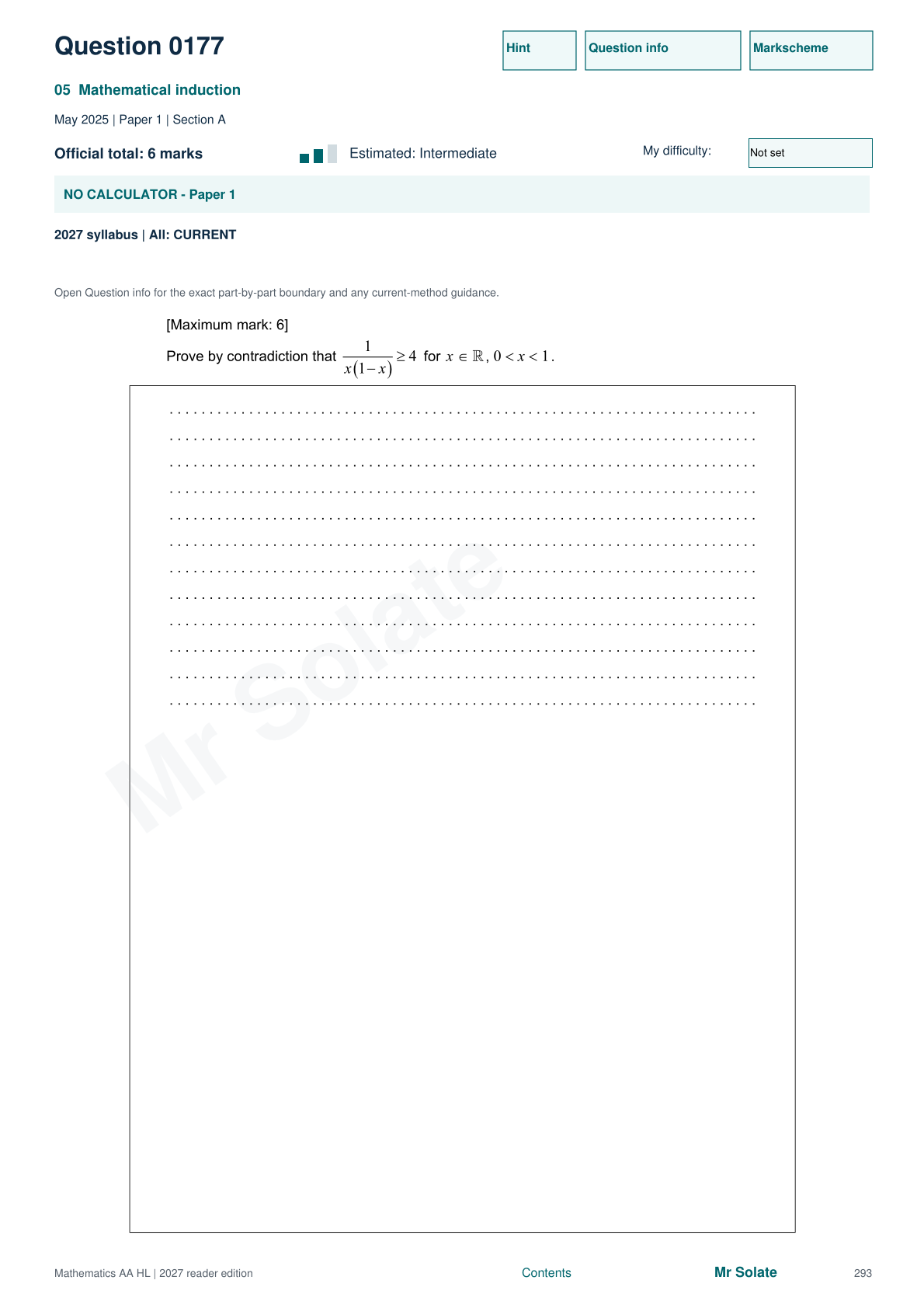
Question 177
Apply the method to the original question.
Compatibility: All parts test current AA HL content and can be solved using current syllabus methods.
View the original question
Original page images preserve the equations and diagrams. Write your response before revealing the reasoning.
Reveal the revision reasoning
Suppose for contradiction that 1/[x(1-x)]<4 for some x with 0<x<1.
Here x and 1-x are both positive, so multiplying by x(1-x) preserves the inequality: 1<4x(1-x).
Rearrange to 4x²-4x+1<0, or (2x-1)²<0.
A real square cannot be negative, so this contradicts the assumption. Therefore 1/[x(1-x)]≥4 throughout the stated interval.
Editorial revision reasoning. Check the original answer for its marking detail.
All 41 questions in this topic
Close your notes first
Can you retrieve the method?
1. What must be verified before the induction step?
Check answer 1
The first integer allowed by the claim.
2. What does “assume true for k” permit?
Check answer 2
Use the complete kth statement to derive the next case; it does not allow assuming the next case.
3. How many counterexamples disprove a universal statement?
Check answer 3
One valid counterexample.
Before you move on
- Before writing, identify exactly where the induction hypothesis will be used. If no line uses it, your step is likely circular or incomplete.
- After the algebra, include the conclusion and the integer range. Avoid ending a proof with an unexplained expression.
Your revision note
Record one missed cue, one corrected step and one question to retry. Saved only in this browser.