Start with the exam
What you need to be able to do
Motion questions use the same calculus operations but attach different meanings to them. Position differentiates to velocity, velocity to acceleration, and integrating velocity gives displacement. Distance requires nonnegative travel and therefore splits at reversals. The bank repeatedly tests that distinction, along with rest times, maximum speed and acceleration when velocity is supplied as a function of position.
Spend 3 minutes reading the overview and diagram, 7 minutes learning the question patterns, 5 minutes writing out the worked example, and 5 minutes on a bank question or recall check. Take longer when you need to; the full bank is here for later practice.
Recognise → set up → write
How the questions are set
Move between position, velocity and acceleration
Recognise it: One motion quantity is given and another is requested.
- Use v=ds/dt and a=dv/dt. When integrating, use the given initial position or velocity to determine the constant.
- Rest occurs at v=0, not at s=0 or a=0. A direction change requires the sign of v to change around the rest time.
- For a return to the start, solve s(t)=s(0), equivalently a zero net velocity integral from the start. Exclude the initial time if a later return is requested.
Define the positive direction and show the derivative or initial-value integral.
Zero acceleration means stationary velocity, not necessarily rest. Crossing the origin need not mean reversing direction.
Distance and maximum speed
Recognise it: The interval includes reversals or the question asks how far the particle travels.
- Find all zeros of velocity in the interval and determine its sign between them.
- Distance is ∫|v|dt, or the sum of absolute changes in position over monotone segments. Displacement is the signed integral ∫v dt.
- For maximum speed, compare |v| at relevant stationary-velocity candidates and endpoints. When deciding whether speed increases, check that v and a have the same sign.
Show the rest times and the interval split before adding positive distances.
The absolute value of total displacement is not total distance when reversals occur.
Velocity given as a function of position
Recognise it: The formula uses s rather than t, or drag depends on velocity.
- Apply the chain rule a=dv/dt=(dv/ds)(ds/dt)=v dv/ds.
- If solving for time from a velocity-dependent acceleration, rearrange dt=dv/a(v) with appropriate initial and final velocities.
- For piecewise motion, match position and any required velocity conditions at the transition. Use consistent units before calculating, especially when one part uses kilometres per hour.
Write the chain-rule identity before differentiating a velocity-position model.
dv/ds is not acceleration by itself; it needs the extra factor v.
Write it before you reveal it
A worked exam-style example
Original teaching example, created for this lesson.
Original example: v(t)=2t−2 m/s for 0≤t≤3. Find displacement and distance.
Reveal the worked solution
- The rest time is t=1. Velocity is negative before one and positive after.
- An antiderivative is t²−2t. Displacement from zero to three is 9−6=3 m.
- The signed integral from zero to one is −1 m, and from one to three is 4 m.
- Distance is 1+4=5 m.
Answer: Displacement 3 m; distance 5 m.
Check: The particle first travels one metre backwards and then four forwards, leaving it three metres ahead.
From your own collection
Apply it to past-paper questions
These questions anchor the patterns above. Attempt one without the answer, then compare your setup and conclusion with the reasoning. The linked reader contains the source answer and the question-specific syllabus review.
Question 1429
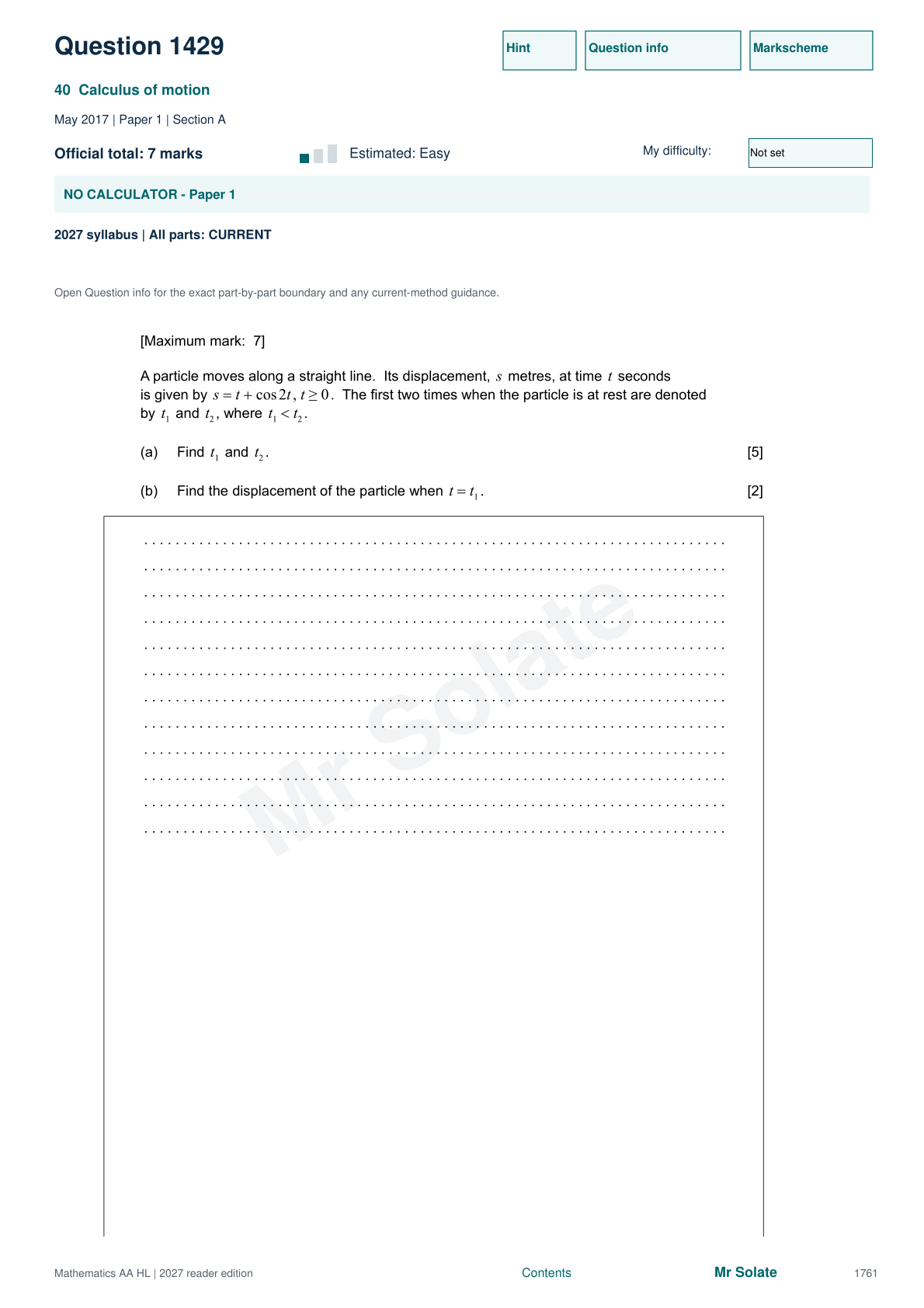
A short direct application of Displacement derivative, Trigonometric rest times, Exact displacement.
Compatibility: Current: All parts
View the original question
Original page images preserve the equations and diagrams. Write your response before revealing the reasoning.
Reveal the revision reasoning
- Differentiate s=t+cos2t to get v=1-2sin2t.
- The first two nonnegative roots satisfy 2t=π/6 and 5π/6, so t1=π/12,t2=5π/12.
- Substitute t1 into s to obtain π/12+√3/2 metres.
Editorial revision reasoning. Check the original answer for its marking detail.
Question 1431
Apply the method to the original question.
Compatibility: This AA HL question uses current syllabus methods in the references shown.
View the original question
Original page images preserve the equations and diagrams. Write your response before revealing the reasoning.
Reveal the revision reasoning
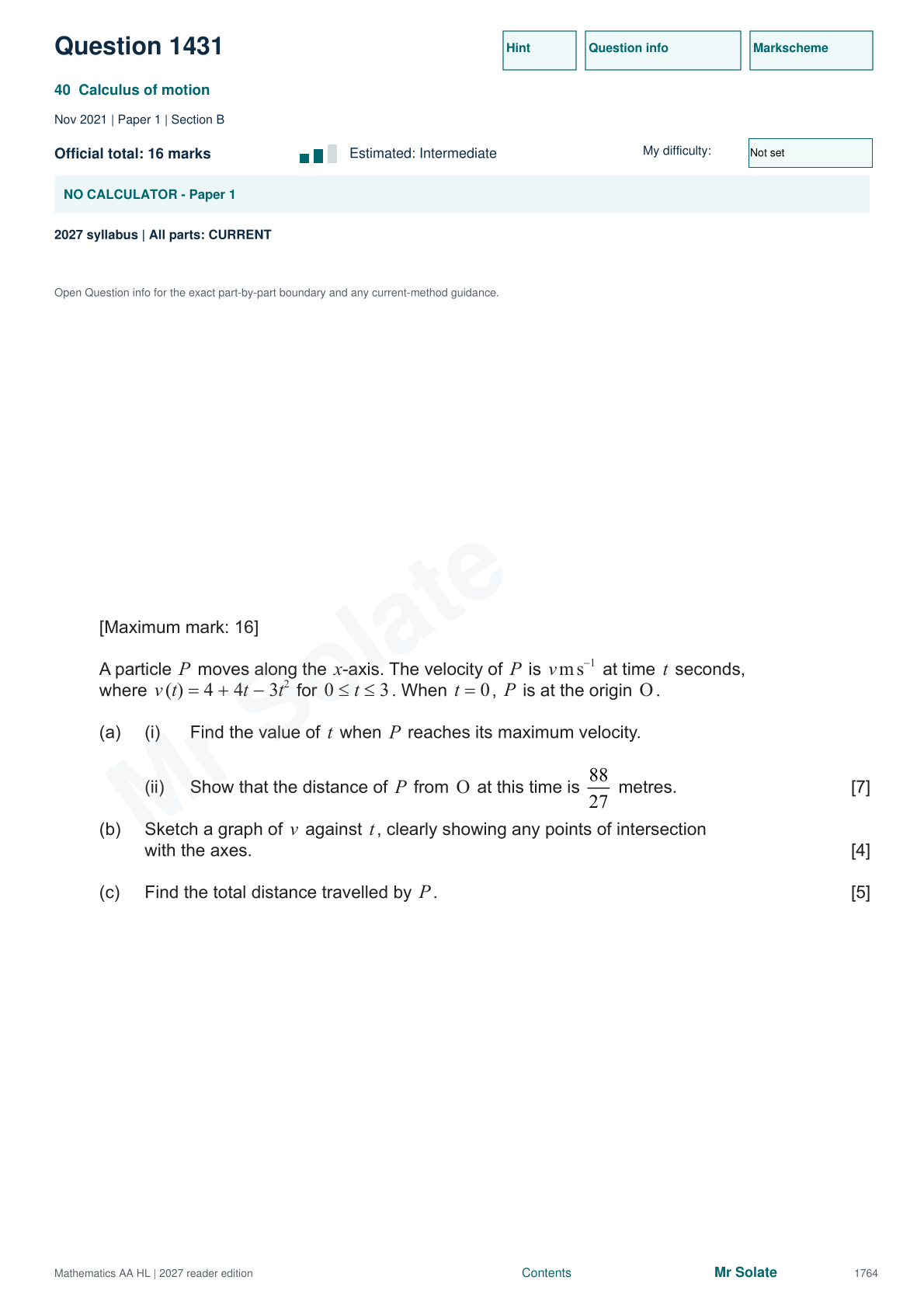
The acceleration is v′=4-6t, so the maximum velocity occurs at t=2/3. The downward-opening quadratic confirms it is a maximum.
Using s(0)=0, integrate to s(t)=4t+2t²-t³. At 2/3 this is 88/27 metres.
The graph starts at (0,4), peaks at (2/3,16/3), crosses the time axis at t=2, and ends at (3,-11). The other root -2/3 lies outside the time interval.
The particle moves forward until t=2 and backward thereafter. Since s(2)=8 and s(3)=3, total distance is 8+(8-3)=13 metres.
Editorial revision reasoning. Check the original answer for its marking detail.
Question 1430
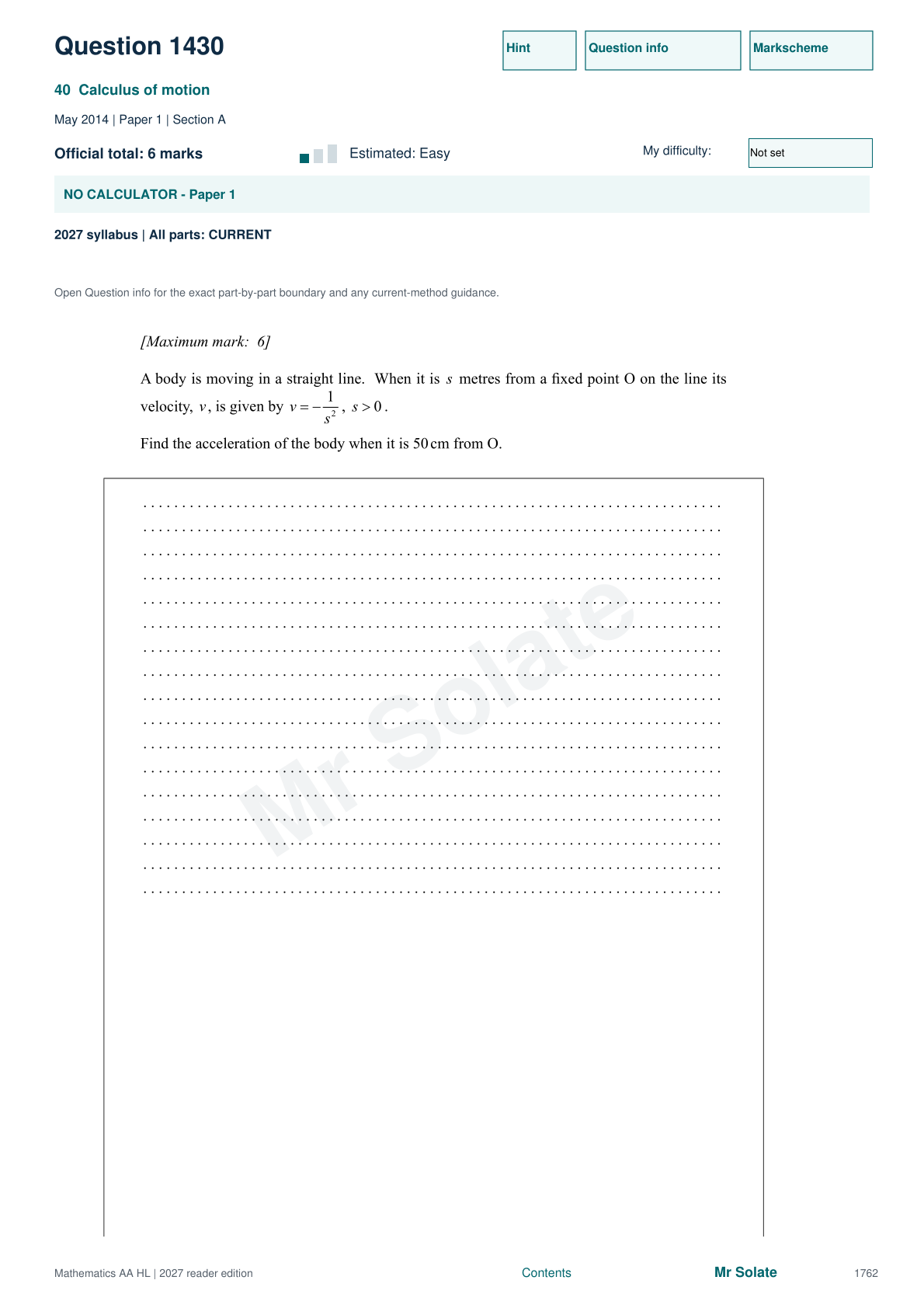
A short direct application of Velocity as function of displacement, Chain rule acceleration, Unit conversion.
Compatibility: Current: All parts
View the original question
Original page images preserve the equations and diagrams. Write your response before revealing the reasoning.
Reveal the revision reasoning
- For v=-s^(-2), dv/ds=2s^(-3).
- Multiply by v to obtain a=-2s^(-5).
- Convert 50 cm to s=0.5 m and substitute, giving a=-64 m/s².
Editorial revision reasoning. Check the original answer for its marking detail.
All 35 questions in this topic
Close your notes first
Can you retrieve the method?
1. Rest condition?
Check answer 1
v=0.
2. When does speed increase?
Check answer 2
When velocity and acceleration have the same sign.
3. Acceleration from v(s)?
Check answer 3
v dv/ds.
Before you move on
- Mark rest times before distance calculations.
- Check a return condition against initial position, not automatically against zero.
- Report distance and displacement separately with appropriate signs.
Your revision note
Record one missed cue, one corrected step and one question to retry. Saved only in this browser.