Start with the exam
What you need to be able to do
Identify the outer operation before differentiating: product, quotient or composition. The bank mixes trigonometric, exponential, logarithmic and inverse functions, sometimes using tabulated values. Keep the derivative symbolic until you know which input must be evaluated. Correct structure prevents many more errors than rushing to simplify the final expression.
Spend 3 minutes reading the overview and diagram, 7 minutes learning the question patterns, 5 minutes writing out the worked example, and 5 minutes on a bank question or recall check. Take longer when you need to; the full bank is here for later practice.
Recognise → set up → write
How the questions are set
Chain rules and nested functions
Recognise it: A familiar function contains another varying expression.
- For an inner function u, differentiate the outer function and multiply by u′. Repeat for every layer.
- Use (ln u)′=u′/u, (e^u)′=e^u u′, and ([sin u]²)′=2sin u cos u·u′.
- When setting a derivative to zero, factor first, consider every zero factor and apply the original domain and requested interval.
Show the inner derivative factor before simplifying.
The derivative of sin²x is not cos²x; the square belongs outside the sine.
Products, quotients and tables
Recognise it: Two varying factors are multiplied or divided.
- Use (uv)′=u′v+uv′ and (u/v)′=(u′v−uv′)/v². Keep brackets around composite expressions.
- In a table composition f(g(x)), evaluate f′ at g(x), not automatically at x. Derive the symbolic expression before selecting entries.
- For a second derivative, every varying factor must be differentiated again. Simplify or factor first if that makes the structure clearer.
Show the rule with the actual functions inserted and the table inputs identified.
A quotient derivative is not u′/v′, and the denominator must be squared.
Inverse derivatives and identities
Recognise it: An inverse gradient or a derivative-based identity is requested.
- If y=f⁻¹(x), find the original input y satisfying f(y)=x. Then use (f⁻¹)′(x)=1/f′(y), where f′(y)≠0.
- For a requested identity, substitute the derivative and simplify using the original relation, retaining restrictions during cancellation.
- For stationary coordinates, solve f′=0 and evaluate f at the retained inputs. If using numerical solving, state the equation being solved.
Write the corresponding input-output pair for an inverse and the reciprocal derivative relation.
An inverse function is not 1/f, and its derivative is not evaluated at the wrong original input.
Write it before you reveal it
A worked exam-style example
Original teaching example, created for this lesson.
Original example: differentiate f(x)=xe^(2x) and find its stationary point.
Reveal the worked solution
- f′=e^(2x)+2xe^(2x)=e^(2x)(1+2x).
- The exponential is positive, so f′=0 requires x=−1/2.
- f(−1/2)=−1/(2e). The derivative changes from negative to positive.
Answer: f′=e^(2x)(1+2x); minimum at (−1/2,−1/(2e)).
Check: The sign change verifies a minimum without a second derivative.
From your own collection
Apply it to past-paper questions
These questions anchor the patterns above. Attempt one without the answer, then compare your setup and conclusion with the reasoning. The linked reader contains the source answer and the question-specific syllabus review.
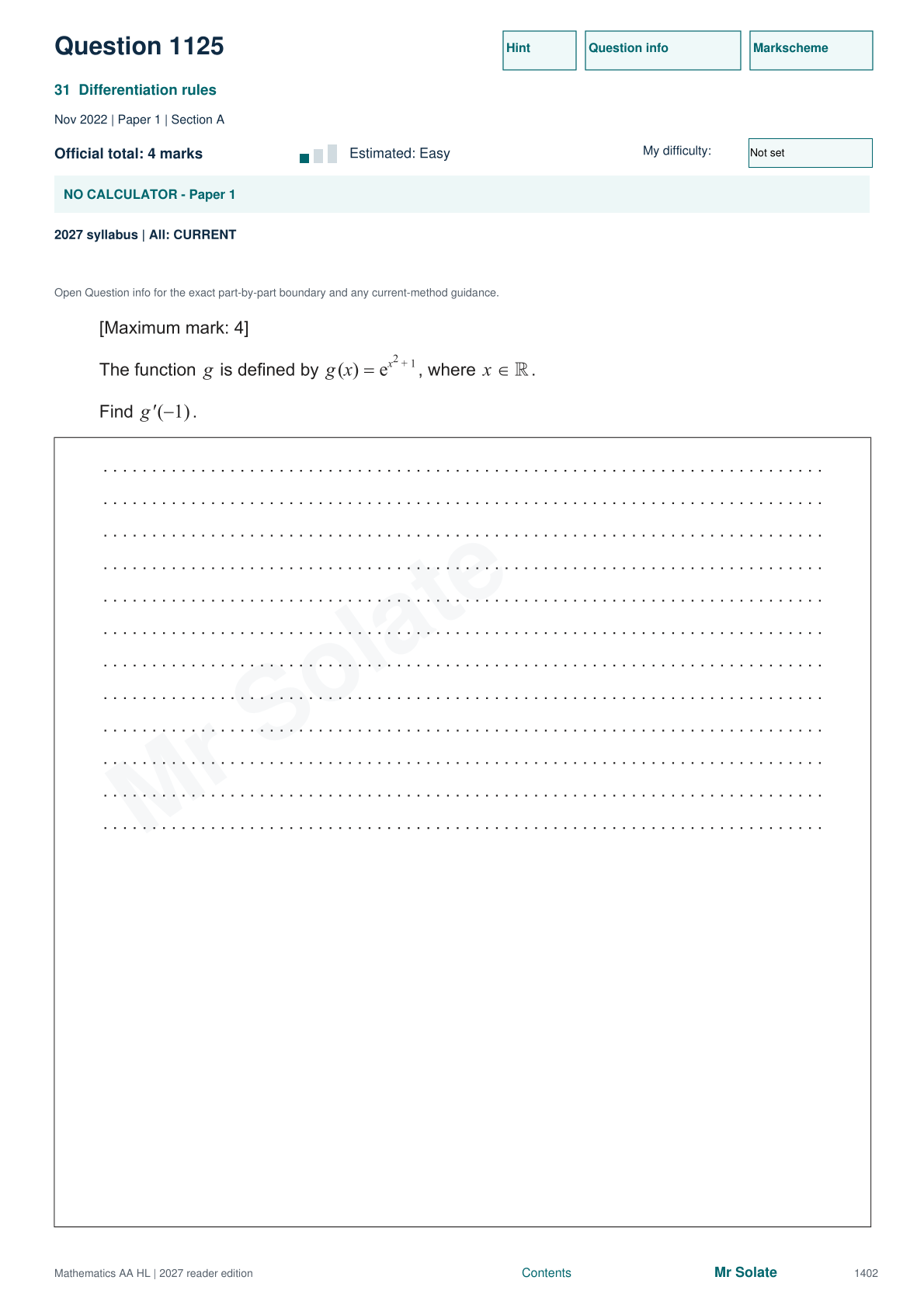
Question 1125
Apply the method to the original question.
Compatibility: All parts test current AA HL content and can be solved using current syllabus methods.
View the original question
Original page images preserve the equations and diagrams. Write your response before revealing the reasoning.
Reveal the revision reasoning
The entire exponent is x²+1. For e^u, the chain rule gives e^u multiplied by du/dx.
Thus g′(x)=2x e^(x²+1). Substitute x=-1 only after finding the derivative.
The exponent becomes 2 and the multiplier becomes -2, so g′(-1)=-2e².
Editorial revision reasoning. Check the original answer for its marking detail.
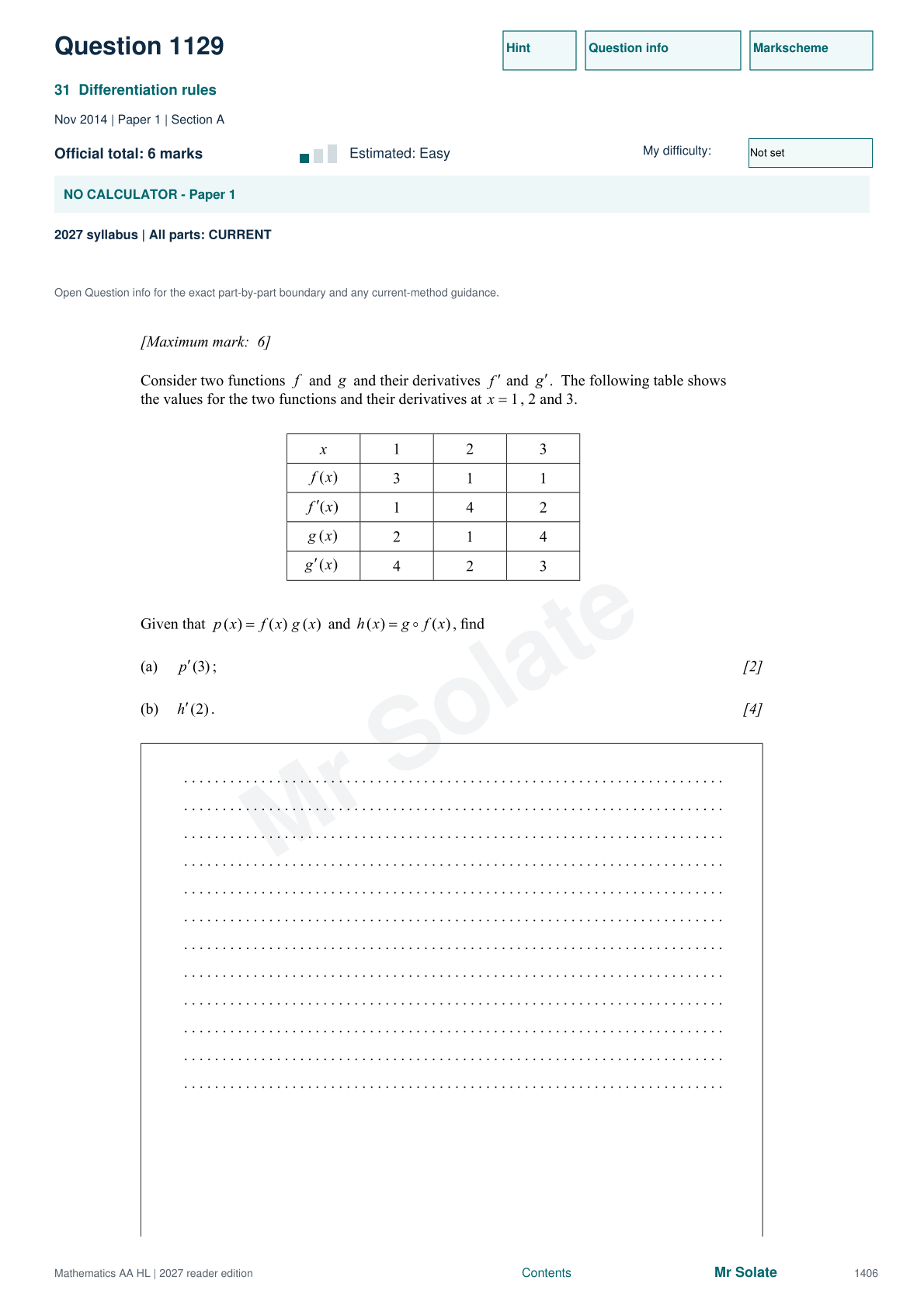
Question 1129
A short direct application of Product rule from a table, Composite derivatives.
Compatibility: Current: All parts
View the original question
Original page images preserve the equations and diagrams. Write your response before revealing the reasoning.
Reveal the revision reasoning
- For p'(3), use f'(3)g(3)+f(3)g'(3)=2·4+1·3=11.
- For h=g∘f, the chain rule gives h'(2)=g'(f(2))f'(2).
- Since f(2)=1, read g'(1)=4 and multiply by f'(2)=4, obtaining 16.
Editorial revision reasoning. Check the original answer for its marking detail.
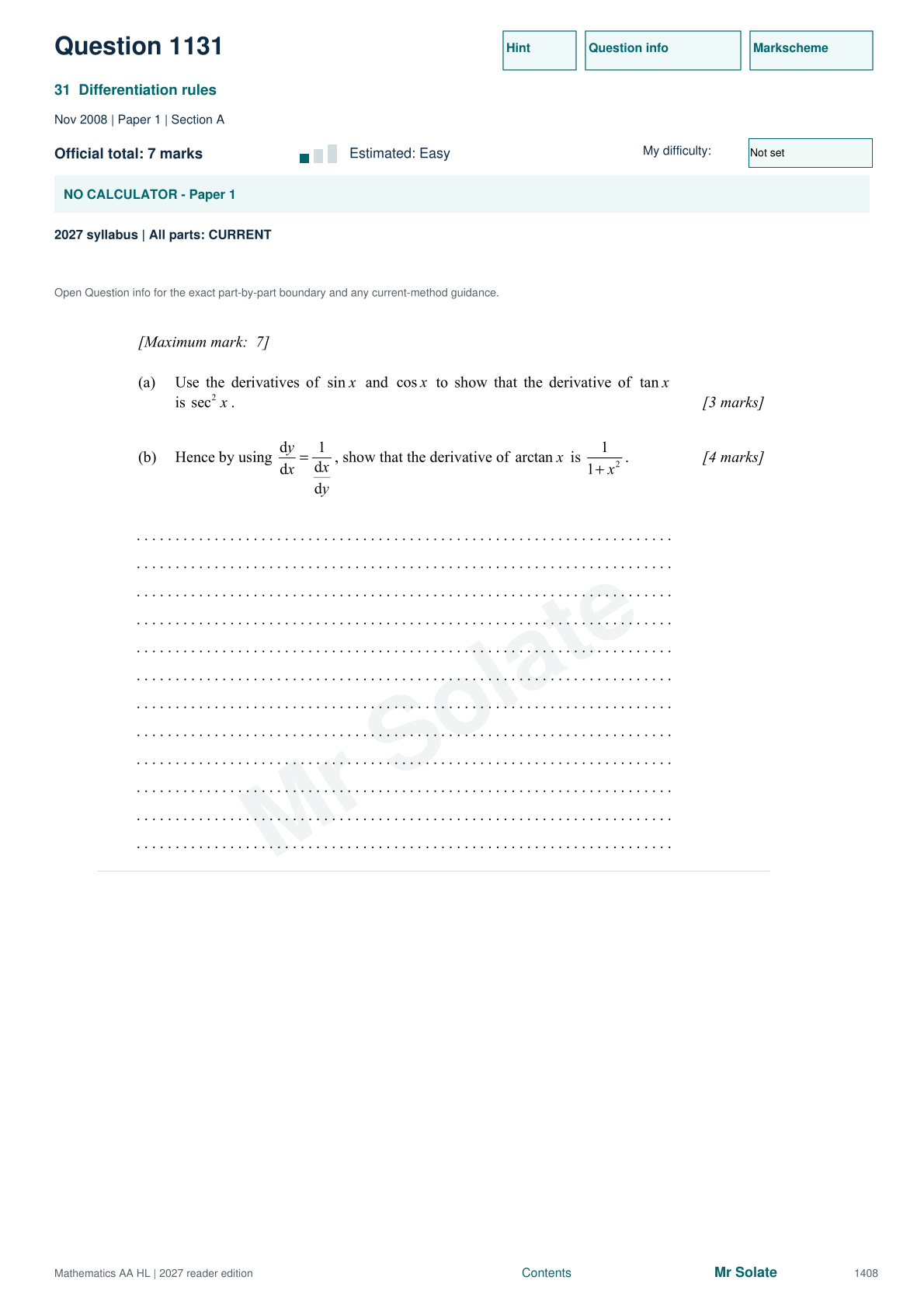
Question 1131
A short direct application of Quotient-rule proof, Inverse-function differentiation.
Compatibility: Current: All parts
View the original question
Original page images preserve the equations and diagrams. Write your response before revealing the reasoning.
Reveal the revision reasoning
- Apply the quotient rule and simplify cos²x+sin²x to 1, obtaining sec²x.
- Put y=arctan x, so x=tan y and dx/dy=sec²y.
- Take the reciprocal and use sec²y=1+tan²y=1+x².
Editorial revision reasoning. Check the original answer for its marking detail.
All 23 questions in this topic
Close your notes first
Can you retrieve the method?
1. Derivative of ln(3x+1)?
Check answer 1
3/(3x+1), on its real domain.
2. First step in a table composition?
Check answer 2
Find the inner value.
3. Why remove e^(2x) when solving f′=0?
Check answer 3
It is strictly positive.
Before you move on
- Annotate each expression with its outer rule.
- Check a derivative after rewriting the original function another way.
- Use f, not f′, for stationary y-coordinates.
Your revision note
Record one missed cue, one corrected step and one question to retry. Saved only in this browser.