Start with the exam
What you need to be able to do
Polynomial questions usually provide information at special inputs: a factor, a remainder, a repeated root or a relation among roots. Translate each sentence into an equation before expanding. The bank often lets you avoid solving the entire polynomial by using coefficient relationships. Keep multiplicities: a double root uses two degrees and supplies a derivative condition, while a non-real root of a real polynomial supplies its conjugate.
Spend 3 minutes reading the overview and diagram, 7 minutes learning the question patterns, 5 minutes writing out the worked example, and 5 minutes on a bank question or recall check. Take longer when you need to; the full bank is here for later practice.
Recognise → set up → write
How the questions are set
Factors and remainders
Recognise it: A polynomial is divisible by x−a or leaves a stated remainder.
- Use P(a)=0 for a factor and P(a)=r for remainder r. For divisor 2x−1, substitute x=1/2.
- Form one equation per condition and solve for unknown coefficients.
- Only perform division if a quotient or remaining roots are needed; evaluation alone is enough for a remainder.
Write P(a)=r before substituting the polynomial. This records the theorem and avoids a sign error in the divisor root.
The root of x+2 is −2, not 2. A nonzero remainder must not be replaced by zero.
Repeated roots and graph behaviour
Recognise it: A factor is squared, the curve touches the axis, or derivatives vanish.
- A double root at a gives P(a)=0 and P′(a)=0. A triple root additionally gives P″(a)=0.
- Use the conditions to determine coefficients or construct the factorization.
- On a sketch, an even multiplicity generally touches and an odd multiplicity crosses the axis; use the leading term for end behaviour.
Display both the value condition and the derivative condition for a repeated factor.
A stationary point is not automatically a root: P′(a)=0 alone does not imply P(a)=0.
Root relationships without explicit roots
Recognise it: The roots form a sequence, include conjugates, or are transformed.
- For a cubic ax³+bx²+cx+d, use root sum −b/a and product −d/a, plus pairwise sum c/a when needed.
- Parameterise structured roots consistently, such as m−d,m,m+d, before substituting into these relations.
- For real coefficients, pair conjugate roots into a real quadratic and preserve all multiplicities.
State which coefficient relation is being used; product signs alternate with degree.
Do not assume the leading coefficient is 1 unless given. The sum of squares is (sum)²−2(pairwise sum), not simply the squared sum.
Write it before you reveal it
A worked exam-style example
Original teaching example, created for this lesson.
Original practice: P(x)=x³+ax+b has a double root at x=2. Find a,b and factor P.
Reveal the worked solution
- P′(x)=3x²+a, so P′(2)=12+a=0 and a=−12.
- P(2)=8−24+b=0 gives b=16.
- Since (x−2)² is a factor and the x² coefficient is zero, the remaining factor is x+4.
Answer: P(x)=x³−12x+16=(x−2)²(x+4).
Check: Expanding gives x³+0x²−12x+16. The graph touches at 2 and crosses at −4.
From your own collection
Apply it to past-paper questions
These questions anchor the patterns above. Attempt one without the answer, then compare your setup and conclusion with the reasoning. The linked reader contains the source answer and the question-specific syllabus review.
Question 413
Apply the method to the original question.
Compatibility: All tested methods remain in current AA HL; the original question is from the 2018 Mathematics HL syllabus.
View the original question
Original page images preserve the equations and diagrams. Write your response before revealing the reasoning.
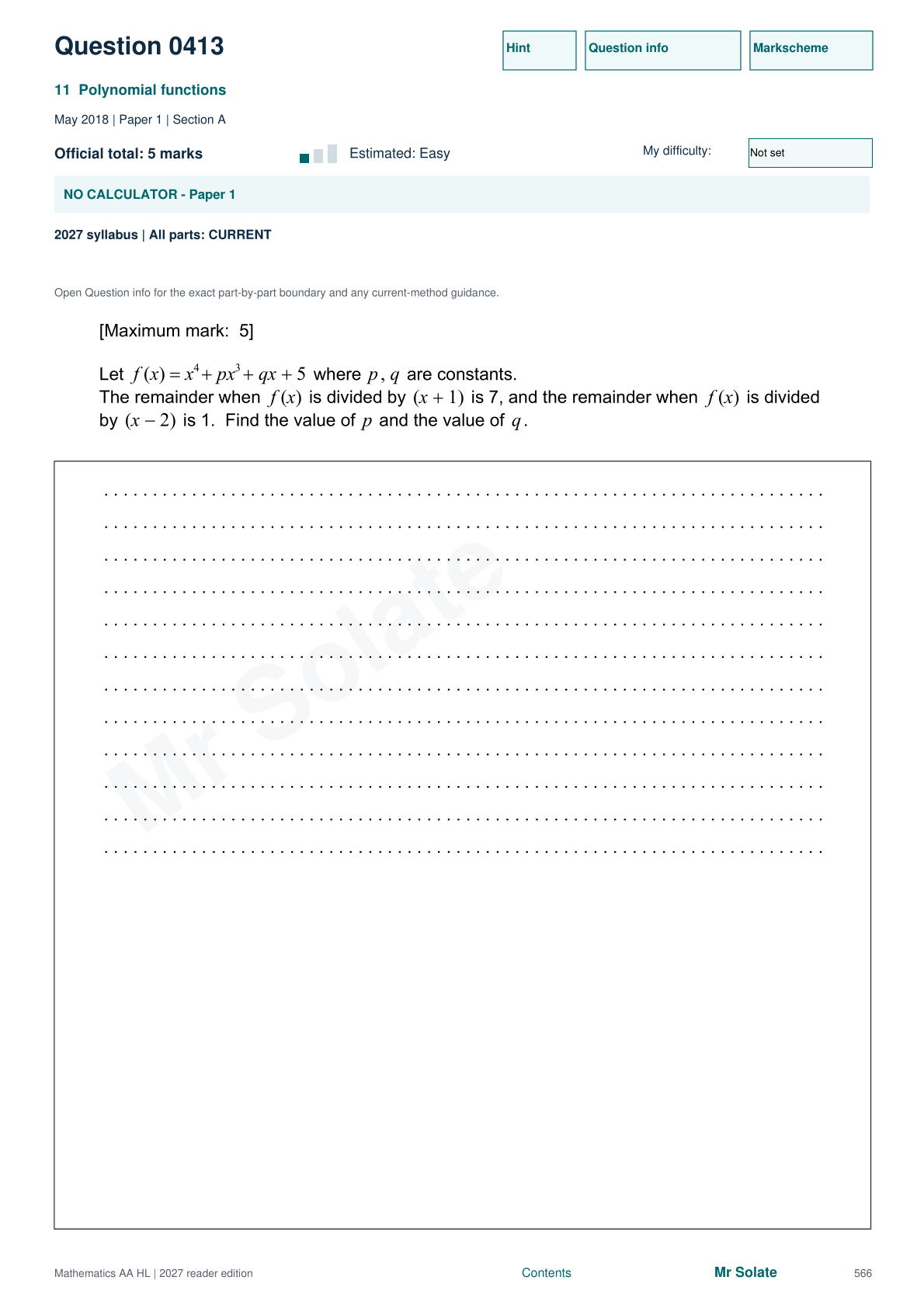
Reveal the revision reasoning
Dividing by x+1 gives remainder f(-1), so 6-p-q=7 and p+q=-1.
Dividing by x-2 gives remainder f(2), so 21+8p+2q=1 and 4p+q=-10.
Subtract the first equation from the second to obtain 3p=-9; hence p=-3 and q=2.
Substitution into both evaluations checks both independent conditions.
Editorial revision reasoning. Check the original answer for its marking detail.
Question 411
Apply the method to the original question.
Compatibility: All parts test current AA HL content and can be solved using current syllabus methods.
View the original question
Original page images preserve the equations and diagrams. Write your response before revealing the reasoning.
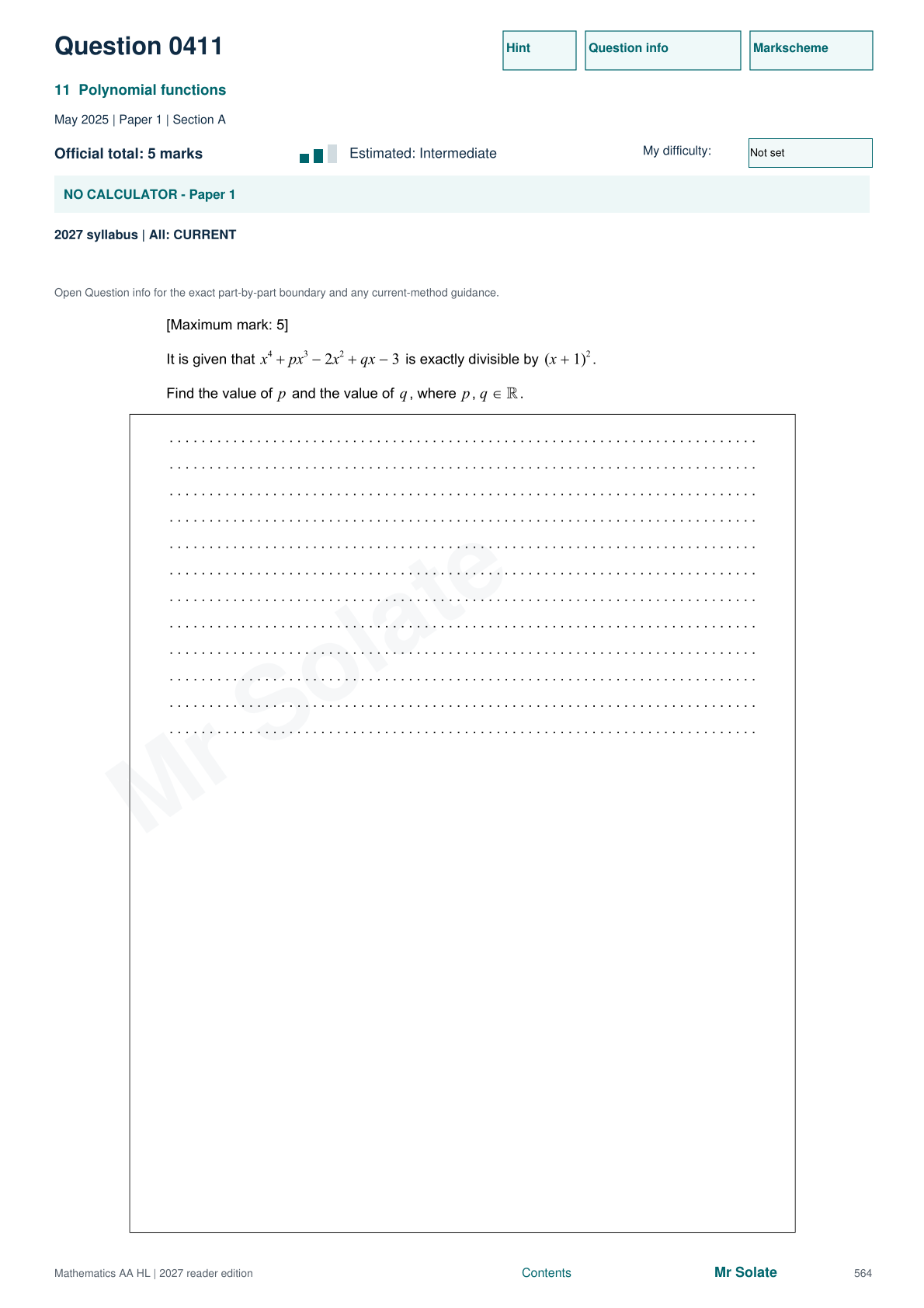
Reveal the revision reasoning
Let P be the given quartic. Since (x+1)² divides P, x=-1 is a double root and P(-1)=0.
This gives 1-p-2-q-3=0, hence p+q=-4.
Also P′(-1)=0. With P′=4x³+3px²-4x+q, this becomes 3p+q=0.
Subtract to obtain 2p=4, so p=2 and q=-6. Equivalently the polynomial factors as (x+1)²(x²-3).
Editorial revision reasoning. Check the original answer for its marking detail.
Question 412
Apply the method to the original question.
Compatibility: The question is from the current AA HL course and uses the listed current syllabus content.
View the original question
Original page images preserve the equations and diagrams. Write your response before revealing the reasoning.
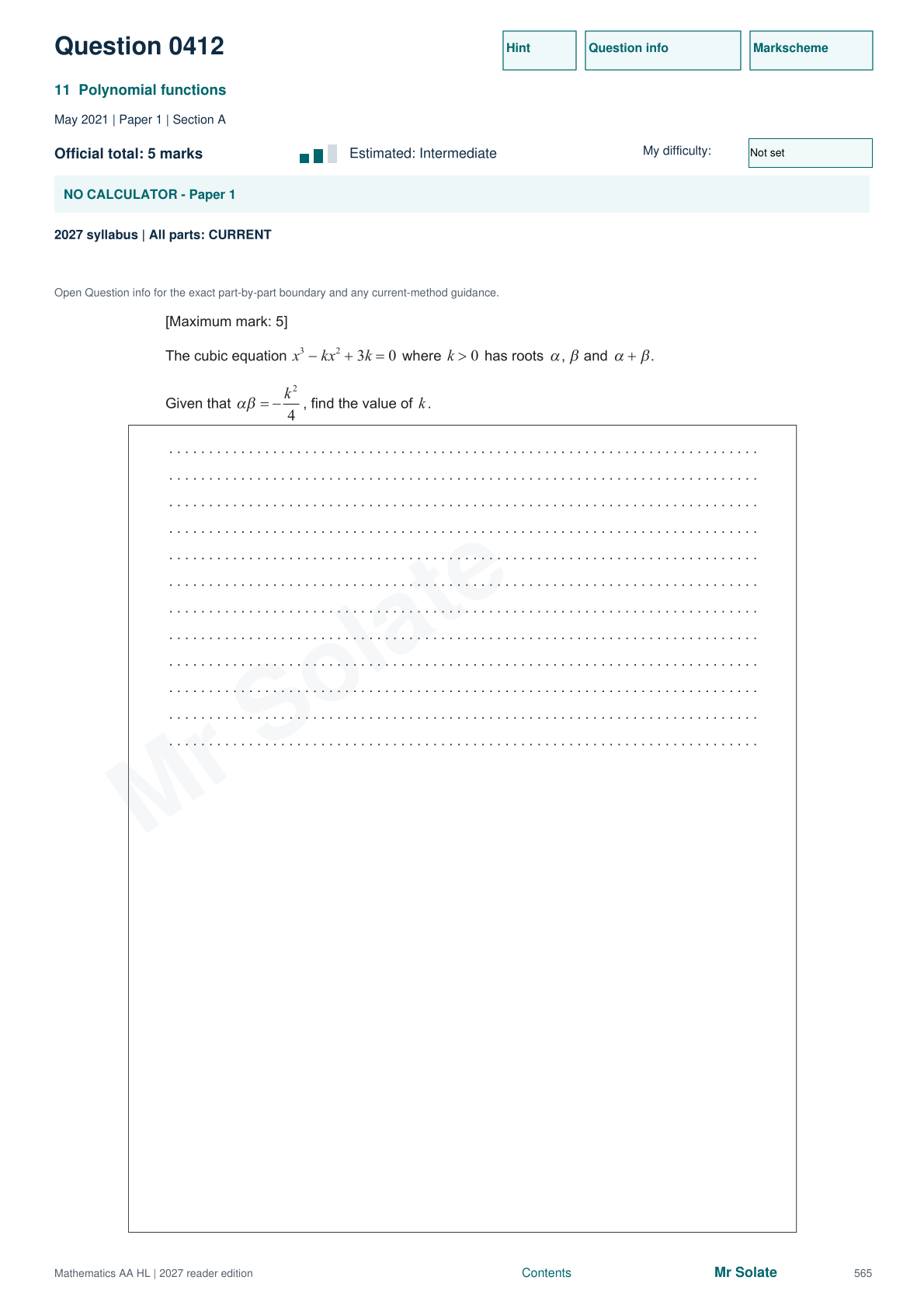
Reveal the revision reasoning
The root sum is α+β+(α+β)=k, so α+β=k/2.
The product of a monic cubic’s roots is the negative of its constant term, giving αβ(α+β)=-3k.
Insert αβ=-k²/4 and α+β=k/2 to obtain -k³/8=-3k.
Since k>0, divide by -k to get k²=24 and k=2√6.
Editorial revision reasoning. Check the original answer for its marking detail.
All 48 questions in this topic
Close your notes first
Can you retrieve the method?
1. What does remainder 7 on division by x+3 mean?
Check answer 1
P(−3)=7.
2. What extra equation does a double root supply?
Check answer 2
P′(a)=0 as well as P(a)=0.
3. What is the product of roots of a monic cubic x³+bx²+cx+d?
Check answer 3
−d, counting multiplicity.
Before you move on
- Count the degrees used by your listed roots. A missing conjugate or repeated copy often explains an incomplete answer.
- Check the final polynomial at each stated divisor root rather than redoing all the algebra.
Your revision note
Record one missed cue, one corrected step and one question to retry. Saved only in this browser.