Start with the exam
What you need to be able to do
Related rates join changing quantities through geometry and the chain rule. Keep the geometric relationship general until after differentiating. The bank uses expanding shapes, filling cones, changing distances and rotating sight lines. Write the requested derivative explicitly: a radius rate, volume rate and angular rate have different meanings and units. Interpret negative signs as directions of change.
Spend 3 minutes reading the overview and diagram, 7 minutes learning the question patterns, 5 minutes writing out the worked example, and 5 minutes on a bank question or recall check. Take longer when you need to; the full bank is here for later practice.
Recognise → set up → write
How the questions are set
One dimension determines the shape
Recognise it: A sphere expands or a similar cone fills.
- Express area or volume in terms of the changing radius or height. For a cone, use similar triangles to express radius as a multiple of height first.
- Apply dV/dt=(dV/dr)(dr/dt) or its height version. Substitute instantaneous dimensions only after differentiating.
- Solve for the requested rate and state units. Constant inflow does not normally give a constant height rate because the cross-sectional area changes.
Show the dimension relationship and the chain-rule equation before substitution.
A cone’s similarity ratio is constant, but its water-surface radius changes as it fills.
Several dimensions change
Recognise it: A cylinder changes both radius and height or a sector has two varying quantities.
- Differentiate all varying factors. V=πr²h gives dV/dt=2πrh dr/dt+πr² dh/dt.
- Use any supplied relation between dimensions or rates to remove unknowns. Only set a derivative to zero if the model fixes that quantity.
- Assign signs before numerical substitution. Decreasing height means dh/dt<0 even if its rate is described as a positive magnitude.
Keep both product-rule terms until the conditions justify removing one.
Differentiating only r silently assumes h is fixed and is wrong for a changing-height cylinder.
Distance and angular motion
Recognise it: Objects approach each other or a line of sight rotates.
- Choose coordinates and a relation such as s²=x²+y² or tan θ=y/x. Differentiate with respect to time.
- For Pythagoras, write 2s ds/dt=2x dx/dt+2y dy/dt. Find the instantaneous s from the geometry if necessary.
- Use radians for angular rates and convert speeds to consistent units. Determine whether each coordinate separation increases or decreases.
Show the labelled geometry and time derivative, then interpret the sign of the answer.
Speed is nonnegative, but a coordinate derivative can be negative. Approach speed must carry the appropriate sign.
Write it before you reveal it
A worked exam-style example
Original teaching example, created for this lesson.
Original example: a sphere’s radius grows at 2 cm/s. Find its volume rate when r=3 cm.
Reveal the worked solution
- V=(4/3)πr³.
- Differentiate in time: dV/dt=4πr² dr/dt.
- Substitute r=3 and dr/dt=2 to obtain 72π.
Answer: The volume increases at 72π cm³/s.
Check: Area times length per time has the required volume-per-time units.
From your own collection
Apply it to past-paper questions
These questions anchor the patterns above. Attempt one without the answer, then compare your setup and conclusion with the reasoning. The linked reader contains the source answer and the question-specific syllabus review.
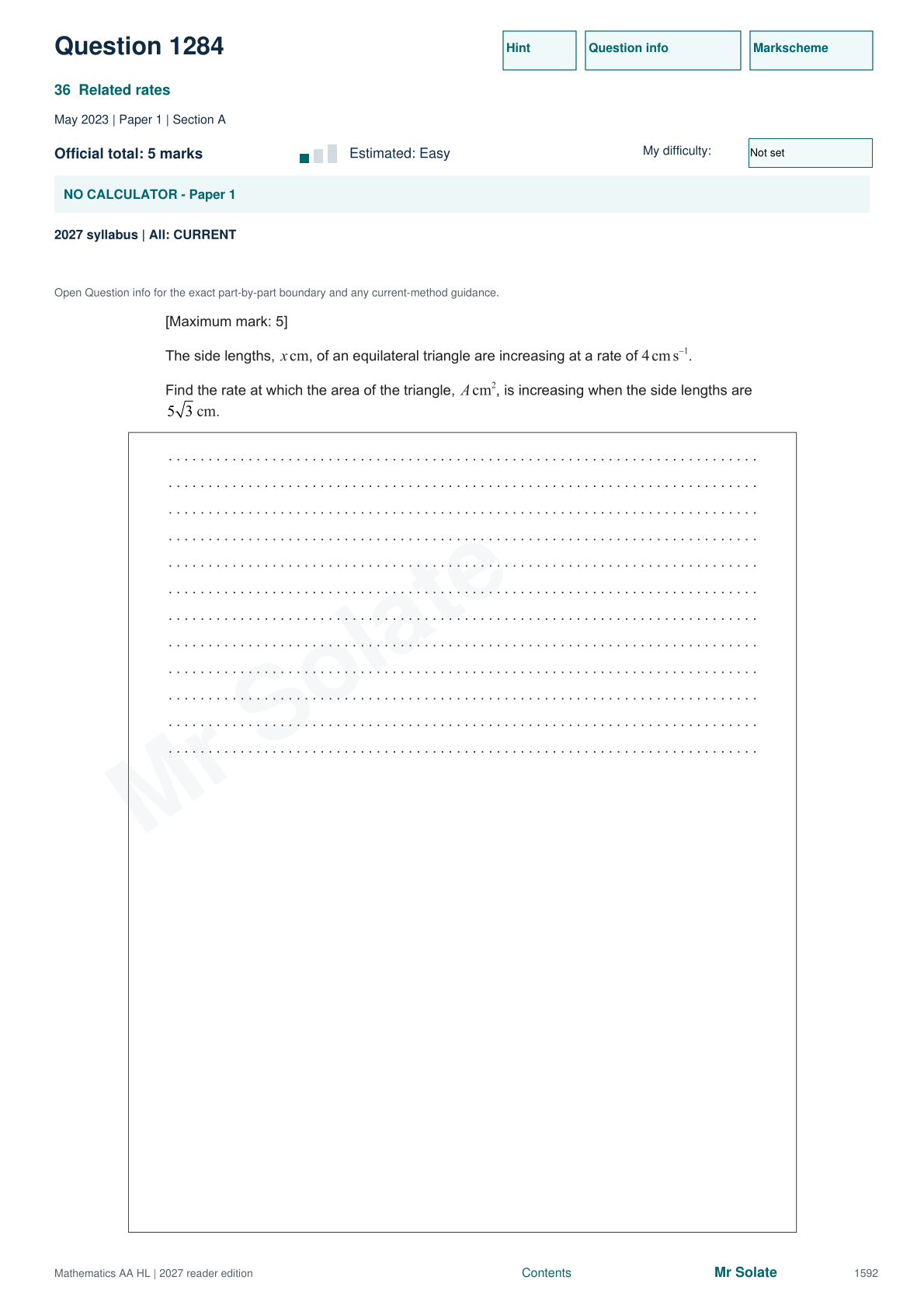
Question 1284
Apply the method to the original question.
Compatibility: All parts test current AA HL content and can be solved using current syllabus methods.
View the original question
Original page images preserve the equations and diagrams. Write your response before revealing the reasoning.
Reveal the revision reasoning
For an equilateral triangle, A=(1/2)x²sin60°=(√3/4)x².
Differentiate with respect to time: dA/dt=(√3/2)x dx/dt.
Substitute x=5√3 and dx/dt=4 to obtain dA/dt=30 cm² s⁻¹.
The rate is positive, consistent with increasing side lengths.
Editorial revision reasoning. Check the original answer for its marking detail.
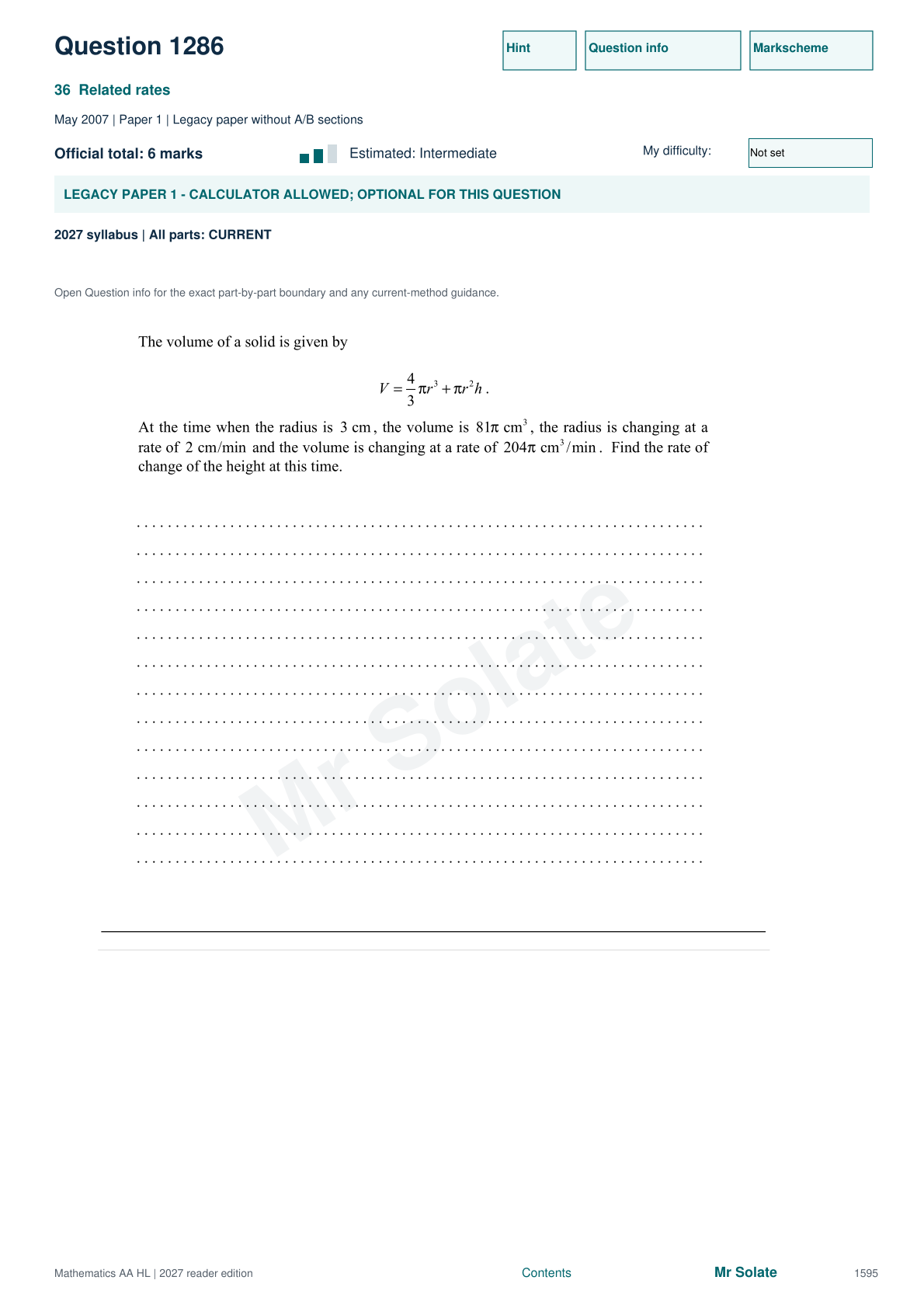
Question 1286
Several linked steps involving Composite-solid volume, Product rule, Simultaneous dimensional change.
Compatibility: Current: All parts
View the original question
Original page images preserve the equations and diagrams. Write your response before revealing the reasoning.
Reveal the revision reasoning
- At r=3 and V=81π, the volume formula gives h=5.
- Differentiate V=(4π/3)r³+πr²h to obtain V'=4πr²r'+2πrhr'+πr²h'.
- Insert V'=204π and r'=2; solve 204π=72π+60π+9πh', giving h'=8 cm/min.
Editorial revision reasoning. Check the original answer for its marking detail.
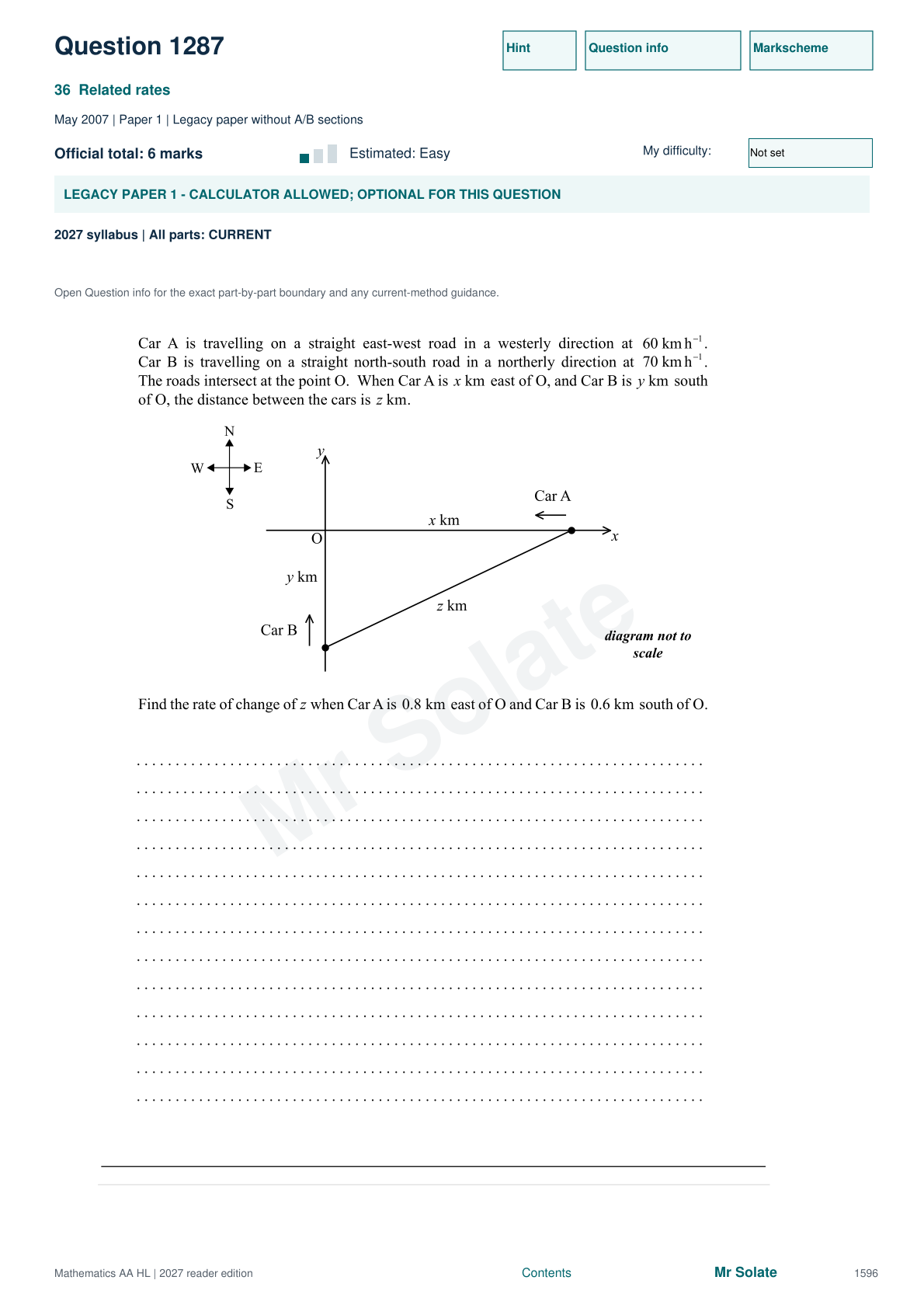
Question 1287
A short direct application of Perpendicular motion, Signed related rates, Distance change.
Compatibility: Current: All parts
View the original question
Original page images preserve the equations and diagrams. Write your response before revealing the reasoning.
Reveal the revision reasoning
- Pythagoras gives z²=x²+y²; at the stated instant z=1 km.
- Differentiate to zz'=xx'+yy'.
- Use x'=-60,y'=-70 with x=0.8,y=0.6, giving z'=-90 km/h.
Editorial revision reasoning. Check the original answer for its marking detail.
All 24 questions in this topic
Close your notes first
Can you retrieve the method?
1. Derivative of r² with respect to time?
Check answer 1
2r dr/dt.
2. When substitute the current radius?
Check answer 2
After differentiating.
3. Angle unit for calculus rates?
Check answer 3
Radians.
Before you move on
- Write the target derivative first.
- Retain every varying factor and label each rate sign.
- Finish with units and a sentence describing increase, decrease, approach or separation.
Your revision note
Record one missed cue, one corrected step and one question to retry. Saved only in this browser.