Start with the exam
What you need to be able to do
A density gives probability through area. Its height can exceed one, while a single point has probability zero. These questions ask for normalising constants, moments, medians, modes and conditional intervals. Decide which integral represents the requested statistic before choosing an integration method. Piecewise densities require particular care at their breakpoints.
Spend 3 minutes reading the overview and diagram, 7 minutes learning the question patterns, 5 minutes writing out the worked example, and 5 minutes on a bank question or recall check. Take longer when you need to; the full bank is here for later practice.
Recognise → set up → write
How the questions are set
Normalise the density
Recognise it: There is an unknown coefficient or support endpoint.
- Set the total integral over the support equal to one. For a piecewise density, add all branch integrals using their own limits.
- Check nonnegativity and restrictions from logarithms or roots. Unknown endpoints must satisfy those restrictions as well as normalisation.
- Use continuity only when the question supplies or requires it. A probability density need not be continuous at every join.
Show all branch integrals and the resulting equation for the unknown.
Each branch does not separately have area one; the complete density does.
Choose the correct statistic
Recognise it: Find mean, variance, median, quartile or mode.
- Mean is ∫xf(x)dx; variance is ∫x²f(x)dx−μ². State symmetry if using it to find a mean.
- A p-quantile q satisfies F(q)=p. For a piecewise model, calculate the accumulated probability up to the join before choosing the branch containing q.
- The mode maximises density height, so compare stationary candidates and endpoints. Median divides probability equally, not necessarily support length.
Label the statistic and write its defining integral before evaluation.
Mean, median and mode generally differ; f′=0 does not find a median.
Conditional events and new scores
Recognise it: An interval is restricted by given that, or a score transforms X.
- Find the overlap interval and divide its probability integral by that of the conditioning interval. Split either at density breakpoints when necessary.
- For Y=aX+b, use E(Y)=aμ+b and Var(Y)=a²Var(X). Reverse an inequality when dividing by negative a.
- A calculated interval probability may become the success probability of a repeated independent experiment. Carry it forward without early rounding.
Display the conditional ratio with actual bounds and define any transformed variable.
Strict and non-strict endpoints give equal probabilities for this continuous model.
Write it before you reveal it
A worked exam-style example
Original teaching example, created for this lesson.
Original example: f(x)=kx on [0,2], zero otherwise. Find k, the mean, median and P(X>1).
Reveal the worked solution
- ∫₀²kx dx=2k=1, so k=1/2.
- E(X)=∫₀²x²/2 dx=4/3.
- F(x)=x²/4 on [0,2]. F(m)=1/2 gives m=√2.
- P(X>1)=1−F(1)=3/4.
Answer: k=1/2; mean 4/3; median √2; probability 3/4.
Check: The triangular area is (1/2)×2×1=1, independently confirming normalisation.
From your own collection
Apply it to past-paper questions
These questions anchor the patterns above. Attempt one without the answer, then compare your setup and conclusion with the reasoning. The linked reader contains the source answer and the question-specific syllabus review.
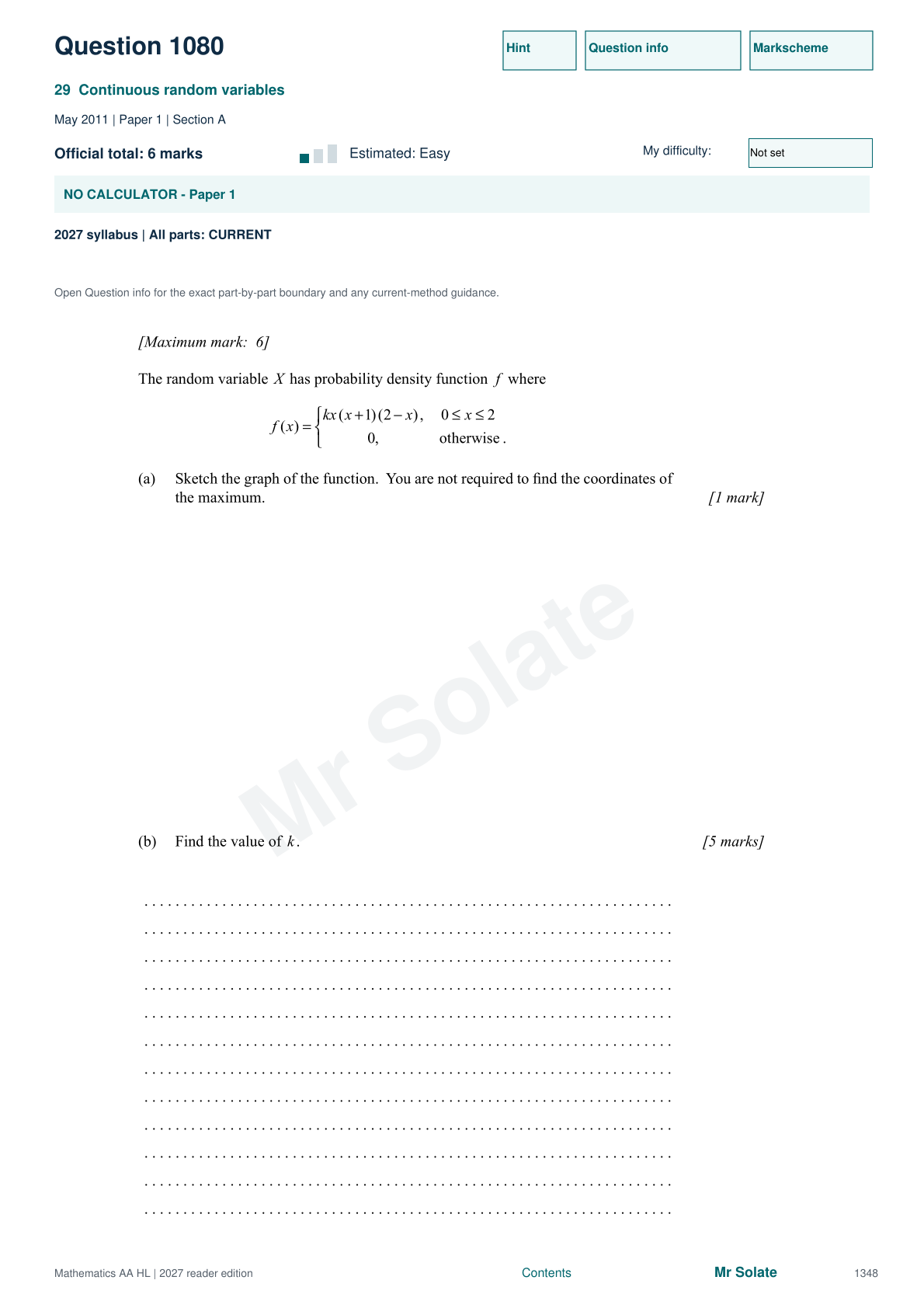
Question 1080
Direct application of Density sketch, Polynomial expansion, Normalization.
Compatibility: All parts: The tested methods are current AA HL: Density sketch, Polynomial expansion, Normalization.
View the original question
Original page images preserve the equations and diagrams. Write your response before revealing the reasoning.
Reveal the revision reasoning
- The density has zeros at 0 and 2 and is positive between them, forming a single hump; it is zero outside [0,2].
- Expand x(x+1)(2−x)=−x³+x²+2x.
- Require k∫₀²(−x³+x²+2x)dx=1.
- The integral is −4+8/3+4=8/3, so k=3/8.
Editorial revision reasoning. Check the original answer for its marking detail.
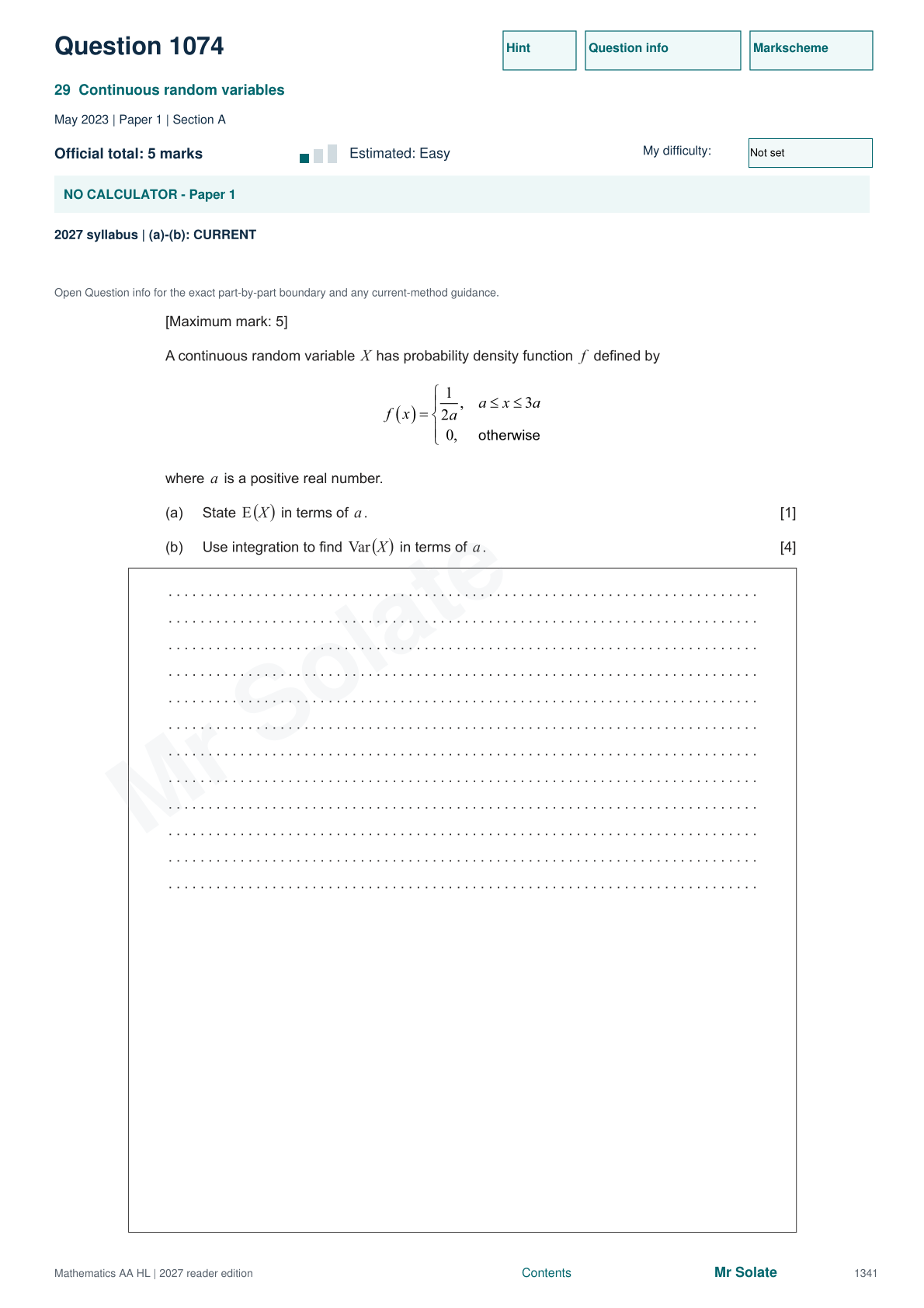
Question 1074
Apply the method to the original question.
Compatibility: All parts test current AA HL content and can be solved using current syllabus methods.
View the original question
Original page images preserve the equations and diagrams. Write your response before revealing the reasoning.
Reveal the revision reasoning
The interval is symmetric about 2a, hence E(X)=2a.
Calculate E(X²)=∫ₐ³ᵃ x²/(2a) dx=[x³/(6a)]ₐ³ᵃ=13a²/3.
Use Var(X)=E(X²)-[E(X)]², giving 13a²/3-4a²=a²/3.
The question specifically asks for integration, so quoting a memorised uniform-distribution variance alone does not show the required method.
Editorial revision reasoning. Check the original answer for its marking detail.
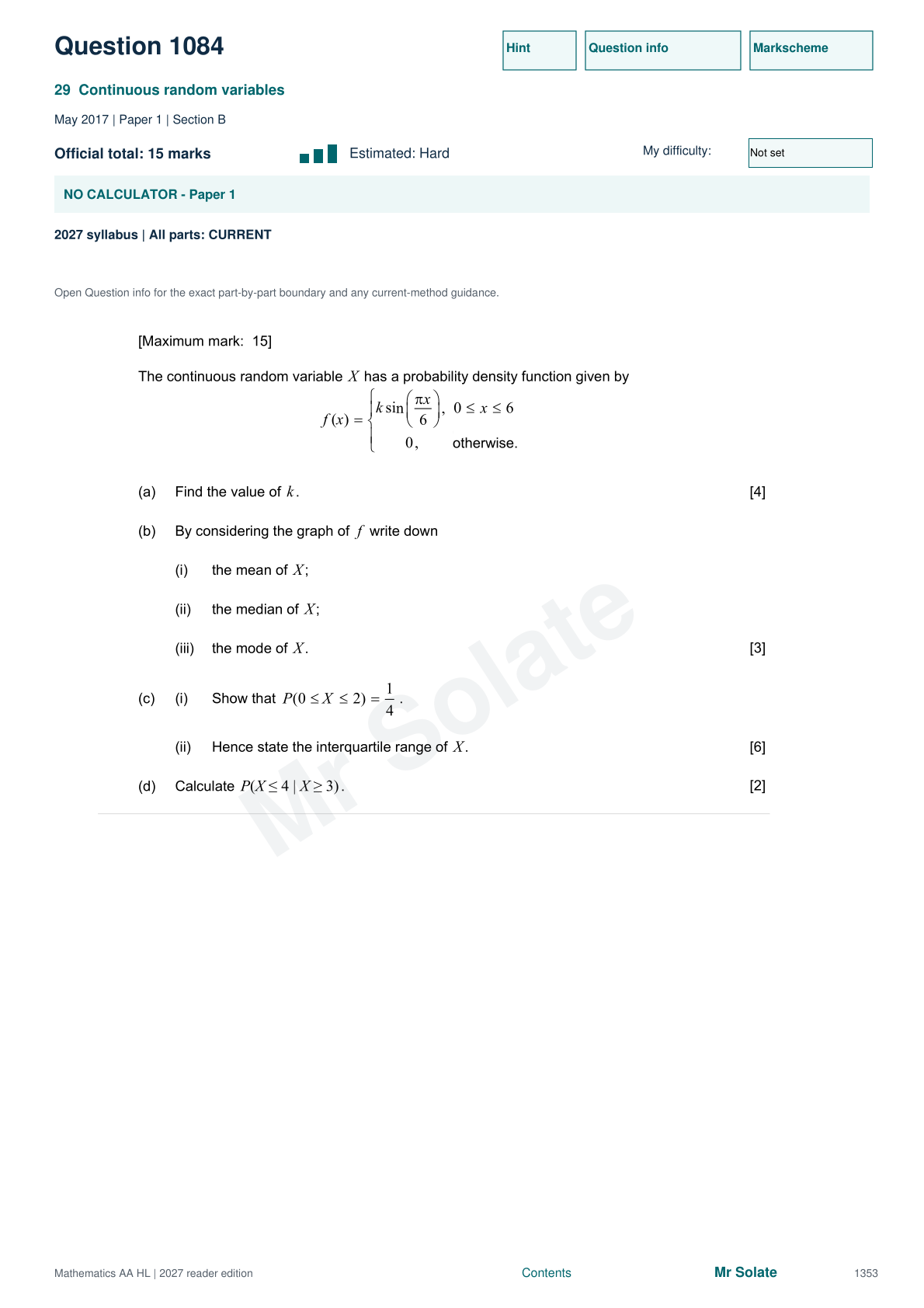
Question 1084
Requires a sustained multi-stage argument involving Sine density normalization, Symmetry of centre measures, Quartiles, Conditional probability.
Compatibility: All parts: The tested methods are current AA HL: Sine density normalization, Symmetry of centre measures, Quartiles, Conditional probability.
View the original question
Original page images preserve the equations and diagrams. Write your response before revealing the reasoning.
Reveal the revision reasoning
- Normalization gives k∫₀⁶sin(πx/6)dx=12k/π=1, so k=π/12.
- Symmetry and the unique peak give mean, median and mode all equal to 3.
- Integrating from 0 to 2 gives (1/2)[1−cos(π/3)]=1/4.
- Thus Q₁=2 and, by symmetry, Q₃=4, giving IQR=2.
- For the conditional probability, the numerator is P(3≤X≤4)=1/4 and denominator P(X≥3)=1/2.
- Their ratio is 1/2.
Editorial revision reasoning. Check the original answer for its marking detail.
All 44 questions in this topic
Close your notes first
Can you retrieve the method?
1. P(X=1) for a continuous density?
Check answer 1
Zero.
2. Equation for a median m?
Check answer 2
F(m)=1/2.
3. May density height exceed one?
Check answer 3
Yes; total area must equal one.
Before you move on
- Write the support above each integral.
- Practise a normalisation, a moment and a piecewise quantile.
- Check probabilities lie in [0,1] and the median lies in the support.
Your revision note
Record one missed cue, one corrected step and one question to retry. Saved only in this browser.