Start with the exam
What you need to be able to do
A sequence question usually hides two decisions: whether the information describes individual terms or accumulated totals, and whether consecutive changes are additive or multiplicative. Make those decisions before choosing a formula. The bank also mixes sequences with areas, logarithms, interest and population changes. Strip away that context, but keep its indexing and units. Your exam working should show the two equations that determine the unknown first term and difference or ratio.
Spend 3 minutes reading the overview and diagram, 7 minutes learning the question patterns, 5 minutes writing out the worked example, and 5 minutes on a bank question or recall check. Take longer when you need to; the full bank is here for later practice.
Recognise → set up → write
How the questions are set
Recover an arithmetic sequence
Recognise it: Two numbered terms, a total, equal spacing or an arithmetic mean is given.
- Write u_n=a+(n−1)d and substitute each stated index explicitly. Subtract term equations to eliminate a.
- For a total use S_n=n[2a+(n−1)d]/2. A statement about S_8 is not a statement about u_8.
- When asked for a greatest total, inspect the next term: S_(n+1)−S_n=u_(n+1). A sum grows while the next term is positive.
For example, u_3=11 gives a+2d=11. This substitution makes the index gap visible and supports later algebra.
Using nd instead of (n−1)d shifts every term. A maximum over integer indices needs neighbouring integer checks.
Geometric growth and accumulated change
Recognise it: Ratios, percentage changes, similar shapes or repeated deposits appear.
- Write u_n=ar^(n−1), then find r from the actual quantity: area scales by the square of a length factor.
- Use S_n=a(1−r^n)/(1−r) when r≠1; use S_n=na when r=1. Use S_infinity=a/(1−r) only after establishing |r|<1.
- For deposits or withdrawals draw a timeline: money added after growth does not earn that period’s interest. Solve a threshold inequality, then test the first acceptable integer.
State both the multiplier and its meaning, for example r=0.93 for a 7% annual decrease before replenishment.
A negative ratio alternates signs. Do not discard it simply because the context-free equation has two possible ratios.
Partial sums and mixed progressions
Recognise it: A formula for S_n is supplied, or selected arithmetic terms also form a geometric sequence.
- Recover u_n=S_n−S_(n−1), checking u_1 separately if the displayed formula has a restricted range.
- For three geometric terms A,B,C use B²=AC and retain any nonzero conditions before cancellation.
- Write selected arithmetic terms with their actual index gaps. Solve for d, then calculate r from consecutive selected geometric terms.
Label the recovered expression u_n. Showing the subtraction explains why a quadratic partial sum creates an arithmetic term formula.
A sum formula and a term formula have different indexing; the middle of three selected terms need not be the middle original index.
Write it before you reveal it
A worked exam-style example
Original teaching example, created for this lesson.
Original practice: u_3=11 and u_8=31 for an arithmetic sequence. Find a, d and S_10.
Reveal the worked solution
- Write a+2d=11 and a+7d=31.
- Subtract to obtain 5d=20, so d=4 and a=3.
- Then u_10=3+9(4)=39. Calculate S_10=10(3+39)/2.
Answer: a=3, d=4, S_10=210.
Check: Substitute in both given terms: 3+8=11 and 3+28=31. The average of ten terms is 21, so the sum 210 is consistent.
From your own collection
Apply it to past-paper questions
These questions anchor the patterns above. Attempt one without the answer, then compare your setup and conclusion with the reasoning. The linked reader contains the source answer and the question-specific syllabus review.
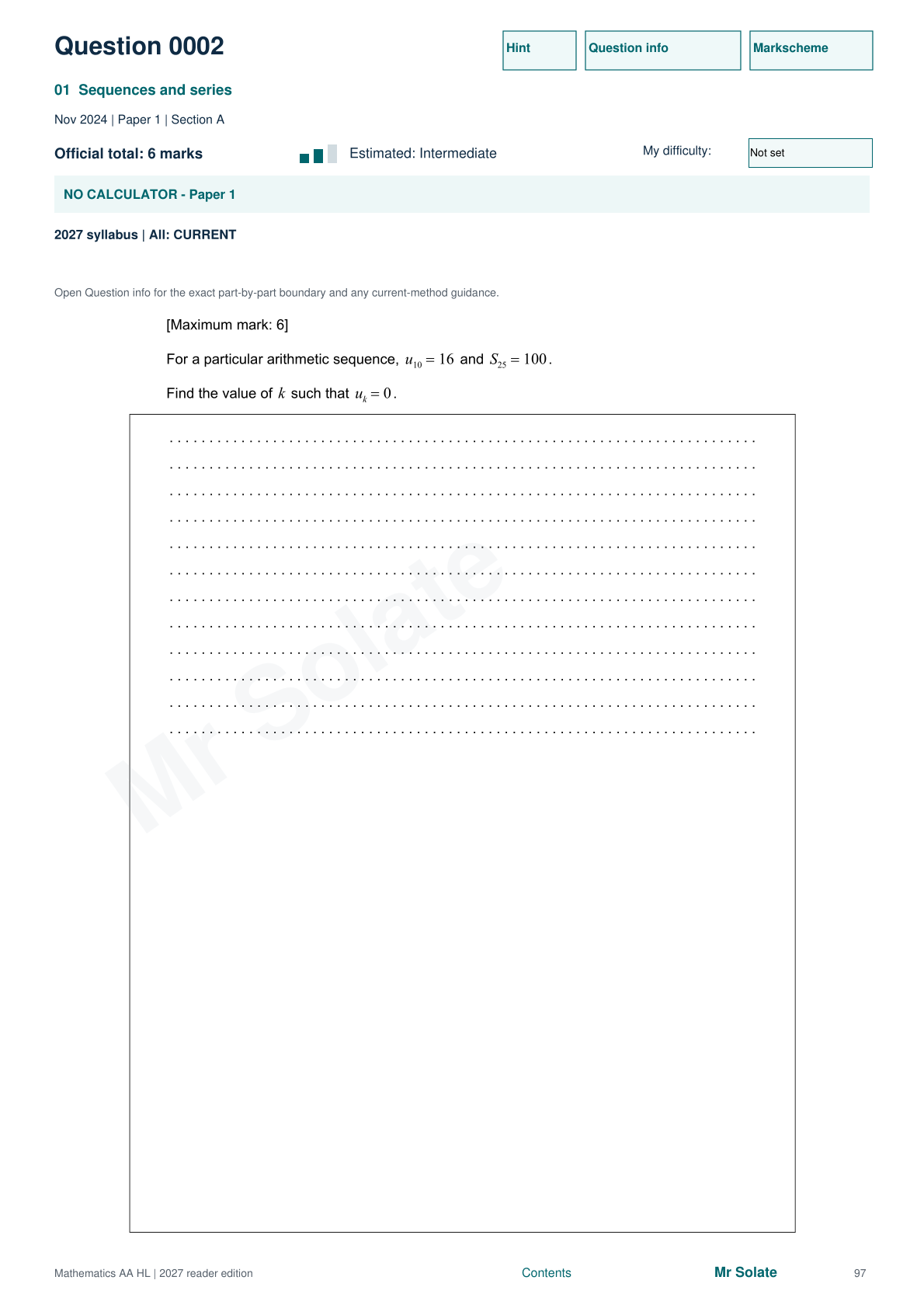
Question 2
Apply the method to the original question.
Compatibility: All parts test current AA HL content and can be solved using current syllabus methods.
View the original question
Original page images preserve the equations and diagrams. Write your response before revealing the reasoning.
Reveal the revision reasoning
The tenth term gives u₁+9d=16.
The sum formula gives 100=(25/2)(2u₁+24d), so u₁+12d=4.
Subtract the equations to get 3d=-12, hence d=-4 and u₁=52.
Now u_k=52-4(k-1)=0, giving k=14.
Editorial revision reasoning. Check the original answer for its marking detail.
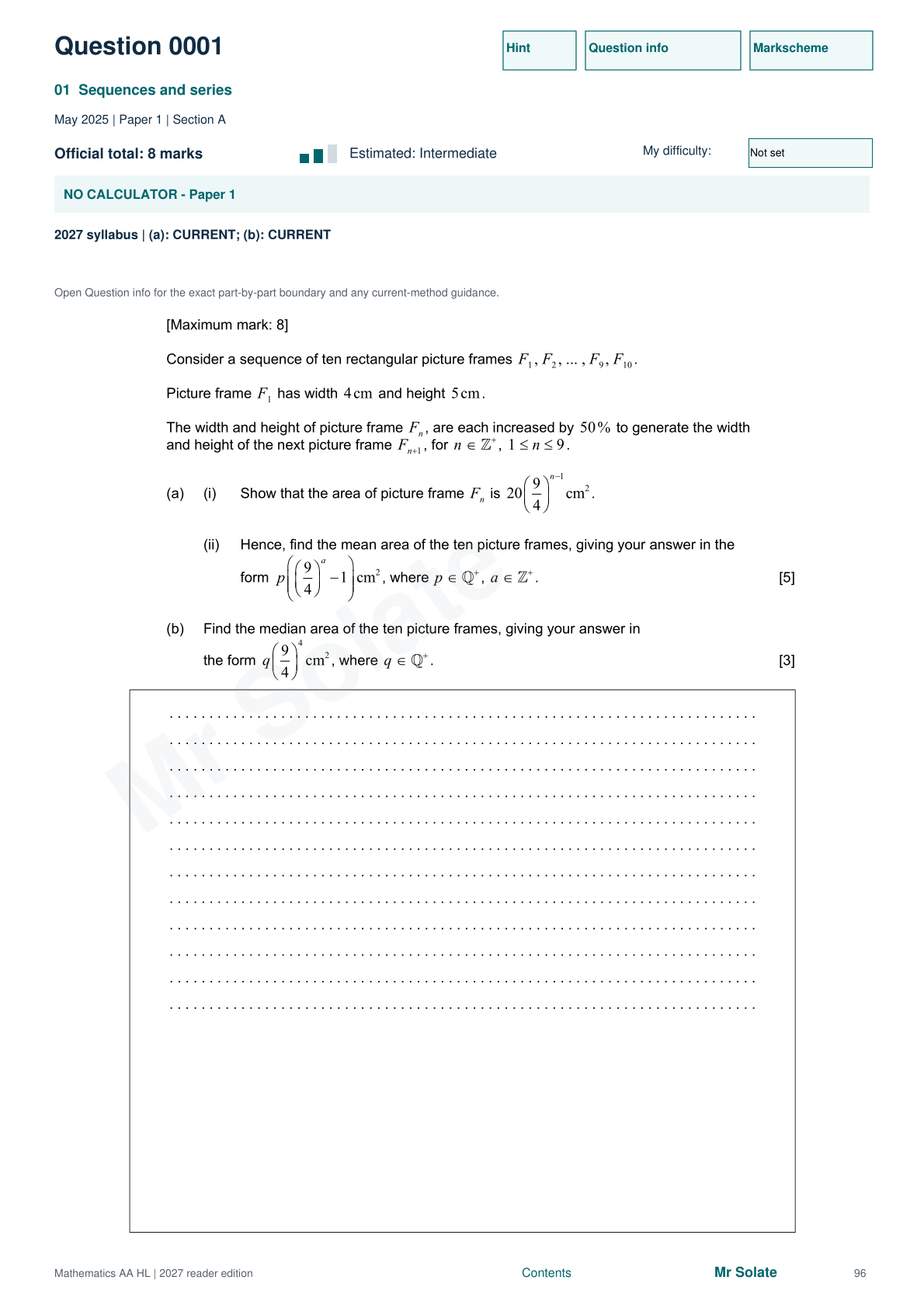
Question 1
Apply the method to the original question.
Compatibility: All parts test current AA HL content and can be solved using current syllabus methods.
View the original question
Original page images preserve the equations and diagrams. Write your response before revealing the reasoning.
Reveal the revision reasoning
Widths and heights each multiply by 3/2, so areas multiply by 9/4. Starting from 4×5=20, A_n=20(9/4)^(n-1).
The sum of ten areas is 20[(9/4)^10-1]/[(9/4)-1]=16[(9/4)^10-1].
Divide by ten for the mean: (8/5)[(9/4)^10-1], so p=8/5 and a=10.
The increasing ten-area list has median (A₅+A₆)/2. Factor (9/4)^4 to get 10(9/4)^4(1+9/4)=(65/2)(9/4)^4.
Hence q=65/2 for the median form.
Editorial revision reasoning. Check the original answer for its marking detail.
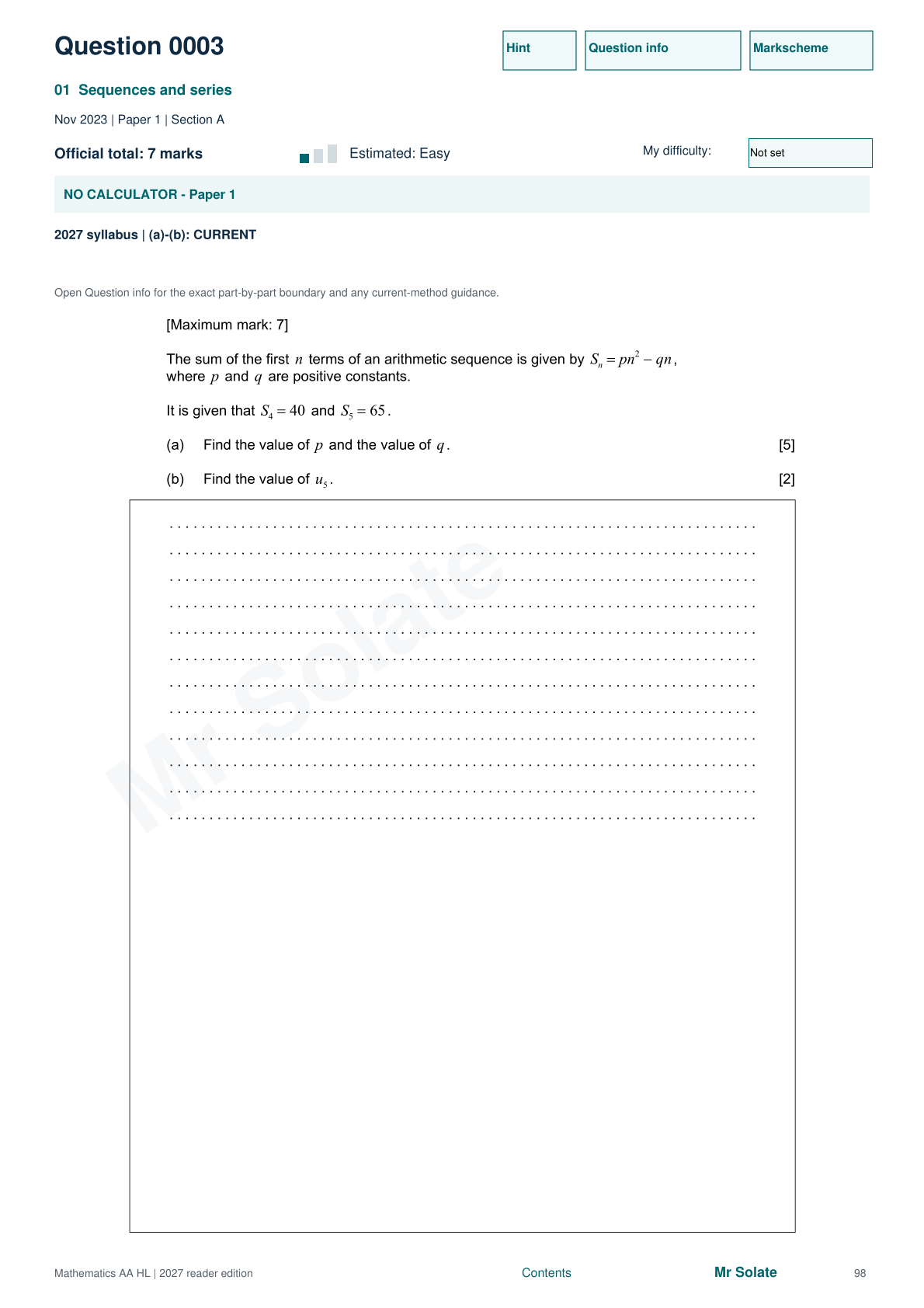
Question 3
Apply the method to the original question.
Compatibility: All parts test current AA HL content and can be solved using current syllabus methods.
View the original question
Original page images preserve the equations and diagrams. Write your response before revealing the reasoning.
Reveal the revision reasoning
The data give 16p-4q=40 and 25p-5q=65.
Divide by 4 and 5 respectively to obtain 4p-q=10 and 5p-q=13. Subtraction gives p=3, then q=2.
The fifth term is the increase in the partial sum: u₅=S₅-S₄=65-40=25.
Editorial revision reasoning. Check the original answer for its marking detail.
All 76 questions in this topic
Close your notes first
Can you retrieve the method?
1. What does S_9−S_8 represent?
Check answer 1
The ninth term u_9.
2. A length multiplies by 1.2. What is the corresponding area ratio?
Check answer 2
1.2²=1.44 for similar shapes.
3. When may a geometric infinite sum be used?
Check answer 3
Only when |r|<1; otherwise the finite sums do not approach that formula.
Before you move on
- Before practice, reconstruct both sum formulas from the first term and the endpoint or ratio; do not substitute from memory without identifying n.
- For a threshold answer, write the rejected neighbouring integer and the first accepted integer. For an infinite sum, include the convergence inequality in the final answer.
Your revision note
Record one missed cue, one corrected step and one question to retry. Saved only in this browser.