Start with the exam
What you need to be able to do
These questions ask you to expose a leading term, justify a limit or derive a derivative from its definition. A supplied unusual model is context, not necessarily something to memorise. For unknown parameters, the existence of a finite limit may supply an equation before the limit’s value can be found.
Spend 3 minutes reading the overview and diagram, 7 minutes learning the question patterns, 5 minutes writing out the worked example, and 5 minutes on a bank question or recall check. Take longer when you need to; the full bank is here for later practice.
Recognise → set up → write
How the questions are set
An indeterminate quotient
Recognise it: Substitution gives 0/0 or an applicable infinite-over-infinite form.
- Evaluate numerator and denominator separately. Try factoring, a local expansion or l’Hôpital when its conditions apply.
- For l’Hôpital, differentiate numerator and denominator separately, not the whole quotient by the quotient rule. Recheck the limiting form before repeating.
- Keep chain factors in trigonometric and inverse-trigonometric derivatives. Use radians and retain any parameter restrictions.
Show the original limiting form and the transformed quotient.
A zero denominator alone does not justify l’Hôpital; a nonzero numerator may indicate divergence.
A leading-term limit
Recognise it: Low-order terms cancel or an expansion is supplied.
- Expand far enough to retain the first term surviving subtraction. Preserve exact coefficients.
- If dividing by x^m, track the numerator through the needed order. For unknown parameters, force unwanted lower-order coefficients to vanish first.
- For a composite series, substitute and collect powers systematically. Do not multiply terms incapable of contributing to the requested degree.
Show the cancellations and the surviving term that controls the limit.
Stopping the expansion before the first surviving power can erase the answer.
First-principles differentiation
Recognise it: The command explicitly requires the derivative definition.
- Begin with lim as h→0 of [f(x+h)−f(x)]/h. Substitute complete bracketed expressions.
- Factor or expand until a common h cancels for h≠0. For negative powers, a common denominator can simplify the difference.
- Only after cancellation take h→0. A known derivative rule can check the result but cannot replace the requested proof.
Display the difference quotient, the cancellation and the final limit.
Substituting h=0 too early gives 0/0 instead of a derivative.
Write it before you reveal it
A worked exam-style example
Original teaching example, created for this lesson.
Original example: find lim x→0 of (eˣ−1−x)/x² and differentiate x² from first principles.
Reveal the worked solution
- eˣ=1+x+x²/2+terms of higher order, so division leaves a limit of 1/2.
- [(x+h)²−x²]/h=(2xh+h²)/h=2x+h for h≠0.
- As h→0, the derivative is 2x.
Answer: Limit 1/2; derivative 2x.
Check: Two l’Hôpital steps give eˣ/2→1/2, agreeing with the expansion.
From your own collection
Apply it to past-paper questions
These questions anchor the patterns above. Attempt one without the answer, then compare your setup and conclusion with the reasoning. The linked reader contains the source answer and the question-specific syllabus review.
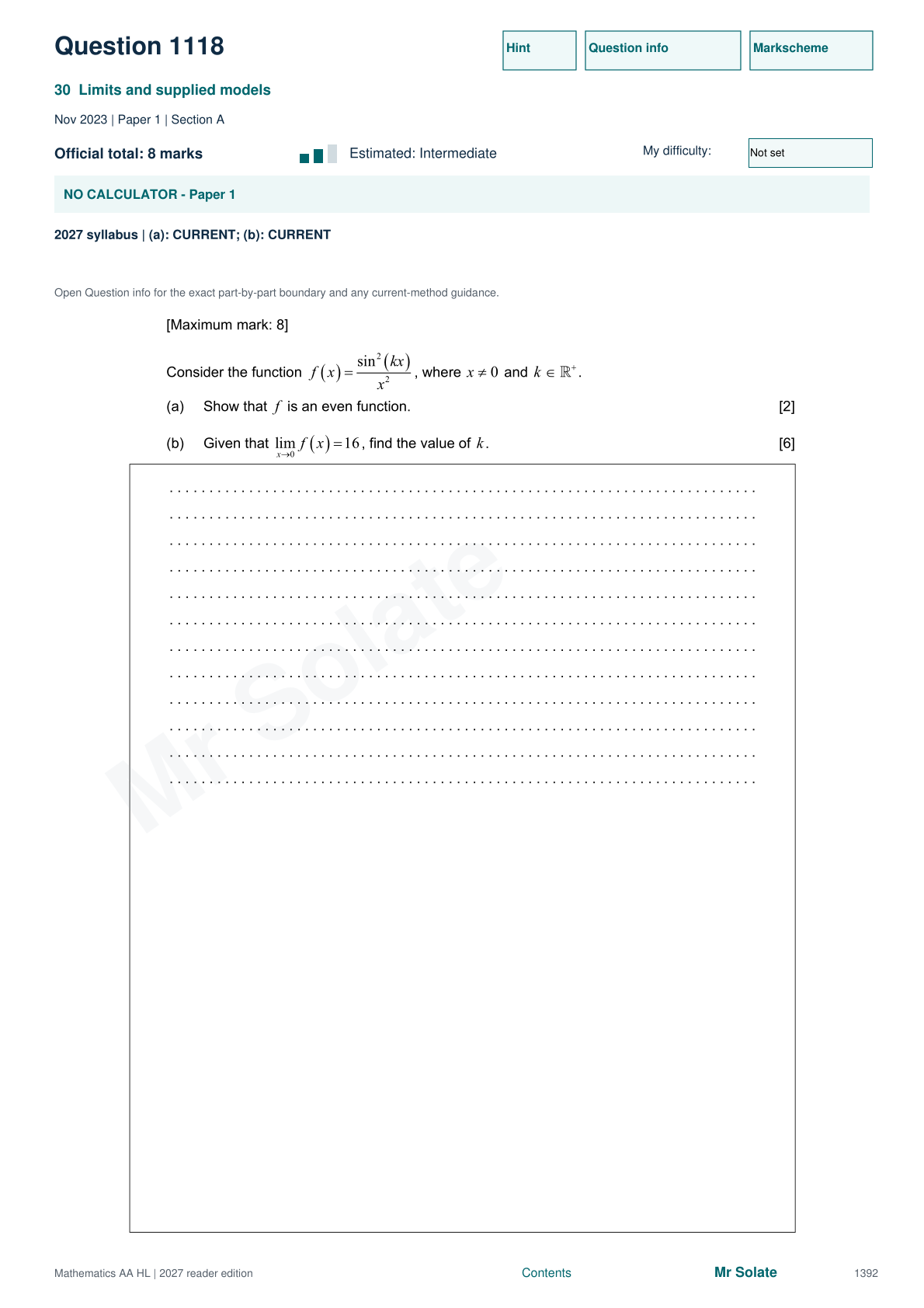
Question 1118
Apply the method to the original question.
Compatibility: All parts test current AA HL content and can be solved using current syllabus methods.
View the original question
Original page images preserve the equations and diagrams. Write your response before revealing the reasoning.
Reveal the revision reasoning
Since sin(-kx)=-sin(kx), squaring removes the sign. Also (-x)²=x², so f(-x)=f(x) for every nonzero x.
At x=0 the ratio sin²(kx)/x² has form 0/0. L’Hôpital’s rule once gives 2k sin(kx)cos(kx)/(2x), still 0/0.
A second differentiation gives limiting value 2k²cos(2kx)/2=k² at zero.
The required limit is 16, so k²=16. The given k>0 selects k=4.
Editorial revision reasoning. Check the original answer for its marking detail.
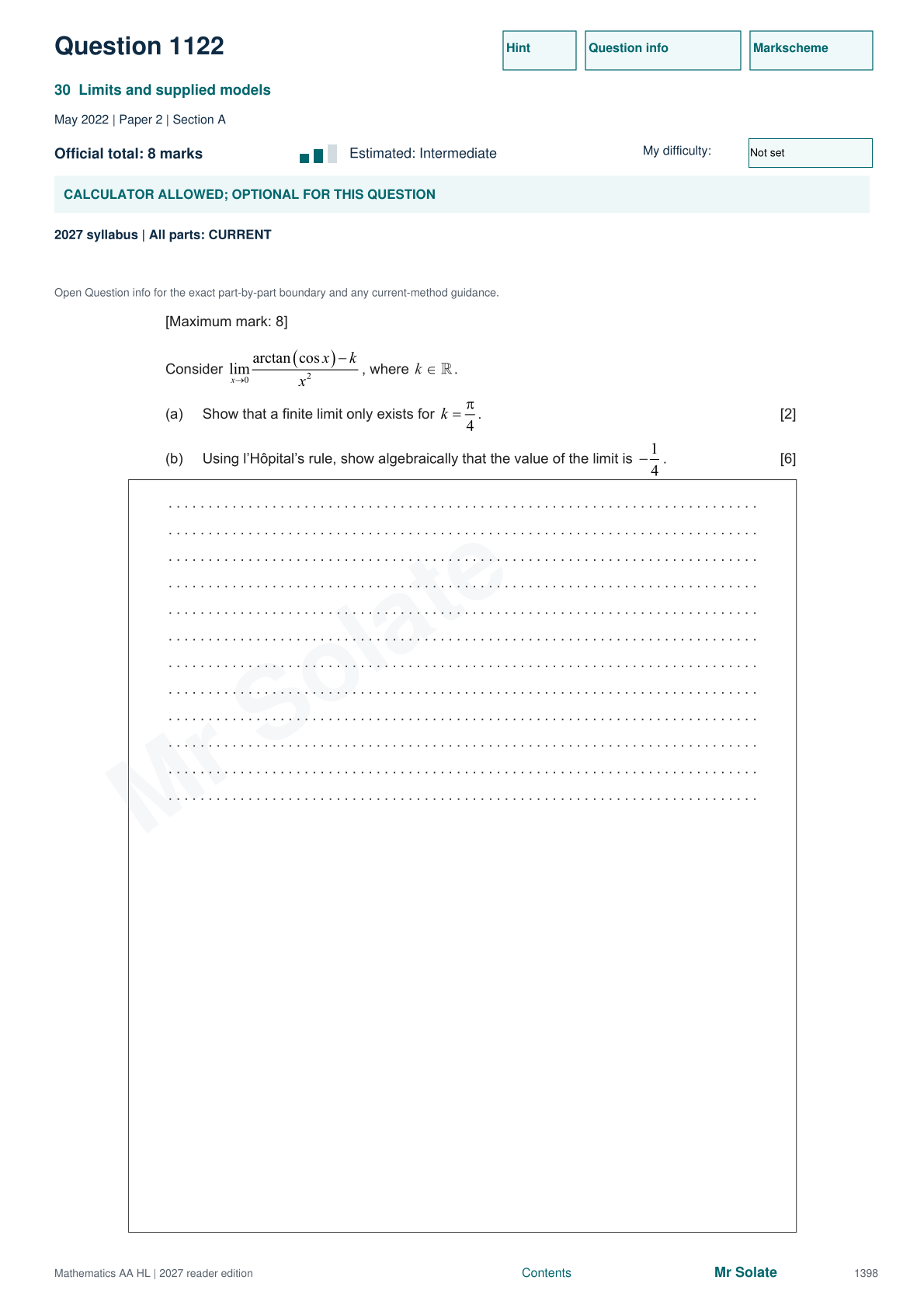
Question 1122
Several linked steps in Finite-limit parameter, Inverse-trigonometric derivative, Repeated l’Hôpital rule.
Compatibility: The tested concepts and methods match the current AA HL syllabus; the original paper format and wording are retained.
View the original question
Original page images preserve the equations and diagrams. Write your response before revealing the reasoning.
Reveal the revision reasoning
As x→0, the denominator x² tends to zero and the numerator tends to arctan1−k. A finite limit therefore requires k=π/4.
With that value the form is 0/0. One application of l’Hôpital gives [−sin x/(1+cos²x)]/(2x).
Rewrite this as −sin x/[2x(1+cos²x)], still 0/0, and apply l’Hôpital again.
The resulting limit is −cos x/[2(1+cos²x)−4x sin x cos x] at x=0, giving −1/4.
Editorial revision reasoning. Check the original answer for its marking detail.
Question 1120
A short direct application of Binomial expansion, Derivative from first principles.
Compatibility: Current: All parts
View the original question
Original page images preserve the equations and diagrams. Write your response before revealing the reasoning.

Reveal the revision reasoning
- Expand (x+h)^3 as x^3+3x²h+3xh²+h³.
- Subtract f(x)=x³, then cancel the common factor h while h≠0.
- Take h→0 only after cancellation, leaving f'(x)=3x².
Editorial revision reasoning. Check the original answer for its marking detail.
Close your notes first
Can you retrieve the method?
1. When can h cancel?
Check answer 1
Before taking the limit, for h≠0.
2. What must precede l’Hôpital?
Check answer 2
Checking an applicable indeterminate form and its conditions.
3. What controls a series quotient limit?
Check answer 3
The first surviving numerator term relative to the denominator power.
Before you move on
- Compare two methods on one limit.
- For parameters, establish existence before evaluating.
- Check whether the required method was first principles or a supplied expansion.
Your revision note
Record one missed cue, one corrected step and one question to retry. Saved only in this browser.