Start with the exam
What you need to be able to do
The legacy Analysis and Approximation option contains convergence proofs, error bounds and numerical methods beyond the core revision path. Some Maclaurin manipulations transfer directly to the current series chapter, but do not assume every theorem in these old option questions is required for current AA HL. Distinguish an observed numerical approximation from a guaranteed error bound supported by a theorem’s conditions.
Spend 3 minutes reading the overview and diagram, 7 minutes learning the question patterns, 5 minutes writing out the worked example, and 5 minutes on a bank question or recall check. Take longer when you need to; the full bank is here for later practice.
This collection contains content outside the current course, or a mixture of current and legacy skills. Use the compatibility note for each original question to decide which parts to practise for your exam.
Recognise → set up → write
How the questions are set
Numerical iteration
Recognise it: A root is approximated by Newton’s method or a fixed-point rule.
- For Newton iteration, write xₙ₊₁=xₙ−f(xₙ)/f′(xₙ), avoiding starting points where the denominator vanishes.
- For a supplied fixed-point rule xₙ₊₁=g(xₙ), check the relevant interval is mapped into itself if proving convergence. A uniform |g′|≤k<1 supports a contraction argument under the theorem’s conditions.
- Keep intermediate precision and distinguish a small change between iterates from a proved small error relative to the true root.
Show the recurrence, starting value and successive numerical substitutions.
Different rearrangements of the same root equation can converge or diverge differently.
Quadrature with a guaranteed bound
Recognise it: An old problem asks for trapezium or Simpson approximation and an error limit.
- Write the spacing h=(b−a)/n and use the method’s correct endpoint and interior weights. Composite Simpson requires an even number of subintervals.
- Use the supplied theorem to bound the needed derivative over the entire interval, not just at sampled points.
- Solve the error-bound inequality for n, then choose an admissible integer, including the evenness condition when necessary. Explain which bound controls the guarantee.
Show the derivative maximum bound and the inequality that establishes the requested tolerance.
A calculator difference from an apparent exact value is an observed error, not a general guaranteed error bound.
Series convergence and remainders
Recognise it: A power series or infinite numerical sum requires justification.
- Apply a suitable ratio or comparison test, keeping track of absolute values and the limit. For power series, test boundary points separately after finding the interior interval.
- For an alternating-series remainder bound, verify decreasing positive term magnitudes tending to zero; the next omitted term then controls the error.
- For Maclaurin products and limits, collect only the required powers but retain enough terms after cancellation. Use the current Maclaurin chapter for the core coefficient skills.
Name the test and verify its hypotheses before stating convergence or a bound.
A ratio-test limit of one is inconclusive. Interior power-series convergence does not settle endpoints.
Write it before you reveal it
A worked exam-style example
Original teaching example, created for this lesson.
Original extension example: make two Newton steps for √2 using f(x)=x²−2 and x₀=1.
Reveal the worked solution
- The iteration is xₙ₊₁=xₙ−(xₙ²−2)/(2xₙ)=(xₙ+2/xₙ)/2.
- x₁=(1+2)/2=3/2.
- x₂=(3/2+4/3)/2=17/12≈1.416667.
- Its squared value is 289/144, slightly greater than 2.
Answer: After two steps, x₂=17/12.
Check: The residual x₂²−2 is 1/144. This residual is not the same number as the root error.
From your own collection
Apply it to past-paper questions
These questions anchor the patterns above. Attempt one without the answer, then compare your setup and conclusion with the reasoning. The linked reader contains the source answer and the question-specific syllabus review.
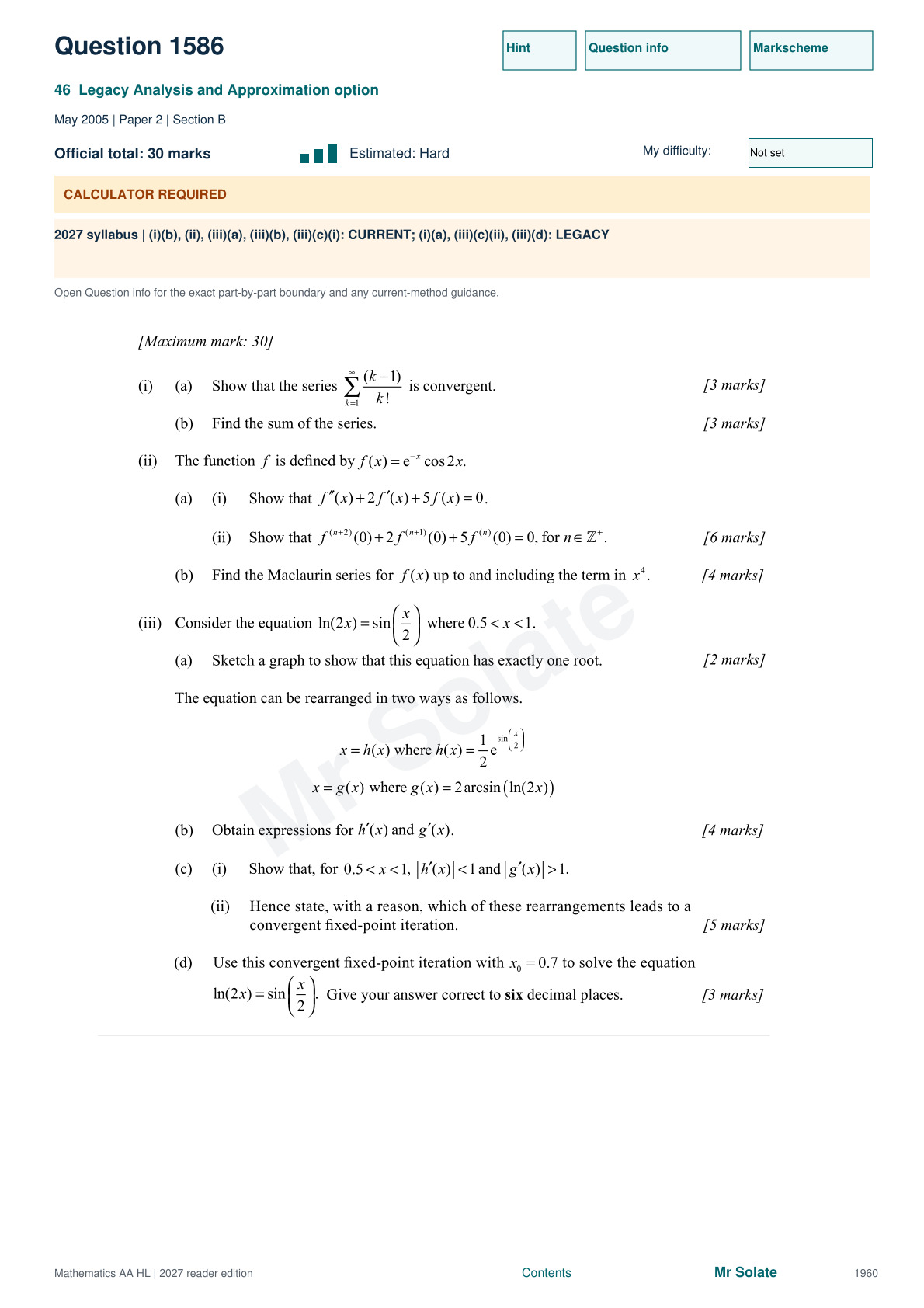
Question 1586
Extended reasoning linking (i) Factorial series convergence and telescoping, (ii) Derivative recurrence and Maclaurin coefficients, (iii) Fixed-point rearrangements, derivative bounds and numerical iteration.
Compatibility: Current: (i)(b), (ii), (iii)(a), (iii)(b), (iii)(c)(i); Legacy: (i)(a), (iii)(c)(ii), (iii)(d)
View the original question
Original page images preserve the equations and diagrams. Write your response before revealing the reasoning.
Reveal the revision reasoning
- For t_k=(k−1)/k!, the successive-term ratio tends to zero, proving convergence. Rewrite t_k=1/(k−1)!−1/k!; the partial sum is 1−1/n!, so its limit is 1.
- Differentiate f=e^(−x)cos(2x) twice, retaining both product-rule contributions. Substitution cancels terms in f″+2f′+5f. Differentiating this identity n times and setting x=0 produces the stated recurrence.
- From f(0)=1 and f′(0)=−1, the recurrence gives f″(0)=−3, f‴(0)=11 and f⁽⁴⁾(0)=−7. Divide by the appropriate factorials to obtain 1−x−3x²/2+11x³/6−7x⁴/24.
- Sketch ln(2x) and sin(x/2) on (0.5,1). Their difference changes sign, and its derivative 1/x−cos(x/2)/2 is positive, confirming exactly one intersection.
- For h(x)=exp(sin(x/2))/2, h′=exp(sin(x/2))cos(x/2)/4. For g(x)=2arcsin(ln(2x)), g′=2/[x sqrt(1−ln²(2x))].
- On the given interval the first derivative has magnitude at most e/4<1, whereas the second exceeds 1. Hence h is the locally convergent rearrangement; it also maps the interval into itself.
- Iterate x_next=h(x) from 0.7 without rounding intermediate values. The successive values settle at 0.706747 to six decimal places.
Editorial revision reasoning. Check the original answer for its marking detail.
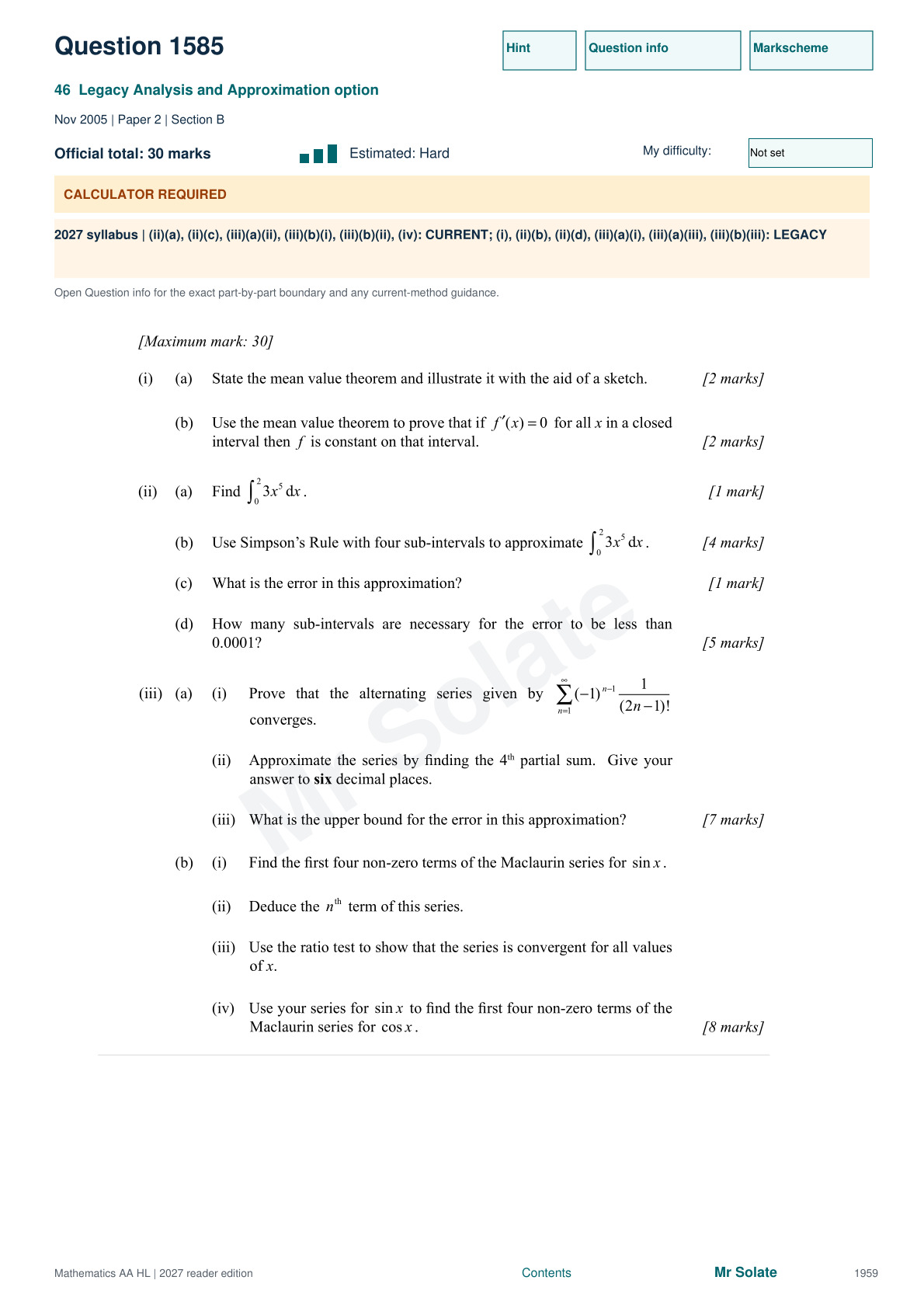
Question 1585
Extended reasoning linking (i) Mean value theorem and zero derivative, (ii) Simpson quadrature and fourth-derivative error bound, (iii a) Alternating series and remainder bound.
Compatibility: Current: (ii)(a), (ii)(c), (iii)(a)(ii), (iii)(b)(i), (iii)(b)(ii), (iii)(b)(iv); Legacy: (i), (ii)(b), (ii)(d), (iii)(a)(i), (iii)(a)(iii), (iii)(b)(iii)
View the original question
Original page images preserve the equations and diagrams. Write your response before revealing the reasoning.
Reveal the revision reasoning
- State the theorem with continuity on [a,b] and differentiability on (a,b): some interior c has f′(c)=[f(b)−f(a)]/(b−a). For any two points p<q, a zero derivative makes this secant slope zero, so f(p)=f(q) and the function is constant.
- The exact integral of 3x⁵ from 0 to 2 is 32. Four Simpson subintervals have h=0.5; evaluate at 0,0.5,1,1.5,2 and apply weights 1,4,2,4,1 to obtain 32.25, an error of 0.25.
- The fourth derivative is 360x, with maximum magnitude 720 on [0,2]. The Simpson bound is 2(2/n)^4(720)/180. Requiring it below 0.0001 gives n>33.6; the next even integer, 34, guarantees the requested accuracy.
- The alternating factorial terms have positive magnitudes 1/(2n−1)! decreasing to zero, so the alternating-series test applies. Four terms give 1−1/3!+1/5!−1/7!≈0.841468.
- The next omitted term bounds the error by 1/9!≈0.00000276. This bounds the unrounded partial sum; rounding the displayed approximation is a separate small error.
- Derivatives of sine cycle through sine and cosine, giving x−x³/3!+x⁵/5!−x⁷/7!. Its nth nonzero term is (−1)^(n−1)x^(2n−1)/(2n−1)!.
- The absolute term ratio is x²/[(2n)(2n+1)]→0 for every fixed x, proving convergence for all real x. Differentiate the sine power series term by term to obtain 1−x²/2!+x⁴/4!−x⁶/6! for cosine.
Editorial revision reasoning. Check the original answer for its marking detail.
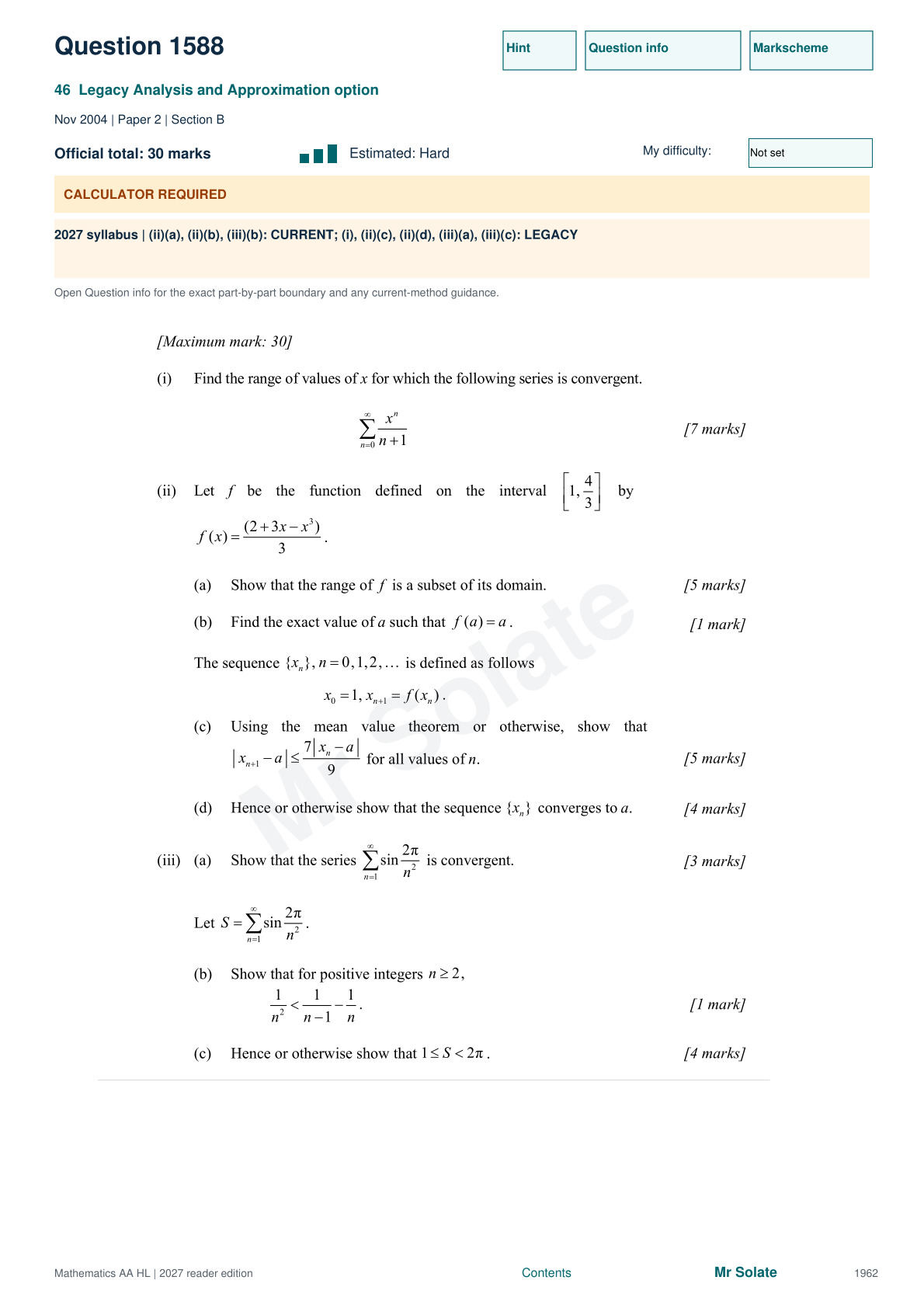
Question 1588
Extended reasoning linking (i) Power-series ratio test and endpoint tests, (ii) Invariant interval, fixed point and contraction bound, (iii) Comparison and telescoping upper bound.
Compatibility: Current: (ii)(a), (ii)(b), (iii)(b); Legacy: (i), (ii)(c), (ii)(d), (iii)(a), (iii)(c)
View the original question
Original page images preserve the equations and diagrams. Write your response before revealing the reasoning.
Reveal the revision reasoning
- For Σx^n/(n+1), the absolute successive-term ratio tends to |x|. This gives absolute convergence for |x|<1 and divergence outside. At x=1 the harmonic tail diverges; at x=−1 the decreasing alternating terms converge. The interval is [−1,1).
- For f(x)=(2+3x−x³)/3, f′(x)=1−x²≤0 on [1,4/3]. Its endpoint values are 4/3 and 98/81, both within that interval, so f maps the interval into itself.
- The fixed-point equation f(a)=a reduces to a³=2, hence a=∛2. Starting at x0=1, the invariant-interval result keeps all iterates in the domain.
- Apply the mean value theorem between x_n and a. Since the magnitude of f′ is at most 7/9 throughout the interval, |x_(n+1)−a|≤(7/9)|x_n−a|.
- Iterating this bound gives |x_n−a|≤(7/9)^n|1−a|≤(7/9)^n. The geometric bound tends to zero, proving convergence to a.
- For Σsin(2π/n²), the first term is zero and all later terms are nonnegative and at most 2π/n². Comparison with the convergent reciprocal-square series proves convergence.
- For n≥2, 1/n²<1/[n(n−1)]=1/(n−1)−1/n. Summing this telescoping bound gives an upper bound 2π for S, strictly exceeded by none of the terms; the n=2 term is 1, giving 1≤S<2π.
Editorial revision reasoning. Check the original answer for its marking detail.
All 12 questions in this topic
Close your notes first
Can you retrieve the method?
1. What if the ratio-test limit equals one?
Check answer 1
The test is inconclusive.
2. Simpson subinterval condition?
Check answer 2
An even number.
3. Residual versus root error?
Check answer 3
Residual is f(x); root error is x minus the true root.
Before you move on
- Keep this chapter labelled as legacy extension.
- For a theorem-based claim, list the hypotheses that actually hold.
- Use exact fractions where possible and distinguish empirical accuracy from a guaranteed bound.
Your revision note
Record one missed cue, one corrected step and one question to retry. Saved only in this browser.