Start with the exam
What you need to be able to do
Normal questions reward translating wording into a shaded event before using numerical tools. The bank includes direct tails, inverse percentiles, recovery of both parameters, and normal probabilities reused in binomial experiments. Keep the measurement variable separate from a count of qualifying measurements. Draw the mean and boundaries first; that sketch is a quick check on tail direction.
Spend 3 minutes reading the overview and diagram, 7 minutes learning the question patterns, 5 minutes writing out the worked example, and 5 minutes on a bank question or recall check. Take longer when you need to; the full bank is here for later practice.
Recognise → set up → write
How the questions are set
Direct and conditional probabilities
Recognise it: A measurement is above, below, between or accepted within limits.
- Write X~N(μ,σ²), then standardise with Z=(X−μ)/σ. The denominator is standard deviation.
- For an interval, subtract lower cumulative probabilities. For an absolute-value inequality, determine whether the event is central or consists of two outside tails.
- For conditioning, divide the probability of the overlap by the probability of the conditioning region. Multiply an event probability by population size for an expected frequency.
Write the event and identify μ and σ before reporting a decimal.
An upper-tail 10% corresponds to lower cumulative probability 90%; variance is not standard deviation.
Inverse quantiles and unknown parameters
Recognise it: A percentile or two boundary probabilities are supplied.
- Convert each statement to P(X≤x)=p and obtain z=Φ⁻¹(p). Write x=μ+zσ.
- Two percentiles give two linear equations. Subtract to find σ and then recover μ. Quartile symmetry can locate μ directly.
- For a changed model, keep whichever parameter the wording says is unchanged. Use unrounded quantiles during the algebra.
Display both quantile equations with their correct signs.
Below-median quantiles have negative z. A distance below the mean does not mean a positive standardised coordinate.
A new experiment based on a threshold
Recognise it: Several independent observations qualify or a mixture is sampled.
- Find the single-observation probability q first. Define Y as the qualifying count and use B(n,q) when assumptions hold.
- Exactly one of two qualifying includes both orders; one specified order includes only one product.
- For a mixture, weight each group’s event probability by its population proportion. To infer the group given an outcome, divide the relevant joint probability by total outcome probability.
Keep X for the measurement and Y for the count, with q explicitly shown.
The normal mean is not the mean count of qualifying observations.
Write it before you reveal it
A worked exam-style example
Original teaching example, created for this lesson.
Original example: X~N(50,10²). Find P(X>60), then exactly one exceedance in two independent measurements.
Reveal the worked solution
- The standardised boundary is (60−50)/10=1.
- q=P(Z>1)≈0.158655.
- Exactly one exceedance gives 2q(1−q)≈0.266968.
Answer: Upper-tail probability ≈0.159; exactly one out of two ≈0.267.
Check: The two-order answer is double the probability for one specified order.
From your own collection
Apply it to past-paper questions
These questions anchor the patterns above. Attempt one without the answer, then compare your setup and conclusion with the reasoning. The linked reader contains the source answer and the question-specific syllabus review.
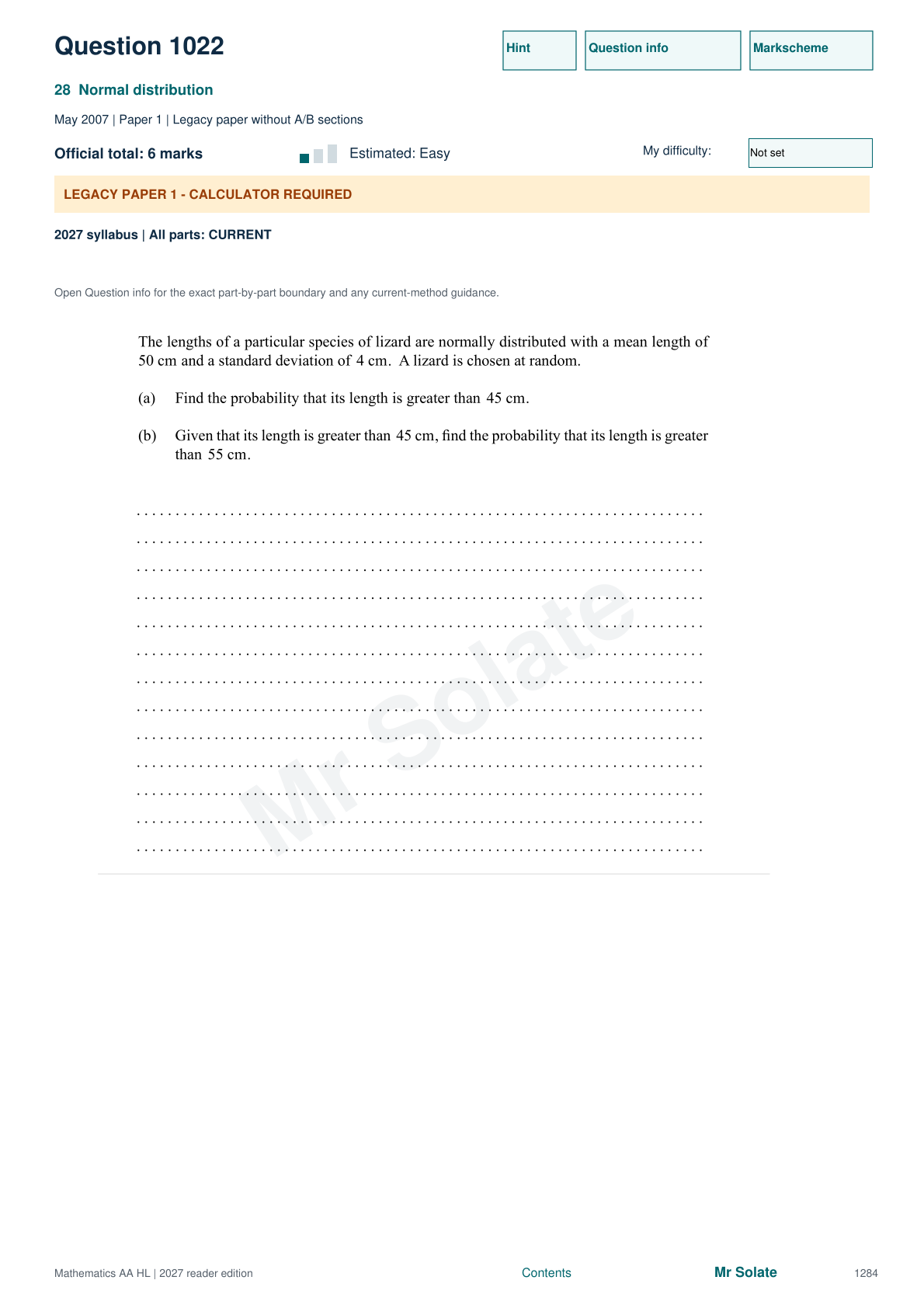
Question 1022
Direct application of Normal tail probability, Conditional probability for nested events.
Compatibility: All parts: The tested methods are current AA HL: Normal tail probability, Conditional probability for nested events.
View the original question
Original page images preserve the equations and diagrams. Write your response before revealing the reasoning.
Reveal the revision reasoning
- Standardise 45 to−1.25 and calculate P(X>45)≈0.894.
- By symmetry about 50, P(X>55)≈0.106.
- For the requested conditional, the intersection is simply X>55.
- Divide the upper 55 tail by the upper 45 tail, giving approximately 0.118.
Editorial revision reasoning. Check the original answer for its marking detail.
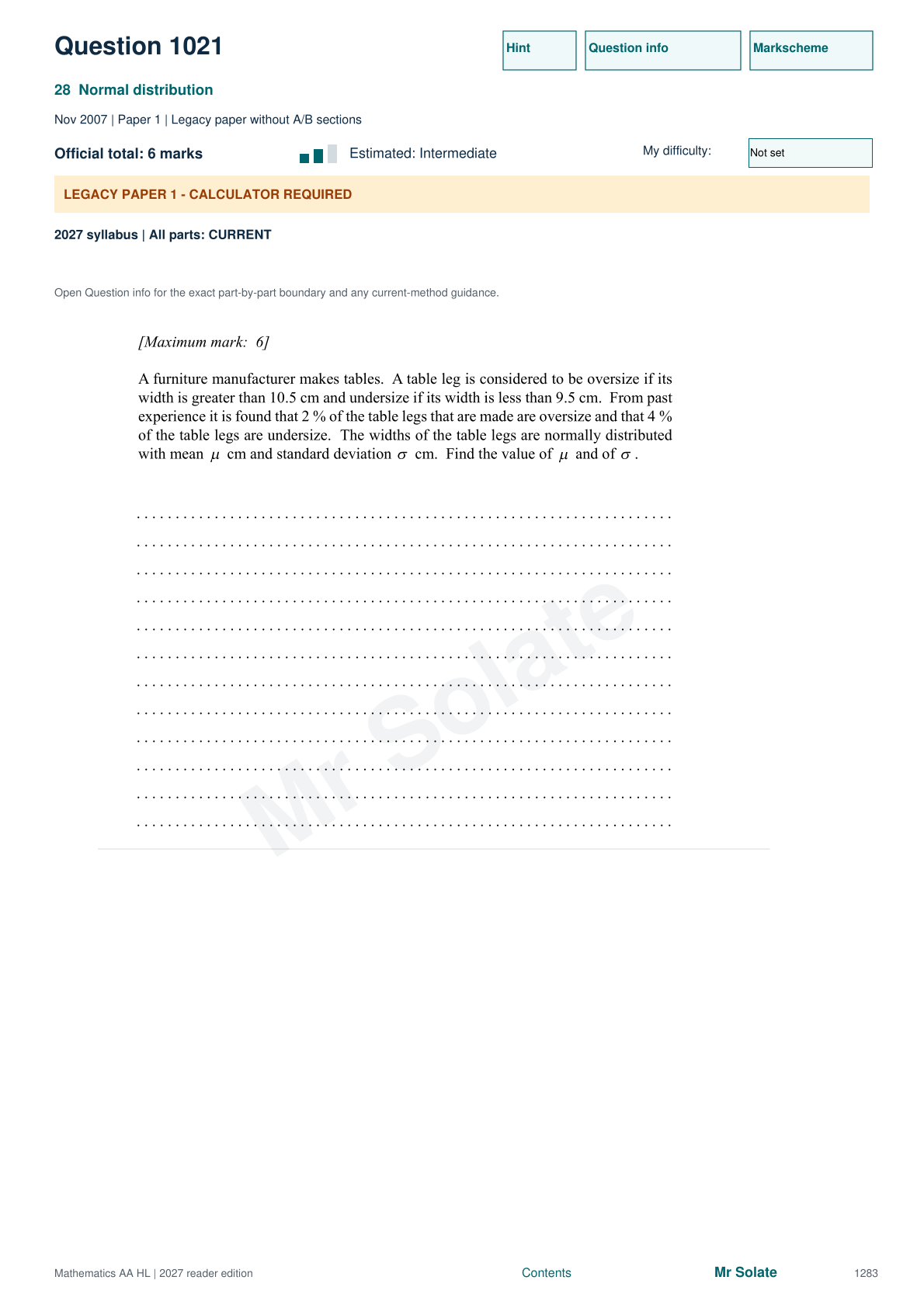
Question 1021
Requires linking Normal inverse-tail parameters, Simultaneous equations.
Compatibility: All parts: The tested methods are current AA HL: Normal inverse-tail parameters, Simultaneous equations.
View the original question
Original page images preserve the equations and diagrams. Write your response before revealing the reasoning.
Reveal the revision reasoning
- Two percent above 10.5 gives z≈2.054 at 10.5.
- Four percent below 9.5 gives z≈−1.751 at 9.5.
- Write 10.5=μ+2.054σ and 9.5=μ−1.751σ.
- Subtract to find σ≈0.263 cm and then μ≈9.96 cm.
Editorial revision reasoning. Check the original answer for its marking detail.
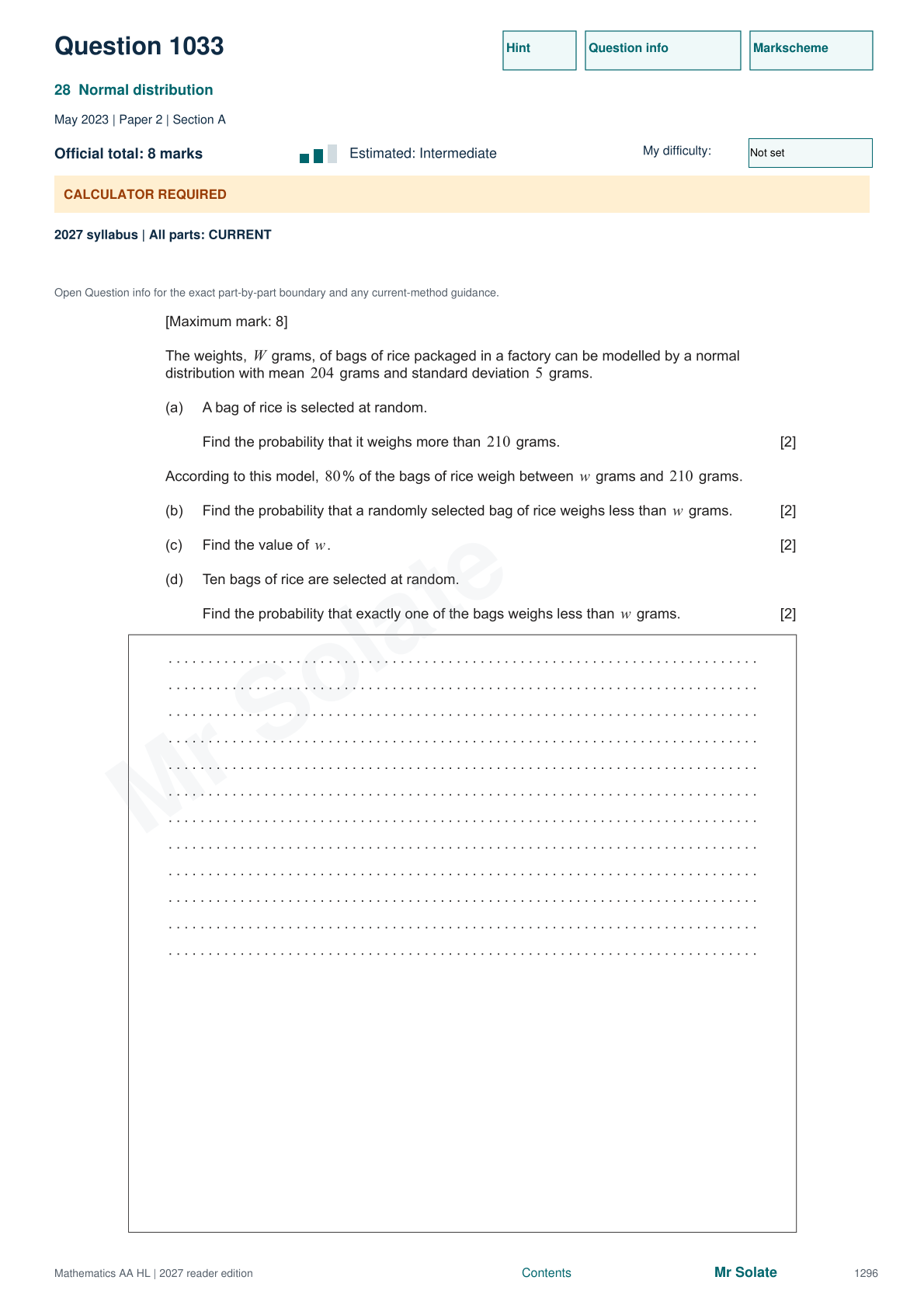
Question 1033
Several linked steps in Normal upper tail, Probability partition, Inverse normal.
Compatibility: The tested concepts and methods match the current AA HL syllabus; the original paper format and wording are retained.
View the original question
Original page images preserve the equations and diagrams. Write your response before revealing the reasoning.
Reveal the revision reasoning
P(W>210)=P(Z>1.2)≈0.115069.
The lower-tail probability is p=1−0.8−0.115069≈0.0849302.
Use inverse normal: w=204+5Φ⁻¹(p)≈197.136g, or 197g.
For ten independent bags, exactly one below w has probability 10p(1−p)⁹≈0.382076≈0.382.
Editorial revision reasoning. Check the original answer for its marking detail.
All 53 questions in this topic
Close your notes first
Can you retrieve the method?
1. Lower cumulative value for the upper 5%?
Check answer 1
0.95.
2. What standardises a value?
Check answer 2
Subtract μ and divide by σ.
3. How many equations recover μ and σ?
Check answer 3
Two independent quantile equations.
Before you move on
- Practise a direct tail, inverse quantile and normal-binomial combination.
- Compare each boundary with the mean to check the probability size.
- Retain full precision until the final answer.
Your revision note
Record one missed cue, one corrected step and one question to retry. Saved only in this browser.