Start with the exam
What you need to be able to do
Identify the differential-equation form before integrating. The bank uses separable equations, homogeneous substitutions, first-order linear equations and Euler approximations. Initial conditions choose constants and sometimes branches or valid intervals. A formula is not fully checked until it satisfies both the differential equation and the stated initial condition. Keep equilibrium solutions in mind before dividing by an expression involving y.
Spend 3 minutes reading the overview and diagram, 7 minutes learning the question patterns, 5 minutes writing out the worked example, and 5 minutes on a bank question or recall check. Take longer when you need to; the full bank is here for later practice.
Recognise → set up → write
How the questions are set
Separation and initial values
Recognise it: The derivative can be written as a product of an x-expression and a y-expression.
- For y′=f(x)g(y), separate dy/g(y)=f(x)dx where g(y)≠0 and integrate both sides.
- Before dividing, check whether g(y)=0 gives constant equilibrium solutions. Use logarithmic absolute values where required and apply the initial condition to select constants or branches.
- State the solution interval where the original equation and chosen branch remain valid. For logistic models, interpret the equilibrium and identify maximum growth using the derivative as a function of y.
Show separated variables, integrals and the initial-condition equation.
Dividing by y can discard y=0. Algebraic continuation through a singularity is not automatically a valid solution.
Homogeneous or linear forms
Recognise it: The slope depends on y/x, or the equation is y′+P(x)y=Q(x).
- For a homogeneous equation, set y=vx and differentiate to obtain y′=v+xv′. Substitute both expressions before separating.
- For a linear equation, use integrating factor μ=e^(∫P dx). Multiplication makes the left side (μy)′, which can then be integrated.
- Apply the initial condition after returning to the original variables. Check positive-root or logarithmic branches against the given starting point.
Write the substitution derivative or the integrating-factor product derivative explicitly.
For y=vx, the derivative is not xv′ alone. An integrating factor multiplies every term, including the right side.
Euler approximation and solution checks
Recognise it: The question requests numerical stepping, comparison or error direction.
- For y′=f(x,y), use yₙ₊₁=yₙ+h f(xₙ,yₙ), then xₙ₊₁=xₙ+h. Use the old x and old y together in each slope.
- Keep enough digits between steps and display a table of x, y and slope. Compare with an exact solution only at the same final x.
- For error direction, use justified concavity on the relevant interval: tangent-based Euler steps tend below a convex solution in a suitably controlled setting. Verify the required behaviour rather than assuming all Euler approximations underestimate.
Show at least the substitution for each step and the comparison defining absolute error.
Using the newly updated x with the old y is a different algorithm and is not the stated Euler step.
Write it before you reveal it
A worked exam-style example
Original teaching example, created for this lesson.
Original example: solve y′=2xy with y(0)=3, then make one Euler step of size 0.1.
Reveal the worked solution
- Separate dy/y=2x dx and integrate: ln|y|=x²+C.
- The positive initial condition gives y=3e^(x²).
- At (0,3), the slope is 2×0×3=0, so Euler gives y(0.1)≈3.
- The exact value is 3e^0.01≈3.03015.
Answer: Exact solution y=3e^(x²); one-step Euler value 3.
Check: Differentiating 3e^(x²) gives 2x times the original y, and y(0)=3.
From your own collection
Apply it to past-paper questions
These questions anchor the patterns above. Attempt one without the answer, then compare your setup and conclusion with the reasoning. The linked reader contains the source answer and the question-specific syllabus review.
Question 1467
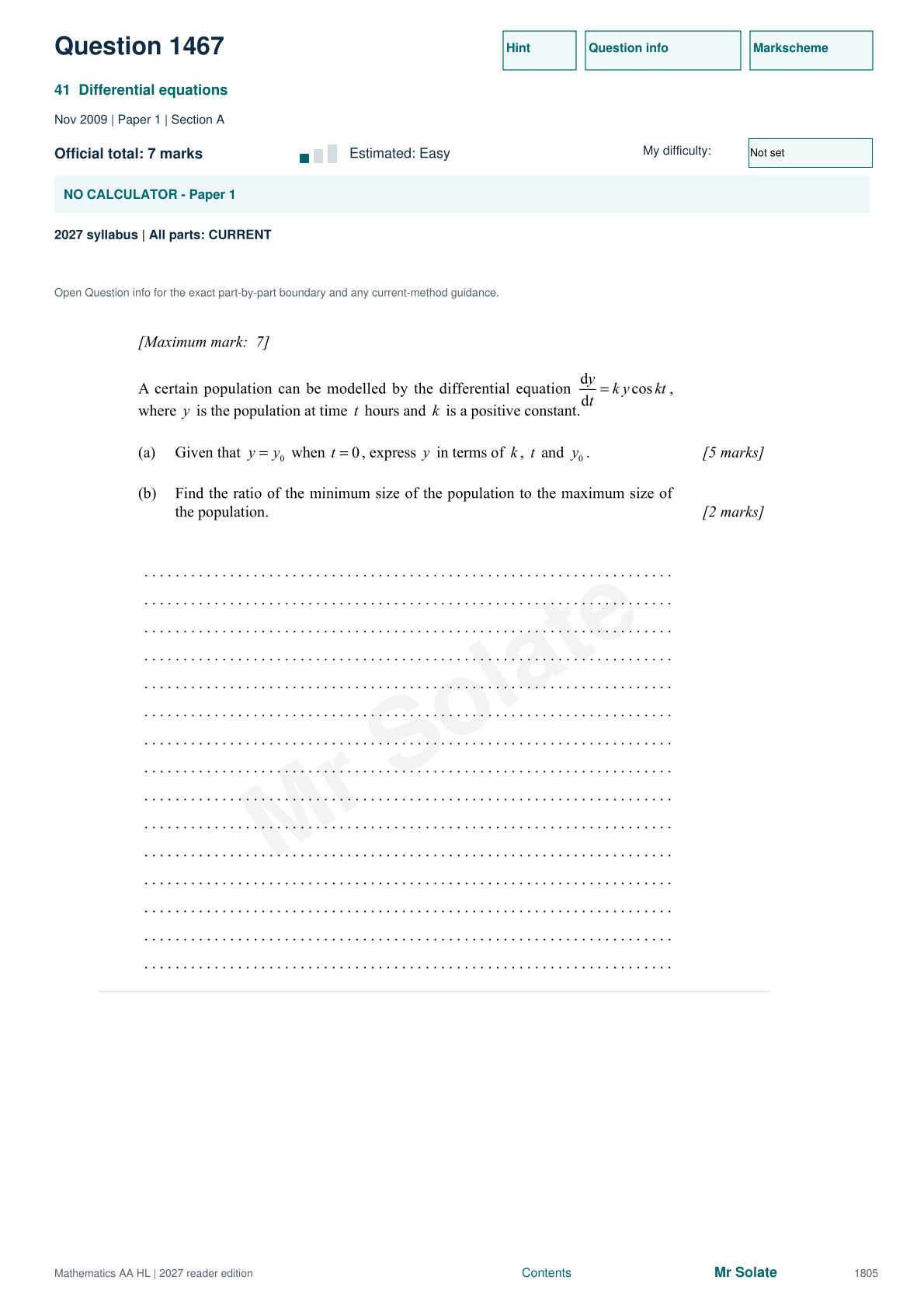
A short direct application of Variable-rate population growth, Separation of variables, Exponential extrema.
Compatibility: Current: All parts
View the original question
Original page images preserve the equations and diagrams. Write your response before revealing the reasoning.
Reveal the revision reasoning
- Separate dy/y=k cos(kt)dt.
- Integration gives ln y=sin(kt)+C; y(0)=y₀ yields y=y₀ exp(sin kt).
- Since k>0, the sine factor attains both −1 and 1 over time.
- Thus the minimum is y₀/e and the maximum is ey₀; their ratio is e^(−2), or 1:e².
Editorial revision reasoning. Check the original answer for its marking detail.
Question 1463
Apply the method to the original question.
Compatibility: All parts test current AA HL content and can be solved using current syllabus methods.
View the original question
Original page images preserve the equations and diagrams. Write your response before revealing the reasoning.
Reveal the revision reasoning
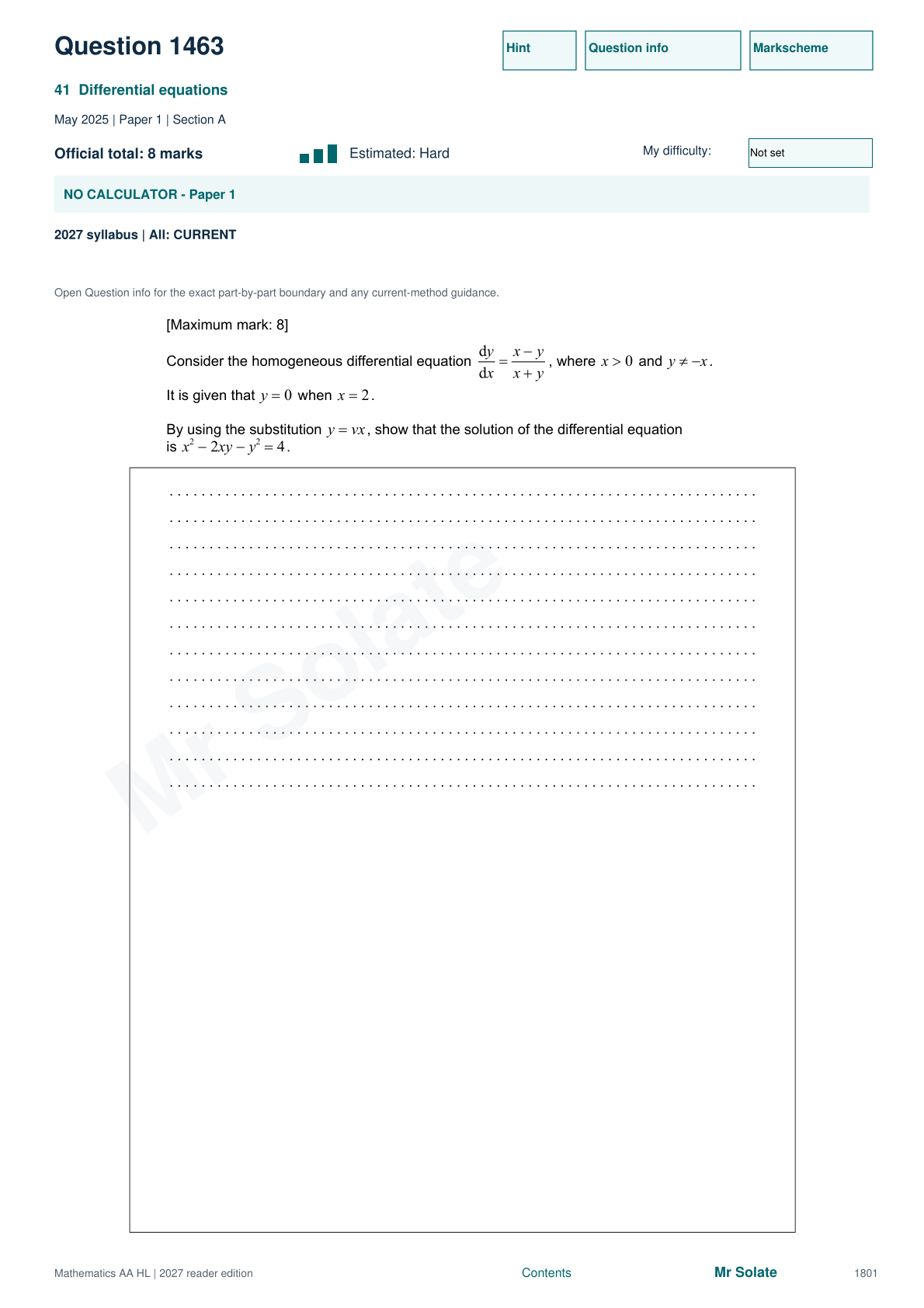
The substitution gives y′=v+xv′=(1-v)/(1+v), so xv′=(1-2v-v²)/(1+v).
Separate (1+v)/(1-2v-v²) dv=dx/x. The numerator is -1/2 times the denominator derivative.
Integrate to -(1/2)ln|1-2v-v²|=ln x+C. At (x,y)=(2,0), v=0 and C=-ln2.
Exponentiation gives |1-2v-v²|=4/x². At the initial point the interior is positive; the continuous solution branch retains that sign.
Substitute v=y/x and multiply by x² to obtain x²-2xy-y²=4, as required.
Editorial revision reasoning. Check the original answer for its marking detail.
Question 1479
Several linked steps in Euler iteration, Concavity and numerical bias, Selecting the initial-value branch.
Compatibility: The tested concepts and methods match the current AA HL syllabus; the original paper format and wording are retained.
View the original question
Original page images preserve the equations and diagrams. Write your response before revealing the reasoning.
Reveal the revision reasoning
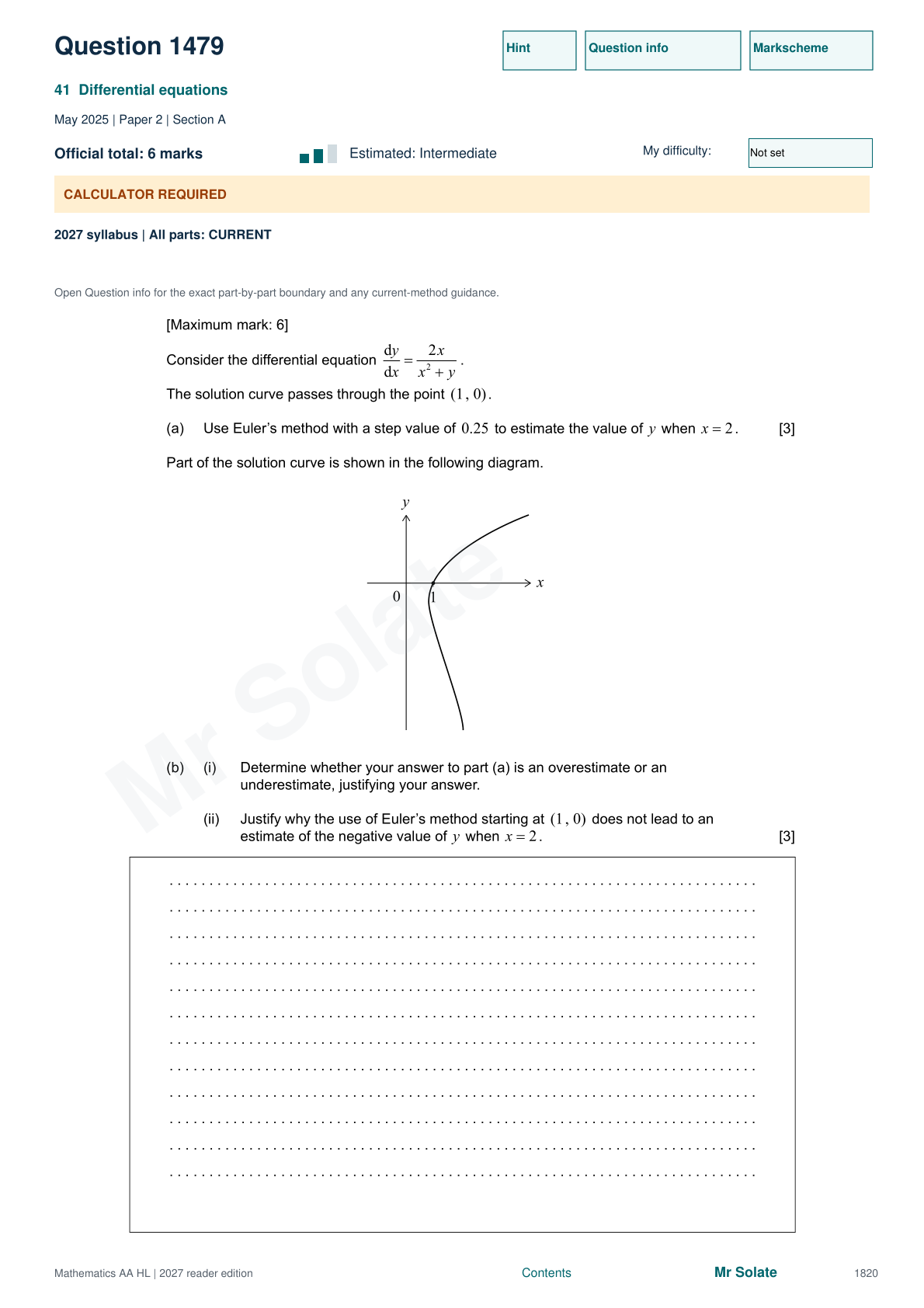
Use y_next=y+0.25[2x/(x+2y)], starting at (1,0).
The successive y-values are 0.5, 0.803030…, 1.04868… and 1.26152…, giving y(2)≈1.26.
The displayed branch is concave down, so forward tangent steps lie above it and give an overestimate.
At (1,0) the gradient is 2. Following positive x steps selects the upper branch with positive initial slope; the lower branch shown is not the continuation chosen by this initial-value solution.
Editorial revision reasoning. Check the original answer for its marking detail.
All 35 questions in this topic
Close your notes first
Can you retrieve the method?
1. What can division by g(y) lose?
Check answer 1
Equilibrium solutions where g(y)=0.
2. Derivative of y=vx?
Check answer 2
v+xv′.
3. Which values determine an Euler slope?
Check answer 3
The old x and old y together.
Before you move on
- Classify the equation before starting.
- Check equilibria, initial conditions and branch restrictions.
- For numerical work, record the step size and compare values at identical inputs.
Your revision note
Record one missed cue, one corrected step and one question to retry. Saved only in this browser.