Start with the exam
What you need to be able to do
Probability wording tells you which group forms the denominator. “Given B” restricts attention to B, whereas “A or B” describes a union. The bank repeatedly moves between conditional probabilities, intersections, complements and independence, then extends these ideas to trees and repeated trials. Draw the regions or branches before calculating. Independence must be given or established; it cannot be assumed simply because two events have different names.
Spend 3 minutes reading the overview and diagram, 7 minutes learning the question patterns, 5 minutes writing out the worked example, and 5 minutes on a bank question or recall check. Take longer when you need to; the full bank is here for later practice.
Recognise → set up → write
How the questions are set
Venn regions and independence
Recognise it: Union, complement, conditional probability or independence appears.
- Use P(A∪B)=P(A)+P(B)−P(A∩B). Fill the overlap first when it is known.
- From P(A|B), recover overlap=P(A|B)P(B). Fill exclusive regions and the neither region by subtraction.
- Test independence with P(A∩B)=P(A)P(B), or compare P(A|B) with P(A) when P(B)>0.
State both values being compared in an independence proof; a bare “independent” is not justification.
Mutually exclusive positive-probability events are not independent.
Trees and reversed conditions
Recognise it: A box, machine, travel mode or population group is selected before an outcome.
- Branch first on the initial group, then use outcome probabilities conditional on that group.
- Multiply along a branch for a joint probability and add disjoint branches for the total outcome probability.
- To reverse a condition, divide the relevant joint branch by the total probability of the observed outcome.
Show the weighted sum in the denominator of a reversed conditional probability.
The false-positive rate among healthy people differs from the fraction of positive tests that are false.
Changing counts and repeated games
Recognise it: Draws occur without replacement, or play continues until a win.
- Without replacement, update both favourable and total counts after each draw, separately on each history.
- For “at least one”, consider the complement of none when shorter.
- For alternating games, identify a complete unsuccessful cycle. Winning on later turns may form a geometric series; verify its ratio magnitude is below 1 before summing.
Describe the first winning branch and the factor for returning to the same game state.
Do not treat without-replacement trials as independent or confuse the number of completed failures with the turn number.
Write it before you reveal it
A worked exam-style example
Original teaching example, created for this lesson.
Original practice: P(A)=0.6, P(B)=0.5 and P(A∪B)=0.8. Find P(A|B) and test independence.
Reveal the worked solution
- The overlap is 0.6+0.5−0.8=0.3.
- P(A|B)=0.3/0.5=0.6.
- Since P(A)P(B)=0.6×0.5=0.3, it equals the overlap.
Answer: P(A|B)=0.6; A and B are independent.
Check: The four regions are A only 0.3, overlap 0.3, B only 0.2 and neither 0.2. They are nonnegative and sum to 1.
From your own collection
Apply it to past-paper questions
These questions anchor the patterns above. Attempt one without the answer, then compare your setup and conclusion with the reasoning. The linked reader contains the source answer and the question-specific syllabus review.
Question 875
Apply the method to the original question.
Compatibility: All parts test current AA HL content and can be solved using current syllabus methods.
View the original question
Original page images preserve the equations and diagrams. Write your response before revealing the reasoning.
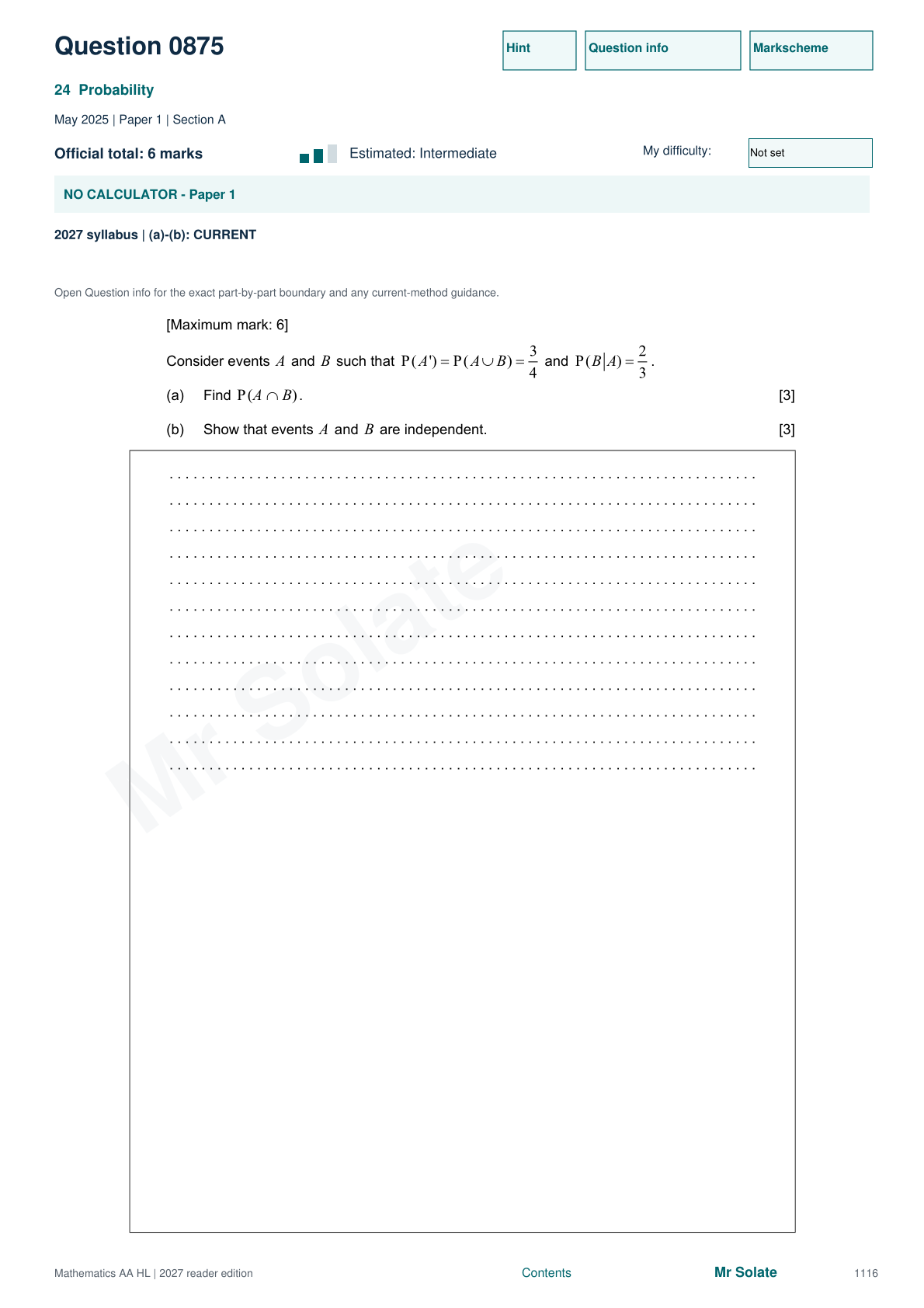
Reveal the revision reasoning
The given P(A′)=3/4 gives P(A)=1/4.
Since P(B|A)=2/3, P(A∩B)=P(B|A)P(A)=(2/3)(1/4)=1/6.
Use the given P(A∪B)=3/4: 3/4=1/4+P(B)-1/6, so P(B)=2/3.
Now P(B|A)=P(B), or equivalently P(A∩B)=P(A)P(B)=1/6. This equality proves independence.
Editorial revision reasoning. Check the original answer for its marking detail.
Question 881
Apply the method to the original question.
Compatibility: This AA HL question uses current syllabus methods in the references shown.
View the original question
Original page images preserve the equations and diagrams. Write your response before revealing the reasoning.
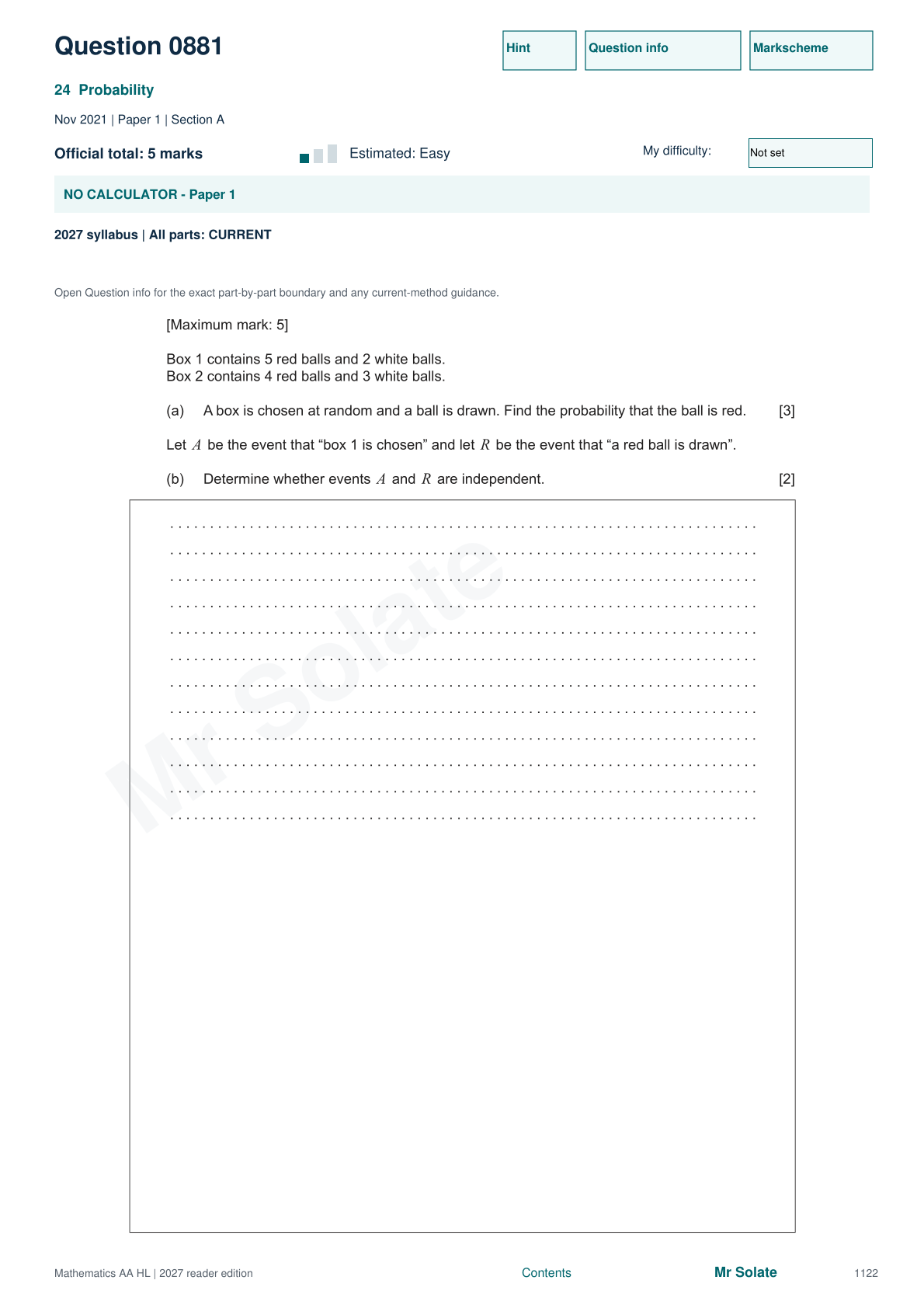
Reveal the revision reasoning
Each box is chosen with probability 1/2. Thus P(R)=(1/2)(5/7)+(1/2)(4/7)=9/14.
If box 1 is known to have been selected, P(R|A)=5/7=10/14.
This differs from P(R)=9/14, so choosing box 1 and drawing red are not independent.
Editorial revision reasoning. Check the original answer for its marking detail.
Question 899
Requires a sustained multi-stage argument involving Alternating trials, Geometric series, First-success probability.
Compatibility: All parts: The tested methods are current AA HL: Alternating trials, Geometric series, First-success probability.
View the original question
Original page images preserve the equations and diagrams. Write your response before revealing the reasoning.
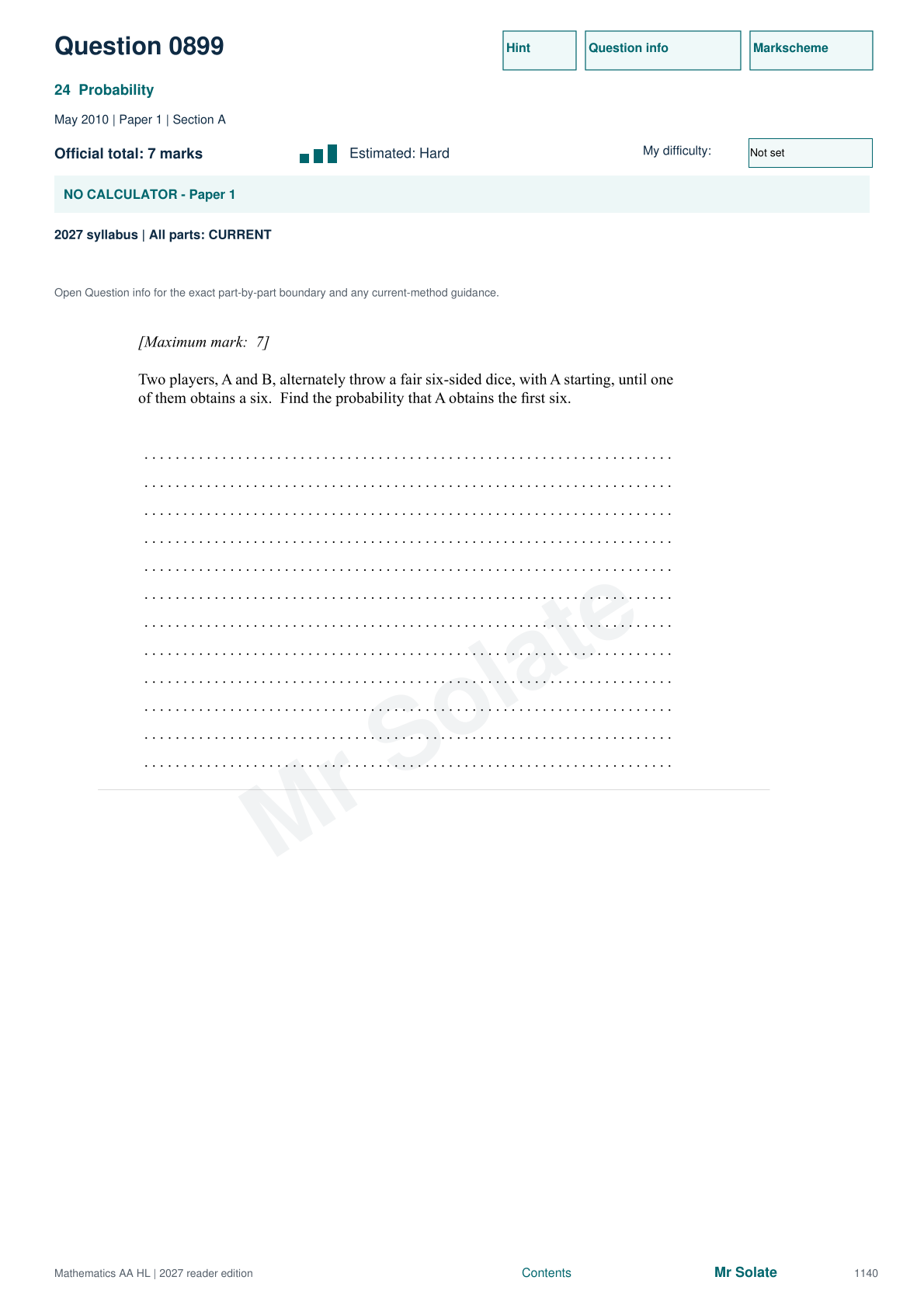
Reveal the revision reasoning
- A wins immediately with probability 1/6.
- For A’s next chance, both players must first fail, with probability (5/6)².
- Thus the winning probabilities form a geometric series with first term 1/6 and ratio 25/36.
- Sum the infinite series, whose ratio is below 1.
- Alternatively let p=1/6+(25/36)p and solve.
Editorial revision reasoning. Check the original answer for its marking detail.
All 65 questions in this topic
Close your notes first
Can you retrieve the method?
1. What is the denominator of P(A|B)?
Check answer 1
P(B), the probability of the conditioning event.
2. How do you find “neither A nor B”?
Check answer 2
1−P(A∪B).
3. When may probabilities be multiplied as P(A)P(B)?
Check answer 3
For the intersection when A and B are independent.
Before you move on
- Check every computed region lies in [0,1] and the disjoint regions sum to 1. An impossible region often identifies a wrong denominator.
- For a tree, ensure branches leaving each node sum to 1 and keep exact fractions until the final requested rounding.
Your revision note
Record one missed cue, one corrected step and one question to retry. Saved only in this browser.