Start with the exam
What you need to be able to do
A vector line is a point plus a multiple of a direction. Most errors in line problems come from confusing the anchor point with the direction or using one parameter for two independently chosen points. The bank connects lines to intersection, skewness, shortest distance and moving objects. Use separate parameters for path intersections; use the same time only when comparing positions at the same physical moment.
Spend 3 minutes reading the overview and diagram, 7 minutes learning the question patterns, 5 minutes writing out the worked example, and 5 minutes on a bank question or recall check. Take longer when you need to; the full bank is here for later practice.
Recognise → set up → write
How the questions are set
Construct and intersect lines
Recognise it: Two points, symmetric equations or parametric lines are supplied.
- From points A and B use r=a+t(b−a). Convert symmetric equations by setting each ratio equal to one parameter.
- For two lines write a+tu=b+sv using independent t,s. Solve two coordinate equations, then check the third.
- Proportional directions indicate parallel lines; check an anchor point to distinguish coincident from distinct parallel lines.
Show all three coordinate equations and the third-coordinate verification.
Solving only two coordinates can falsely claim intersection for skew lines.
Distances and common perpendiculars
Recognise it: Find the nearest point or distance between a point and line, or two lines.
- For point Q and P=a+tu on the line, impose (Q−P)·u=0 to locate the perpendicular foot.
- For two skew lines choose P=a+tu and Q=b+sv, then impose (Q−P)·u=0 and (Q−P)·v=0.
- Calculate |Q−P| after finding the parameters, and restrict them if the problem uses finite segments.
Write the perpendicularity equations before solving; they explain why the chosen connecting segment is shortest.
The distance between anchor points is generally not the shortest line distance.
Motion and closest approach
Recognise it: Objects travel on paths with time-dependent position vectors.
- Distinguish a geometric path crossing from a collision. A collision requires equal position at the same time.
- For separation form d(t)=r_1(t)−r_2(t), then minimize d(t)·d(t) over the allowed time interval.
- For piecewise motion, use the correct velocity on each interval and compare any boundary times. Speed is the magnitude of velocity, not position.
State the time variable and its units; retain the same time in both moving positions.
Independent path parameters may locate a crossing that the objects reach at different times.
Write it before you reveal it
A worked exam-style example
Original teaching example, created for this lesson.
Original practice: find the nearest point on r=(1,0,0)+t(1,1,0) to Q=(0,2,0).
Reveal the worked solution
- A general point is P=(1+t,t,0), so Q−P=(−1−t,2−t,0).
- Perpendicularity gives (Q−P)·(1,1,0)=1−2t=0, hence t=1/2.
- Therefore P=(3/2,1/2,0). The displacement is (−3/2,3/2,0).
Answer: Nearest point (3/2,1/2,0); distance 3/√2 units.
Check: The displacement dot direction is −3/2+3/2=0. Its squared length is 9/2.
From your own collection
Apply it to past-paper questions
These questions anchor the patterns above. Attempt one without the answer, then compare your setup and conclusion with the reasoning. The linked reader contains the source answer and the question-specific syllabus review.
Question 738
Apply the method to the original question.
Compatibility: All parts test current AA HL content and can be solved using current syllabus methods.
View the original question
Original page images preserve the equations and diagrams. Write your response before revealing the reasoning.
Reveal the revision reasoning
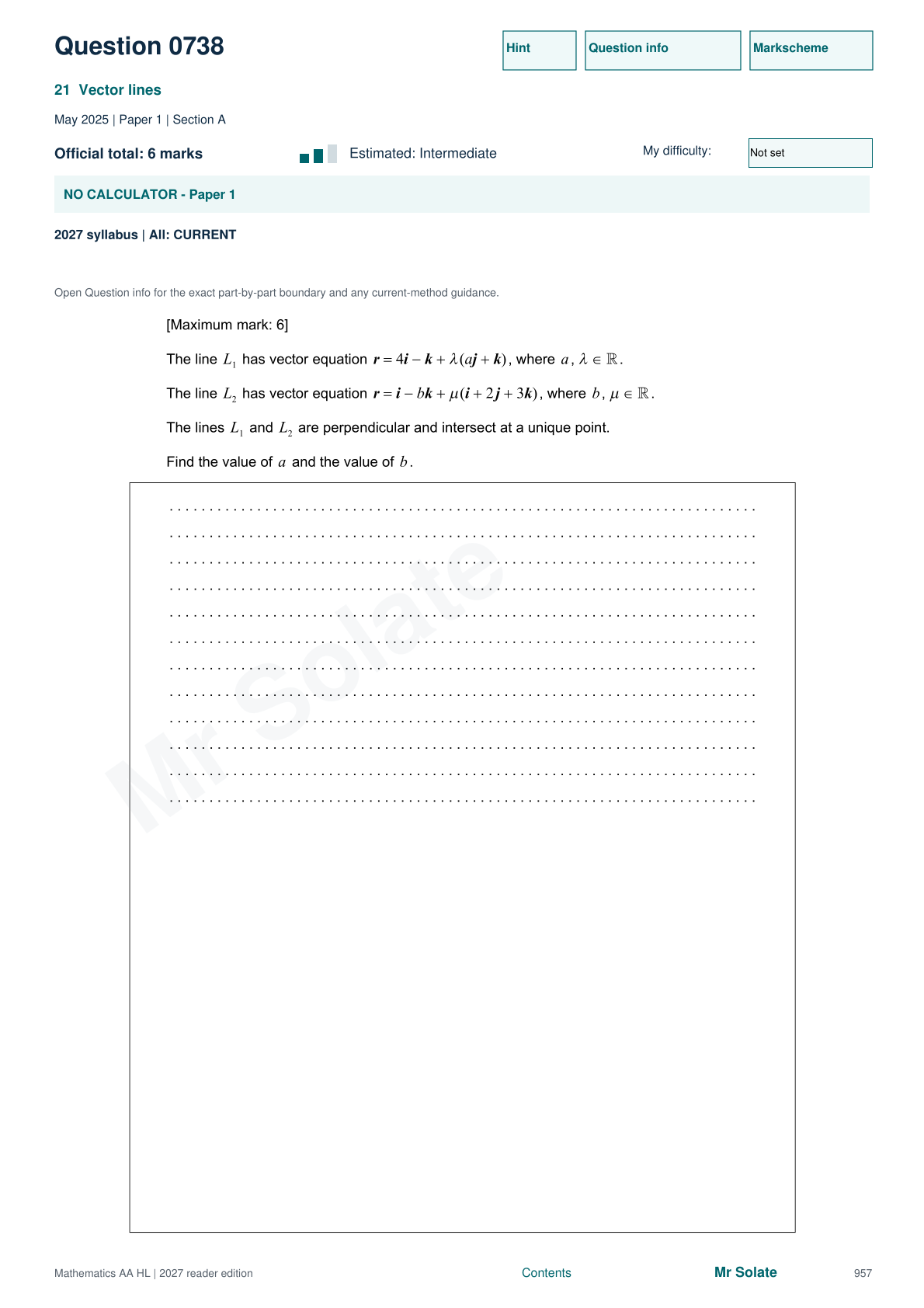
The direction vectors are (0,a,1) and (1,2,3). Their zero dot product gives 2a+3=0, so a=-3/2.
At the intersection the x coordinates give 4=1+μ, hence μ=3.
The y coordinates give aλ=2μ, so (-3/2)λ=6 and λ=-4.
Finally compare z: -1+λ=-b+3μ, giving -5=-b+9 and b=14.
Editorial revision reasoning. Check the original answer for its marking detail.
Question 740
Apply the method to the original question.
Compatibility: The question is from the current AA HL course and uses the listed current syllabus content.
View the original question
Original page images preserve the equations and diagrams. Write your response before revealing the reasoning.
Reveal the revision reasoning
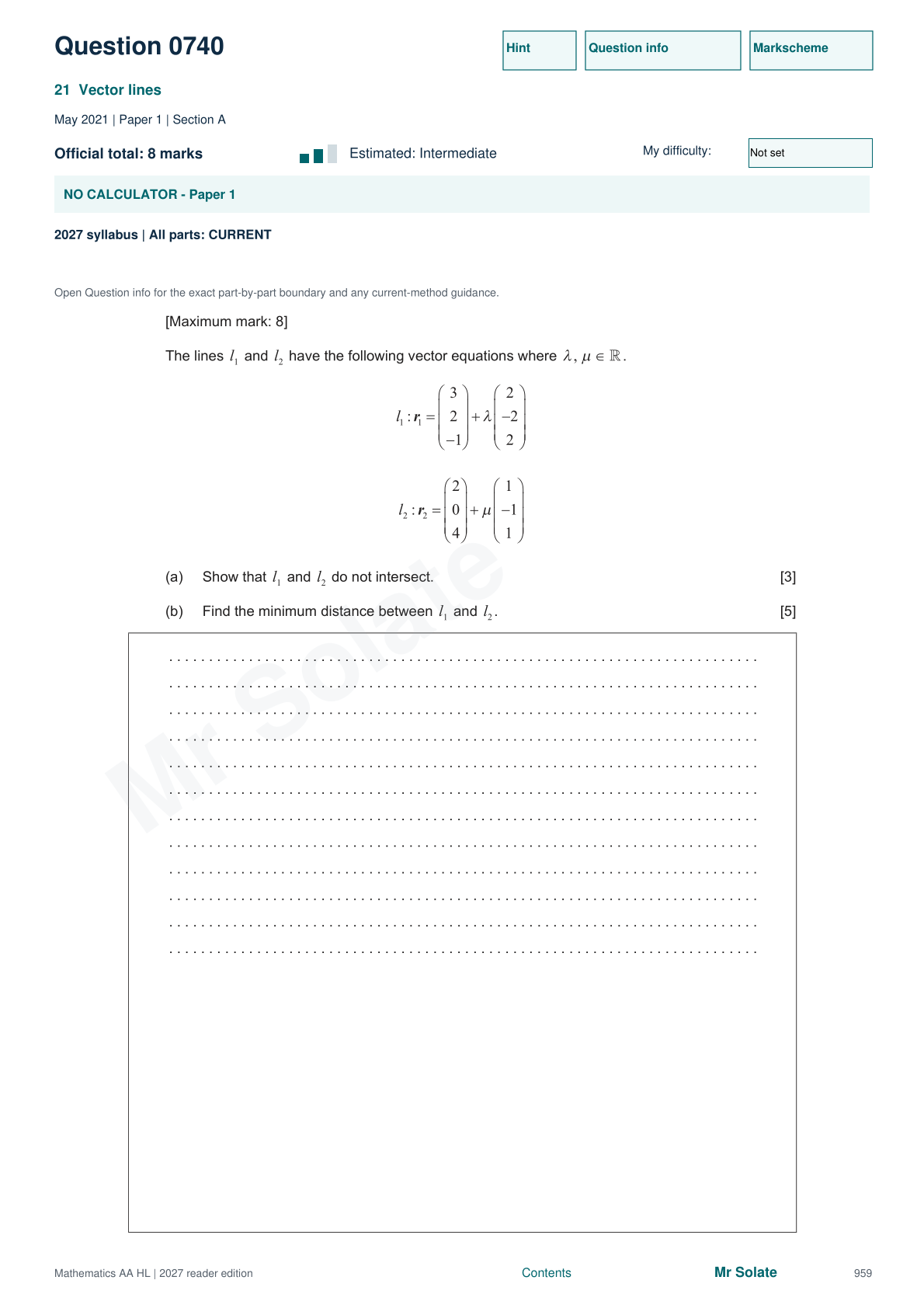
The directions (2,-2,2) and (1,-1,1) are proportional, so the lines are parallel.
Joining their stated points gives w=(2,0,4)-(3,2,-1)=(-1,-2,5), which is not parallel to (1,-1,1). Hence the lines are distinct and do not intersect.
Use d=(1,-1,1). Then w·d=6, abs(w)²=30 and abs(d)²=3.
The squared perpendicular separation is abs(w)²-(w·d)²/abs(d)²=30-12=18. Therefore the minimum distance is 3√2.
Editorial revision reasoning. Check the original answer for its marking detail.
Question 753
Direct application of Velocity vector magnitude, Angle of descent.
Compatibility: The tested concepts and methods match the current AA HL syllabus; the original paper format and wording are retained.
View the original question
Original page images preserve the equations and diagrams. Write your response before revealing the reasoning.
Reveal the revision reasoning
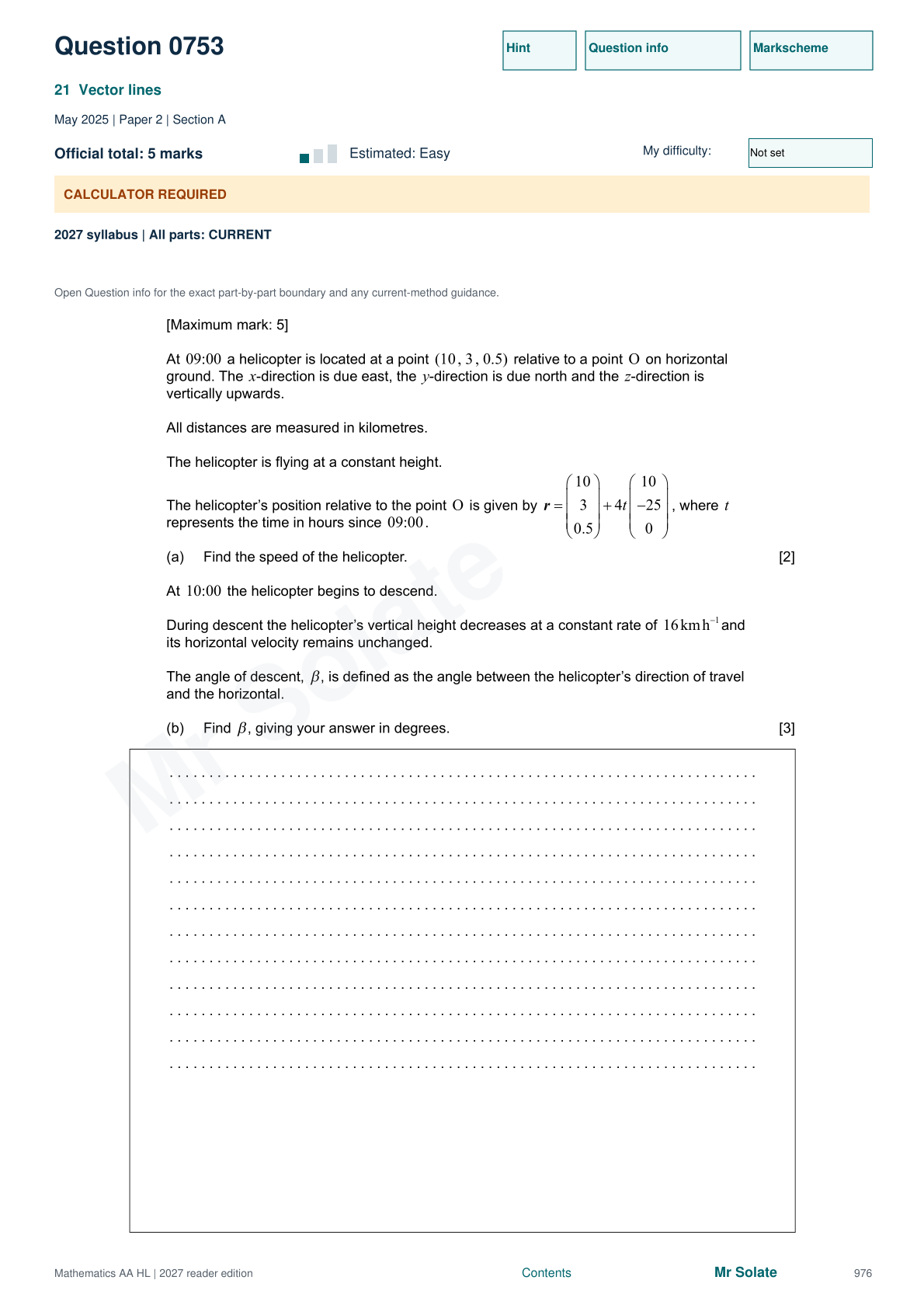
The velocity is (40,−100,0)km/h, so the horizontal speed is √(40²+100²)=20√29≈108km/h.
After descent begins, the velocity is (40,−100,−16).
The angle below horizontal satisfies tanβ=16/(20√29), giving β≈8.45°.
Editorial revision reasoning. Check the original answer for its marking detail.
All 33 questions in this topic
Close your notes first
Can you retrieve the method?
1. How many parameters should two independent lines use?
Check answer 1
One for each line.
2. What extra condition makes a crossing a collision?
Check answer 2
Both objects must arrive at the crossing at the same time.
3. How do you test a perpendicular foot?
Check answer 3
Its connecting displacement has zero dot product with the line direction.
Before you move on
- For a claimed intersection, substitute the parameter values into both original vector equations and compare all coordinates.
- For a distance minimization, inspect the physical time or segment bounds; an unconstrained minimum may lie outside the allowed interval.
Your revision note
Record one missed cue, one corrected step and one question to retry. Saved only in this browser.