Start with the exam
What you need to be able to do
Fusion and stellar questions often link several observations: parallax gives distance, apparent brightness and distance give luminosity, and a spectrum gives surface temperature. These then locate a star on an HR diagram or constrain radius. Luminosity is total emitted power; apparent brightness is power received per unit area at the observer. Do not infer that a faint-looking star has low luminosity without considering distance. Historical astrophysics extensions are identified by the bank’s compatibility notes. In a multi-part problem, carry unrounded intermediate values from distance into luminosity and then radius. Otherwise a small early rounding error can grow through the squared-distance relation. End by checking whether the inferred radius and temperature agree qualitatively with the star’s plotted luminosity and HR region.
Spend 3 minutes reading the overview and diagram, 7 minutes learning the question patterns, 5 minutes writing out the worked example, and 5 minutes on a bank question or recall check. Take longer when you need to; the full bank is here for later practice.
Recognise → set up → write
How the questions are set
Build distance and luminosity from observations
Recognise it: Parallax, brightness, a spectrum or a stellar-radius comparison appears.
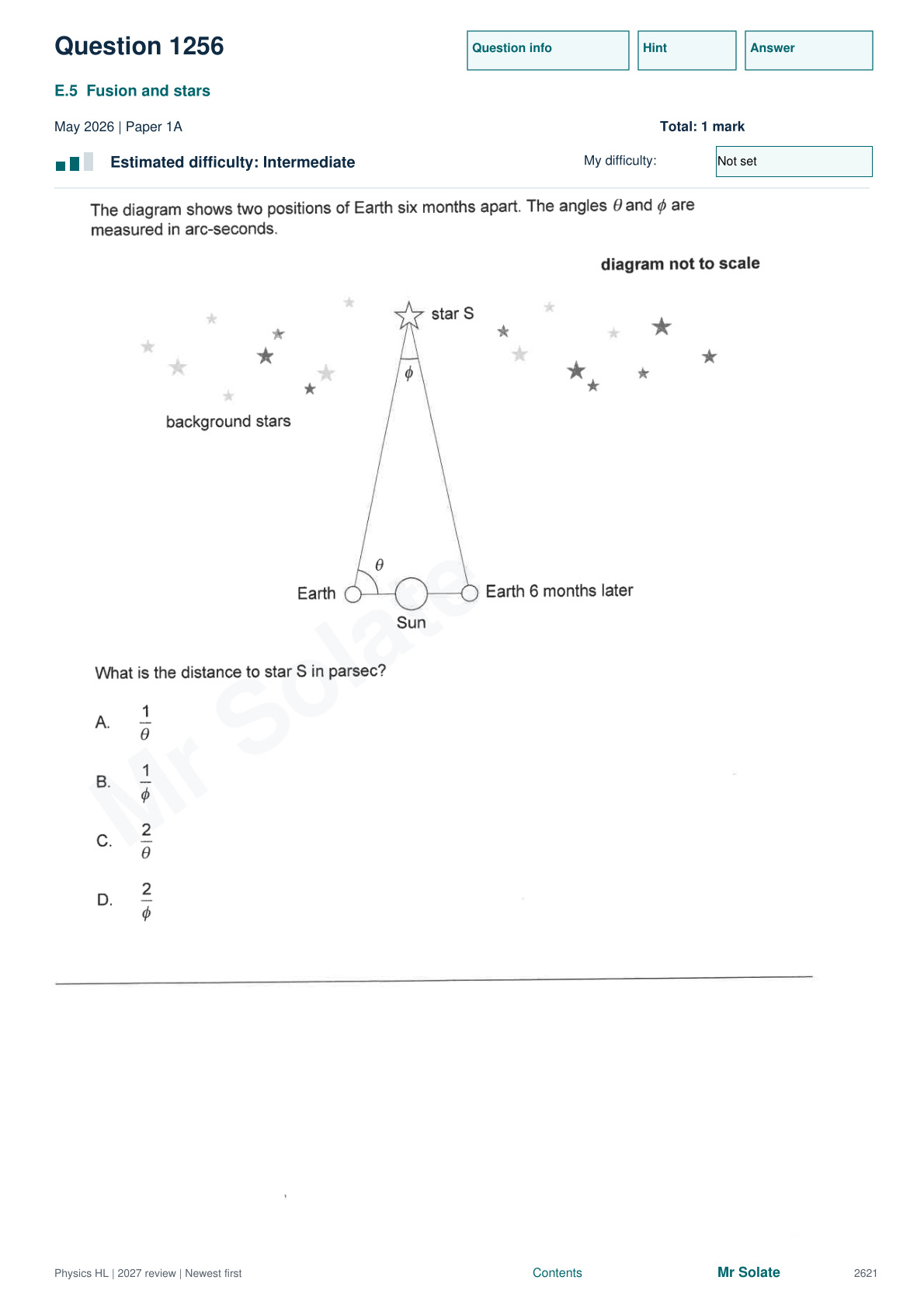
- Identify the parallax angle as half the total angular shift between observations six months apart. Use d in parsecs = 1/p in arcseconds.
- Then use b = L/(4πd²) with consistent distance units. Ratios can eliminate 4π and avoid conversions when both distances use the same unit.
- Use λmaxT = constant for temperature and L = 4πR²σT⁴ for radius or luminosity. Combine ratios carefully: radius depends on the square root of luminosity and inverse square of temperature.
The star’s luminosity follows from its apparent brightness and distance, L = 4πd²b; brightness alone is insufficient.
The six-month angular displacement is 2p, not p.
Read the HR diagram as luminosity and temperature
Recognise it: A stellar region, evolution track or radius comparison is requested.
- Read the temperature-axis direction: temperature commonly decreases to the right. The vertical axis is luminosity, not apparent brightness.
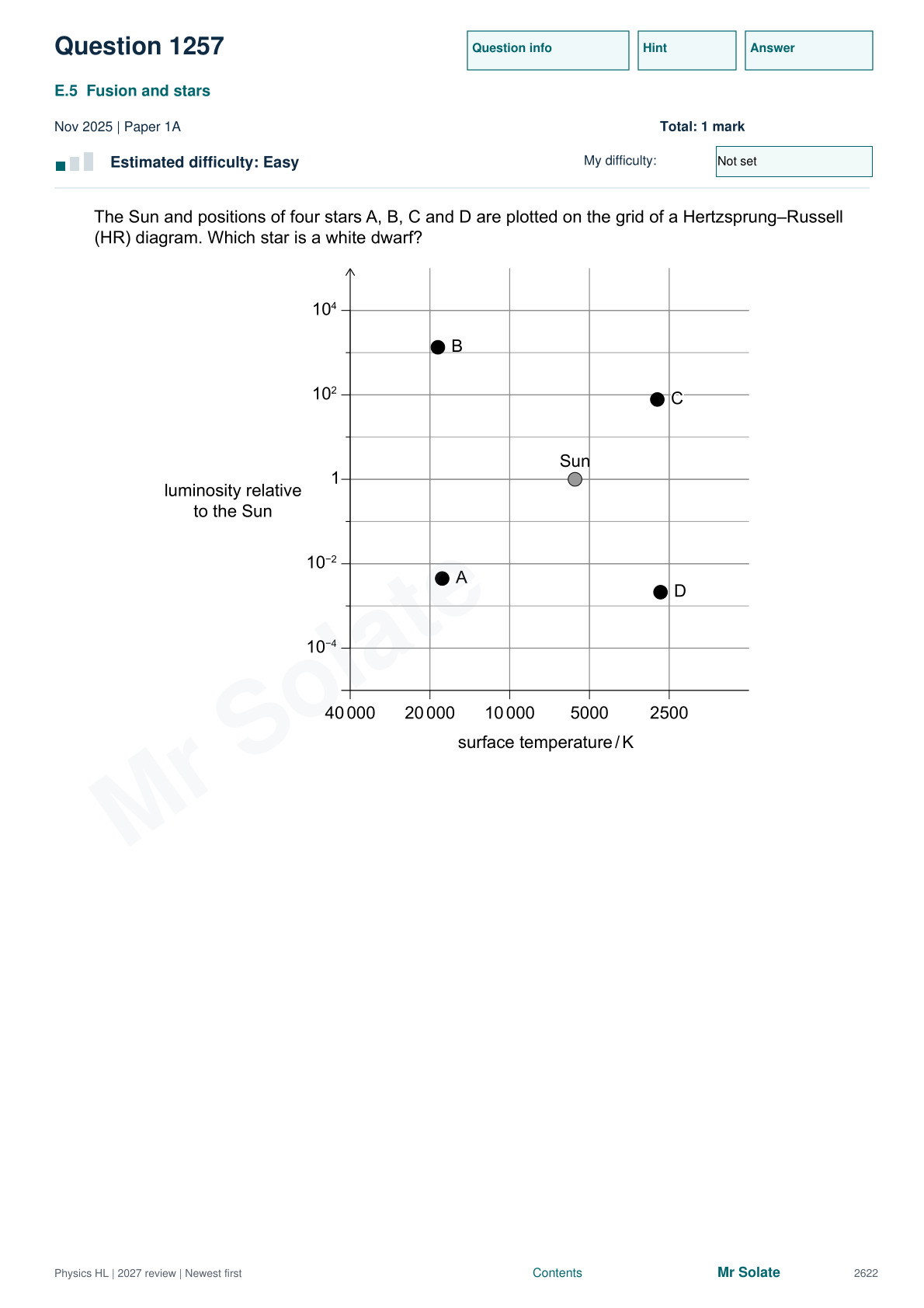
- A hot but faint star has a small emitting area and can be a white dwarf. A cool but luminous star needs a large radius. Use L ∝ R²T⁴ to support the classification rather than relying only on a memorised name.
- Explain evolution in terms of the balance between inward gravity and outward pressure support, fuel changes and initial mass. Apply the mass-dependent fate indicated by the course or supplied model.
At high temperature but low luminosity, L = 4πR²σT⁴ requires a small radius, consistent with a white dwarf.
An evolution track is not a star travelling physically across space; it represents changing stellar properties.
Calculate fusion yield and interpret stellar lifetimes
Recognise it: Fusion masses, fuel supply, core conditions or lifetime scaling is given.
- Balance the nuclear reaction and calculate rest-mass decrease or total binding-energy increase. Compare energy per unit fuel mass when judging fuels, not just energy per reaction.
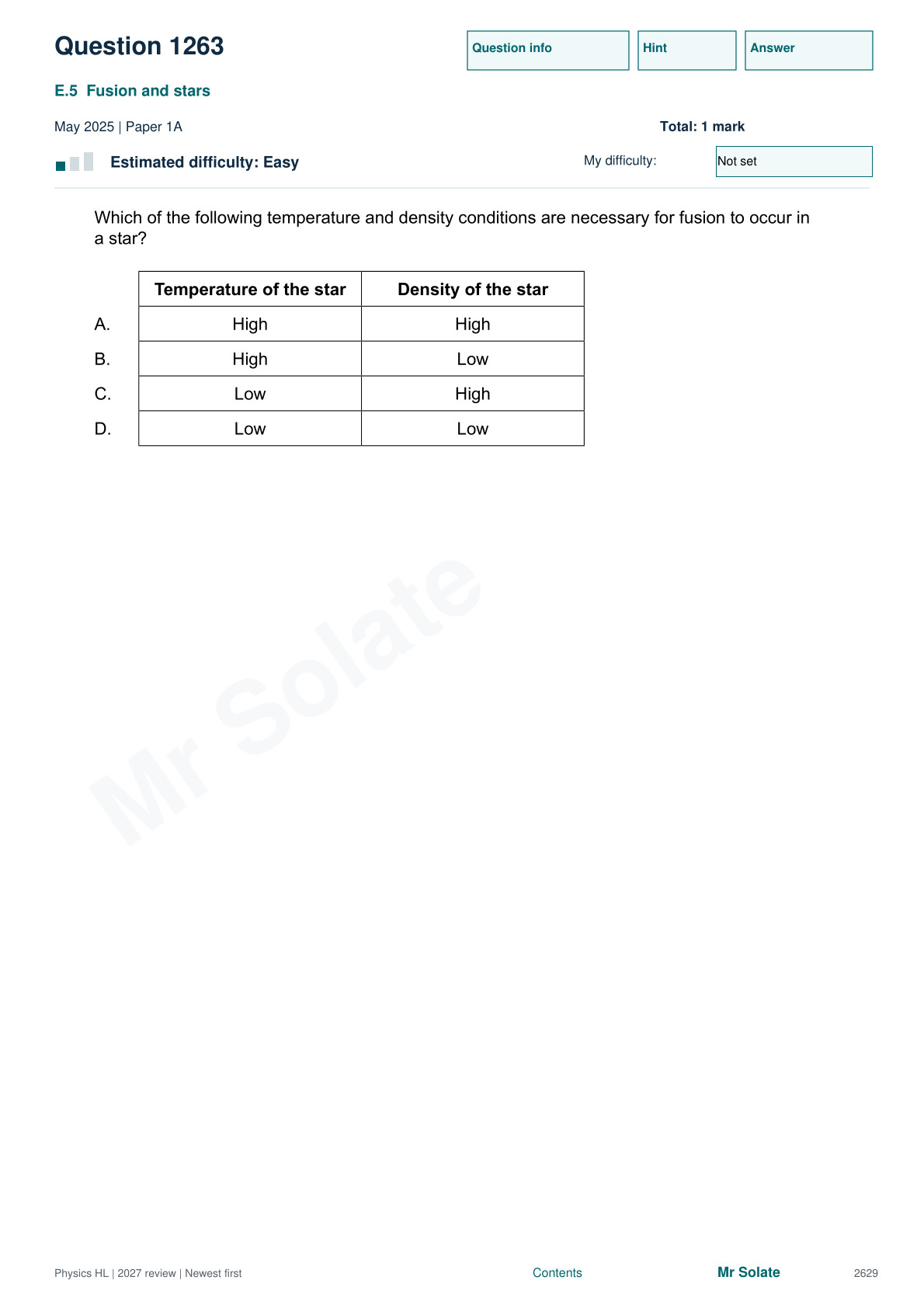
- High core temperature gives particles sufficient kinetic energy for close approaches, with quantum tunnelling relevant to actual fusion; high density increases encounter rate. State the physical role of each condition.
- For a lifetime estimate, divide usable fuel energy by luminosity. If a mass–luminosity relation is supplied, combine it with fuel mass scaling; a more massive star can have a shorter lifetime despite more fuel.
Estimated lifetime is available fusion energy divided by luminosity, so a strongly increased luminosity can outweigh the larger fuel supply.
Do not assume every kilogram of a star is usable fuel or that all rest mass is converted into released energy.
Write it before you reveal it
A worked exam-style example
Original teaching example, created for this lesson.
A star has parallax 0.050 arcsec. Its luminosity is four times the Sun’s and its temperature equals the Sun’s. Find its distance in parsecs and radius relative to the Sun.
Reveal the worked solution
- Distance d = 1/p = 1/0.050 = 20 pc.
- At equal temperature, luminosity ratio equals radius ratio squared: L/L☉ = (R/R☉)².
- Thus R/R☉ = √4 = 2. Parallax determines distance independently of this radius comparison.
Answer: Distance 20 pc; radius 2R☉.
Check: Doubling radius gives four times the radiating area at unchanged temperature, reproducing the luminosity ratio.
From your own collection
Apply it to past-paper questions
These questions anchor the patterns above. Attempt one without the answer, then compare your setup and conclusion with the reasoning. The linked reader contains the source answer and the question-specific syllabus review.
Question 1256
Distinguishes six-month angular shift from parallax.
Compatibility: Current syllabus: Distinguishes six-month angular shift from parallax.
View the original question
Original page images preserve the equations and diagrams. Write your response before revealing the reasoning.
Reveal the revision reasoning
The full angle φ uses Earth's orbit diameter, so p=φ/2. Thus d=1/p=2/φ parsec.
Editorial revision reasoning. Check the original answer for its marking detail.
Question 1257
Identifies a white dwarf by high temperature and low luminosity.
Compatibility: Current syllabus: Identifies a white dwarf by high temperature and low luminosity.
View the original question
Original page images preserve the equations and diagrams. Write your response before revealing the reasoning.
Reveal the revision reasoning
White dwarfs are hot but faint. Point A lies in the lower-left region, unlike the hot luminous giant at B or cool objects at C and D.
Editorial revision reasoning. Check the original answer for its marking detail.
Question 1263
Identifies the core conditions favouring fusion.
Compatibility: Current syllabus: Identifies the core conditions favouring fusion.
View the original question
Original page images preserve the equations and diagrams. Write your response before revealing the reasoning.
Reveal the revision reasoning
High temperature supplies large kinetic energies and high density increases collision frequency. Both conditions favour fusion.
Editorial revision reasoning. Check the original answer for its marking detail.
All 67 questions in this topic
Close your notes first
Can you retrieve the method?
1. How does parallax change when distance doubles?
Check answer 1
It halves.
2. Why can a hot star have low luminosity?
Check answer 2
Its emitting area and radius can be very small.
3. Why can a massive star live less long?
Check answer 3
Its luminosity can rise faster than its available fuel supply.
Before you move on
- Label observed brightness and intrinsic luminosity with different symbols.
- Check the HR temperature-axis direction before identifying a region.
Your revision note
Record one missed cue, one corrected step and one question to retry. Saved only in this browser.