Start with the exam
What you need to be able to do
The forces and momentum collection frequently links several events: motion before impact, the collision itself, and motion afterwards. These need different equations. Newton’s second law describes the resultant force on a chosen object; conservation of momentum describes a system during an interval with negligible external impulse; mechanical energy conservation needs negligible dissipative transfer. State the object or system first. In force diagrams, draw forces exerted on that object only. Weight and normal contact force are not a Newton’s-third-law pair because they act on the same object.
Spend 3 minutes reading the overview and diagram, 7 minutes learning the question patterns, 5 minutes writing out the worked example, and 5 minutes on a bank question or recall check. Take longer when you need to; the full bank is here for later practice.
Recognise → set up → write
How the questions are set
Build a force balance for the correct object
Recognise it: Connected blocks, a slope, terminal speed, apparent weight or buoyancy appears.
- Draw weight, normal reaction, tension, friction, drag and buoyancy only when the interaction exists. Choose axes along and perpendicular to the motion or slope.
- Resolve forces before applying ΣF = ma. For a connected system, solve the combined motion first if useful, then isolate one block to calculate the contact force or tension. Internal forces cancel only for the combined system.
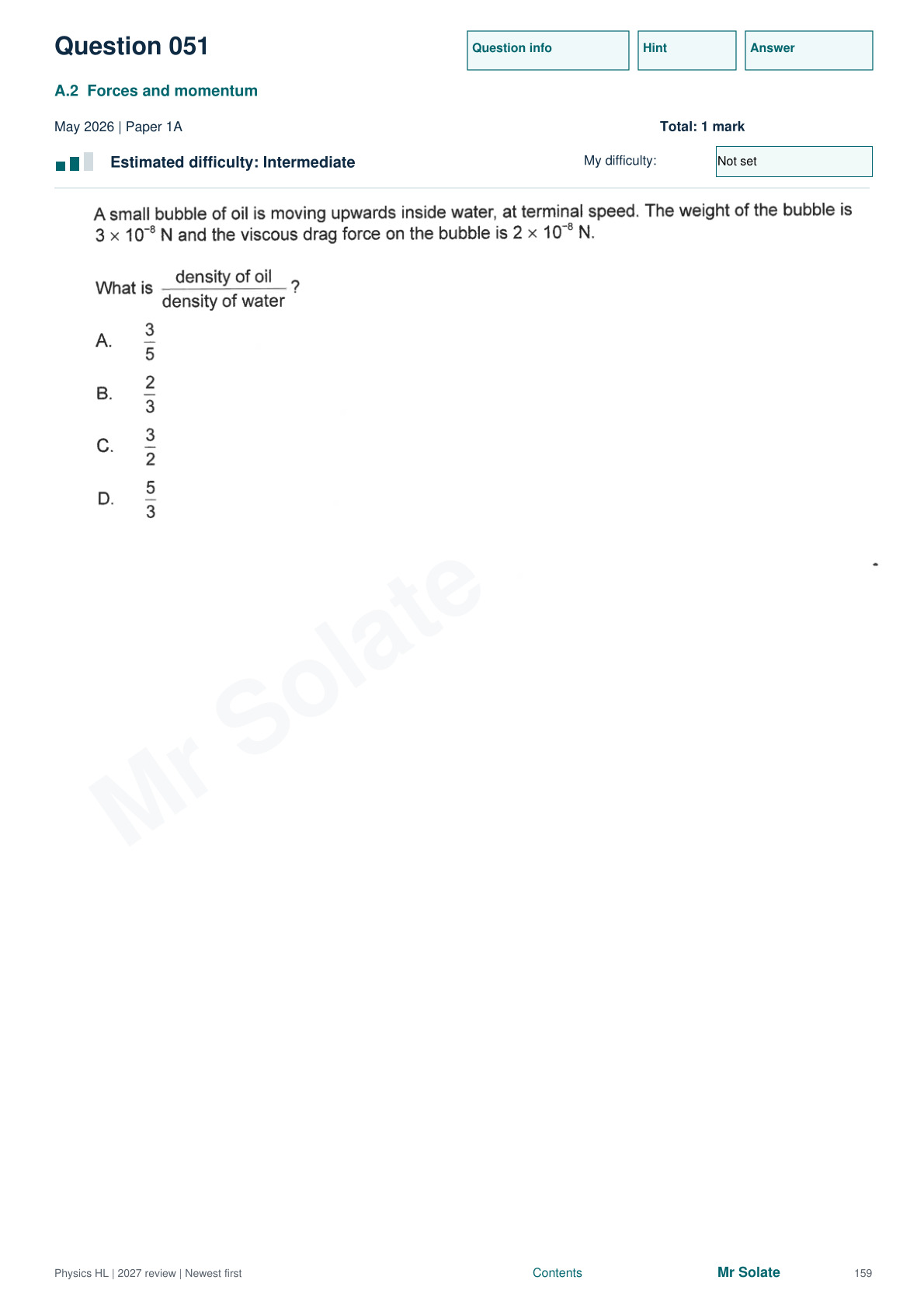
- At terminal speed, acceleration is zero but velocity is not. For a sinking sphere, weight = buoyancy + drag; omitting buoyancy overestimates drag and can bias an inferred viscosity.
At terminal speed the resultant force is zero, therefore mg − ρfluidVg − Fdrag = 0.
Constant speed implies zero resultant force only for straight-line motion; circular velocity changes direction.
Keep collision momentum separate from energy
Recognise it: Objects stick together, rebound, receive an impulse or acquire an extra load.
- Define the system and a positive direction. Write total initial momentum equal to total final momentum if the external impulse is negligible over the collision. Include negative velocities for rebounds.
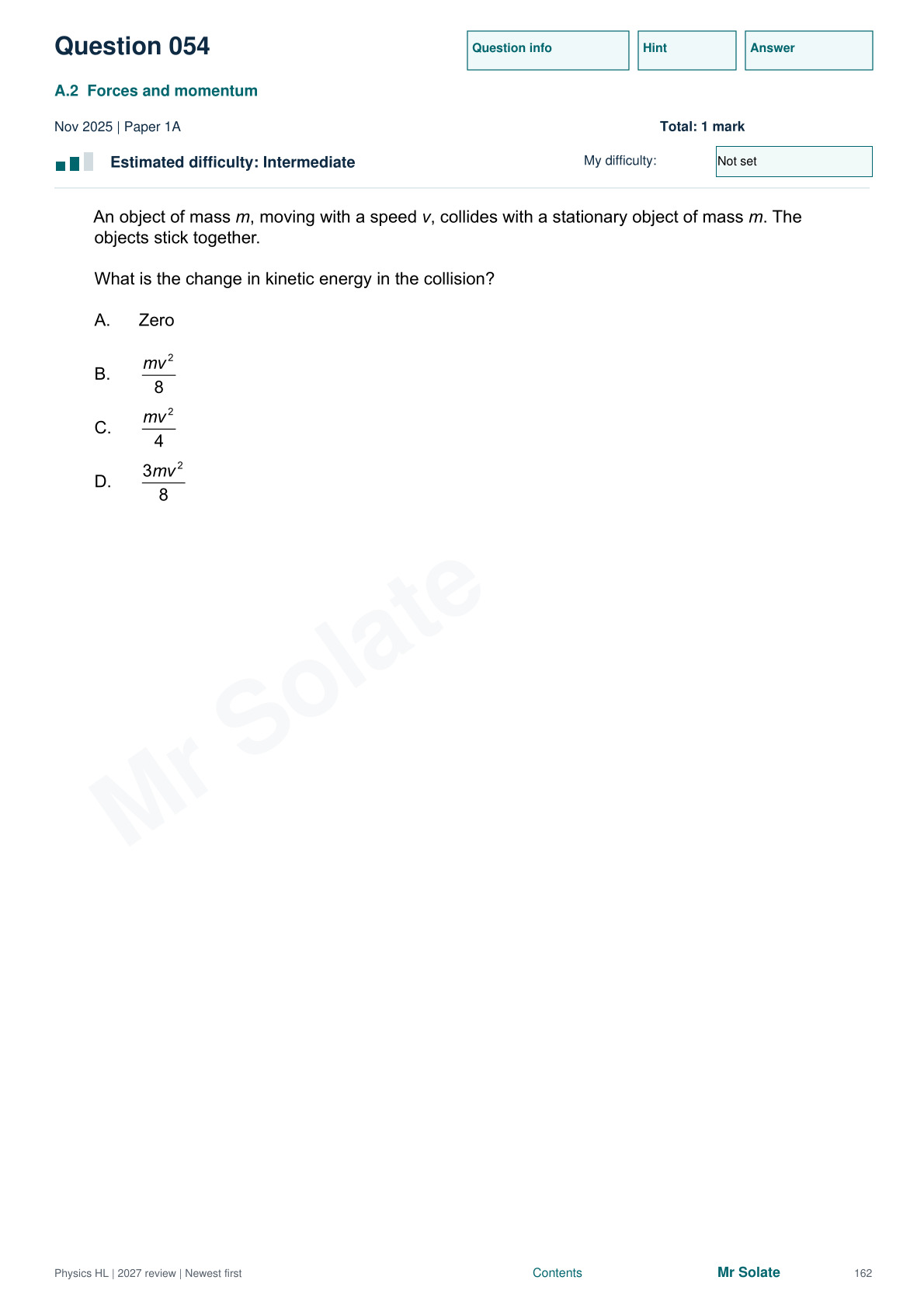
- For sticking objects, give both objects the same final velocity. Calculate initial and final kinetic energies separately if energy loss is requested. Momentum conservation does not imply an elastic collision.
- Use impulse = Δp or the signed area under a force–time graph. To find an average contact force, first identify whether the impulse result represents contact force or resultant force; weight may need adding.
External impulse is negligible during the collision, so m₁u₁ + m₂u₂ = (m₁ + m₂)v.
A rebound changes momentum by more than stopping from the same incoming speed because final momentum reverses sign.
Supply the required inward resultant
Recognise it: A loop, hill, rotating wall or banked road appears.
- Mark the centre and choose inward as the radial positive direction. Write the actual radial force components equal to mv²/r. “Centripetal force” is the name of the resultant, not an extra force.
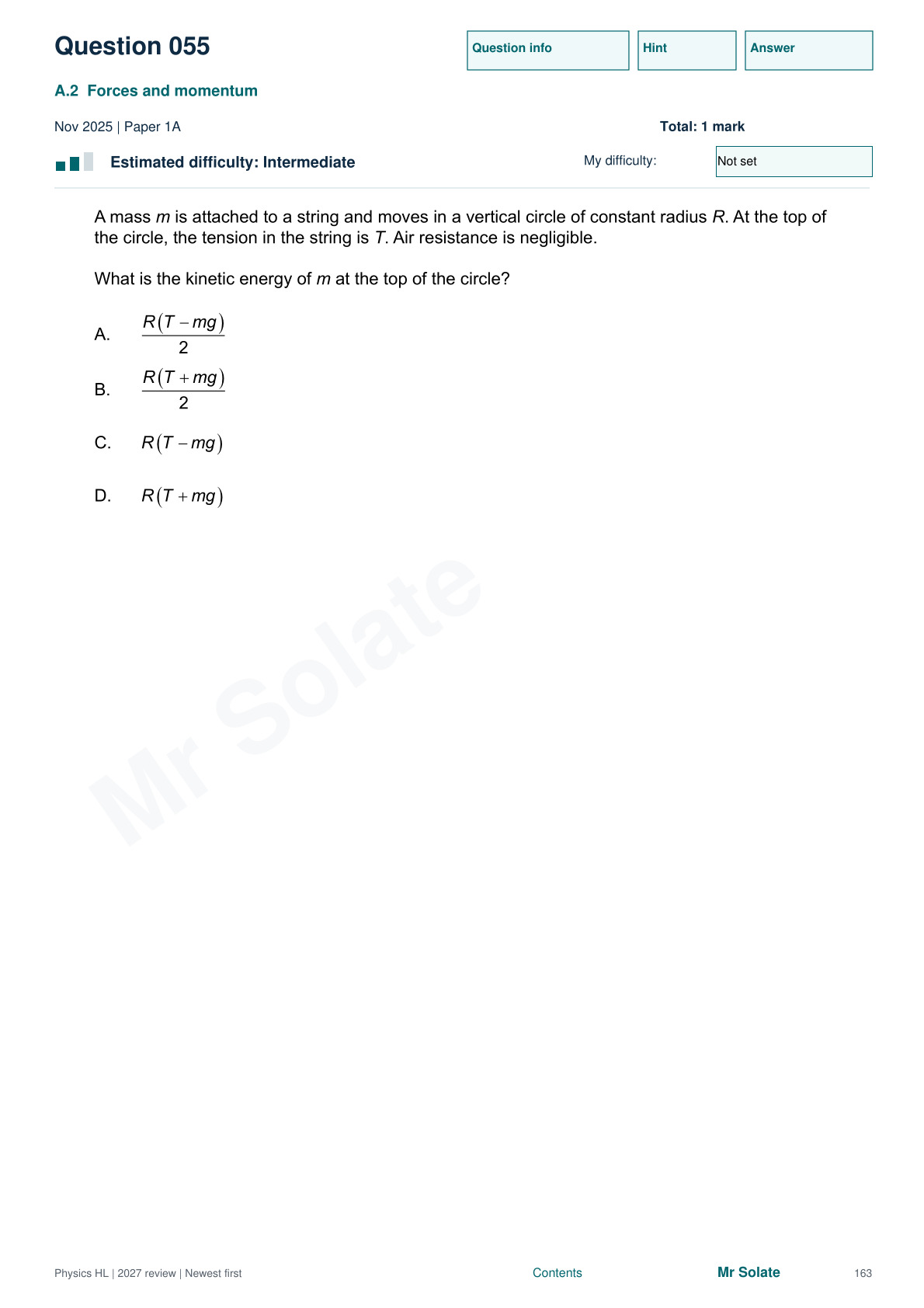
- At the bottom of a vertical loop, T − mg = mv²/r for a hanging object on a string. At the top, T + mg = mv²/r if both tension and weight point inward.
- Use energy to determine the speed at the relevant position before calculating the force. At the contact-loss limit, normal force is zero. Friction limits and contact conditions are additional constraints, not replacements for radial dynamics.
At the bottom, the upward tension exceeds the weight by the required inward resultant: T − mg = mv²/r.
Do not set tension equal to mv²/r when weight also has a radial component.
Write it before you reveal it
A worked exam-style example
Original teaching example, created for this lesson.
A 0.40 kg cart moving at 3.0 m s⁻¹ sticks to a stationary 0.20 kg cart on a horizontal track. Find their final speed and the kinetic energy lost.
Reveal the worked solution
- Treat both carts as one system and neglect external horizontal impulse during impact. Initial momentum is 0.40 × 3.0 = 1.20 kg m s⁻¹.
- The combined mass is 0.60 kg, so v = 1.20/0.60 = 2.0 m s⁻¹ in the original direction.
- Initial kinetic energy is ½ × 0.40 × 3.0² = 1.80 J. Final kinetic energy is ½ × 0.60 × 2.0² = 1.20 J.
Answer: Final speed 2.0 m s⁻¹; kinetic energy lost 0.60 J.
Check: Momentum remains 1.20 kg m s⁻¹. The positive energy loss is consistent with an inelastic collision.
From your own collection
Apply it to past-paper questions
These questions anchor the patterns above. Attempt one without the answer, then compare your setup and conclusion with the reasoning. The linked reader contains the source answer and the question-specific syllabus review.
Question 51
Combines buoyancy with terminal-speed force balance.
Compatibility: Current syllabus: Combines buoyancy with terminal-speed force balance.
View the original question
Original page images preserve the equations and diagrams. Write your response before revealing the reasoning.
Reveal the revision reasoning
Buoyancy equals five force units; weight is three. Since the volumes are equal, oil density divided by water density is 3/5.
Editorial revision reasoning. Check the original answer for its marking detail.
Question 54
Combines momentum conservation with kinetic-energy loss.
Compatibility: Current syllabus: Combines momentum conservation with kinetic-energy loss.
View the original question
Original page images preserve the equations and diagrams. Write your response before revealing the reasoning.
Reveal the revision reasoning
Equal masses stick together, so the common speed is v/2. Initial kinetic energy is mv²/2 and final energy is mv²/4; the decrease is mv²/4.
Editorial revision reasoning. Check the original answer for its marking detail.
Question 55
Combines radial forces at the top with kinetic energy.
Compatibility: Current syllabus: Combines radial forces at the top with kinetic energy.
View the original question
Original page images preserve the equations and diagrams. Write your response before revealing the reasoning.
Reveal the revision reasoning
T+mg=mv²/R. Hence kinetic energy mv²/2=R(T+mg)/2; weight must not be subtracted at the top.
Editorial revision reasoning. Check the original answer for its marking detail.
All 91 questions in this topic
Close your notes first
Can you retrieve the method?
1. Can a moving object have zero resultant force?
Check answer 1
Yes: straight-line motion at constant velocity has zero acceleration.
2. Why is centripetal force absent as an extra arrow?
Check answer 2
It is the inward resultant of existing interactions.
3. Which conservation law survives an inelastic isolated collision?
Check answer 3
Total momentum; kinetic energy generally decreases.
Before you move on
- Separate a multi-stage problem into pre-impact, impact and post-impact intervals.
- Check that every force arrow has an identifiable object exerting it.
Your revision note
Record one missed cue, one corrected step and one question to retry. Saved only in this browser.