Start with the exam
What you need to be able to do
Atomic-structure questions ask what observations justify a model and how energy levels connect to measurable spectra. Most alpha particles passing through foil suggests the atom is mostly empty space; rare large deflections point to a small region containing concentrated positive charge and most atomic mass. A photon transition depends on the energy difference between levels, not the height of one level or how far apart lines look in a schematic drawing. Use the numerical level labels. For an explanation, use an observation–inference pair in each sentence. Avoid naming a model and assuming its consequences are obvious. In a numerical answer, identify whether the requested energy is a photon energy, ionisation energy or kinetic energy; those quantities can involve different reference states.
Spend 3 minutes reading the overview and diagram, 7 minutes learning the question patterns, 5 minutes writing out the worked example, and 5 minutes on a bank question or recall check. Take longer when you need to; the full bank is here for later practice.
Recognise → set up → write
How the questions are set
Link scattering evidence to nuclear structure
Recognise it: Alpha scattering, closest approach or departures from the Rutherford model appear.
- Pair each observation with its inference. Mostly undeflected particles indicate a very small obstructing region; rare large-angle scattering requires concentrated charge capable of a strong repulsive interaction.
- For head-on closest approach in a Coulomb-only model, set initial kinetic energy equal to the increase in electric potential energy. At the turning point the radial speed is zero.
- If inferred closest approach becomes comparable to nuclear size, a point-charge Coulomb-only model can fail. Explain the scale comparison rather than assuming every high-energy deviation has the same cause.
The rare large deflections show that positive charge is concentrated in a small nucleus, rather than spread throughout the atom.
“Atoms contain electrons” does not explain why massive alpha particles sometimes reverse direction.
Choose a transition from an energy-level diagram
Recognise it: Emission, absorption, wavelength, ionisation or the number of spectral lines is requested.
- For emission, draw a downward transition and calculate ΔE = Einitial − Efinal as a positive photon energy. For absorption, select an upward gap matching the incoming photon energy.
- Use Eγ = hf = hc/λ. The smallest positive gap gives the longest wavelength. Convert electronvolts to joules when using SI constants, or use a consistent eV–nm conversion.
- For an atom initially excited to a high level, several downward pathways may be possible. Count distinct pairs only when the question permits all relevant transitions, and distinguish excitation from complete ionisation.
The emitted photon has energy equal to the difference between the two levels, so λ = hc/ΔE.
A more negative level has lower energy; subtracting signed values requires care.
Apply nuclear size and simple atomic-model scaling
Recognise it: Nuclear radius, nucleon number, density or a one-electron atomic model is supplied.
- For nuclear size, use R = R₀A¹ᐟ³, so volume scales with nucleon number A. Nuclear mass also approximately scales with A, explaining approximately constant nuclear density.
- To compare radii, take a cube root; to infer a nucleon-number ratio from radii, cube the ratio. Keep nucleon number distinct from proton number and electron count.
- When a Bohr-type relation is used, respect its one-electron-model conditions. Derive from the supplied quantisation and Coulomb equations rather than applying a hydrogen formula unchanged to any neutral atom.
Because nuclear mass and volume both scale approximately with A, their ratio and hence nuclear density are approximately constant.
Doubling nucleon number does not double nuclear radius.
Write it before you reveal it
A worked exam-style example
Original teaching example, created for this lesson.
An atom emits a photon when an electron moves from −2.0 eV to −5.1 eV. Find photon energy and wavelength using hc ≈ 1240 eV nm.
Reveal the worked solution
- Energy released is (−2.0) − (−5.1) = 3.1 eV.
- Use λ = hc/E = 1240/3.1 = 400 nm.
- The energy is positive because the atom moves to a lower energy state. The inverse transition would require absorption of a 3.1 eV photon.
Answer: Photon energy 3.1 eV; wavelength 400 nm.
Check: A smaller gap would produce a longer wavelength, consistent with E ∝ 1/λ.
From your own collection
Apply it to past-paper questions
These questions anchor the patterns above. Attempt one without the answer, then compare your setup and conclusion with the reasoning. The linked reader contains the source answer and the question-specific syllabus review.
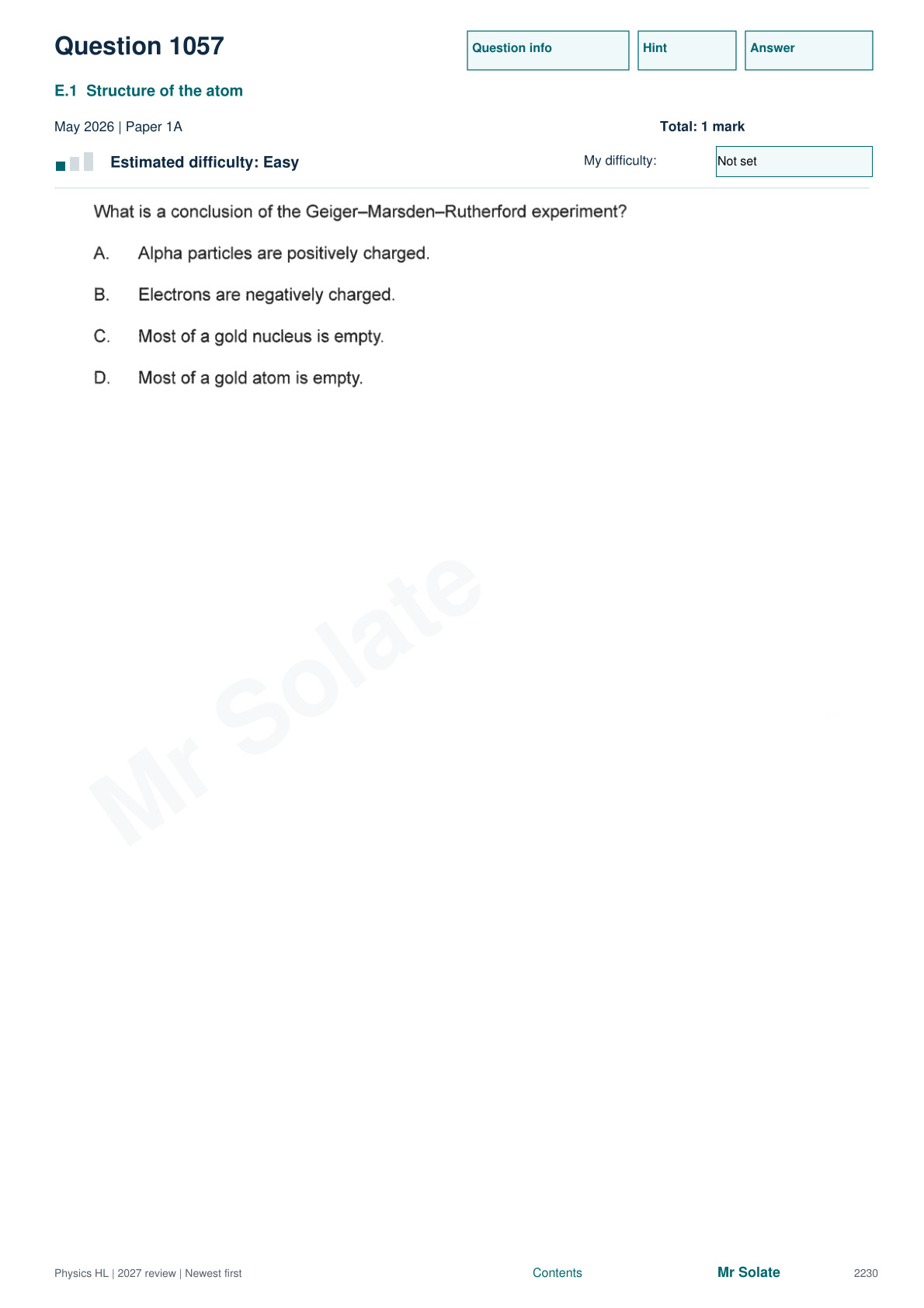
Question 1057
Interprets mostly undeflected alpha particles.
Compatibility: Current syllabus: Interprets mostly undeflected alpha particles.
View the original question
Original page images preserve the equations and diagrams. Write your response before revealing the reasoning.
Reveal the revision reasoning
Most alpha particles pass through with little deflection, showing that most of the atom is empty space. Rare large deflections reveal the tiny nucleus.
Editorial revision reasoning. Check the original answer for its marking detail.
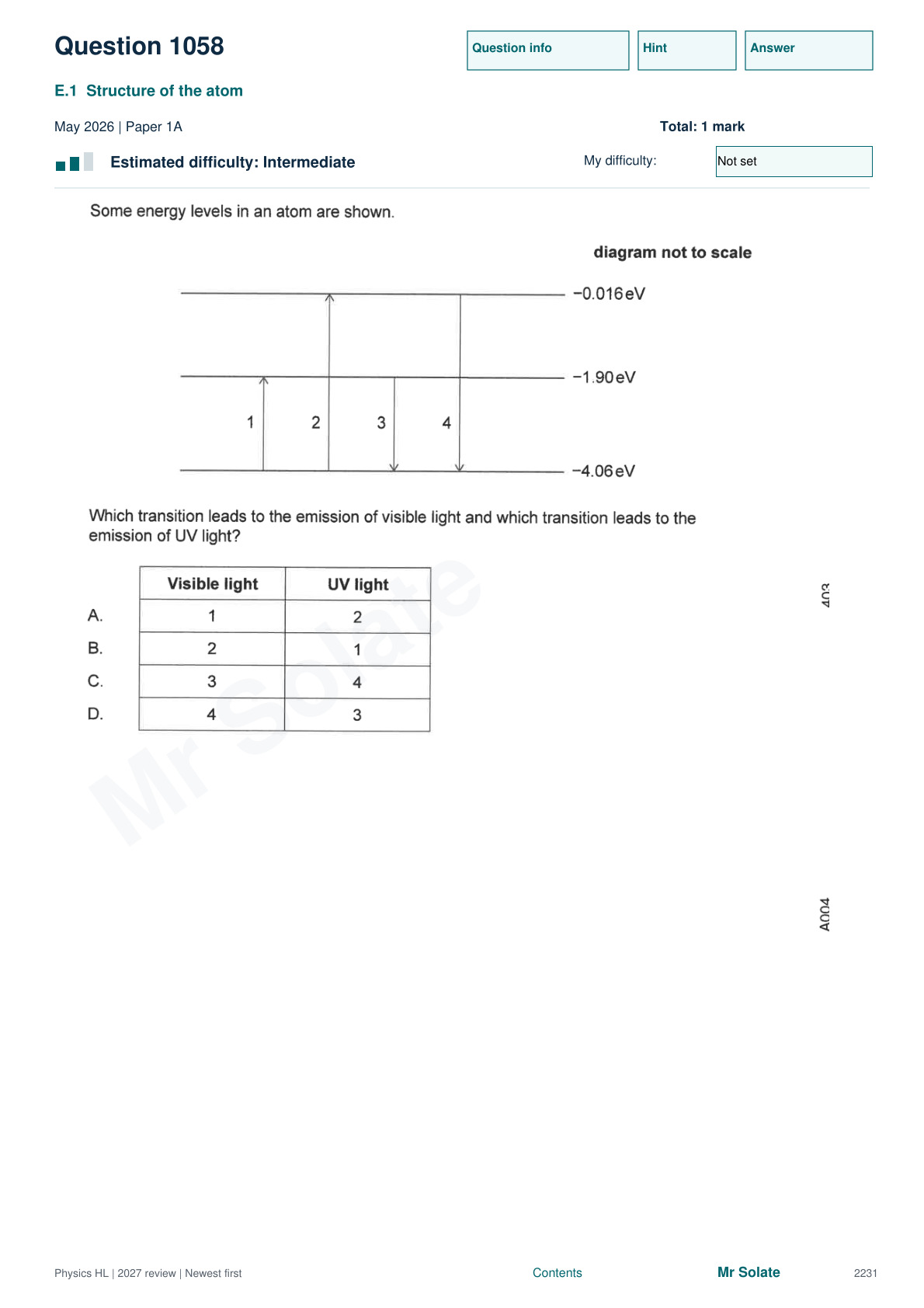
Question 1058
Identifies emission transitions and compares photon energies.
Compatibility: Current syllabus: Identifies emission transitions and compares photon energies.
View the original question
Original page images preserve the equations and diagrams. Write your response before revealing the reasoning.
Reveal the revision reasoning
Transition 3 releases 2.16 eV, while 4 releases about 4.04 eV. These correspond to visible and ultraviolet photons respectively.
Editorial revision reasoning. Check the original answer for its marking detail.
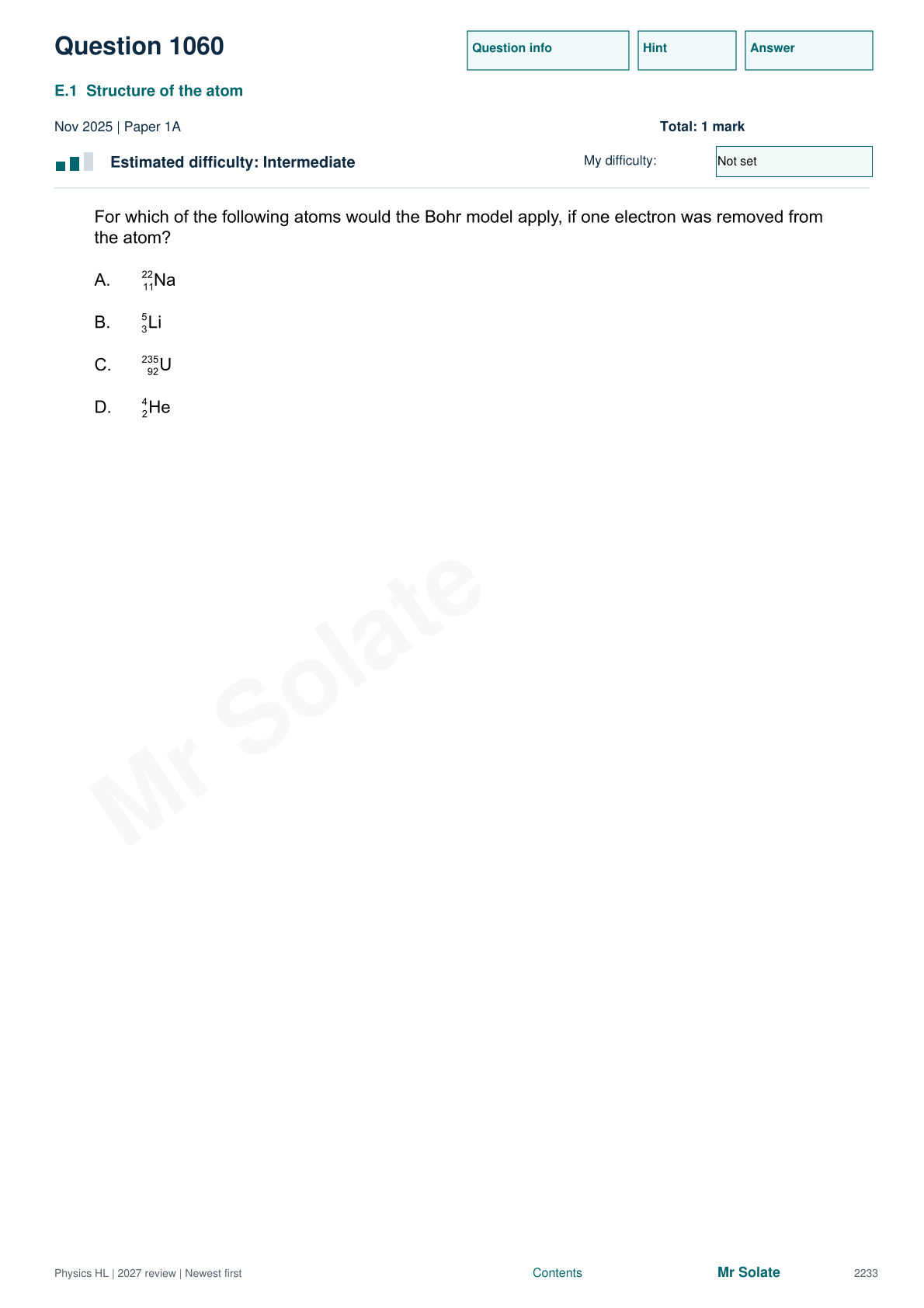
Question 1060
Identifies the one-electron condition underlying a Bohr-type atom.
Compatibility: Current syllabus: Identifies the one-electron condition underlying a Bohr-type atom.
View the original question
Original page images preserve the equations and diagrams. Write your response before revealing the reasoning.
Reveal the revision reasoning
Neutral helium has two electrons, so He⁺ has one. The listed other atoms remain many-electron systems after one electron is removed.
Editorial revision reasoning. Check the original answer for its marking detail.
All 56 questions in this topic
Close your notes first
Can you retrieve the method?
1. What observation supports a small concentrated nucleus?
Check answer 1
Rare large-angle alpha-particle deflections.
2. Which transition produces the longest wavelength?
Check answer 2
The allowed transition with the smallest positive energy gap.
3. How does nuclear radius change if A increases eightfold?
Check answer 3
It doubles because R ∝ A¹ᐟ³.
Before you move on
- Write signed level energies before calculating a positive photon energy.
- Connect each model conclusion to a specific experimental observation.
Your revision note
Record one missed cue, one corrected step and one question to retry. Saved only in this browser.