Start with the exam
What you need to be able to do
Relativity questions are primarily about identifying events and frames. A time interval is proper time only when its two defining events occur at the same position in that frame. A proper length is measured in the object’s rest frame; another frame’s length measurement requires simultaneous endpoint positions in that frame. The bank also contains historical extensions, so follow each question’s compatibility note. Learn the current event-and-frame reasoning first, and treat supplied extra relations as models to apply rather than evidence that every historical subpart is required.
Spend 3 minutes reading the overview and diagram, 7 minutes learning the question patterns, 5 minutes writing out the worked example, and 5 minutes on a bank question or recall check. Take longer when you need to; the full bank is here for later practice.
Recognise → set up → write
How the questions are set
Identify proper time and proper length
Recognise it: A travelling clock, particle lifetime, spacecraft or contracted distance is given.
- Name the two events—for example, particle creation and decay—and identify the frame where they occur at one location. That frame measures proper time Δτ. Compute γ = 1/√(1 − v²/c²).
- Use Δt = γΔτ for a moving clock’s interval in the observer frame, and L = L₀/γ for a moving object’s length. Keep the speed associated with the correct pair of frames.
- For particle survival, use the lab flight time with the dilated lifetime, or the contracted distance with the rest lifetime. Both methods must predict the same survival fraction.
Creation and decay occur at the particle’s position in its rest frame, so its rest lifetime is the proper time.
A journey between spatially separated events in a frame cannot automatically be treated as that frame’s proper-time interval.
Transform events instead of guessing simultaneity
Recognise it: Spacetime coordinates, tilted axes or events at different places are supplied.
- Write both event coordinates and form Δx and Δt. Apply the Lorentz transformation with the stated relative velocity and consistent signs: Δt′ = γ(Δt − vΔx/c²).
- On a ct–x diagram, light worldlines have slopes ±1 when the axes have equal physical scales. A stationary object has a vertical worldline; a moving object’s slope gives c/v.
- Simultaneous events lie on a line parallel to the appropriate frame’s space axis. Do not read oblique-axis distances with a Euclidean ruler unless the spacetime calibration is provided.
Because Δx is nonzero, the transformed interval includes the relativity-of-simultaneity term −γvΔx/c².
Time dilation alone misses the position term for two events separated in space in the original frame.
Add velocities with a defined sign convention
Recognise it: Two moving spacecraft, a moving source or opposite velocities are compared.
- State which frame measures each velocity. For a frame moving at v along +x, transform an object’s velocity using u′ = (u − v)/(1 − uv/c²).
- Insert negative signs for motion along −x. Do not confuse the rate at which a separation closes in one frame with the velocity measured in the rest frame of one object.
- Check the low-speed limit: when uv/c² is negligible, the result approaches Galilean subtraction. If u = c, the transformed result is c, reflecting invariant light speed.
Using signed velocities in the Earth frame, u′ = (u − v)/(1 − uv/c²).
Adding two large speeds arithmetically does not give their relative speed in special relativity.
Write it before you reveal it
A worked exam-style example
Original teaching example, created for this lesson.
A spacecraft travels at 0.60c relative to Earth. Its onboard clock records 4.0 years between departure and arrival. Find Earth-frame elapsed time and the Earth-frame travel distance, neglecting acceleration intervals.
Reveal the worked solution
- Departure and arrival occur at the spacecraft clock, so 4.0 years is proper time.
- γ = 1/√(1 − 0.60²) = 1.25, giving Earth time 1.25 × 4.0 = 5.0 years.
- Earth-frame distance = 0.60c × 5.0 years = 3.0 light-years. The moving separation in the spacecraft frame is 3.0/1.25 = 2.4 light-years.
Answer: Earth time 5.0 years; Earth-frame distance 3.0 light-years.
Check: In the spacecraft frame, 2.4 light-years/0.60c = 4.0 years, agreeing with the onboard clock.
From your own collection
Apply it to past-paper questions
These questions anchor the patterns above. Attempt one without the answer, then compare your setup and conclusion with the reasoning. The linked reader contains the source answer and the question-specific syllabus review.
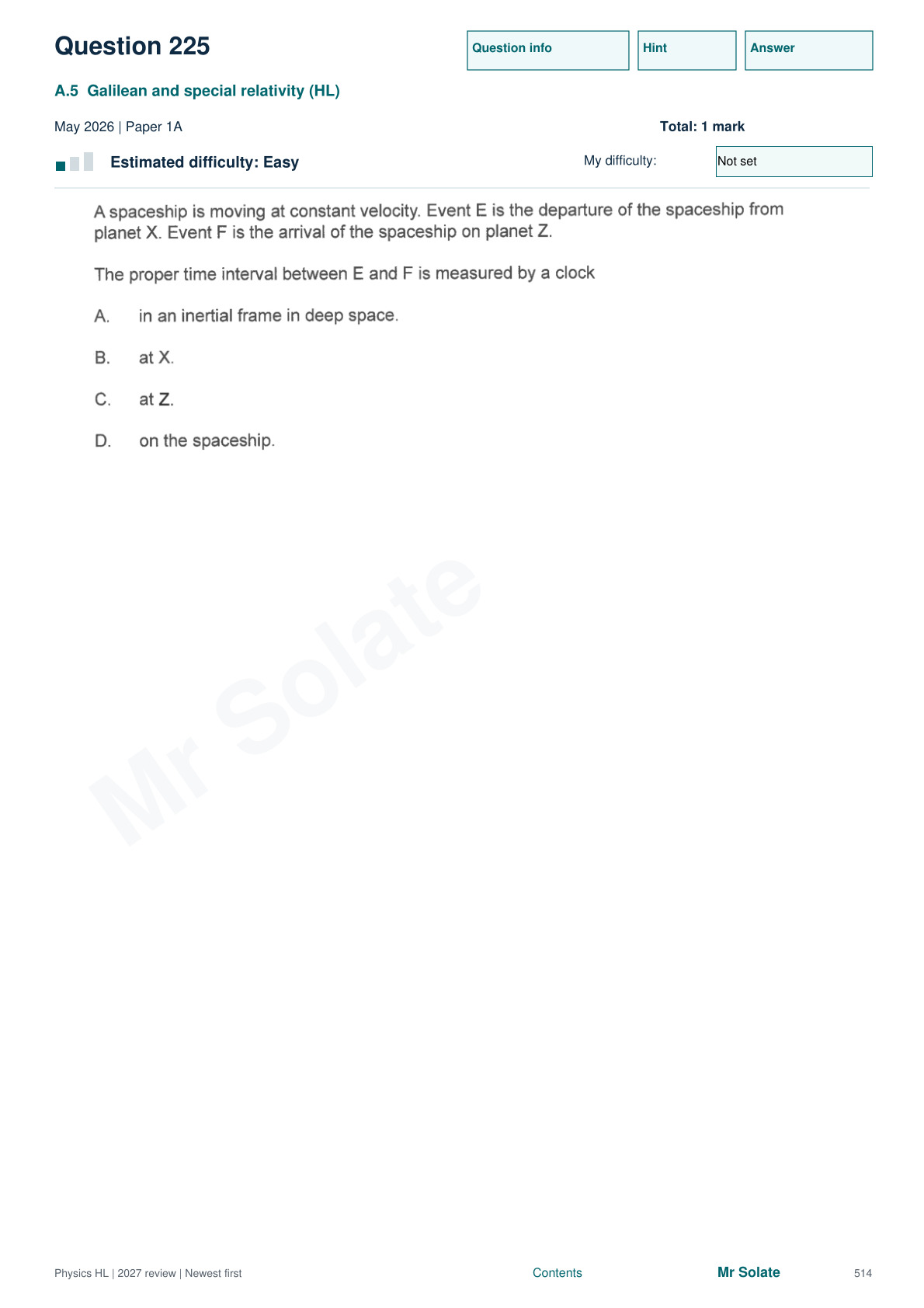
Question 225
Identifies the frame containing both events at one position.
Compatibility: Current syllabus: Identifies the frame containing both events at one position.
View the original question
Original page images preserve the equations and diagrams. Write your response before revealing the reasoning.
Reveal the revision reasoning
The spaceship clock is at both events. In its frame they occur at the same spatial position, so it measures proper time.
Editorial revision reasoning. Check the original answer for its marking detail.
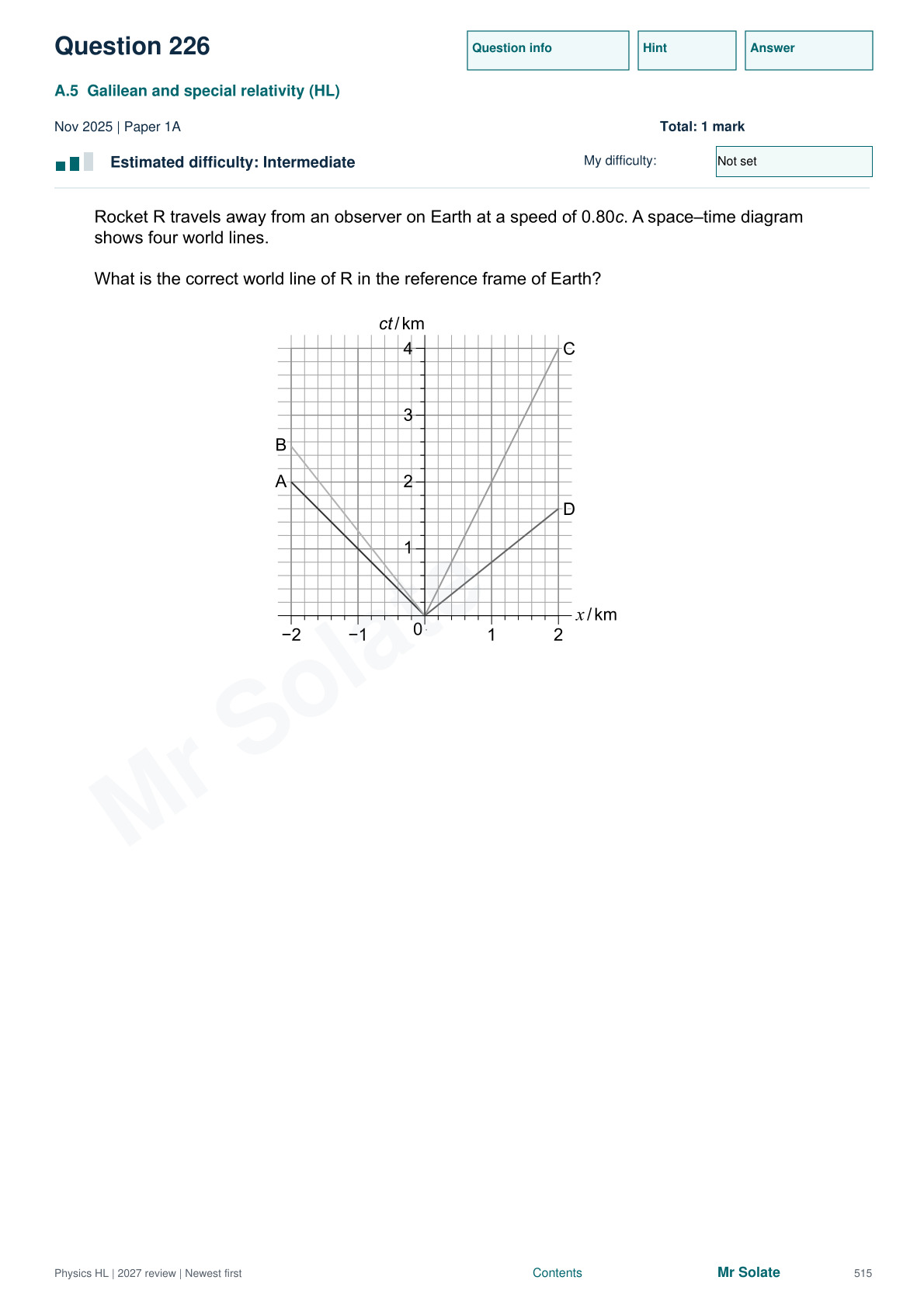
Question 226
Reads velocity from a spacetime world line with ct vertical.
Compatibility: Current syllabus: Reads velocity from a spacetime world line with ct vertical.
View the original question
Original page images preserve the equations and diagrams. Write your response before revealing the reasoning.
Reveal the revision reasoning
For 0.80c, the magnitude of ct/x is 1.25. Line B has this slope, corresponding to motion in the negative x direction away from the observer. A light-speed or shallower line cannot represent the stated speed.
Editorial revision reasoning. Check the original answer for its marking detail.
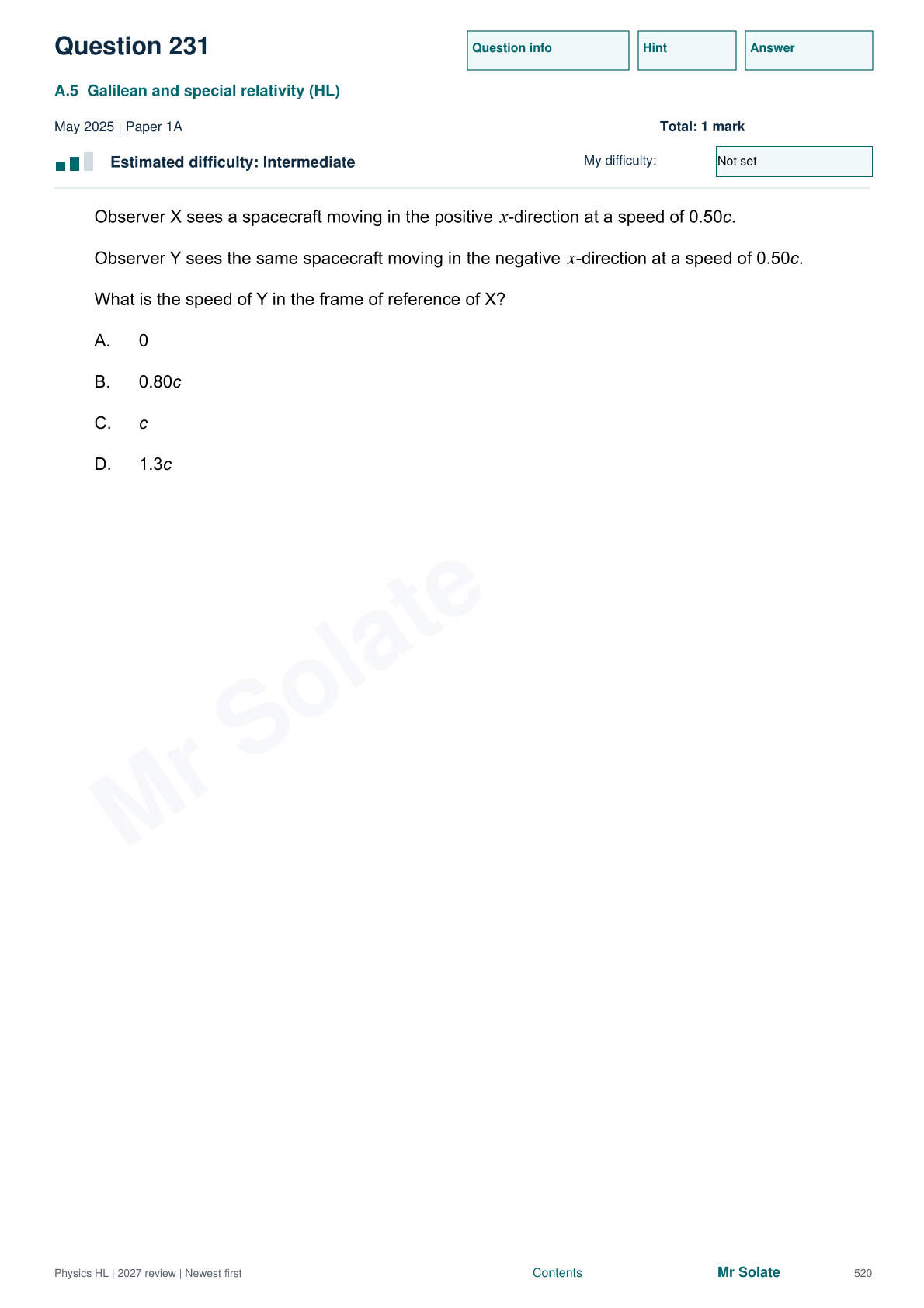
Question 231
Solves relativistic velocity transformation with opposite observed velocities.
Compatibility: Current syllabus: Solves relativistic velocity transformation with opposite observed velocities.
View the original question
Original page images preserve the equations and diagrams. Write your response before revealing the reasoning.
Reveal the revision reasoning
Use−0.5c=(0.5c−v)/(1−0.5v/c). Rearranging gives v=0.8c for Y relative to X.
Editorial revision reasoning. Check the original answer for its marking detail.
All 77 questions in this topic
Close your notes first
Can you retrieve the method?
1. What identifies proper time?
Check answer 1
Both defining events occur at one spatial position in that frame.
2. Can observers disagree about simultaneity at separated positions?
Check answer 2
Yes; the Lorentz time transformation contains a position-dependent term.
3. What happens when you transform light speed?
Check answer 3
It remains c in every inertial frame.
Before you move on
- Make a two-column event table before a transformation calculation.
- Separate a signal’s emission event from its later reception event.
Your revision note
Record one missed cue, one corrected step and one question to retry. Saved only in this browser.