Start with the exam
What you need to be able to do
Fission questions in this collection concentrate on chain-reaction control, neutron moderation and energy per reaction. The moderator and control rods have different jobs. A moderator slows neutrons through collisions; control rods absorb neutrons to adjust how many remain available to cause further fissions. The incident neutron belongs in nuclear bookkeeping. When calculating electrical output, separate energy released in nuclear reactions from the useful electrical fraction. In an extended response, follow the energy through the reactor: nuclear products transfer kinetic energy to material, thermal energy is carried away, and an energy-conversion system provides electrical output. The exam calculation normally idealises this chain with an efficiency. State where that efficiency enters your power balance.
Spend 3 minutes reading the overview and diagram, 7 minutes learning the question patterns, 5 minutes writing out the worked example, and 5 minutes on a bank question or recall check. Take longer when you need to; the full bank is here for later practice.
Recognise → set up → write
How the questions are set
Balance the reaction and identify the released energy
Recognise it: A fission equation, unknown fragment or binding-energy data is supplied.
- Add nucleon numbers and charges on the reactant side, including the absorbed neutron. Match both totals on the product side to identify the missing nucleus or neutron count.
- Calculate energy from total rest-mass loss or total binding-energy increase. If binding energy is given per nucleon, multiply by the nucleon number of each nucleus first.
- Convert MeV per reaction to joules before combining with a reaction rate in s⁻¹. Fission produces kinetic energy mainly in fragments and other products that then transfer energy to surrounding material.
The absorbed neutron adds one to the initial nucleon total but adds no charge; both totals must match the products.
Leaving out the incoming neutron changes the predicted number of outgoing neutrons.
Distinguish moderation from control
Recognise it: A reactor component or the role of light nuclei is asked.
- Explain moderation as kinetic-energy transfer from fast neutrons to moderator nuclei through collisions. Nuclei of comparable mass can take a large fraction of neutron kinetic energy per elastic collision.
- Explain control rods as neutron absorbers. Greater insertion removes more neutrons that might otherwise induce fission, reducing the multiplication of the chain reaction.
- Keep coolant separate: its role is carrying thermal energy away. One material can have multiple practical roles, but answer the specific physical function asked.
The moderator slows neutrons by collisions, whereas control rods absorb neutrons to regulate the chain reaction.
Saying a control rod “slows neutrons down” confuses its main purpose with moderation.
Connect a steady chain reaction to power and fuel
Recognise it: Steady reactor output, reaction rate, efficiency or fuel consumption is supplied.
- For steady operation, on average one neutron from each fission must go on to cause another fission. Other neutrons may be absorbed without fission or escape; emitted neutron count is not the same as successful next-generation count.
- Nuclear power is reaction rate times energy released per reaction. Electrical power is η times nuclear thermal power. Solve in the right order if the useful output is given.
- Convert the number of fissions into fuel mass using the number of nuclei per mole and the relevant isotope molar mass. State whether all supplied fuel is assumed available or consumed.
A steady chain reaction requires one successful subsequent fission per fission on average, even if several neutrons are emitted.
Using electrical power directly as nuclear power underestimates the reaction rate when efficiency is below 100%.
Write it before you reveal it
A worked exam-style example
Original teaching example, created for this lesson.
A model reactor releases 200 MeV per fission and produces 100 MW of electrical power at 40% efficiency. Estimate the fission rate. Use 1 eV = 1.60 × 10⁻¹⁹ J.
Reveal the worked solution
- Required thermal power is 100 × 10⁶/0.40 = 2.50 × 10⁸ W.
- Energy per fission is 200 × 10⁶ × 1.60 × 10⁻¹⁹ = 3.20 × 10⁻¹¹ J.
- Rate = thermal power/energy per fission = 2.50 × 10⁸/(3.20 × 10⁻¹¹) = 7.81 × 10¹⁸ s⁻¹.
Answer: Fission rate ≈ 7.8 × 10¹⁸ reactions s⁻¹.
Check: Multiplying this rate by reaction energy gives 250 MW thermal; 40% of that is the stated 100 MW electrical.
From your own collection
Apply it to past-paper questions
These questions anchor the patterns above. Attempt one without the answer, then compare your setup and conclusion with the reasoning. The linked reader contains the source answer and the question-specific syllabus review.
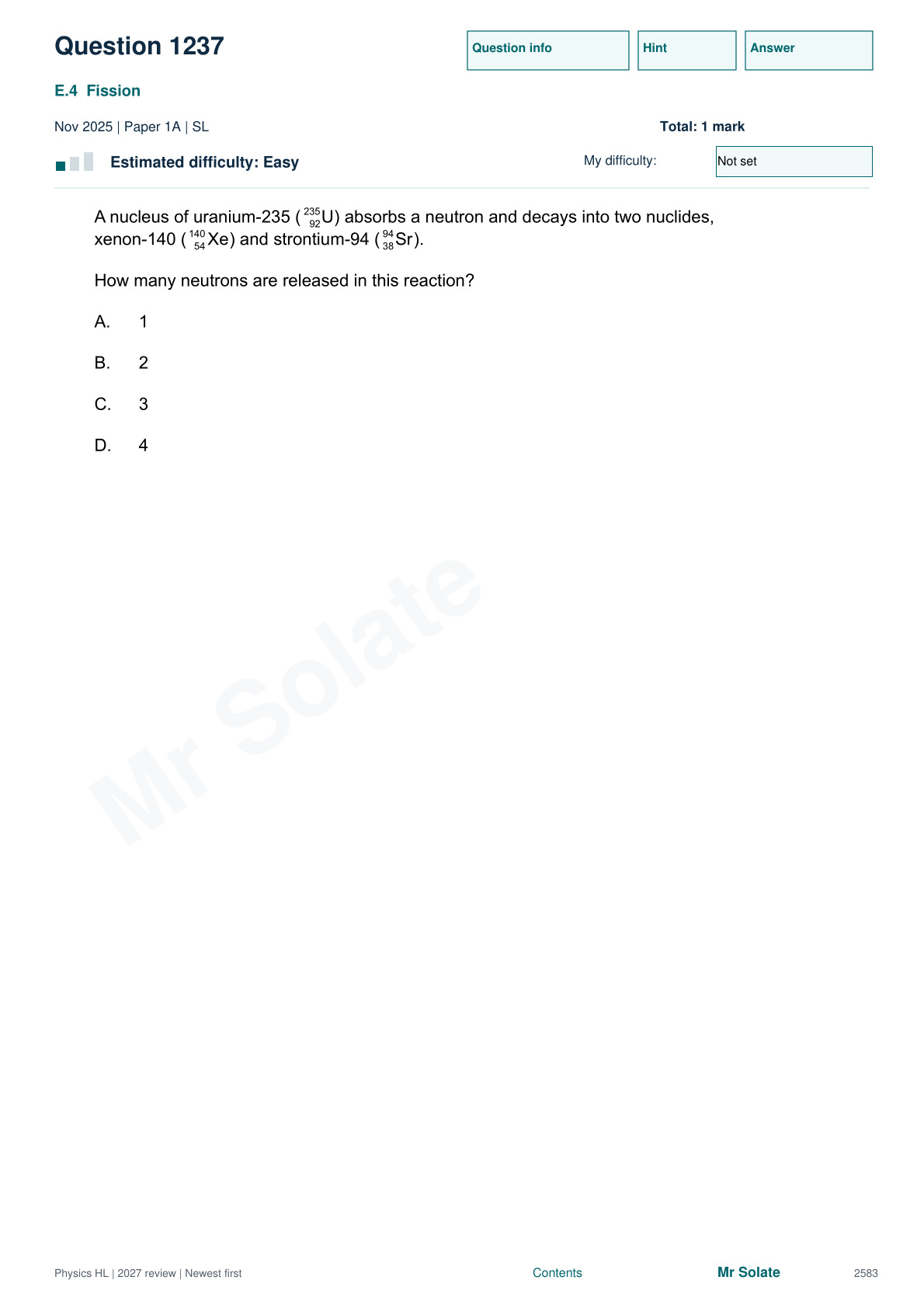
Question 1237
Includes the absorbed neutron in nucleon-number bookkeeping.
Compatibility: This is an SL source question testing concepts shared with the current Physics HL syllabus. Includes the absorbed neutron in nucleon-number bookkeeping.
View the original question
Original page images preserve the equations and diagrams. Write your response before revealing the reasoning.
Reveal the revision reasoning
The initial nucleon number is 235+1=236. The two nuclei account for 140+94=234, leaving two emitted neutrons. Proton numbers already balance: 92=54+38.
Editorial revision reasoning. Check the original answer for its marking detail.
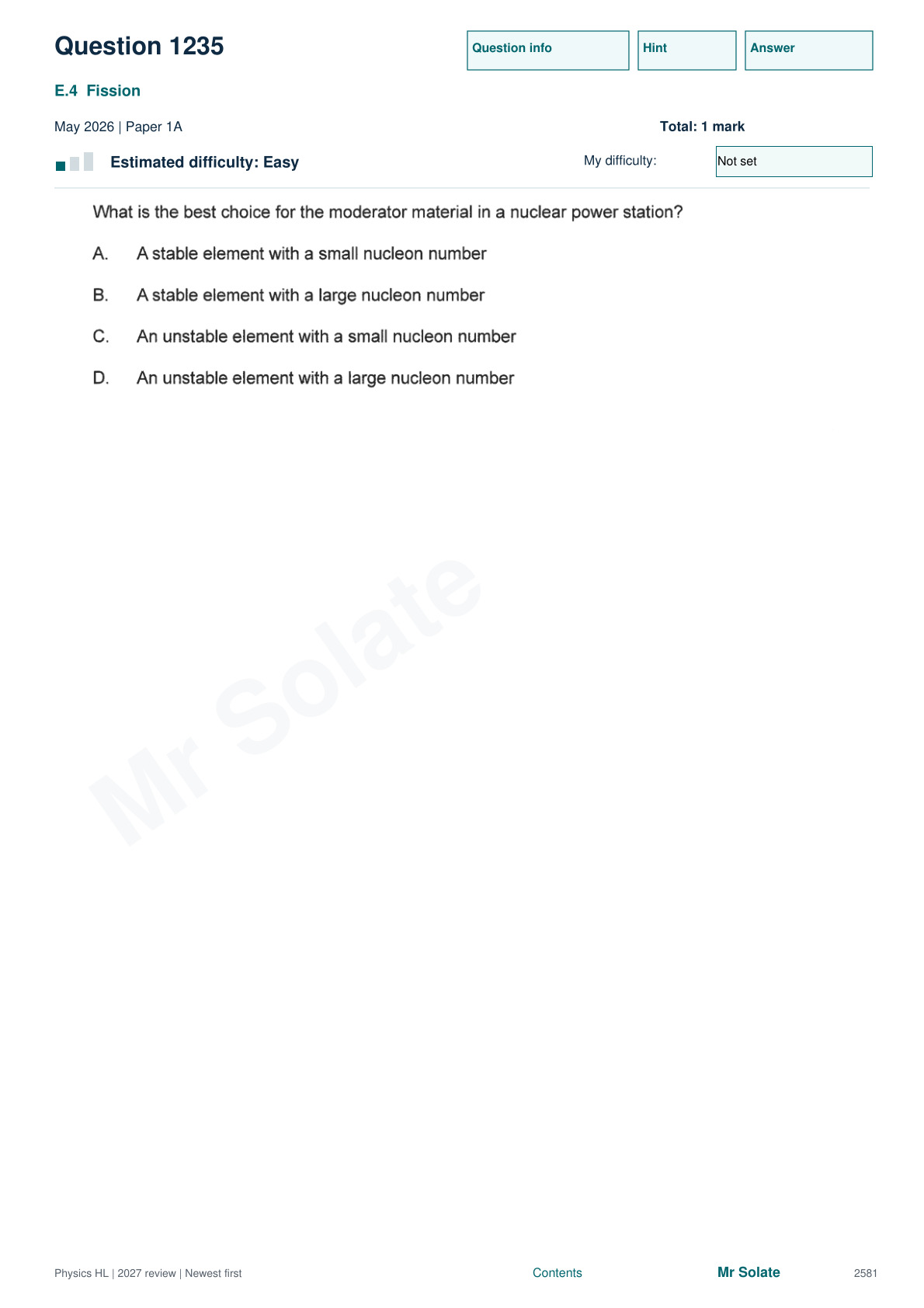
Question 1235
Links moderator effectiveness to collisions with light nuclei.
Compatibility: Current syllabus: Links moderator effectiveness to collisions with light nuclei.
View the original question
Original page images preserve the equations and diagrams. Write your response before revealing the reasoning.
Reveal the revision reasoning
A stable light element is suitable: its light nuclei efficiently slow neutrons through collisions without being inherently radioactive.
Editorial revision reasoning. Check the original answer for its marking detail.
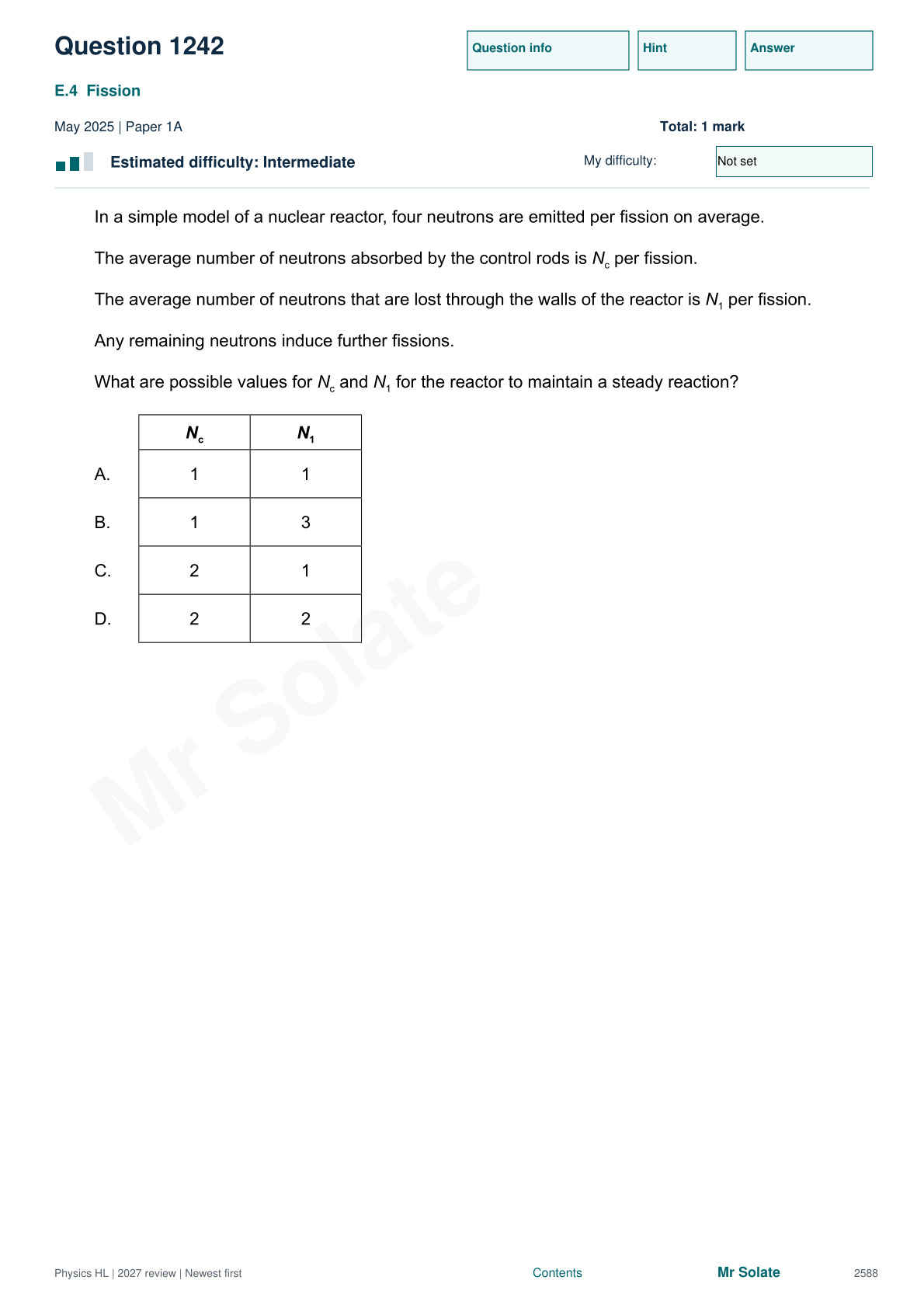
Question 1242
Requires one surviving neutron per fission for steady operation.
Compatibility: Current syllabus: Requires one surviving neutron per fission for steady operation.
View the original question
Original page images preserve the equations and diagrams. Write your response before revealing the reasoning.
Reveal the revision reasoning
Of four emitted neutrons, three must be removed. N_c=2 and N_l=1 leave exactly one to induce the next fission.
Editorial revision reasoning. Check the original answer for its marking detail.
All 21 questions in this topic
Close your notes first
Can you retrieve the method?
1. What is the moderator’s job?
Check answer 1
Reduce neutron kinetic energy through collisions.
2. What is the control rod’s job?
Check answer 2
Absorb neutrons to regulate the chain reaction.
3. How many successful next-generation fissions are needed per fission for steady operation?
Check answer 3
One on average.
Before you move on
- Use distinct words for emitted, absorbed, escaped and fission-causing neutrons.
- Keep nuclear thermal power and electrical output on separate lines.
Your revision note
Record one missed cue, one corrected step and one question to retry. Saved only in this browser.