Start with the exam
What you need to be able to do
Induction questions are about changing magnetic flux linkage. A large flux does not automatically give a large emf: the rate of change matters. Start by identifying whether field strength, coil area or orientation changes. Faraday’s law gives magnitude and time dependence, while Lenz’s law determines the physical opposition to the change. The induced field opposes the change in flux, not necessarily the original field itself. Historical transformer or capacitor parts in the bank should be followed using their compatibility notes.
Spend 3 minutes reading the overview and diagram, 7 minutes learning the question patterns, 5 minutes writing out the worked example, and 5 minutes on a bank question or recall check. Take longer when you need to; the full bank is here for later practice.
Recognise → set up → write
How the questions are set
Differentiate flux and distinguish angle conventions
Recognise it: A flux–time graph, rotating coil or a field reversal is given.
- Write flux per turn Φ = BA cosθ, where θ is the angle between the field and the area normal. Multiply by N for flux linkage when appropriate.
- Use ε = −N dΦ/dt. On a flux graph, the greatest absolute gradient gives the greatest emf magnitude; a turning point of flux gives zero emf.
- For uniform rotation, flux is sinusoidal and emf is a quarter cycle out of phase. Increasing angular speed increases emf amplitude and frequency. A reversal from +BA to −BA changes flux by magnitude 2BA.
The induced emf depends on the slope of flux linkage against time, so it is zero where flux is instantaneously stationary.
Do not multiply by the number of turns again if the graph already shows flux linkage.
Use Lenz’s law to determine current and force
Recognise it: A magnet approaches a coil, a loop enters a field, or eddy-current braking occurs.
- State the direction of the external flux and whether it is increasing or decreasing. Decide the induced field needed to oppose that change.
- Apply the coil right-hand rule to convert the induced field into conventional-current direction. State the viewing direction when using clockwise or anticlockwise.
- A loop entering and leaving a uniform field gives opposite current directions. While fully inside a uniform field with unchanged orientation, flux is constant and induced emf is zero in the ideal model.
The into-page flux is increasing, so the induced current produces an out-of-page field to oppose the increase.
“Opposes the magnetic field” is incomplete: when flux decreases, the induced field supports the original direction.
Connect motional emf to energy and braking
Recognise it: A moving rod, conducting loop, dropping magnet or heating pulse appears.
- For a straight rod moving perpendicular to its length and a uniform field, charge separation gives ε = Bℓv. If a circuit closes, current follows from its total resistance.
- The induced current experiences a magnetic force opposing motion in a passive setup. An external agent must supply mechanical power to maintain speed; that power becomes electrical dissipation.
- For a pulse graph, signed time integral of emf gives minus the change in flux linkage. Heating depends on ε²/R integrated over time, so opposite-signed pulses can both produce positive thermal energy.
At steady speed, external mechanical power Fv equals I²R in the ideal resistive circuit.
Opposite emf pulses can cancel in signed area while their heating effects add.
Write it before you reveal it
A worked exam-style example
Original teaching example, created for this lesson.
A 200-turn coil has area 3.0 × 10⁻³ m². A perpendicular field falls uniformly from 0.40 T to 0.10 T in 0.050 s. Find the induced emf magnitude.
Reveal the worked solution
- The area normal is parallel to the field, so flux per turn changes by AΔB = 3.0 × 10⁻³ × (0.10 − 0.40) = −9.0 × 10⁻⁴ Wb.
- Flux linkage changes by 200 times this value: −0.180 Wb-turn.
- The emf magnitude is |Δ(NΦ)|/Δt = 0.180/0.050 = 3.6 V. The induced field would support the decreasing original field direction.
Answer: Induced emf magnitude 3.6 V.
Check: Wb s⁻¹ has units of volts; doubling the change time would halve the emf.
From your own collection
Apply it to past-paper questions
These questions anchor the patterns above. Attempt one without the answer, then compare your setup and conclusion with the reasoning. The linked reader contains the source answer and the question-specific syllabus review.
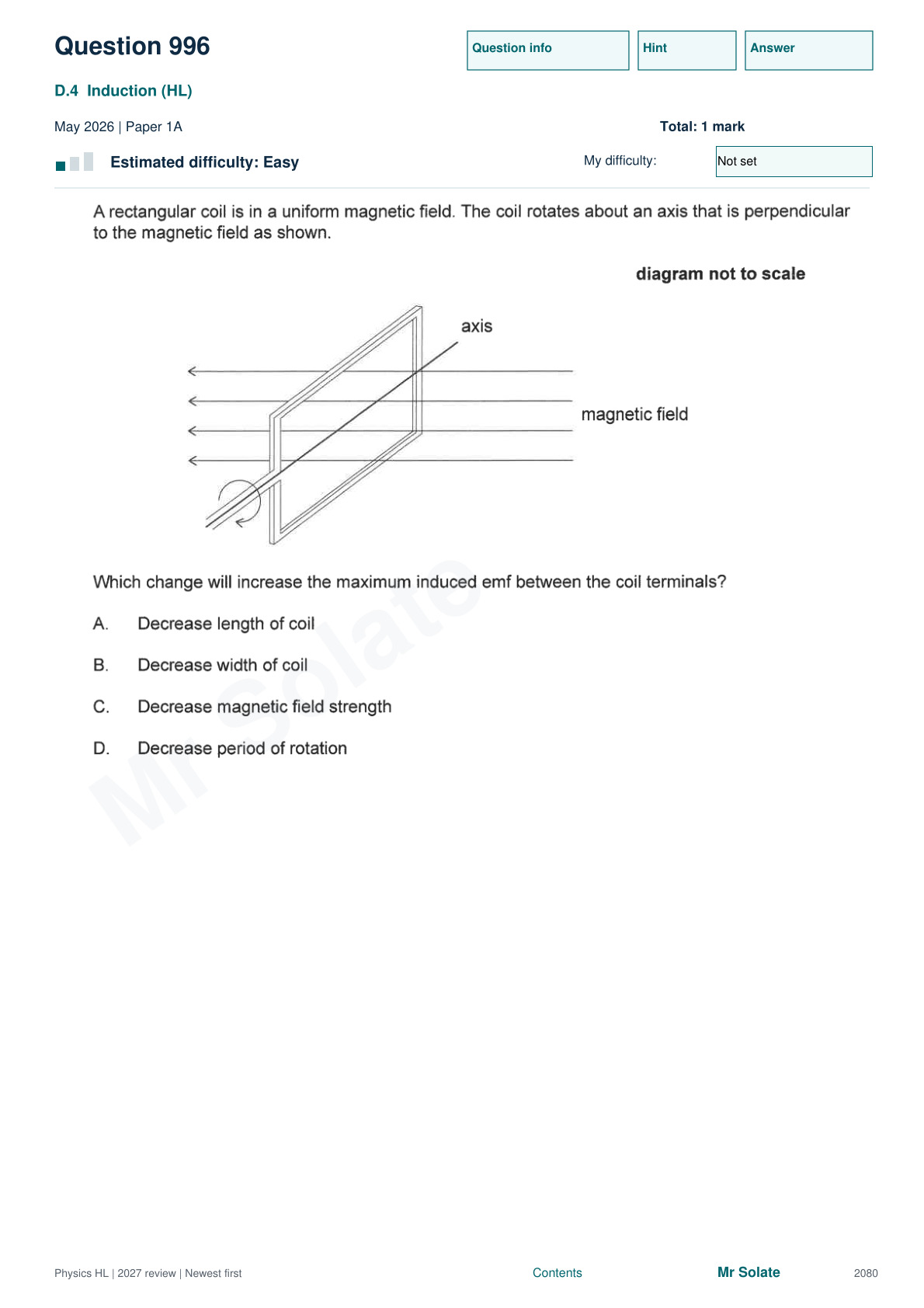
Question 996
Relates generator amplitude to rotation period.
Compatibility: Current syllabus: Relates generator amplitude to rotation period.
View the original question
Original page images preserve the equations and diagrams. Write your response before revealing the reasoning.
Reveal the revision reasoning
Decreasing the period increases ω and maximum emf. Decreasing either coil dimension or field strength reduces it.
Editorial revision reasoning. Check the original answer for its marking detail.
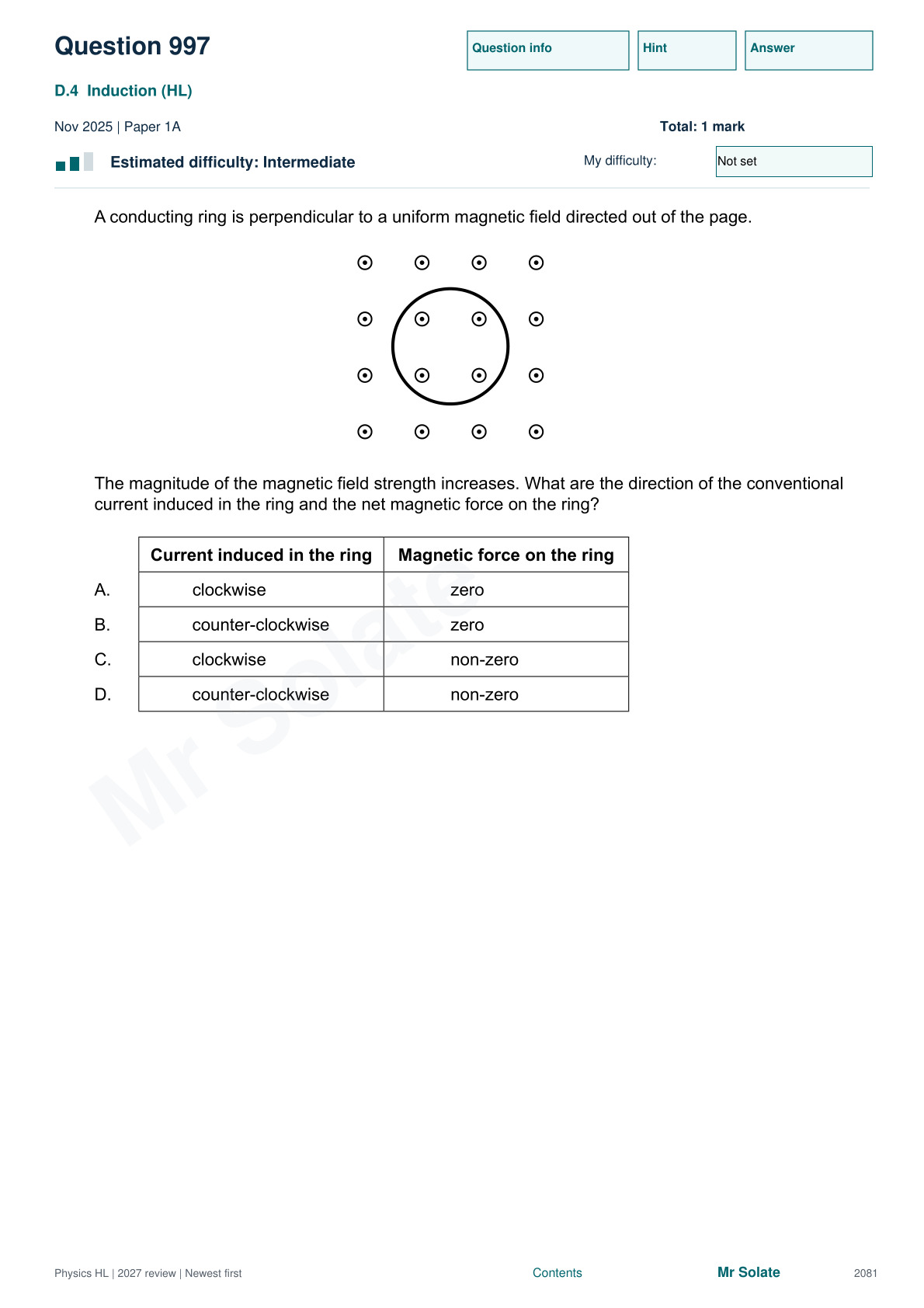
Question 997
Combines Lenz's law with symmetry of forces on a closed ring.
Compatibility: Current syllabus: Combines Lenz's law with symmetry of forces on a closed ring.
View the original question
Original page images preserve the equations and diagrams. Write your response before revealing the reasoning.
Reveal the revision reasoning
The induced field must point into the page, requiring clockwise conventional current. Forces act around the ring but cancel in the uniform field, so the net magnetic force is zero.
Editorial revision reasoning. Check the original answer for its marking detail.
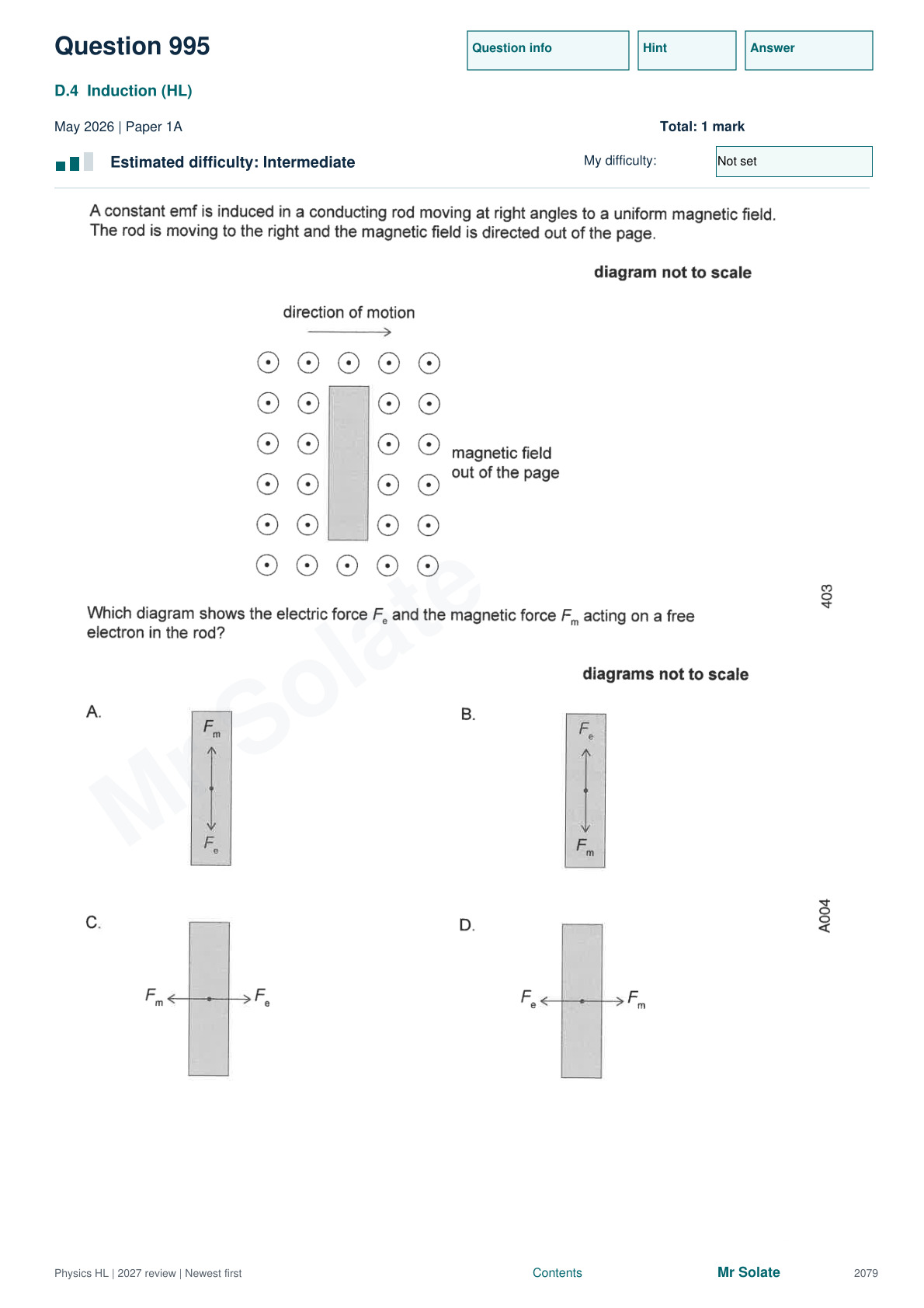
Question 995
Balances magnetic and electric forces during motional emf.
Compatibility: Current syllabus: Balances magnetic and electric forces during motional emf.
View the original question
Original page images preserve the equations and diagrams. Write your response before revealing the reasoning.
Reveal the revision reasoning
Rightward motion in an outward field gives an upward magnetic force on the electron. Charge separation establishes a downward electric force, equal in magnitude at steady emf.
Editorial revision reasoning. Check the original answer for its marking detail.
All 62 questions in this topic
Close your notes first
Can you retrieve the method?
1. When does a flux maximum produce zero emf?
Check answer 1
At the instant its time gradient is zero.
2. What does Lenz’s law oppose?
Check answer 2
The change in magnetic flux that produces the induction.
3. Can two opposite emf pulses both heat a resistor?
Check answer 3
Yes, because heating power depends on ε²/R.
Before you move on
- Write field direction and “increasing” or “decreasing” before using a hand rule.
- Check whether a graph shows flux or flux linkage before inserting N.
Your revision note
Record one missed cue, one corrected step and one question to retry. Saved only in this browser.